


Specific Objectives
By the end of this topic, the learner should be able to:
- Create a table of values from given relations;
- Use the table of values to draw graphs of the relations;
- Determine and interpret instantaneous rates of change from a graph;
- Interpret information from graphs;
- Draw and interpret graphs from empirical data;
- Solve cubic equations graphically;
- Draw the line of best fit;
- Identify the equation of a circle;
- Find the equation of a circle given the centre and the radius;
- Determine the centre and radius of a circle and draw the circle on a Cartesian plane.
Content
- Tables and graphs of given relations
- Graphs of cubic equations
- Graphical solutions of cubic equations
- Average rate of change
- Instantaneous rate of change
- Empirical data and their graphs
- The line of best fit
- Equation of a circle
- Finding the equation of a circle
- Determining the centre and radius of a circle
Introduction
Graphical methods are techniques used to solve mathematical functions by representing them visually using graphs. This approach helps in understanding the behavior of functions and solving equations by analyzing their graphical representations.
Graphing Solutions of Cubic Equations
A cubic equation has the form
ax3 + bx2 + cx + d = 0,
where a, b, c, and d are constants.
It must include the term in x3 (so a ≠ 0), but any or all of b, c, and d can be zero. For example,
x3 − 6x2 + 11x − 6 = 0, 4x3 + 57 = 0, x3 + 9x = 0
are all cubic equations.
The graphs of cubic equations typically take the following shapes.

Consider the equation Y = x3 − 6x2 + 11x − 6 = 0.
Notice that the graph starts low on the left because as x becomes large and negative, x3 also becomes large and negative. It finishes higher on the right because as x becomes large and positive, x3 also becomes large and positive. The curve crosses the x-axis three times: once where x = 1, once where x = 2, and once where x = 3. This gives us three distinct solutions.
Example
(a) Fill in the table below for the function y = -6 + x + 4x2 + x3 for -4 ≤ x ≤ 2.
| x | -4 | -3 | -2 | -1 | 0 | 1 | 2 |
|---|---|---|---|---|---|---|---|
| -6 | -6 | -6 | -6 | -6 | -6 | -6 | -6 |
| x | -4 | -3 | -2 | -1 | 0 | 1 | 2 |
| 4x2 | 64 | 36 | 16 | 4 | 0 | 4 | 16 |
| x3 | -64 | -27 | -8 | -1 | 0 | 1 | 8 |
| y | -10 | 0 | 0 | -4 | -6 | 0 | 20 |
(b) Using the grid provided, draw the graph for y = -6 + x + 4x2 + x3 for -4 ≤ x ≤ 2.
(c) Use the graph to solve the equations:
- -6 + x + 4x2 + x3 = 0
- x3 + 4x2 + x – 4 = 0
- -2 + 4x2 + x3 = 0
Solution
The table shows corresponding values of x and y for y = -6 + x + 4x2 + x3.
| x | -4 | -3 | -2 | -1 | 0 | 1 | 2 |
|---|---|---|---|---|---|---|---|
| -6 | -6 | -6 | -6 | -6 | -6 | -6 | -6 |
| x | -4 | -3 | -2 | -1 | 0 | 1 | 2 |
| 4x2 | 64 | 36 | 16 | 4 | 0 | 4 | 16 |
| x3 | -64 | -27 | -8 | -1 | 0 | 1 | 8 |
| y | -10 | 0 | 0 | -4 | -6 | 0 | 20 |
From the graph, the solutions for x are x = -3, x = -2, and x = 1.
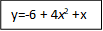
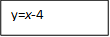
- To solve the equation y = x3 + 4x2 + x – 6, draw a straight line representing the difference of the two equations and read the coordinates at the points of intersection of the curve and the straight line.
y = x3 + 4x2 + x – 6
0 = x3 + 4x2 + x – 4
y = -2 solutions: 0.8, -1.5, and -3.2
x: 1, 0, -2
y = x3 + 4x2 + x – 6; y: -3, -4, -8
0 = x3 + 4x2 + 0 – 2
y = x – 4

Y = -2
(c) (i) Solutions: 0.8, -1.5, and -3.2
Average Rate of Change
Defining the Average Rate of Change
The average rate of change describes how one variable changes with respect to another. If you have a graph representing data points of the form (x, y), then the average rate of change between any two points is the change in the y value divided by the change in the x value.
Change in y The average rate of change of y with respect to x is Change in x |
Note:
- The rate of change of a straight line (the slope) is constant between all points along the line.
- The rate of change of a quadratic function is not constant and varies at different points.
Example
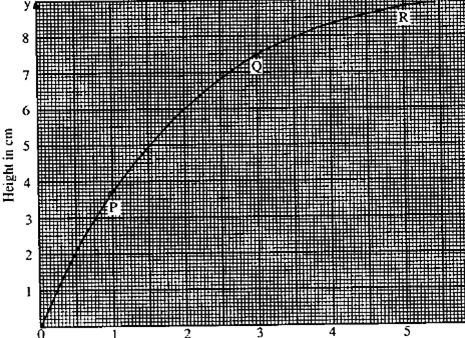
The graph below shows the growth rate of a plant. The change in height between day 1 and day 3 is 7.5 cm – 3.8 cm = 3.7 cm.
The average rate of change for this period is calculated as the change in height divided by the change in time.
The average rate of change for the next two days is 0.65 cm/day.
Note:
- The rate of growth in the first two days was 1.85 cm/day, while in the next two days it decreased to 0.65 cm/day. These rates correspond to the gradients of the lines PQ and QR respectively.
Number of days
The gradient of the straight line is 20, which is constant. This gradient represents the rate of distance change with time (speed), which is 20 m/s.

Rate of Change at an Instant
To find the rate of change at a specific instant (a particular point), we:
- Draw a tangent to the curve at that point;
- Determine the gradient of the tangent.
The gradient of the tangent to the curve at that point represents the instantaneous rate of change.
Empirical Graphs
An empirical graph is used to evaluate how well a distribution fits your data by drawing the line of best fit. This is important because raw data often contain errors or variations.
Example
The table below shows how the length l (cm) of a metal rod varies with temperature T (°C).
| Temperature (°C) | 0 | 1 | 2 | 3 | 5 | 6 | 7 | 8 |
|---|---|---|---|---|---|---|---|---|
| Length (cm) | 4.0 | 4.3 | 4.7 | 4.9 | 5.0 | 5.9 | 6.0 | 6.4 |
Solution

Note:
- There is a linear relation between length and temperature.
- We draw a line of best fit that passes through as many points as possible.
- The remaining points should be evenly distributed above and below the line.

The line cuts the y-axis at (0, 4) and passes through the point (5, 5.5). Therefore, the gradient of the line is 0.3. The equation of the line is l = 0.3T + 4.
Reduction of Non-linear Laws to Linear Form
When plotting the graph of xy = k, we get a curve. However, plotting y against 1/x yields a straight line whose gradient is k. This approach is used to transform non-linear relations into linear ones for easier analysis.
Example
The table below shows the relationship between A and r.
| r | 1 | 2 | 3 | 4 | 5 |
|---|---|---|---|---|---|
| A | 3.1 | 12.6 | 28.3 | 50.3 | 78.5 |
It is suspected that the relation is of the form A = k / r. By drawing a suitable graph, verify the law connecting A and r and determine the value of k.
Solution
If we plot A against 1/r, we should get a straight line.
| r | 1 | 2 | 3 | 4 | 5 |
|---|---|---|---|---|---|
| A | 3.1 | 12.6 | 28.3 | 50.3 | 78.5 |
| 1 | 0.5 | 0.33 | 0.25 | 0.2 |
Since the graph of A against 1/r is a straight line, the law A = k / r holds. The gradient of this line is 3.1 (to one decimal place), which is the value of k.
Example
From 1960 onwards, the population P of Kisumu is believed to obey a law of the form P = kAt, where k and A are constants and t is the time in years from 1960. The table below shows the population of the town since 1960.
| Year | 1960 | 1965 | 1970 | 1975 | 1980 | 1985 | 1990 |
|---|---|---|---|---|---|---|---|
| P | 5000 | 6080 | 7400 | 9010 | 10960 | 13330 | 16200 |
By plotting a suitable graph, check whether the population growth obeys the given law. Use the graph to estimate the value of A.
Solution
The law to be tested is P = kAt. Taking logarithms of both sides gives log P = log k + t log A, which is in the form y = mx + c. Thus, we plot log P against t (note that log A is a constant). The table below shows the corresponding values of t and log P.
| Year | 1960 | 1965 | 1970 | 1975 | 1980 | 1985 | 1990 |
|---|---|---|---|---|---|---|---|
| Log P | 3.699 | 3.784 | 3.869 | 3.955 | 4.040 | 4.125 | 4.210 |

Since the graph is a straight line, the law P = kAt holds.
log A is given by the gradient of the straight line. Therefore, log A = 0.017.
Hence, A = 1.04.
log k is the vertical intercept.
Hence, log k = 3.69.
Therefore, k = 4898.
Thus, the relationship is P = 4898 (1.04)t.
Note:
- Laws of the form y = kAx can be written in linear form as: log y = log k + x log A by taking logarithms of both sides.
- When log y is plotted against x, a straight line is obtained. Its gradient is log A and the intercept is log k.
- The law of the form y = kxn, where k and n are constants, can be written in linear form as:
- log y = log k + n log x.
- We therefore plot log y against log x.
- The gradient of the line gives n while the vertical intercept is log k.
Summary
For the law y = d + cx2 to be verified, it is necessary to plot a graph of the variables in a modified form as follows: compare y – d with y = mx + c, that is, plot:
- y on the y-axis;
- x2 on the x-axis;
- The gradient is c;
- The vertical axis intercept is d.
For the law y – a = bx to be verified, plot the variables as follows:
y – a = bx, i.e., y = bx + a, which is compared with y = mx + c.
- y on the y-axis;
- x on the x-axis;
- The gradient is b;
- The vertical axis intercept is a.
For the law y – e = fx to be verified, plot the variables as follows:
- y on the vertical axis;
- x on the horizontal axis;
- The gradient is f;
- The vertical axis intercept is e.
For the law y – cx = bx2 to be verified, plot the variables as follows:
- y – cx on the y-axis;
- x on the x-axis;
- The gradient is b;
- The vertical axis intercept is c.
For the law y = ax + b to be verified, plot the variables as follows:
- y on the vertical axis;
- x on the horizontal axis;
- The gradient is a;
- The vertical intercept is b.
Equation of a Circle
A circle is the set of all points that are at the same distance r from a fixed point called the centre. The figure below shows a circle with centre at (0,0) and radius 3 units.

Let P(x, y) be a point on the circle. Triangle PON is right-angled at N.
By Pythagoras’ theorem:
ON = x, PN = y, and OP = 3. Therefore,
Note:
The general equation of a circle with centre (0,0) and radius r is
x2 + y2 = r2.
Example
Find the equation of a circle with centre (0, 0) passing through (3, 4).

Solution
Let the radius of the circle be r.
From Pythagoras’ theorem:
r = √(32 + 42) = 5.
Therefore, the equation of the circle is x2 + y2 = 25.
Example
Consider a circle with centre (5, 4) and radius 3 units.
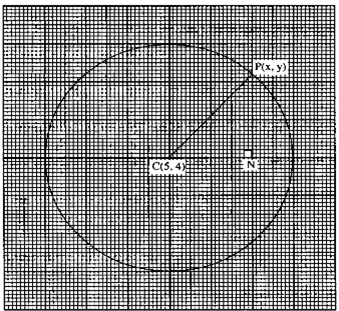
Solution
In the figure below, triangle CNP is right-angled at N. By Pythagoras’ theorem:
CN = (x – 5), NP = (y – 4), and CP = 3 units.
Therefore, (x – 5)2 + (y – 4)2 = 9.
Note:
The equation of a circle with centre (a, b) and radius r units is given by:
(x – a)2 + (y – b)2 = r2.
Example
Find the equation of a circle with centre (-2, 3) and radius 4 units.
Solution
The general equation of the circle is (x + 2)2 + (y – 3)2 = 16.
Example
Line AB is the diameter of a circle such that the coordinates of A and B are (-1, 1) and (5, 1) respectively.
- Determine the centre and the radius of the circle.
- Find the equation of the circle.
Solution
- Radius = half the distance AB = 3.
- Centre = midpoint of AB = (2, 1).
- Equation of the circle is (x – 2)2 + (y – 1)2 = 9.
Example
The equation of a circle is given by x2 + y2 – 6x + 4y = 12. Determine the centre and radius of the circle.
Solution
Complete the square on the left-hand side:
(x2 – 6x + 9) + (y2 + 4y + 4) = 12 + 9 + 4
(x – 3)2 + (y + 2)2 = 25
Therefore, the centre of the circle is (3, -2) and the radius is 5 units. Note that the signs change to their opposites: positive becomes negative and negative becomes positive.
Example
Write the equation of the circle that has (x1, y1) and (x2, y2) as endpoints of a diameter.
Method 1: Determine the centre using the Midpoint Formula:
Centre = ((x1 + x2)/2, (y1 + y2)/2)
Determine the radius using the distance formula (distance between centre and one endpoint):
Radius = distance between centre and one endpoint.
Equation of the circle is:
(x – h)2 + (y – k)2 = r2.
Method 2: Determine centre using the Midpoint Formula (as before):
Thus, the circle equation will have the form (x – h)2 + (y – k)2 = r2.
Find r by plugging the coordinates of a point on the circle in for (x, y).
Let’s use one endpoint.
Again, we get this equation for the circle.
End of topic
Did you understand everything? If not, ask a teacher, friends, or anybody and make sure you understand before going to sleep! |
Past KCSE Questions on the Topic
The table shows the height (metres) of an object thrown vertically upwards varying with time t (seconds).
The relationship between s and t is represented by the equation s = at2 + bt + 10 where a and b are constants.
T 0 1 2 3 4 5 6 7 8 9 10 S 45.1 49.9 -80 - Using the information in the table, determine the values of a and b.
- Complete the table.
- Draw a graph to represent the relationship between s and t.
- Using the graph, determine the velocity of the object when t = 5 seconds.
Data collected from an experiment involving two variables X and Y is recorded in the table below.
x 1.1 1.2 1.3 1.4 1.5 1.6 y -0.3 0.5 1.4 2.5 3.8 5.2 The variables satisfy a relation of the form y = ax3 + b where a and b are constants.
- For each value of x in the table, write down the value of x3.
- By drawing a suitable straight line graph, estimate the values of a and b.
- Write down the relationship connecting y and x.
Two quantities P and r are connected by the equation P = krn. The table of values of P and r is given below.
P 1.2 1.5 2.0 2.5 3.5 4.5 R 1.58 2.25 3.39 4.74 7.86 11.5 - State a linear equation connecting P and r.
- Using the scale 2 cm to represent 0.1 units on both axes, draw a suitable line graph on the grid provided. Hence estimate the values of K and n.
The points with coordinates (5,5) and (-3,-1) are the ends of a diameter of a circle with centre A.
Determine:
- The coordinates of A.
- The equation of the circle, expressing it in the form x2 + y2 + ax + by + c = 0 where a, b, and c are constants.
The figure below is a sketch of the graph of the quadratic function y = k(x + 1)(x – 2).

Find the value of k.
The table below shows the values of the length X (in metres) of a pendulum and the corresponding values of the period T (in seconds) of its oscillations obtained in an experiment.
X (metres) 0.4 1.0 1.2 1.4 1.6 T (seconds) 1.25 2.01 2.19 2.37 2.53 - Construct a table of values of log X and corresponding values of log T, correcting each value to 2 decimal places.
- Given that the relation between the values of log X and log T approximates a linear law of the form m log X + log a where a and b are constants:
- Use the axes on the grid provided to draw the line of best fit for the graph of log T against log X.
- Use the graph to estimate the values of a and b.
- Find, to decimal places, the length of the pendulum whose period is 1 second.
Data collected from an experiment involving two variables x and y is recorded in the table below.
X 1.1 1.2 1.3 1.4 1.5 1.6 Y -0.3 0.5 1.4 2.5 3.8 5.2 The variables satisfy a relation of the form y = ax3 + b where a and b are constants.
- For each value of x in the table, write down the value of x3.
- By drawing a suitable straight line graph, estimate the values of a and b.
- Write down the relationship connecting y and x.
Two variables x and y are linked by the relation y = axn. The figure below shows part of the straight line graph obtained when log y is plotted against log x.
Calculate the values of a and n.
The luminous intensity I of a lamp was measured for various values of voltage V across it. The results are shown below.
V (volts) 30 36 40 44 48 50 54 L (Lux) 708 1248 1726 2320 3038 3848 4380 It is believed that V and I are related by an equation of the form I = aVn where a and n are constants.
- Draw a suitable linear graph and determine the values of a and n.
- From the graph, find:
- The value of I when V = 52.
- The value of V when I = 2800.
In a certain relation, the values of A and B satisfy B = CA + KA2 where C and K are constants. The table below shows values of A and B.
A 1 2 3 4 5 6 B 3.2 6.75 10.8 15.1 20 25.2 - By drawing a suitable straight line graph, determine the values of C and K.
- Write down the relationship between A and B.
- Determine the value of B when A = 7.
The variables P and Q are connected by the equation P = abq where a and b are constants. The values of P and Q are given below.
P 6.56 17.7 47.8 129 349 941 2540 6860 Q 0 1 2 3 4 5 6 7 - State the equation in terms of P and Q which gives a straight line graph.
- By drawing a straight line graph, estimate the values of constants a and b, giving your answer correct to 1 decimal place.


