


Specific Objectives
By the end of the topic the learner should be able to:
- State properties of rotation as a transformation
- Determine centre and angle of rotation
- Apply properties of rotation in the Cartesian plane
- Identify point of rotational symmetry
- State order of rotational symmetry of plane figure
- Identify axis of rotational symmetry of solids
- State order of rotational symmetry of solids
- Deduce congruence from rotation
Content
- Properties of rotation
- Centre and angle of rotation
- Rotation in the Cartesian plane
- Rotational symmetry of plane figures and solids (point, axis and order)
- Congruence and rotation
Introduction
A transformation in which a plane figure turns around a fixed center point called center of rotation. A rotation in the anticlockwise direction is taken to be positive whereas a rotation in the clockwise direction is taken to be negative.
For example, a rotation of 900 clockwise is taken to be negative, -900, while a rotation of anticlockwise 900 is taken to be +900.
For a rotation to be completely defined the center and the angle of rotation must be stated.


Illustration
To rotate triangle A through the origin, angle of rotation +1/4 turn.
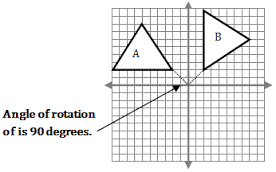
Draw a line from each point to the center of rotation, in this case it’s the origin. Measure 900 from the object using the protractor and make sure the baseline of the protractor is on the same line as the line from the point of the object to the center. The 0 mark should start from the object.
Mark 900 and draw a straight line to the center joining the lines at the origin. The distance from the point of the object to the center should be the same distance as the line you drew. This gives you the image point.
The distance between the object point and the image point under rotation should be the same as the center of rotation in this case 900.
Illustration
To find the center of rotation:
- Draw a segment connecting point’s P and P′.
- Using a compass, find the perpendicular bisector of this line.
- Draw a segment connecting point’s Q and Q′. Find the perpendicular bisector of this segment.
- The point of intersection of the two perpendicular bisectors is the center of rotation. Label this point O.
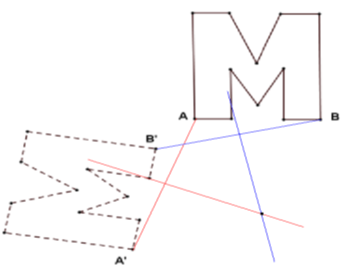
Justify your construction by measuring angles ∠P O P′ and ∠Q O Q′. Did you obtain the same measure? The angle between is the angle of rotation. The zero mark of the protractor should be on the object to give you the direction of rotation.
Rotational symmetry of plane figures
The number of times the figure fits onto itself in one complete turn is called the order of rotational symmetry.
Note:
The order of rotational symmetry of a figure = 360° / angle between two identical parts of the figure.
Rotational symmetry is also called point symmetry. Rotation preserves length, angles, and area, and the object and its image are directly congruent.
End of topic
Did you understand everything? If not, ask a teacher, friends, or anybody and make sure you understand before going to sleep! |


