

Specific Objectives
By the end of the topic, the learner should be able to:
- Define tangent, sine, and cosine ratios from a right-angled triangle.
- Read and use tables of trigonometric ratios.
- Use sine, cosine, and tangent in calculating lengths and angles.
- Establish and use the relationship of sine and cosine of complementary angles.
- Relate the three trigonometric ratios.
- Determine the trigonometric ratios of special angles 30°, 45°, 60°, and 90° without using tables.
- Read and use tables of logarithms of sine, cosine, and tangent.
- Apply the knowledge of trigonometry to real-life situations.
Content
- Tangent, sine, and cosine of angles.
- Trigonometric tables.
- Angles and sides of a right-angled triangle.
- Sine and cosine of complementary angles.
- Relationship between tangent, sine, and cosine.
- Trigonometric ratios of special angles 30°, 45°, 60°, and 90°.
- Logarithms of sines, cosines, and tangents.
- Application of trigonometry to real-life situations.
Introduction
Tangent of Acute Angle
The constant ratio between the opposite side and adjacent side of a right-angled triangle is called the tangent. It is abbreviated as tan.
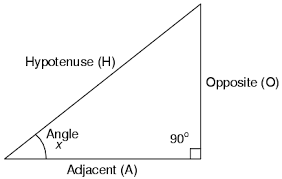
Tan = opposite / adjacent
Sine of an Angle
The ratio of the side opposite to angle x to the hypotenuse side is called the sine.
Sin = opposite / hypotenuse
Cosine of an Angle
The ratio of the side adjacent to the angle and the hypotenuse is called the cosine.
Cosine = adjacent / hypotenuse


Example

In the figure above, the adjacent length is 4 cm and angle x is given. Calculate the opposite length.
Solution
Opposite length = 4 × tan x cm.
Example

In the figure above, opposite (o) = 5 cm, adjacent (a) = 12 cm. Calculate sin x and cos x.
Solution
sin x = opposite / hypotenuse = 5 / 13 = 0.3846
cos x = adjacent / hypotenuse = 12 / 13 = 0.9231
Sine and Cosine of Complementary Angles
For any two complementary angles x and y, sin x = cos y and cos x = sin y. For example, sin 30° = cos 60°.
Example
Find the acute angles given sin x = cos y.
Solution
Therefore, x and y are complementary angles such that x + y = 90°.
Trigonometric Ratios of Special Angles
These trigonometric ratios can be deduced by using isosceles right-angled triangles and equilateral triangles as follows.
Tangent, Cosine, and Sine of 45°
The triangle should have a base and a height of one unit each, giving a hypotenuse of √2.

Cos 45° = sin 45° = 1 / √2, tan 45° = 1
Tangent, Cosine, and Sine of 30° and 60°

The equilateral triangle has sides of 2 units each.
Sin 30° = 1/2, Cos 30° = √3/2, Tan 30° = 1/√3
Sin 60° = √3/2, Cos 60° = 1/2, Tan 60° = √3
End of topic
Did you understand everything? If not, ask a teacher, friends, or anybody and make sure you understand before going to sleep! |
Past KCSE Questions on the Topic
1. Given sin (90° – a) = ½, find without using trigonometric tables the value of cos a. (2 marks)
2. If  , find without using tables or calculator, the value of
 (3 marks)
3. At point A, David observed the top of a tall building at an angle of 30°. After walking 100 meters towards the foot of the building, he stopped at point B where he observed it again at an angle of 60°. Find the height of the building.
4. Find the value of θ, given that ½ sin θ = 0.35 for 0° ≤ θ ≤ 360°.
5. A man walks from point A towards the foot of a tall building 240 m away. After covering 180 m, he observes that the angle of elevation of the top of the building is 45°. Determine the angle of elevation of the top of the building from A.
6. Solve for x in 2 Cos 2x° = 0.6000, 0° ≤ x ≤ 360°.
7. Wangechi, whose eye level is 182 cm tall, observed the angle of elevation to the top of her house to be 32° from her eye level at point A. She walks 20 m towards the house on a straight line to point B, at which point she observes the angle of elevation to the top of the building to be 40°. Calculate, correct to 2 decimal places:
- a) Distance of A from the house.
- b) The height of the house.
8. Given that cos A = 5/13 and angle A is acute, find the value of:
2 tan A + 3 sin A

9. Given that tan 5° = 3 + 5, without using tables or a calculator, determine tan 25°, leaving your answer in the form a + b√c.
10. Given that tan x = 5, find the value of the following without using mathematical tables or calculator:
- (a) Cos x
- (b) Sin²(90° – x)
11. If tan θ = 8/15, find the value of Sin θ – Cos θ without using a calculator or table.
Cos θ + Sin θ


