

Specific Objectives
By the end of the topic the learner should be able to:
- Identify similar figures
- Construct similar figures
- State properties of enlargement as a transformation
- Apply the properties of enlargement to construct objects and images
- Apply enlargement in Cartesian planes
- State the relationship between linear, area and volume scale factor
- Apply the scale factors to real life situations.
Content
- Similar figures and their properties
- Construction of similar figures
- Properties of enlargement
- Construction of objects and images under enlargement
- Enlargement in the Cartesian plane
- Linear, area and volume scale factors
- Real life situations.
Introduction
Similar Figures
Two or more figures are said to be similar if:
- The ratio of the corresponding sides is constant.
- The corresponding angles are equal.
Example 1
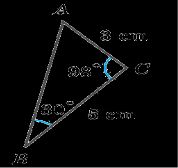
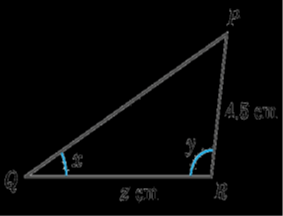
In the figures below, given that △ABC ~ △PQR, find the unknowns x, y, and z.
Solution:
BA corresponds to QP; each of them has opposite angle y and 98°. Hence, y = 98°.
BC corresponds to QR and AC corresponds to PR.
Using the ratio of corresponding sides:
AC / PR = BC / QR
3 / 4.5 = 5 / z
Solving for z:
z = 7.5 cm
Note:
Two figures can have the ratio of corresponding sides equal but fail to be similar if the corresponding angles are not the same.
Two triangles are similar if either all their corresponding angles are equal or the ratio of their corresponding sides is constant.
Example:
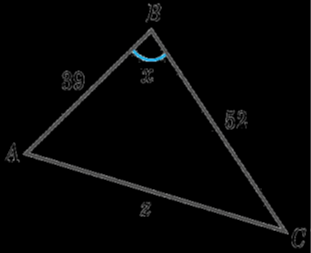
In the figure, △ABC is similar to △RPQ. Find the values of the unknowns.
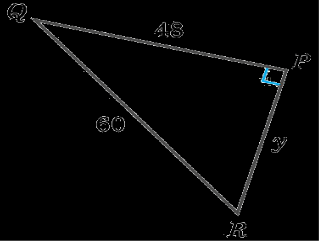
Since △ABC ~ △RPQ,
∠B = ∠P, therefore x = 90°.
Also, using the ratio of corresponding sides:
AB / RP = BC / PQ
39 / y = 52 / 48
Cross-multiplying:
y = (48 × 39) / 52
y = 36
Also,
AC / RQ = BC / PQ
z / 60 = 52 / 48
z = 65
ENLARGEMENT
What’s enlargement?
Enlargement, sometimes called scaling, is a kind of transformation that changes the size of an object. The image created is similar to the object. Despite the name enlargement, it includes making objects smaller.
For every enlargement, a scale factor must be specified. The scale factor is how many times larger than the object the image is.
Length of side in image = length of side in object × scale factor
For any enlargement, there must be a point called the center of enlargement.
Distance from center of enlargement to point on image = Distance from center of enlargement to point on object × scale factor
The center of enlargement can be anywhere, but it has to exist.

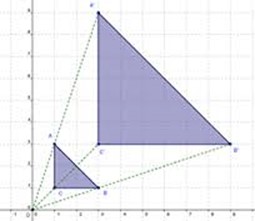
This process of obtaining triangle A’B’C’ from triangle ABC is called enlargement. Triangle ABC is the object and triangle A’B’C’ is its image under enlargement with scale factor 2.
Hence,
OA’ / OA = OB’ / OB = OC’ / OC = 2
The ratio is called the scale factor of enlargement. The scale factor is called the linear scale factor.
By measurement, OA = 1.5 cm, OB = 3 cm, and OC = 2.9 cm. To get A’, the image of A, we proceed as follows:
OA = 1.5 cm
OA’ / OA = 2 (scale factor 2)
OA’ = 1.5 × 2 = 3 cm
Also, OB’ / OB = 2
OB’ = 3 × 2 = 6 cm
Note:
Lines joining object points to their corresponding image points meet at the center of enlargement.
CENTER OF ENLARGEMENT
To find the center of enlargement, join object points to their corresponding image points and extend the lines. Where they meet gives you the center of enlargement. Or draw straight lines from each point on the image through its corresponding point on the object, and continue further. The point where all the lines cross is the center of enlargement.
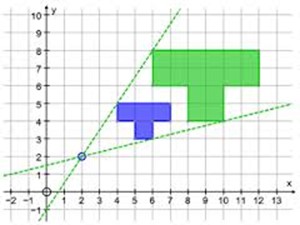
SCALE FACTOR
The scale factor can be a whole number, negative, or fraction. A whole number scale factor means that the image is on the same side as the object and it can be larger or the same size.
A negative scale factor means that the image is on the opposite side of the object, and a fractional scale factor means that the image is smaller, either on the same side or opposite side.
Linear scale factor is a ratio in the form a:b or a/b. This ratio describes an enlargement or reduction in one dimension and can be calculated using:
New length / Original length
Area scale factor is a ratio in the form e:f or e/f. This ratio describes how many times to enlarge or reduce the area of a two-dimensional figure. Area scale factor can be calculated using:
New Area / Original Area
Area scale factor = (linear scale factor)2
Volume scale factor is the ratio that describes how many times to enlarge or reduce the volume of a three-dimensional figure. Volume scale factor can be calculated using:
New Volume / Original Volume
Volume scale factor = (linear scale factor)3
CONGRUENT TRIANGLES
When two triangles are congruent, all their corresponding sides and corresponding angles are equal.
TRANSLATION VECTOR
A translation vector moves every point of an object by the same amount in the given vector direction. It can simply be defined as the addition of a constant vector to every point.
| Translations and vectors: The translation on the left shows a vector translating the top triangle 4 units to the right and 9 units downward. The notation for such vector movement may be written as:
Vectors such as those used in translations are what is known as free vectors. Any two vectors of the same length and parallel to each other are considered identical. They need not have the same initial and terminal points. |
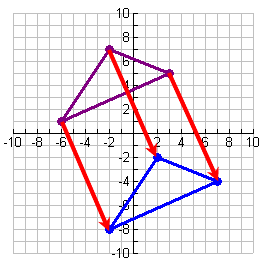
 or
or 
End of topic
Did you understand everything? If not, ask a teacher, friends, or anybody and make sure you understand before going to sleep! |
Past KCSE Questions on Reflection and Congruence, Rotation, Similarity and Enlargement
- A translation maps a point (1, 2) onto (-2, 2). What would be the coordinates of the object whose image is (-3, -3) under the same translation?
- Use binomial expression to evaluate (0.96)5 correct to 4 significant figures.
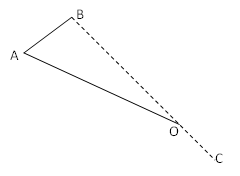
- In the figure below, triangle ABO represents a part of a school badge. The badge has symmetry of order 4 about O. Complete the figures to show the badge.
- A point (-5, 4) is mapped onto (-1, -1) by a translation. Find the image of (-4, 5) under the same translation.
- A triangle is formed by the coordinates A (2, 1), B (4, 1), and C (1, 6). It is rotated clockwise through 90° about the origin. Find the coordinates of this image.
The diagram on the grid provided below shows a trapezium ABCD.
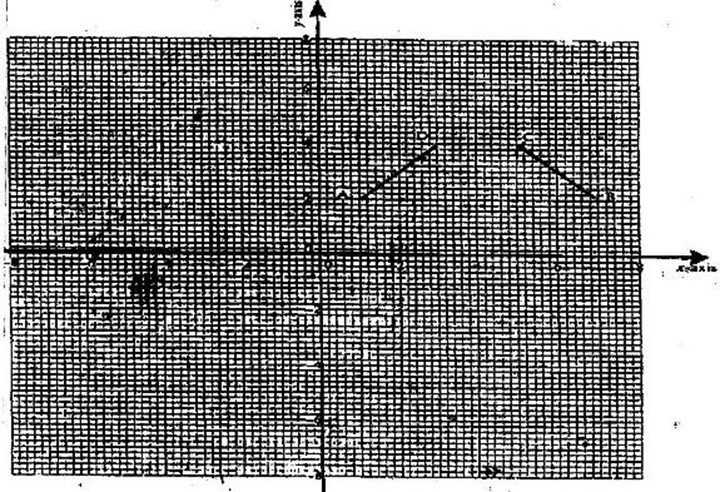
On the same grid:
(a) (i) Draw the image A’B’C’D’ of ABCD under a rotation of 90° clockwise about the origin.
(ii) Draw the image of A”B”C”D” of A’B’C’D’ under a reflection in line y = x. State coordinates of A”B”C”D”.
(b) A”B”C”D” is the image of A”B”C”D under the reflection in the line x=0. Draw the image A”B”C”D” and state its coordinates.
(c) Describe a single transformation that maps A”B”C”D onto ABCD.
A translation maps a point P(3,2) onto P'(5,4).
(a) Determine the translation vector.
(b) A point Q’ is the image of the point Q (, 5) under the same translation. Find the length of PQ leaving the answer in surd form.
Two points P and Q have coordinates (-2, 3) and (1, 3) respectively. A translation maps point P to P'(10, 10).
(a) Find the coordinates of Q’, the image of Q under the translation.

(b) The position vectors of P and Q in (a) above are p and q respectively. Given that mp – nq = -12, find the values of m and n. (3 marks)
On the Cartesian plane below, triangle PQR has vertices P(2, 3), Q(1, 2), and R(4, 1), while triangle P”Q”R” has vertices P”(-2, 3), Q”(-1, 2), and R”(-4, 1).

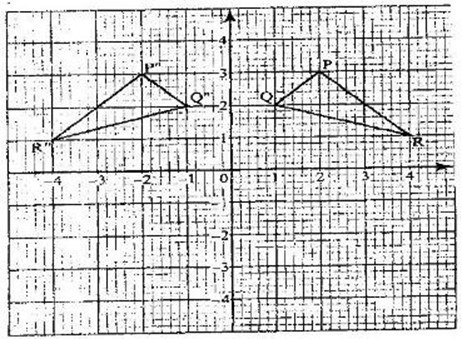
(a) Describe fully a single transformation which maps triangle PQR onto triangle P”Q”R”.
(b) On the same plane, draw triangle P’Q’R’, the image of triangle PQR, under reflection in line y = -x.
(c) Describe fully a single transformation which maps triangle P’Q’R’ onto triangle P”Q”R.
(d) Draw triangle P”Q”R” such that it can be mapped onto triangle PQR by a positive quarter turn about (0, 0).
(e) State all pairs of triangles that are oppositely congruent.


