


CHAPTER FOUR: PRESSURE
Pressure is defined as the force acting normally (perpendicularly) per unit area. The SI unit for pressure is newton per metre squared (N/m2). One N/m2 is known as one Pascal (Pa).
Pressure = normal force / area or pressure = thrust / area. Another unit for measuring pressure is the bar. 1 bar = 105 N/m2. 1 millibar = 100 N/m2.
Calculating pressure
Examples
A rectangular brick of weight 10 N measures 50 cm × 30 cm × 10 cm. Calculate the values of the maximum and minimum pressures which the block exerts when resting on a horizontal table.
Solution:
Area of the smallest face = 0.3 × 0.1 = 0.03 m2.
Area of the largest face = 0.5 × 0.3 = 0.15 m2.
Maximum pressure = 10 N / 0.03 = 3.3 × 10² N/m2. Minimum pressure = 10 N / 0.15 = 67 N/m2.
A man of mass 84 kg stands upright on a floor. If the area of contact of his shoes and the floor is 420 cm2, determine the average pressure he exerts on the floor. (Take g = 10 N/kg)
Solution:
Pressure = force / area = 840 / 0.042 = 20,000 N/m2.
Pressure in liquids
The following formula is used to determine pressure in liquids:
Pressure = h ρ g, where h – height of the liquid, ρ – density, and g – acceleration due to gravity.
Examples
A diver is 10 m below the surface of water in a dam. If the density of water is 1,000 kg/m3, determine the pressure due to the water on the diver. (Take g = 10 N/kg)
Solution:
Pressure = h ρ g = 10 × 1000 × 10 = 100,000 N/m2.
The density of mercury is 13,600 kg/m3. Determine the liquid pressure at a point 76 cm below the surface of mercury. (Take g = 10 N/kg)
Solution:
Pressure = h ρ g = 0.76 × 13,600 × 10 = 103,360 N/m2.
The height of the mercury column in a barometer is found to be 67.0 cm at a certain place. What would be the height of a water barometer at the same place? (Densities of mercury and water are 1.36 × 10⁴ kg/m3 and 1.0 × 10³ kg/m3 respectively.)
Solution:
Let the pressure due to water be h1 ρ1 g = h ρ g, hence:
h1 = h ρ / ρ1 = (0.67) × (1.36 × 104) / (1.0 × 10³) = 9.11 m (or 911.2 cm).
U-tube manometer
It is a transparent tube bent into a U-shape. When a liquid is poured into a U-tube, it settles at equal levels since pressure depends on height and they share the same bottom. Consider the following diagram:

For the levels to differ, the pressure P1 must be greater than P2, hence:
P1 = P2 + hρg.
If P1 is the lung pressure and P0 is the atmospheric pressure, then if the difference is ‘h‘ the lung pressure can be calculated as follows:
P1 = P0 + hρg.
Example
A man blows into one end of a U-tube containing water until the levels differ by 40.0 cm. If the atmospheric pressure is 1.01 × 10⁵ N/m2 and the density of water is 1000 kg/m3, calculate his lung pressure.
Solution:
Lung pressure = atmospheric pressure + liquid pressure
P1 = P0 + hρg = (1.01 × 10⁵) + (0.4 × 10 × 1000) = 1.05 × 10⁵ N/m2.
Measuring pressure
Simple mercury barometer – It is constructed using a thick-walled glass tube of length 1 m and is closed at one end. Mercury is added into the tube, then inverted and dipped into a dish containing more mercury. The space above the mercury column is called the Torricellian vacuum. The height ‘h‘ (if it is at sea level) would be found to be 760 mm. Atmospheric pressure can be calculated as:
P = ρ g h, where ρ (mercury) = 1.36 × 10⁴ kg/m3, g = 9.81 N/kg, h = 0.76 m.
Then P = (1.36 × 104) × 9.81 × 0.76 = 1.014 × 10⁵ Pa.
NOTE – this is the standard atmospheric pressure, sometimes called one atmosphere. It is approximately one bar.

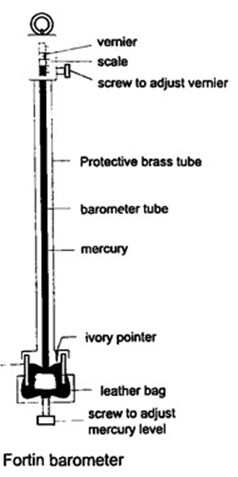
Fortin barometer – This is a more accurate mercury barometer. The adjusting screw is adjusted first to touch the mercury level in the leather bag.
Aneroid barometer – Increase in pressure causes the box to contract. The movements are magnified by the system of levers and transmitted to the pointer by a fine chain, causing the pointer to move. The scale is suitably calibrated to read pressure. Since pressure falls or rises as altitude falls or rises, the pointer can also be calibrated to read altitude.
Bourdon gauge – Also called gauge pressure, it is used in gas cylinders. When air is blown into the rubber tube, the curved metal tube tries to straighten out, causing movement transmitted by levers and gears attached to a pointer. This gauge can measure both gas and liquid pressure.



Example
The height of the mercury column in a barometer is found to be 67.0 cm at a certain place. What would be the height of a water barometer at the same place? (Densities of mercury: 1.36 × 10⁴ kg/m3 and water: 1.0 × 10³ kg/m3).
Solution:
Let the pressure due to water be h1 ρ1 g and that of mercury be h ρ g. Then h1 ρ1 g = h ρ g. Hence:
h1 = (0.67) × (1.36 × 104) / (1.0 × 10³) = 9.11 m (or 911.2 cm).
Application of pressure in gases and liquids
Rubber sucker – This is a shallow rubber cap. Before use, it is moistened to get a good seal, then pressed firmly on a smooth surface so that the air inside is pushed out. The atmospheric pressure will then hold it firmly against the surface as shown below. They are used by printing machines to lift papers, lifting glass panes, heavy metal sheets, etc.
Drinking straw – When a liquid is drawn using a straw, air is sucked through the straw to the lungs. This leaves the space in the straw partially evacuated. The atmospheric pressure pushing down the liquid in the container becomes greater than the pressure inside the straw, forcing the liquid into your mouth.
The syringe – They work on the same principle as the straw. They are used by doctors in hospitals for giving injections.
Bicycle pump – It uses two valves, one in the pump (greasy leather) and the other in the tire. When the handle is pushed in, the pressure inside the barrel becomes greater than that in the tire, pushing air inside. The valve in the tire is made such that air is locked inside once pumped.
The siphon – It is used to empty tanks which may not be easy to empty by pouring their contents out. The tubing must be lowered below the base of the tank. The liquid flows out due to pressure difference caused by the difference in height (h ρ g).
Lift pump.
Force pump.


Transmission of pressure in liquids and gases
It was first recognized by a French mathematician and physicist called Blaise Pascal in the 17th century. Pressure is equally distributed in a fluid and equally transmitted as shown below.
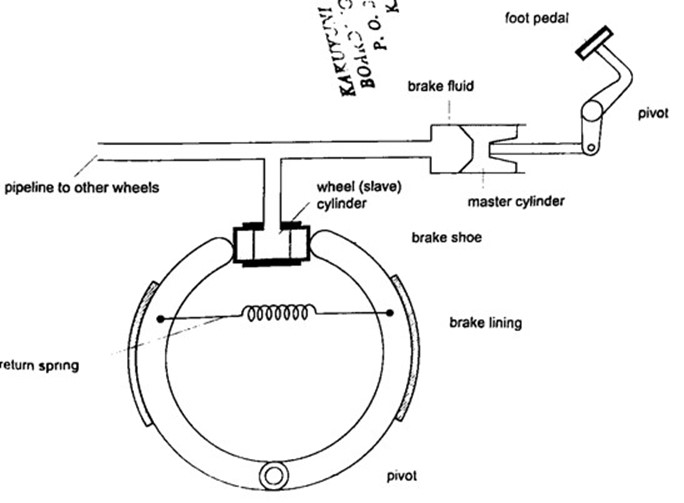
Hydraulic brake system – The master cylinder transmits pressure to the four slave cylinders on each wheel. The cylinders contain brake fluid. Fluid is used because liquids are almost incompressible. When force is applied on the pedal, the resulting pressure in the master cylinder is transmitted to the slave cylinders. This forces the pistons to open the brake shoes which then push the brake lining against the drum. This force slows down the rotation of the wheel. It is important to note that pressure is equally distributed to all wheels so that the car doesn’t pull or veer to one side.
Hydraulic press – It consists of two pistons with different cross-sectional areas. Since pressure is transmitted equally in fluids, when force is applied on one piston it is transmitted to the other piston. The smaller piston is called the force piston while the bigger piston is called the load piston. They are used to lift heavy loads in industries, bending metals and sheets, etc.

Examples
The area of the smaller piston of a hydraulic press is 0.01 m2 and that of the bigger piston is 0.5 m2. If the force applied to the smaller piston is 2 N, what force is transmitted to the larger piston?
Solution:
Pressure = force / area = 2 / 0.01 = 200 Pa.
Force = Pressure × Area = 200 × 0.5 = 100 N.
The master cylinder piston in a car braking system has a diameter of 2.0 cm. The effective area of the brake pads on each of the four wheels is 30 cm2. The driver exerts a force of 500 N on the brake pedal. Calculate:
- The pressure in the master cylinder.
- The total braking force in the car.
Solution:
- Area of the master cylinder = π r2 = 3.14 × (1.0)2 = 3.14 cm2 = 3.14 × 10⁻⁴ m2.
- Pressure = force / area = 500 / (3.14 × 10⁻⁴) = 1.59 × 10⁶ N/m2.
- Area of brake pads = (30 × 4) cm2 = 120 cm2 = 120 × 10-4 m2.
- Force = Pressure × Area = (1.59 × 106) × (120 × 10-4) = 1.91 × 10⁴ N.


4 Comments