

Specific Objectives
By the end of the topic the learner should be able to:
- Derive Pythagoras theorem
- Solve problems using Pythagoras theorem
- Apply Pythagoras theorem to solve problems in life situations
Content
- Pythagoras Theorem
- Solution of problems using Pythagoras Theorem
- Application to real life situations
Introduction
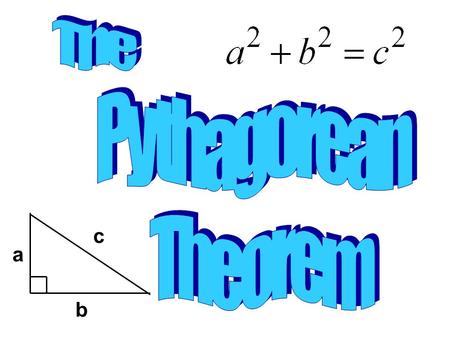
Consider the triangle below:

Pythagoras theorem states that for a right-angled triangle, the square of the hypotenuse is equal to the sum of the squares of the two shorter sides.
Example
In a right-angled triangle, the two shorter sides are 6 cm and 8 cm. Find the length of the hypotenuse.
Solution
Using Pythagoras theorem:
6² + 8² = hyp²
36 + 64 = hyp²
100 = hyp²
hyp = √100 = 10 cm

End of topic
Did you understand everything? If not, ask a teacher, friends, or anybody and make sure you understand before going to sleep! |
Past KCSE Questions on the topic
1. The angle of elevation of the top of a tree from a point P on the horizontal ground is 24.5°. From another point Q, five metres nearer to the base of the tree, the angle of elevation of the top of the tree is 33.2°. Calculate to one decimal place, the height of the tree.
2. A block of wood in the shape of a frustrum of a cone of slanting edge 30 cm and base radius 10 cm is cut parallel to the base, one third of the way from the base along the slanting edge. Find the ratio of the volume of the cone removed to the volume of the complete cone.


