


Specific Objectives
By the end of the topic the learner should be able to:
- Find the surface area of a prism
- Find the surface area of a pyramid
- Find the surface area of a cone
- Find the surface area of a frustum
- Find the surface area of a sphere and a hemisphere
Content
Surface area of prisms, pyramids, cones, frustums and spheres.
Introduction
Surface area of a prism
A prism is a solid with uniform cross-section. The surface area of a prism is the sum of its faces.
Cylinder
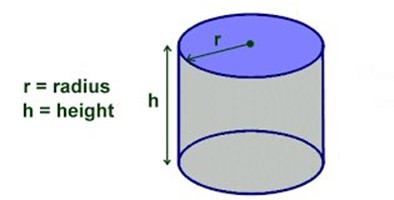
Area of closed cylinder
Area of open cylinder
Example
Find the area of the closed cylinder where r = 2.8 cm and l = 13 cm.
Solution
Note: For an open cylinder do not multiply by two; find the area of only one circle.
Surface area of a pyramid
The surface area of a pyramid is the sum of the area of the slanting faces and the area of the base.
Surface area = base area + area of the four triangular faces (take the slanting height marked green below)
Example

Solution
Surface area = base area + area of the four triangular faces
= (14 × 14) + (14 × 14)
= 196 + 252
= 448

Example
The figure below is a right pyramid with a square base of 4 cm and a slanting edge of 8 cm. Find the surface area of the pyramid.
 a = 4 cm, e = 8 cm
Surface area = base area + area of the four triangular faces
= (l × w) + 4 ( )
Remember height is the slanting height
Slanting height =
=
Surface area =
= 77.97
Surface area of a cone
Total surface area of a cone =
Curved surface area of a cone =

Example
Find the surface area of the cone above.
= 50.24 + 62.8
= 113.04
Note: Always use slanting height; if it’s not given, find it using Pythagoras theorem.
Surface area of a frustum
The bottom part of a cut pyramid or cone is called a frustum. Examples of frustums are buckets, lampshades, and hoppers.
 Examples: a lampshade and a hopper.

Example
Find the surface area of fabric required to make a lampshade in the form of a frustum whose top and bottom diameters are 20 cm and 30 cm respectively and height 12 cm.
Solution
Complete the cone from which the frustum is made by adding a smaller cone of height x cm.

h = 12, H = x cm, r = 10 cm, R = 15 cm
From the knowledge of similar triangles:
Surface area of a frustum = area of the curved surface of bigger cone – area of curved surface of smaller cone.
L = 24 + 12 = 36 cm
Surface area =
=
= 1838.57
= 1021
Surface area of the sphere
A sphere is a solid that is entirely round with every point on the surface at equal distance from the centre. Surface area is

Example
Find the surface area of a sphere whose diameter is 21 cm.
Solution
Surface area =
= 4 × 3.14 × 10.5 × 10.5
= 1386
End of topic
Did you understand everything? If not, ask a teacher, friends, or anybody and make sure you understand before going to sleep! |
Past KCSE Questions on the topic
1. A swimming pool water surface measures 10 m long and 8 m wide. A path of uniform width is made all round the swimming pool. The total area of the water surface and the path is 168 m2.
(a) Find the width of the path (4 mks)
(b) The path is to be covered with square concrete slabs. Each corner of the path is covered with a slab whose side is equal to the width of the path. The rest of the path is covered with slabs of side 50 cm. The cost of making each corner slab is sh 600 while the cost of making each smaller slab is sh 50. Calculate:
(i) The number of the smaller slabs used (4 mks)
(ii) The total cost of the slabs used to cover the whole path (2 mks)
2. The figure below shows a solid regular tetrapack of sides 4 cm.
(a) Draw a labelled net of the solid. (1 mk)
(b) Find the surface area of the solid. (2 mks)

3. The diagram shows a right glass prism ABCDEF with dimensions as shown.

Calculate:
(a) the perimeter of the prism (2 mks)
(b) The total surface area of the prism (3 mks)
(c) The volume of the prism (2 mks)
(d) The angle between the planes AFED and BCEF (3 mks)
4. The base of a rectangular tank is 3.2 m by 2.8 m. Its height is 2.4 m. It contains water to a depth of 1.8 m. Calculate the surface area inside the tank that is not in contact with water. (2 mks)
5. Draw the net of the solid below and calculate surface area of its faces (3 mks)

6.
 G
G
4 cm F
8 cm D
A B
5 cm
The figure above is a triangular prism of uniform cross-section in which AF = 4 cm, AB = 5 cm and BC = 8 cm.
(a) If angle BAF = 30°, calculate the surface area of the prism. (3 marks)
(b) Draw a clearly labeled net of the prism. (1 mark)
7. Mrs. Dawati decided to open a confectionary shop at corner Baridi. She decorated its entrance with 10 models of cone ice cream, five on each side of the door. The model has the following shape and dimensions. Using π = 3.142 and calculations to 4 d.p.

(a) Calculate the surface area of the conical part. (2 mks)
(b) Calculate the surface area of the top surface. (4 mks)
(c) Find total surface area of one model. (2 mks)
(d) If painting 5 cm2 costs Ksh 12.65, find the total cost of painting the models (answer to 1 s.f). (2 mks)
8. A right pyramid of height 10 cm stands on a square base ABCD of side 6 cm.
(a) Draw the net of the pyramid in the space provided below. (2 mks)
(b) Calculate:
(i) The perpendicular distance from the vertex to the side AB. (2 mks)
(ii) The total surface area of the pyramid. (4 mks)
(c) Calculate the volume of the pyramid. (2 mks)
9. The figure below shows a solid object consisting of three parts: a conical part of radius 2 cm and slant height 3.5 cm, a cylindrical part of height 4 cm, and a hemispherical part of radius 3 cm. The cylinder lies at the centre of the hemisphere. ( )
)
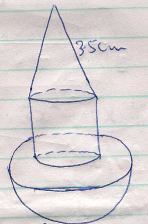
Calculate to four significant figures:
- The surface area of the solid (5 marks)
- The volume of the solid (5 marks)
10. A lampshade is in the form of a frustum of a cone. Its bottom and top diameters are 12 cm and 8 cm respectively. Its height is 6 cm. Find:
(a) The area of the curved surface of the lampshade
(b) The material used for making the lampshade is sold at Kshs. 800 per square metre. Find the cost of ten lampshades if a lampshade is sold at twice the cost of the material.
11. A cylindrical piece of wood of radius 4.2 cm and length 150 cm is cut lengthwise into two equal pieces. Calculate the surface area of one piece.
12. The base of an open rectangular tank is 3.2 m by 2.8 m. Its height is 2.4 m. It contains water to a depth of 1.8 m. Calculate the surface area inside the tank that is not in contact with water.

13. The figure below represents a model of a solid structure in the shape of a frustum of a cone with a hemisphere top. The diameter of the hemispherical part is 70 cm and is equal to the diameter of the top of the frustum. The frustum has a base diameter of 28 cm and slant height of 60 cm.
Calculate:
(a) The area of the hemispherical surface
(b) The slant height of the cone from which the frustum was cut
(c) The surface area of the frustum
(d) The area of the base
(e) The total surface area of the model
14. A room is 6.8 m long, 4.2 m wide and 3.5 m high. The room has two glass doors each measuring 75 cm by 2.5 m and a glass window measuring 400 cm by 1.25 m. The walls are to be painted except the window and doors.
(a) Find the total area of the four walls.
(b) Find the area of the walls to be painted.
(c) Paint A costs Shs. 80 per litre and paint B costs Shs. 35 per litre. 0.8 litres of A covers an area of 1 m2 while 0.5 m2 uses 1 litre of paint B. If two coats of each paint are to be applied, find the cost of painting the walls using:
i) Paint A
ii) Paint B
(d) If paint A is packed in 400 ml tins and paint B in 1.25 litres tins, find the least number of tins of each type of paint that must be bought.
15. The figure below shows a solid frustum of a pyramid with a square top of side 8 cm and a square base of side 12 cm. The slant edge of the frustum is 9 cm.
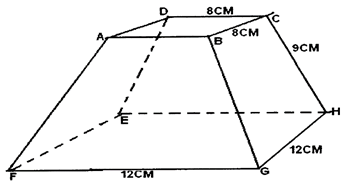
Calculate:
- The total surface area of the frustum
(b) The volume of the solid frustum
(c) The angle between the planes BCHG and the base EFGH.


