


Specific Objectives
By the end of this topic, the learner should be able to:
- Relate the image and object under a given transformation on the Cartesian plane;
- Determine the matrix of a transformation;
- Perform successive transformations;
- Determine and identify a single matrix for successive transformations;
- Relate the identity matrix to transformation;
- Determine the inverse of a transformation;
- Establish and use the relationship between area scale factor and determinant of a matrix;
- Determine shear and stretch transformations;
- Define and distinguish isometric and non-isometric transformations;
- Apply transformations to real-life situations.
Content
- Transformation on the Cartesian plane
- Identification of transformation matrix
- Successive transformations
- Single matrix of transformation for successive transformations
- Identity matrix and transformation
- Inverse of transformations
- Area scale factor and determinant of a matrix
- Shear and stretch (including their matrices)
- Isometric and non-isometric transformations
- Application of transformations to real-life situations
Matrices of Transformation
A transformation changes the shape, position, or size of an object, as discussed in Book Two.
Pre-multiplication of any 2 × 1 column vector by a 2 × 2 matrix results in another 2 × 1 column vector.
Example
If the vector is thought of as a position vector, it represents the points with coordinates (7, -1) mapped to the point (17, -9).
Note:
The transformation matrix affects each point of the plane. Let T be a transformation matrix. Then T maps points (x, y) onto image points.
Finding the Matrix of Transformation
The objective is to find the matrix of a given transformation.
Example
Find the matrix of transformation of triangle PQR with vertices P (1, 3), Q (3, 3), and R (2, 5). The vertices of the image of the triangle are given.
Solution
Let the matrix of the transformation be:
=
Equating the corresponding elements and solving simultaneously:
2a = 2
2c = 0
Therefore, the transformation matrix is:
Example
A trapezium with vertices A (1, 4), B (3, 1), C (5, 1), and D (7, 4) is mapped onto a trapezium whose vertices are given. Describe the transformation and find its matrix.
Solution
Let the matrix of the transformation be:
Equating the corresponding elements we get:
Solve the equations simultaneously:
11b = -11 hence b = -1 or a = 0
3c + d = 3
The matrix of the transformation is therefore:
The transformation is a positive quarter turn about the origin.
Note:
Under any transformation represented by a 2 × 2 matrix, the origin is invariant, meaning it does not change its position. Therefore, if the transformation is a rotation, it must be about the origin; or if the transformation is a reflection, it must be on a mirror line which passes through the origin.
The Unit Square
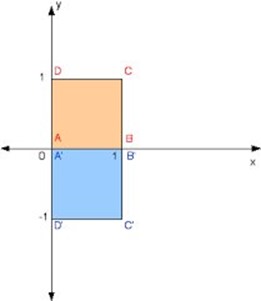
The unit square ABCD with vertices A helps us to find the transformation of a given matrix and also to identify what transformation a given matrix represents.
Example
Find the images of I and J under the transformation whose matrix is given.
Solution
Note:
The images of I and J under transformation represented by any 2 × 2 matrix are:
Example
Find the matrix of reflection in the line y = 0 or x-axis.
Solution
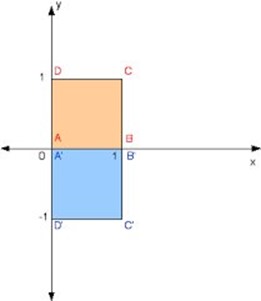
Using a unit square, the image of B is (1, 0) and D is (0, -1). Therefore, the matrix of the transformation is:
Example
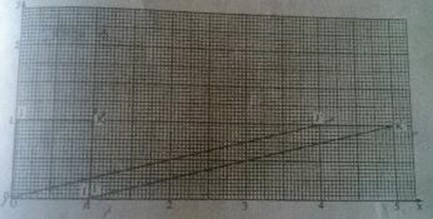
Show on a diagram the unit square and its image under the transformation represented by the matrix.
Solution
Using a unit square, the image of I is (1, 0), the image of J is (4, 1), the image of O is (0, 0), and that of K is:
Successive Transformations
The process of performing two or more transformations in order is called successive transformation. For example, performing transformation H followed by transformation Y is written as YH. Or if A, B, and C are transformations, then ABC means perform C first, then B, and finally A, in that order.
The matrices listed below all perform different rotations or reflections:
This transformation matrix is the identity matrix. When multiplying by this matrix, the point matrix is unaffected and the new matrix is exactly the same as the point matrix.
This transformation matrix creates a reflection in the x-axis. When multiplying by this matrix, the x-coordinate remains unchanged, but the y-coordinate changes sign.
This transformation matrix creates a reflection in the y-axis. When multiplying by this matrix, the y-coordinate remains unchanged, but the x-coordinate changes sign.
This transformation matrix creates a rotation of 180 degrees. When multiplying by this matrix, the point matrix is rotated 180 degrees around (0, 0). This changes the sign of both the x and y coordinates.
This transformation matrix creates a reflection in the line y = x. When multiplying by this matrix, the x-coordinate becomes the y-coordinate and the y-coordinate becomes the x-coordinate.
This transformation matrix rotates the point matrix 90 degrees clockwise. When multiplying by this matrix, the point matrix is rotated 90 degrees clockwise around (0, 0).
This transformation matrix rotates the point matrix 90 degrees anti-clockwise. When multiplying by this matrix, the point matrix is rotated 90 degrees anti-clockwise around (0, 0).
This transformation matrix creates a reflection in the line y = -x. When multiplying by this matrix, the point matrix is reflected in the line y = -x, changing the signs of both coordinates and swapping their values.
Inverse Matrix Transformation
A transformation matrix that maps an image back to the object is called the inverse of the matrix.
Note:
If A is a transformation which maps an object T onto an image, then a transformation that can map back to T is called the inverse of the transformation A.
If R is a positive quarter turn about the origin, the matrix for R is given, and the matrix for its inverse is also given.
Example
T is a triangle with vertices A (2, 4), B (1, 2), and C (4, 2). S is a transformation represented by the matrix.
- Draw T and its image under the transformation S.
- Find the matrix of the inverse of the transformation S.
Solution
Using transformation matrix S =
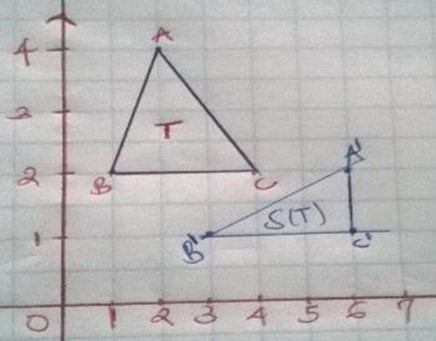
Let the inverse of the transformation matrix be. This can be done in the following ways:
- Therefore
- Equating corresponding elements and solving simultaneously;
- Therefore
Area Scale Factor and Determinant of Matrix
The ratio of the area of the image to the area of the object is the area scale factor (A.S.F).
Area scale factor =
The area scale factor is numerically equal to the determinant. If the determinant is negative, simply ignore the negative sign.
Example
Area of the object is 4 cm² and that of the image is 36 cm². Find the area scale factor.
Solution
If it has a matrix of
Shear and Stretch
Shear
The transformation that maps an object (in orange) to its image (in blue) is called a shear.
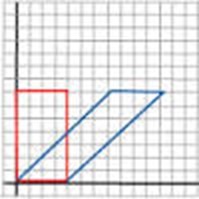
The object has the same base and equal heights. Therefore, their areas are equal. Under any shear, area is always invariant (fixed).
A shear is fully described by giving:
- The invariant line
- A point not on the invariant line, and its image
Example
A shear with x-axis invariant.

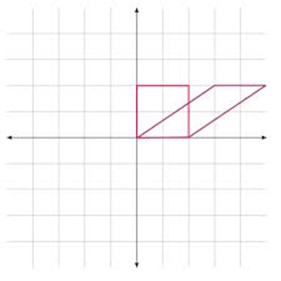
Example
A shear with y-axis invariant.
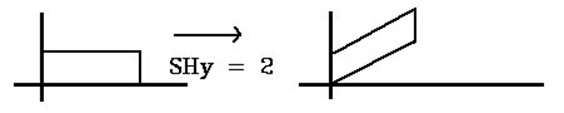
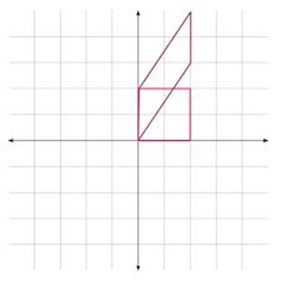
Note:
Shear with x-axis invariant is represented by a matrix of the form. Under this transformation, J (0, 1) is mapped onto.
Likewise, a shear with y-axis invariant is represented by a matrix of the form. Under this transformation, I (0, 1) is mapped onto.
Stretch
A stretch is a transformation which enlarges all distances in a particular direction by a constant factor. A stretch is described fully by giving:
- The scale factor
- The invariant line
Note:
i.) If k is greater than 1, then this really is a stretch.
ii.) If k is less than 1, it is a squish but we still call it a stretch.
iii.) If k = 1, then this transformation is really the identity, i.e., it has no effect.
Example
Using a unit square, find the matrix of the stretch with y-axis invariant and scale factor 3.
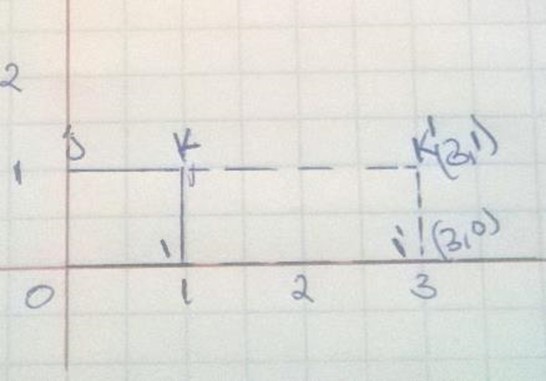
The image of I is therefore the matrix of the stretch is:
Note:
The matrix of the stretch with the y-axis invariant and scale factor k is and the matrix of a stretch with x-axis invariant and scale factor k is.
Isometric and Non-Isometric Transformation
Isometric transformations are those in which the object and the image have the same shape and size (congruent), e.g., rotation, reflection, and translation.
Non-isometric transformations are those in which the object and the image are not congruent, e.g., shear, stretch, and enlargement.
End of topic
Did you understand everything? If not, ask a teacher, friends, or anybody and make sure you understand before going to sleep! |
Past KCSE Questions on the Topic

1. Matrix P is given by:
1 2
4 3
(a) Find P-1
(b) Two institutions, Elimu and Somo, purchase beans at Kshs. B per bag and maize at Kshs. m per bag. Elimu purchased 8 bags of beans and 14 bags of maize for Kshs 47,600. Somo purchased 10 bags of beans and 16 of maize for Kshs. 57,400.
(c) The price of beans later went up by 5% and that of maize remained constant. Elimu bought the same quantity of beans but spent the same total amount of money as before on the two items. State the new ratio of beans to maize.
2. A triangle is formed by the coordinates A (2, 1), B (4, 1), and C (1, 6). It is rotated clockwise through 900 about the origin. Find the coordinates of this image.
3. On the grid provided on the opposite page, A (1, 2), B (7, 2), C (4, 4), D (3, 4) is a trapezium.
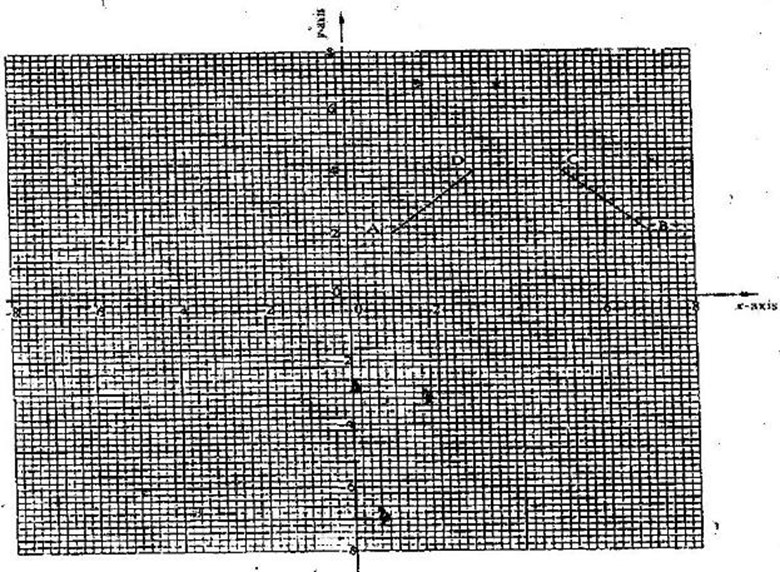
(a) ABCD is mapped onto A’B’C’D’ by a positive quarter turn. Draw the image A’B’C’D on the grid.

(b) A transformation -2 -1 maps A’B’C’D onto A”B”C”D”. Find the coordinates of A”B”C”D”.
4. A triangle T whose vertices are A (2, 3), B (5, 3), and C (4, 1) is mapped onto triangle T1 whose vertices are A1 (-4, 3), B1 (-1, 3), and C1 (x, y) by a transformation M =
a b
c d
(a) Find the:
- (i) Matrix M of the transformation
- (ii) Coordinates of C1
(b) Triangle T2 is the image of triangle T1 under a reflection in the line y = x. Find a single matrix that maps T and T2.
5. Triangles ABC is such that A is (2, 0), B (2, 4), C (4, 4) and A”B”C” is such that A” is (0, 2), B” (-4, -10), and C” is (-4, -12) are drawn on the Cartesian plane.
Triangle ABC is mapped onto A”B”C” by two successive transformations:


R = a b
c d Followed by P = 0 -1
-1 0
(a) Find R
(b) Using the same scale and axes, draw triangles A’B’C’, the image of triangle ABC under transformation R.
Describe fully the transformation represented by matrix R.
6. Triangle ABC is shown on the coordinate plane below.
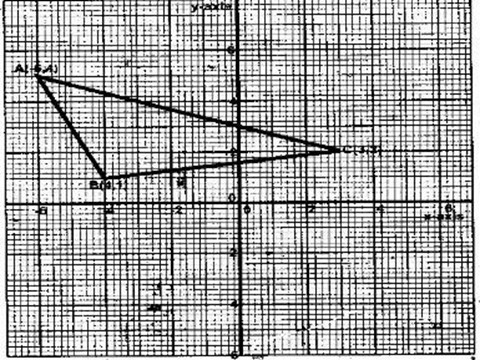
(a) Given that A (-6, 5) is mapped onto A’ (6, -4) by a shear with y-axis invariant:
- Draw triangle A’B’C’, the image of triangle ABC under the shear.
- Determine the matrix representing this shear.

(b) Triangle ABC is mapped onto A”B”C” by a transformation defined by the matrix:
-1 0
1½ -1
(i) Draw triangle A”B”C”.
(ii) Describe fully a single transformation that maps ABC onto A”B”C”.

7. Determine the inverse T1 of the matrix:
1 2
1 -1
Hence find the coordinates of the point at which the two lines x + 2y = 7 and x – y = 1 intersect.


8. Given that A =
0 -1 and B = -1 0
3 2 2 -4
Find the value of x if:
- (i) A – 2x = 2B
- (ii) 3x – 2A = 3B
- (iii) 2A – 3B = 2x
9. The transformation R given by the matrix:


A = a b maps (17, 0) to (15, -8)
c d maps (0, 8) to (17, 15)
(a) Determine the matrix A giving a, b, c, and d as fractions.
(b) Given that A represents a rotation through the origin, determine the angle of rotation.
(c) S is a rotation through 180° about the point (2, 3). Determine the image of (1, 0) under S followed by R.


