

Reception, Response and Co-ordination in Plants and Animals
Introduction
- The structures involved in detecting changes may be located far from those that respond.
- There is a need for a communication system within the body.
- The nervous system and the endocrine system perform this function, linking the parts of the body that detect changes to those that respond.
Irritability
- Living organisms can detect changes in their internal and external environments and respond appropriately.
- This characteristic is called irritability and is vital for survival.
Stimuli
- A stimulus is a change in the internal or external environment to which an organism responds.
- Examples include light, heat, sound, chemicals, pH, water, food, oxygen, and other organisms.
Response
- A response is any change shown by an organism in reaction to a stimulus.
- The response involves movements of the whole or part of the body either towards or away from the stimulus.
- It also results in secretion of substances such as hormones or enzymes by glands.
Co-ordination
- Co-ordination is the working together of all parts of the body to bring about appropriate responses to environmental changes.
Reception
- Reception is the detection of changes in the environment through receptors.
Irritability in Plants
- Response in plants is less pronounced than in animals but equally important for survival.
- Plants respond to stimuli such as light, moisture, gravity, chemicals, and touch.
Tropisms
- Plants often respond by growing in a particular direction; these growth movements are called tropisms.
- They result from unequal growth caused by uneven distribution of growth hormones (auxins).
- One side grows more than the other, causing bending towards (positive tropism) or away from (negative tropism) the stimulus.
Phototropism
- Seedlings exposed to light from one direction have shoots that grow towards the light (positive phototropism).
- The shoot tip receives the unilateral light stimulus, but the response occurs below the tip.
- The hormone auxin, produced at the tip, diffuses down and causes cell elongation.
- Light causes auxin to migrate to the darker side, where it is more concentrated, causing faster growth on that side and bending the shoot towards the light.
Survival Value
- Positive phototropism ensures sufficient light absorption by leaves for photosynthesis.
Geotropism
- Geotropism is growth response to gravity.
- Roots are positively geotropic (grow downwards), while shoots are negatively geotropic (grow upwards).
- When seedlings are placed horizontally, auxin accumulates on the lower side of roots and shoots due to gravity.
- Shoots respond to higher auxin concentration by growing faster on the lower side, bending upwards.
- Roots are inhibited by high auxin concentration, so the lower side grows slower, bending roots downwards.
Survival Value
- Roots grow downwards to absorb water and anchor the plant, aiding nutrient uptake.
Hydrotropism
- Hydrotropism is the growth of roots towards water (moisture).
Survival Value
- Ensures roots grow towards moisture to obtain water needed for photosynthesis and mineral transport.
Chemotropism
- Chemotropism is the response of plant parts towards chemical substances.
- Example: growth of the pollen tube towards the ovule in flowering plants.
Survival Value
- Ensures fertilisation and continuation of the species.
Thigmotropism
- Thigmotropism is a growth response to touch.
- Example: tendrils of climbing plants bend around objects they contact.
Survival Value
- Provides support and positions leaves for optimal light absorption and gas exchange.
Tactic Movements in Plants and Other Organisms
- Tactic movement is movement by a whole organism or motile part in response to a stimulus.
- Named according to the stimulus nature:
- Phototaxis: movement in response to light direction and intensity. Example: Chlamydomonas swim towards optimal light.
- Osmotaxis: movement in response to osmotic conditions, e.g., freshwater amoeba.
- Chemotaxis: movement in response to chemical concentration.
Survival Value
- Ensures favourable conditions for existence and maximises benefits to the organism.
- Example: In bryophytes, antherozoids move towards archegonia for fertilisation.
Nastic Movements
- Nastic movements are responses by plant parts to stimuli not coming from a particular direction.
- Named according to the stimulus:
- Seismonasty/haptonasty: response to shock. Example: Mimosa pudica folds its leaves when touched.
Production of Auxins and Their Effects on Plant Growth
- Auxins are produced by plant apices (root and shoot apex).
- They cause cell elongation and growth.
- Auxins are diffusible substances effective in small amounts.
- Roots require lower auxin concentrations than shoots.
- Auxins also influence other aspects of growth and development.
- Other chemical substances also influence plant growth and development.
Effects of Auxin on Plant Growth
Apical Dominance
- Auxins inhibit growth of side branches (apical dominance).
- If the terminal bud is removed, side branches develop from lateral buds.
- This principle is applied in pruning to control branch development.
Growth of Adventitious Roots
- Adventitious roots develop from the stem.
- Auxins stimulate growth of adventitious roots.
Parthenocarpy
- Formation of fruits without fertilisation.
- Can be induced by treating unpollinated flowers with auxin.
- Used in developing seedless fruit varieties.
- Auxins, along with other hormones, are involved in secondary growth, leaf fall, and fruit ripening.
Reception, Responses and Coordination in Animals
- The nervous and endocrine systems (neuro-endocrine system) coordinate body functions.
- They link receptors to effectors and regulate their activities.
Receptors
- Receptors are cells that detect or receive stimuli.
- They may be scattered over the body surface (e.g., pain, touch, temperature receptors) or located in special sense organs (e.g., light, sound, taste, smell).
- Motor nerves link the Central Nervous System (CNS) to effectors.
- The motor nerve cell body is located at one end of the axon.
- They transmit impulses from the CNS to effectors.
Effectors
- Effectors are cells, organs, or organelles enabling the organism to respond.
- They include muscles, glands, cilia, and flagella.
The Nervous System
Components of the Nervous System in Humans
- Every organ in the human body is connected to nerves.
- The nervous system consists of nerve cells (neurons) transmitting impulses between body parts.
- It includes:
- The Central Nervous System (CNS): brain and spinal cord.
- The Peripheral Nervous System: nerves linking CNS to receptors and effectors.
- Sensory nerves transmit impulses from receptors to CNS.
Structure and Functions of Neurons
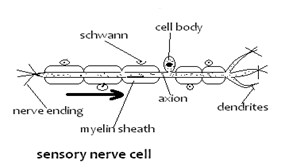
- A nerve cell consists of a cell body (centron) containing the nucleus, with dendrites arising from it.
- One projection is the axon, the longest process.
- The axon contains axoplasm continuous with the cell body cytoplasm.
- The axon is enclosed in a fatty myelin sheath secreted by Schwann cells.
- The myelin sheath is interrupted by nodes of Ranvier at approximately 1 mm intervals.
- The myelin sheath is enclosed by the neurilemma, part of the Schwann cell in contact with the axon.
- The myelin sheath and nodes of Ranvier enhance impulse transmission.
Types of Neurons
Sensory Neuron
- Also called afferent neuron.
- Transmits impulses from sensory cells to CNS.
- Cell body is located along the axon outside the CNS.

Motor Neuron
- Also called efferent or effector neuron.
- Transmits impulses from CNS to effectors (muscles and glands).
- Cell body is located inside the CNS.
Intermediate or Connector Neuron
- Also called relay neuron.
- Found inside the CNS.
- Connect sensory and motor neurons and other nerve cells in the CNS.

Functions of the Neuron
- The nerve impulse is electrical.
- Transmission depends on electrical potential differences between inside and outside of the axon.
- Outside is positive; inside is negative.
- Stimulus changes membrane permeability, altering ion composition.
- Sodium ions rush in, reversing polarity (inside positive, outside negative), creating a nerve impulse.
- Impulse transmits along sensory neuron to CNS at high speed (up to 100 m/s in mammals).
- Dendrites do not connect directly but communicate across synapses (small gaps).
- Impulse transmission across synapses uses chemical transmitter substances stored in synaptic vesicles.
- Common transmitters: acetylcholine or noradrenaline.
- Synaptic vesicles release transmitters when impulse arrives at synaptic knob.
- Motor neuron impulses transmit to effectors across the neuromuscular junction.

Functions of Major Parts of the Human Brain
- The CNS consists of the brain and spinal cord.
- The CNS coordinates body activities by receiving impulses from sensory cells and sending impulses to effectors.
- The brain is enclosed in the cranium and protected by meninges.
- Infection of meninges causes meningitis.
The Brain Consists of the Following Parts:
Cerebrum
- The largest brain part, consisting of two cerebral hemispheres.
- Highly folded to increase surface area.
- Controls learning, intelligence, thought, imagination, and reasoning.
Medulla Oblongata (Brain Stem)
- Controls breathing rate, heartbeat rate, swallowing, salivation, blood pressure, temperature regulation, hearing, taste, and touch.
Cerebellum
- Located in front of the medulla; a folded dorsal expansion of the hindbrain.
- Controls posture, movement, and balance.
Hypothalamus
- Controls body temperature and osmoregulation.
Pituitary Gland
- An endocrine organ secreting hormones controlling osmoregulation, growth, metabolism, and sexual development.
Optic lobes control sight.
Olfactory lobes control smell.
Spinal Cord
- Located within the vertebral column.
- Consists of grey matter (central part with nerve cell bodies and intermediate nerve fibres) and white matter (carries sensory nerve fibres).
- Ventral root carries motor nerve fibres.
Simple and Conditioned Reflex Actions
Simple Reflex Action
- An automatic response to a stimulus.
- The impulse route is called a reflex arc.

Reflex Action Sequence
- Receptor is stimulated; impulse travels along sensory nerve fibre to spinal cord.
- Impulse is picked by intermediate neuron in CNS.
- Intermediate neuron transmits impulse to motor nerve fibre connected to effector.
- Effector responds.
Examples of Reflex Actions
- Pulling hand away from hot object.
- Knee jerk.
- Sneezing.
Conditioned Reflexes
- Learned responses.
- When two or more stimuli are repeatedly presented together, the animal eventually responds to either.
- Example: a hungry animal salivates at food; if a bell rings with food, it learns to salivate at bell alone.
- This is called a conditioned reflex and is a learning mechanism.
The Role of the Endocrine System in Humans
- Consists of glands that secrete hormones.
- Endocrine glands have no ducts; exocrine glands have ducts.
- The pancreas has both exocrine and endocrine parts.
- Hormones are protein chemical substances secreted at one part of the body affecting other parts.
- Secreted directly into blood and transported by blood.
- Each hormone has either a general coordinating effect or a specific response in a target organ.
Hormones Produced in Humans and Their Effects
| Endocrine Gland | Hormone(s) Produced | Role of Hormone | Effect of Deficiency | Effect of Excess |
|---|---|---|---|---|
| Pituitary | Somatotropin (Growth Hormone) | Controls growth | Dwarfism | Gigantism |
| Thyrotrophic Hormone | Controls thyroxin production by thyroid gland | Same as thyroxin deficiency | Same as thyroxin excess | |
| Adrenocorticotrophic Hormone (ACTH) | Stimulates adrenal cortex activity | |||
| Follicle Stimulating Hormone (FSH) | Development of Graafian follicles in ovary | |||
| Luteinising Hormone (LH) | ||||
| Thyroid | Thyroxine | Regulates metabolic rate | Retardation of physical and mental development (cretinism) | High metabolic rate, rapid heartbeat, protrusion of eyeballs (exophthalmic goitre) |
| Islets of Langerhans in Pancreas | Insulin | Regulates blood sugar by converting sugar to glycogen | Hyperglycaemia (diabetes mellitus) | Hypoglycaemia (low blood sugar) |
| Glucagon | Regulates blood sugar by converting glycogen to glucose | Hypoglycaemia | Hyperglycaemia | |
| Gonads | Androgens and Oestrogens | Development of secondary sexual characteristics | In females, failure to develop secondary sexual characteristics; in males, failure to develop male characteristics | In males, development of female characteristics |
| Oestrogen (Ovaries) | Repair of uterine wall | |||
| Progesterone (Ovaries) | Causes thickening of uterine wall; inhibits ovulation during pregnancy; prevents uterine contractions | Miscarriage when level falls during pregnancy | ||
| Testosterone (Testis, interstitial cells) | Promotes spermatogenesis and male secondary sexual characteristics | Male sterility | ||
| Adrenal Glands | Adrenaline | Changes in response to fear, stress, or shock; increases heartbeat; converts glycogen to glucose; dilates pupils; increases blood flow to skeletal muscles | ||
| Hydrocortisone | Metabolism of carbohydrates, lipids, and proteins | Less glycogen stored in liver and muscles | ||
| Aldosterone | Promotes retention of sodium chloride and bicarbonate ions | Kidneys excrete too much sodium, chloride, and bicarbonate ions |
Adrenaline
- Enhances activity of the sympathetic nervous system.
Oversecretion
- Increased heartbeat.
- High blood pressure.
- Thin, toneless muscles.
Undersecretion
- Low blood pressure.
- Inability to withstand stress.
- Muscular weakness.
Thyroxine
Oversecretion (Hyperthyroidism)
- Increased basal metabolic rate (BMR) and temperature.
- Person becomes angry, nervous, and hands may shake.
- Increased heartbeat leading to cardiac failure.
Undersecretion (Hypothyroidism)
- Poor growth and mental retardation (cretinism).
- Reduced metabolic rate and temperature.
- Person becomes inactive and slothful.
- Eyes and face become puffy due to fluid retention.
- Swollen tongue and rough skin in extreme cases.
- Enlarged thyroid gland.
Comparison Between Endocrine and Nervous Systems
| Nervous Communication | Endocrine Communication | |
|---|---|---|
| Speed of Transmission | Usually rapid | Usually slower |
| Response | Usually specific in a given effector | Usually widespread; sometimes in a particular target organ |
| Nature of Impulse | Electrochemical along axon; chemical across synapses | Chemical in the form of hormones traveling in blood |
| Duration of Response | Usually short-lived | Usually long-lasting (e.g., growth) |
Similarities
- Both endocrine and nervous systems coordinate body functions.
- Both have target organs.
- Both are controlled via negative feedback mechanisms.
Effects of Drug Abuse on Human Health
- Drug abuse is misuse of drugs.
- Drugs are chemical compounds affecting body functions or killing microorganisms.
Prescription Drugs
- Prescribed by doctors.
- Overdose can cause death.
Over-the-Counter Drugs (OCD)
- Self-prescribed drugs.
- Can have harmful effects and lead to tolerance requiring higher doses.
Effects of Hard Drugs on Human Health
- Lung cancer caused by nicotine.
- Emphysema.
- Liver cirrhosis caused by alcohol.
- Interference with vision due to alcohol.
- Sterility caused by khat (miraa).
- Sleeplessness (insomnia) caused by khat.
- Hallucinations caused by Cannabis sativa (Bangi).
- Digestive upset, nausea.
- Diarrhoea and vomiting.
- Headache and double vision.
- Skin tone changes (e.g., very dark).
- Extreme appetite changes (very poor or very great).
- Weight loss.
- Personality changes (irritable, confused).
- Convulsions, lethargy, and depression due to inhalation of solvents (e.g., glue).
Structure and Function of Parts of the Human Eye
Structure

- The human eye is spherical and situated within the skull’s orbit.
- Attached by three pairs of muscles controlling movement.
- Composed of three main layers: sclerotic layer, choroid, and light-sensitive retina.
Sclerotic Layer
- Outermost white part at sides and back of eye.
- Made of collagen fibres.
- Protects the eye and maintains shape.
Cornea
- Transparent front part of sclera allowing light passage.
- Curved and bulging, helps focus light onto retina.
Choroid
- Middle layer with many blood vessels supplying nutrients and removing wastes.
- Contains dark pigments absorbing stray light to prevent internal reflection.
Ciliary Body
- Glandular, secretes aqueous humour.
- Has blood vessels for nutrient supply, excretion, and gas exchange.
- Contains ciliary muscles that change lens shape during accommodation.
Suspensory Ligaments
- Inelastic ligaments attaching lens to ciliary body, holding it in position.
Lens
- Biconvex, crystalline, and transparent to refract and focus light onto retina.
Aqueous Humour
- Fluid between lens and cornea.
- Transparent and watery, helps focus and maintain eye shape.
- Conveys nutrients and oxygen to cornea and removes waste.
Iris
- Coloured part with central pupil opening.
- Contains circular and radial muscles controlling pupil size and light entry.
Vitreous Humour
- Fluid between lens and retina.
- Viscous, transparent, gives eye shape and refracts light.
Retina
- Light-sensitive layer at back of eye.
- Contains rods (sensitive to low light, black and white) and cones (sensitive to bright light and colour).
- Nocturnal mammals have more rods; diurnal mammals have more cones.
Fovea Centralis
- Most sensitive retina part, mainly cones for sharp vision (visual acuity).
Optic Nerve
- Transmits impulses from retina to brain for interpretation.
Blind Spot
- Point where optic nerve leaves eye; no rods or cones, not sensitive to light.
Eyelid
- Loose skin covering eye, closes by reflex to protect from damage and excessive light.
Eyelashes
- Prevent dust and particles from entering eye.
Conjunctiva
- Transparent thin layer allowing light passage.
- Continuous with eyelid epithelium, protects cornea.
Accommodation
- Change in lens shape to focus images.
- For distant objects: ciliary muscles relax, suspensory ligaments stretch, lens thins to focus light on retina.
- For near objects: ciliary muscles contract, suspensory ligaments slacken, lens becomes more convex to focus light on retina.
Control of Light Intensity Entering the Eye
- In bright light, circular iris muscles contract, pupil diameter decreases, reducing light entry to protect retina.
- In dim light, circular muscles relax, radial muscles contract, pupil diameter increases, allowing more light in.
Image Formation and Interpretation
- Light rays enter cornea, pass through pupil, refracted by cornea and lens.
- Lens focuses rays to form an inverted image on retina.
- Rods and cones stimulated; impulses transmitted via optic nerve to brain.
- Brain interprets image as upright.
Common Eye Defects and Their Correction
Short-sightedness (Myopia)
- Cannot focus distant objects properly; light focuses in front of retina.
- Caused by eyeball being too long.
- Corrected with concave lenses that diverge light rays before entering eye.
Long-sightedness (Hypermetropia)
- Cannot focus near objects properly; light focuses behind retina.
- Caused by eyeball being too short.
- Corrected with convex lenses that converge light rays before entering eye.
Astigmatism
- Cornea or lens is uneven, causing improper focus on retina.
- Corrected with cylindrical lenses.
Presbyopia
- Light rays from near objects not focused on retina due to lens hardening with age.
- Corrected with convex lenses.
Structure and Functions of Parts of the Human Ear
The Mammalian Ear
- Performs hearing and detects body position changes for balance and posture.
- Divided into three sections: outer ear, middle ear, and inner ear.
The Outer Ear
- Pinna: outer flap made of cartilage, catches and directs sound.
- External auditory canal: tube through which sound travels; secretes wax trapping dust and microbes.
- Tympanum: membrane at inner end of canal that vibrates with sound waves.
The Middle Ear
- Chamber containing three small bones (ossicles): malleus, incus, and stapes.
- Ossicles amplify vibrations and transmit them from tympanum to oval window.
- Oval window: membrane at chamber end that vibrates with ossicle movement.
- Eustachian tube connects middle ear to pharynx, equalising pressure inside and outside tympanum.
The Inner Ear
- Series of fluid-filled chambers including cochlea and semicircular canals.
- Cochlea: coiled tube with many sensory cells connected to brain via auditory nerve; detects vibrations for hearing.
Hearing
- Sound waves vibrate tympanum, transformed into vibrations.
- Ossicles transmit vibrations to oval window.
- Oval window vibrations cause cochlear fluid to vibrate.
- Sensory cells in cochlea convert vibrations to nerve impulses.
- Impulses transmitted to brain via auditory nerve; hearing perceived in brain.
Balance and Posture
- Three semicircular canals in each ear, at right angles, sensitive to movement in different planes.
- Filled with fluid; each has an ampulla containing sensory cells.
- Movement of head moves fluid, stimulating sensory hairs.
- Impulses sent to brain via auditory nerve to register movement.
Defects of the Ear
Acute Labyrinthitis
- Inflammation of middle ear and cochlea.
- May cause deafness.
- Treated with drugs or surgery if necessary.
Tinnitus
- Sensation of noises in the ear.
- Caused by wax accumulation or certain drugs (e.g., quinine).
- Treated by wax removal and stopping causative drugs.
Vertigo (Giddiness)
- Disorientation of body in space, sometimes caused by dilation of endolymph.
- Treated with appropriate drugs.
Deafness
- Inability to hear, varying from partial to complete.
- Causes include chronic cochlea infection, lack of sensory cells, excess wax, or ossicle fusion.
Otitis Media
- Inflammation of middle ear due to fluid build-up.
- Marked by swelling around Eustachian tube from infection or congestion.
- Creates vacuum in middle ear.
- Treated with antibiotics or surgery.
Practical Activities
- Investigate tactic response using choice chambers with fly maggots.
- Observe responses to stimuli such as chemical substances (chemotaxis).
- Place dried beef/fish on one side and rotting meat/fish on the other.
- Place ten maggots in center, cover chamber, and count maggots at each end after 10 minutes.
- Most maggots move to chamber with rotting meat.
Tropisms
- Soak and germinate maize or bean seeds until radicle and plumule appear (about 5 days for beans, 7 for maize).
- Use seedlings with straight radicles and plumules.
Geotropism
- Place seedlings horizontally on soil, vermiculite, sawdust, or sand.
- Observe and record results after three days.
Phototropism
- Place potted plant or young seedling near a window as the only light source or in a dark box.
- Observe after 3-5 days; shoots bend towards the light.
Etiolation
- Place young seedlings in a dark box, keep moist but not exposed to light.
- After two weeks, observe yellow, small leaves; long internodes; elongated, thin stems.
- Compare with seedlings grown in light (control) which are green with larger leaves, shorter internodes, and thicker stems.
Experiment to Determine Distance of the Blind Spot
- Work in pairs; one measures, the other observes.
- Mark a cross and a dot on white paper 6-9 cm apart.
- Hold paper 50 cm from face.
- Close left eye; fix right eye on cross; slowly move paper towards face.
- At 50 cm, both cross and dot are visible.
- As paper moves closer, dot disappears at a certain distance.
- Measure this distance; it is the blind spot distance.
- Dot disappears because light rays focus on blind spot, which lacks photoreceptors.
The Knee Jerk Experiment
- Work in pairs; one sits with one leg crossed over the other.
- The other taps the crossed knee just below the kneecap with palm edge or wooden ruler.
- Observe the knee jerk reflex.
- This is a spinal reflex.
END


