


Specific Objectives
By the end of the topic the learner should be able to:
- State the currencies of different countries.
- Convert currency from one form into another given the exchange rates.
- Calculate profit and loss.
- Express profit and loss as percentages.
- Calculate discount and commission.
- Express discount and commission as percentages.
Content
- Currency
- Current currency exchange rates
- Currency conversion
- Profit and loss
- Percentage profit and loss
- Discounts and commissions
- Percentage discounts and commissions
Introduction
In commercial arithmetic, we deal with calculations involving business transactions. The medium of any business transaction is usually called the currency. The Kenyan currency consists of a basic unit called a shilling. 100 cents are equivalent to one Kenyan shilling, while a Kenyan pound is equivalent to twenty Kenyan shillings.
Currency Exchange Rates
The Kenyan currency cannot be used for business transactions in other countries. To facilitate international trade, many currencies have been given different values relative to another. These are known as exchange rates.
The table below shows the exchange rates of major international currencies at the close of business on a certain day in the year 2015. The buying and selling columns represent the rates at which banks buy and sell these currencies.
| Currency | Buying | Selling |
|---|---|---|
| DOLLAR | 102.1472 | 102.3324 |
| STG POUND | 154.0278 | 154.3617 |
| EURO | 109.6072 | 109.8522 |
| SA RAND | 7.3332 | 7.3486 |
| KES / USHS | 33.0785 | 33.2363 |
| KES / TSHS | 20.9123 | 21.0481 |
| KES / RWF | 7.2313 | 7.3423 |
| AE DIRHAM | 27.8073 | 27.8653 |
| CAN $ | 77.6018 | 77.7661 |
| JAPANESE YEN | 84.0234 | 84.1964 |
| SAUDI RIYAL | 27.2284 | 27.2959 |
| CHINESE YUAN | 16.0778 | 16.1082 |
| AUSTRALIAN $ | 71.8606 | 72.0420 |
Note
The rates are not always fixed and they keep changing. When changing Kenyan currency to foreign currency, the bank sells to you. Therefore, we use the selling column rate. Conversely, when changing foreign currency to Kenyan currency, the bank buys from you, so we use the buying column rate.
Example
Convert each of the following currencies to its stated equivalent:
- US $305 to Ksh
- 530 Dirham to Euro
Solution
- The bank buys US $1 at Ksh 102.1472.
Therefore, US $305 = Ksh (102.1472 × 305) = Ksh 31,154.896 = Ksh 31,155 (to the nearest shilling).
The bank buys 1 Dirham at Ksh 27.8073.
Therefore, 530 Dirham = Ksh (27.8073 × 530) = Ksh 14,737.869 (corrected calculation).
The bank sells 1 Euro at 109.8522.
Therefore, 530 Dirham in Ksh = 14,737.869; converting to Euro: 14,737.869 ÷ 109.8522 = 134.12 Euros (rounded).
Example
During a certain month, the exchange rates in a bank were as follows:
| Buying (Ksh.) | Selling (Ksh.) | |
|---|---|---|
| 1 US $ | 91.65 | 91.80 |
| 1 Euro | 103.75 | 103.93 |
A tourist left Kenya to the United States with Ksh 1,000,000. At the airport, he exchanged all the money to dollars and spent 190 dollars on an air ticket. While in the US, he spent 4,500 dollars for upkeep and proceeded to Europe. While in Europe, he spent a total of 2,000 Euros. How many Euros did he remain with? (3 marks)
Solution
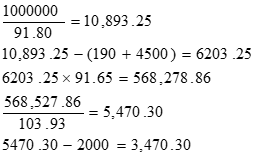
Profit and Loss
The difference between the cost price and the selling price is either profit or loss. If the selling price is greater than the cost price, the difference is a profit; if the selling price is less than the cost price, the difference is a loss.
Note
Selling price – cost price = profit
Percentage profit = (Profit ÷ Cost price) × 100
Cost price – selling price = loss
Percentage loss = (Loss ÷ Cost price) × 100
Example
Ollie bought a cow at sh 18,000 and sold it at sh 21,000. What percentage profit did he make?
Solution
Selling price = sh 21,000
Cost price = sh 18,000
Profit = sh (21,000 – 18,000) = sh 3,000
Percentage profit = (3,000 ÷ 18,000) × 100 = 16.67%
Example
Johnny bought a dress at sh 3,500 and later sold it at sh 2,800. What percentage loss did he incur?
Cost price = sh 3,500
Selling price = sh 2,800
Loss = sh (3,500 – 2,800) = sh 700
Percentage loss = (700 ÷ 3,500) × 100 = 20%
Discount
A shopkeeper may decide to sell an article at a reduced price. The difference between the marked price and the reduced price is referred to as the discount. The discount is usually expressed as a percentage of the actual price.
Example
The price of an article is marked at sh 120. A discount is allowed and the article sold at sh 96. Calculate the percentage discount.
Solution
Actual price = sh 120.00
Reduced price = sh 96.00
Discount = sh (120.00 – 96.00) = sh 24
Percentage discount = (24 ÷ 120) × 100 = 20%
Commission
A commission is an agreed rate of payment, usually expressed as a percentage, to an agent for his services.
Example
Mr. Neasa, a salesman in a soap industry, sold 250 pieces of toilet soap at sh 45.00 and 215 packets of detergent at sh 75.00 per packet. If he got a 5% commission on the sales, how much money did he get as commission?
Solution
Sales for the toilet soap = 250 × 45 = sh 11,250
Sales for the detergent = 215 × 75 = sh 16,125
Total sales = 11,250 + 16,125 = sh 27,375
Commission = 5% of 27,375 = 0.05 × 27,375 = sh 1,368.75
Example
A salesman earns a basic salary of sh 9,000 per month. In addition, he is also paid a commission of 5% for sales above sh 15,000. In a certain month, he sold goods worth sh 120,000 at a discount of 2½%. Calculate his total earnings that month. (3 marks)
Solution
Sales amount = sh 120,000
Discount = 2.5% of 120,000 = 0.025 × 120,000 = sh 3,000
Amount after discount = 120,000 – 3,000 = sh 117,000
Commission is paid on sales above sh 15,000, so commissionable sales = 117,000 – 15,000 = sh 102,000
Commission = 5% of 102,000 = 0.05 × 102,000 = sh 5,100
Total earnings = Basic salary + Commission = 9,000 + 5,100 = sh 14,100
End of topic
Did you understand everything? If not, ask a teacher, friends, or anybody and make sure you understand before going to sleep! |
Past KCSE Questions on the topic
- The cash prize of a television set is Kshs 25,000. A customer paid a deposit of Kshs 3,750. He repaid the amount owing in 24 equal monthly installments. If he was charged simple interest at the rate of 40% p.a., how much was each installment?
- Mr Ngeny borrowed Kshs 560,000 from a bank to buy a piece of land. He was required to repay the loan with simple interest for a period of 48 months. The repayment amounted to Kshs 21,000 per month.
Calculate:
(a) The interest paid to the bank
(b) The rate per annum of the simple interest
- A car dealer charges 5% commission for selling a car. He received a commission of Kshs 17,500 for selling a car. How much money did the owner receive from the sale of his car?
- A company saleslady sold goods worth Kshs 240,000. From this sale, she earned a commission of Kshs 4,000.
(a) Calculate the rate of commission.
(b) If she sold goods whose total marked price was Kshs 360,000 and allowed a discount of 2%, calculate the amount of commission she received.
- A businesswoman bought two bags of maize at the same price per bag. She discovered that one bag was of high quality and the other of low quality. On the high-quality bag, she made a profit by selling at Kshs 1,040, whereas on the low-quality bag she made a loss by selling at Kshs 880. If the profit was three times the loss, calculate the buying price per bag.
- A salesman gets a commission of 2.4% on sales up to Kshs 100,000. He gets an additional commission of 1.5% on sales above this. Calculate the commission he gets on sales worth Kshs 280,000.
- Three people Koris, Wangare, and Hassan contributed money to start a business in the ratio of 7:9:10:14 respectively. The business realized a profit of Kshs 46,800. They shared 12% of the profit equally and the remainder in the ratio of their contributions. Calculate the total amount of money received by Diba.
- A Kenyan tourist left Germany for Kenya through Switzerland. While in Switzerland, he bought a watch worth 52 Deutsche Marks. Find the value of the watch in:
(a) Swiss Francs.
(b) Kenya Shillings.
Use the exchange rates below:
1 Swiss Franc = 1.28 Deutsche Marks.
1 Swiss Franc = 45.21 Kenya Shillings.
- A salesman earns a basic salary of Kshs 9,000 per month. In addition, he is also paid a commission of 5% for sales above Kshs 15,000.
In a certain month, he sold goods worth Kshs 120,000 at a discount of 2½%. Calculate his total earnings that month.
- In this question, mathematical tables should not be used.
A Kenyan bank buys and sells foreign currencies as shown below:
Buying (In Kenya shillings) | Selling (In Kenya shillings)
1 Hong Kong dollar: 9.74 | 9.77
1 South African rand: 12.03 | 12.11
A tourist arrived in Kenya with 105,000 Hong Kong dollars and changed the whole amount to Kenyan shillings. While in Kenya, she spent Kshs 403,897 and changed the balance to South African rand before leaving for South Africa. Calculate the amount, in South African rand, that she received.
- A Kenyan businessman bought goods from Japan worth 2,950,000 Japanese yen. On arrival in Kenya, custom duty of 20% was charged on the value of the goods.
If the exchange rates were as follows:
1 US dollar = 118 Japanese Yen
1 US dollar = 76 Kenya shillings
Calculate the duty paid in Kenya shillings.
- Two businessmen jointly bought a minibus which could ferry 25 paying passengers when full. The fare between two towns A and B was Kshs 80 per passenger for one way. The minibus made three round trips between the two towns daily. The cost of fuel was Kshs 1,500 per day. The driver and the conductor were paid daily allowances of Kshs 200 and Kshs 150 respectively.
A further Kshs 4,000 per day was set aside for maintenance.
(a) One day the minibus was full on every trip.
(i) How much money was collected from the passengers that day?
(ii) How much was the net profit?
(b) On another day, the minibus was 80% full on average for the three round trips. How much did each business get if the day’s profit was shared in the ratio 2:3?
- A traveler had sterling pounds 918 with which he bought Kenya shillings at the rate of Kshs 84 per sterling pound. He did not spend the money as intended. Later, he used the Kenyan shillings to buy sterling pounds at the rate of Kshs 85 per sterling pound. Calculate the amount of money in sterling pounds lost in the whole transaction.
- A commercial bank buys and sells Japanese Yen in Kenya shillings at the rates shown below:
Buying: 0.5024
Selling: 0.5446
A Japanese tourist at the end of his tour of Kenya was left with Kshs 30,000 which he converted to Japanese Yen through the commercial bank. How many Japanese Yen did he get?
- In the month of January, an insurance salesman earned Kshs 6,750 which was commission of 4.5% of the premiums paid to the company.
(a) Calculate the premium paid to the company.
(b) In February, the rate of commission was reduced by 66⅔% and the premiums reduced by 10%. Calculate the amount earned by the salesman in the month of February.
- Akinyi, Bundi, Cura, and Diba invested some money in a business in the ratio of 7:9:10:14 respectively. The business realized a profit of Kshs 46,800. They shared 12% of the profit equally and the remainder in the ratio of their contributions. Calculate the total amount of money received by Diba.
- A telephone bill includes Kshs 4,320 for local calls, Kshs 3,260 for trunk calls, and rental charge Kshs 2,080. A value added tax (V.A.T) is then charged at 15%. Find the total bill.
- During a certain period, the exchange rates were as follows:
1 sterling pound = Kshs 102.0
1 sterling pound = 1.7 US dollars
1 US dollar = Kshs 60.6
A school management intended to import textbooks worth Kshs 500,000 from the UK. It changed the money to sterling pounds. Later the management found out that the books cost sterling pounds to dollars. Unfortunately, a financial crisis arose and the money had to be converted to Kenya shillings. Calculate the total amount of money the management ended up with.
- A fruiterer bought 144 pineapples at Kshs 100 for every six pineapples. She sold some of them at Kshs 72 for every three and the rest at Kshs 60 for every two.
If she made a 65% profit, calculate the number of pineapples sold at Kshs 72 for every three.


