


Specific Objectives
By the end of the topic the learner should be able to:
- Interpret a given scale
- Choose and use an appropriate scale
- Draw suitable sketches from given information
- State the bearing of one point from another
- Locate a point using bearing and distance
- Determine angles of elevation and depression
- Solve problems involving bearings, elevations, and scale drawing
- Apply scale drawing in simple surveying
Content
- Types of scales
- Choice of scales
- Sketching from given information and scale drawing
- Bearings
- Bearings, distance and locating points
- Angles of elevation and depression
- Problems involving bearings, scale drawing, angles of elevation and depression
- Simple surveying techniques
Introduction
The scale
The ratio of the distance on a map to the actual distance on the ground is called the scale of the map. The ratio can be in statement form e.g. 50 cm represents 50,000 cm or as a representative fraction (R.F), 1:5,000,000 is written as.
Example
The scale of a map is given in a statement as 1 cm represents 4 km. Convert this to a representative fraction (R.F).
Solution
One cm represents 4 x 100,000 cm. 1 cm represents 400,000 cm.
Therefore, the ratio is 1:400,000 and the R.F is 1/400,000.
Example
The scale of a map is given as 1:250,000. Write this as a statement.
Solution
1:250,000 means 1 cm on the map represents 250,000 cm on the ground. Therefore, 1 cm represents 2.5 km.
Scale Diagram
When using scale, one should be careful in choosing the right scale so that the drawing fits on the paper without much detail being left out.
Bearing and Distances
Direction is always found using a compass point.
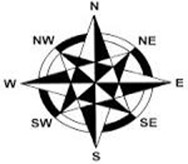
A compass has eight points as shown above. The four main points of the compass are North, South, East, and West. The other points are secondary points and they include North East (NE), South East (SE), South West (SW), and North West (NW). Each angle formed at the centre of the compass is the angle between N and E.
Compass Bearing
When the direction of a place from another is given in degrees and in terms of the four main points of a compass, e.g. N, then the direction is said to be given in compass bearing. Compass bearing is measured either clockwise or anticlockwise from North or South and the angle is acute.
True bearing
North East direction can be given in three figures as measured clockwise from True North. This three-figure bearing is called the true bearing.
The true bearing due north is given as 000°, due south east as 135°, and due north west as 315°.
Example
From town P, a town Q is 60 km away on a bearing South 80º East. A third town R is 100 km from P on the bearing South 40º West. A cyclist travelling at 20 km/h leaves P for Q. He stays at Q for one hour and then continues to R. He stays at R for 1½ hours and then returns directly to P.
(a) Calculate the distance of Q from R.

P² = 100² + 60² – 2(100)(60) Cos 120°
P² = 10,000 + 3,600 – 2(100)(60)(-0.5)
P² = 13,600 + 60,000
P² = 73,600
P = √73,600 ≈ 271.3 km
(b) Calculate the bearing of R from Q.

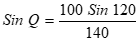
Angle = 38.2°
Bearing = 270° – 38.2° = 231.8°
(c) What is the time taken for the whole round trip?

Time from P to Q = 60 km ÷ 20 km/h = 3 hours
Time from Q to R = 100 km ÷ 20 km/h = 5 hours
Time from R to P = 140 km ÷ 20 km/h = 7 hours
Total time = 3 + 5 + 7 = 15 hours
Example
A port B is on a bearing 080° from a port A and a distance of 95 km. A submarine is stationed at a port D, which is on a bearing of 200° from A, and a distance of 124 km from B. A ship leaves B and moves directly southwards to an island P, which is on a bearing of 140° from A. The submarine at D, on realizing that the ship was heading to the island P, decides to head straight for the island to intercept the ship. Using a scale of 1 cm to represent 10 km, make a scale drawing showing the relative positions of A, B, D, and P. {4 marks}
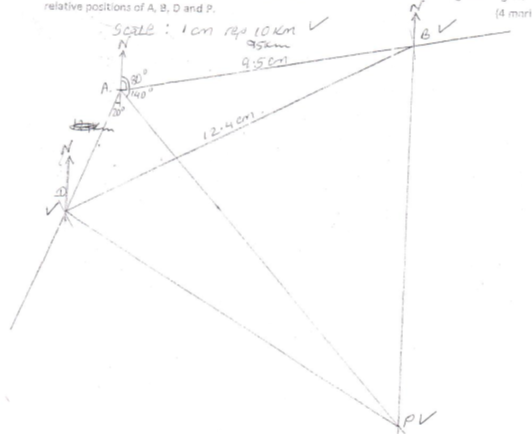
Hence find:
b) The distance from A to D. {2 marks}
c) The bearing of the submarine from the ship when the ship was setting off from B. {1 mark}
d) The bearing of the island P from D. {1 mark}
e) The distance the submarine had to cover to reach the island P. {2 marks}
Angle of Elevation and Depression

Angle of Elevation: The angle above the horizontal that an observer must look to see an object that is higher than the observer. For example, a man looking at a bird.
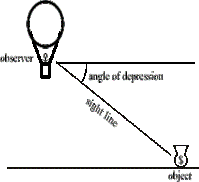
Angle of Depression: The angle below horizontal that an observer must look to see an object that is lower than the observer. For example, a bird looking down at a bug.
Angles of depression and elevation can be measured using an instrument called a clinometer.
To find heights or lengths, we can use scale drawing.
Simple Survey Methods
This involves taking field measurements of the area so that a map of the area can be drawn to scale. Pieces of land are usually surveyed in order to:
- Fix boundaries
- For town planning
- Road construction
- Water supplies
- Mineral development
Areas of Irregular Shapes
Areas of irregular shape can be found by subdividing them into convenient geometrical shapes e.g. triangles, rectangles, or trapezia.
Example
The area in hectares of the field can be found by the help of a baseline and offsets as shown.
Fig 22.26
XY is the baseline 360 m. SM, RP, and QN are the offsets.
Taking X as the starting point of the survey, the information can be entered in a field book as follows.
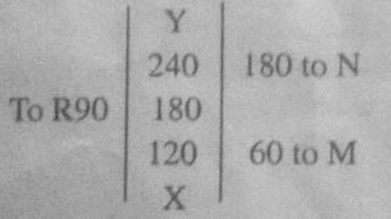
The sketch is as follows:
Using a suitable scale.
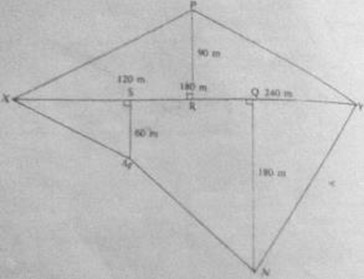
The area of the separate parts is found then combined.
Area of:
Triangle XPR = ½ × 180 × 90 = 8,100 m²
Triangle PRY = ½ × 180 × 90 = 8,100 m²
Triangle XSM = ½ × 120 × 60 = 3,600 m²
Triangle QNY = ½ × 120 × 180 = 10,800 m²
Trapezium SQNM = ½ (QN + SM) × SQ = ½ (180 + 60) × 120 = 14,400 m²
Total area = 8,100 + 8,100 + 3,600 + 10,800 + 14,400 = 45,000 m²
End of topic
Did you understand everything? If not, ask a teacher, friends, or anybody and make sure you understand before going to sleep! |
Past KCSE Questions on the topic
A point B is on a bearing of 080° from a port A and at a distance of 95 km. A submarine is stationed at a port D, which is on a bearing of 200° from A and a distance of 124 km from B.
A ship leaves B and moves directly southwards to an island P, which is on a bearing of 140° from A. The submarine at D, on realizing that the ship was heading for the island P, decides to head straight for the island to intercept the ship.
Using a scale of 1 cm to represent 10 km, make a scale drawing showing the relative positions of A, B, D, and P.
Hence find:
- The distance from A to D
- The bearing of the submarine from the ship when the ship was setting off from B
- The bearing of the island P from D
- The distance the submarine had to cover to reach the island P
Four towns R, T, K, and G are such that T is 84 km directly to the north of R, and K is on a bearing of 295° from R at a distance of 60 km. G is on a bearing of 340° from K and a distance of 30 km. Using a scale of 1 cm to represent 10 km, make an accurate scale drawing to show the relative positions of the towns.
Find:
- The distance and the bearing of T from K
- The distance and the bearing of G from T
- The bearing of R from G
Two aeroplanes, S and T, leave airport A at the same time. S flies on a bearing of 060° at 750 km/h while T flies on a bearing of 210° at 900 km/h.
(a) Using a suitable scale, draw a diagram to show the positions of the aeroplanes after two hours.
(b) Use your diagram to determine:
- The actual distance between the two aeroplanes
- The bearing of T from S
- The bearing of S from T
A point A is directly below a window. Another point B is 15 m from A and at the same horizontal level. From B, the angle of elevation of the bottom of the window is 30° and the angle of elevation of the top of the window is 35°. Calculate the vertical distance:
- From A to the bottom of the window
- From the bottom to the top of the window
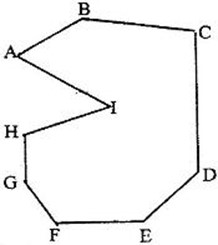
Find by calculation the sum of all the interior angles in the figure ABCDEFGHI below.

Shopping centers X, Y, and Z are such that Y is 12 km south of X and Z is 15 km from X. Z is on a bearing of 330° from Y. Find the bearing of Z from X.
An electric pylon is 30 m high. A point S on the top of the pylon is vertically above another point R on the ground. Points A and B are on the same horizontal ground as R. Point A is due south of the pylon and the angle of elevation of S from A is 26°. Point B is due west of the pylon and the angle of elevation of S from B is 32°.
Find:
- Distance from A and B
- Bearing of B from A
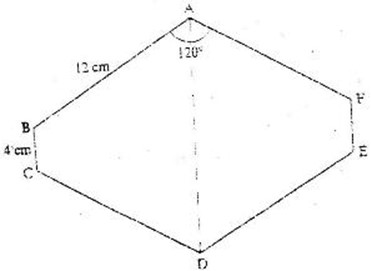
The figure below is a polygon in which AB = CD = FA = 12 cm, BC = EF = 4 cm, and angles BAF and CDE are 120°. AD is a line of symmetry.
Find the area of the polygon.
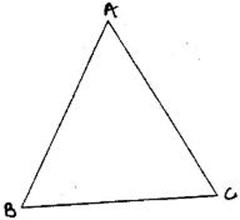
The figure below shows a triangle ABC.
(a) Using a ruler and a pair of compasses, determine a point D on the line BC such that BD:DC = 1:2.
(b) Find the area of triangle ABD, given that AB = AC.
A boat at point X is 200 m to the south of point Y. The boat sails from X to another point Z. Point Z is 200 m on a bearing of 310° from X. Y and Z are on the same horizontal plane.
- Calculate the bearing and the distance of Z from Y.
- W is the point on the path of the boat nearest to Y. Calculate the distance WY.
- A vertical tower stands at point Y. The angle of point X from the top of the tower is 6°. Calculate the angle of elevation of the top of the tower from W.
The figure below shows a quadrilateral ABCD in which AB = 8 cm, DC = 12 cm, ∠BAD = 45°, ∠CBD = 90°, and ∠BCD = 30°.
Find:
- The length of BD
- The size of the angle ADB
In the figure below, ABCDE is a regular pentagon and ABF is an equilateral triangle.
Find the size of:
- ∠ADE
- ∠AEF
- ∠DAF
Use a pair of compasses and a ruler only:
- Construct triangle ABC such that AB = 6 cm, BC = 8 cm, and ∠ABC = 135°. (2 marks)
- Construct the height of triangle ABC in (a) above taking BC as the base. (1 mark)
The size of an interior angle of a regular polygon is 3x°, while its exterior angle is (x – 20)°. Find the number of sides of the polygon.
Points L and M are equidistant from another point K. The bearing of L from K is 330°. The bearing of M from K is 220°. Calculate the bearing of M from L.
Four points B, C, Q, and D lie on the same plane. Point B is 42 km due southwest of town Q. Point C is 50 km on a bearing of 56° from Q. Point D is equidistant from B, Q, and C.
- Using the scale 1 cm represents 10 km, construct a diagram showing the position of B, C, Q, and D.
- Determine the:
- Distance between B and C
- Bearing of D from B

Two aeroplanes P and Q leave an airport at the same time. P flies on a bearing of 240° at 900 km/h while Q flies due East at 750 km/h.
- Using a scale of 1 cm, draw a diagram to show the positions of the aeroplanes after 40 minutes.
- Use the scale drawing to find the distance between the two aeroplanes after 40 minutes.
- Determine the bearing of:
- P from Q (answer 254°)
- Q from P (answer 74°)
A port B is on a bearing of 080° from a port A and at a distance of 95 km. A submarine is stationed at port D, which is on a bearing of 200° from A, and a distance of 124 km from B.
A ship leaves B and moves directly southwards to an island P, which is on a bearing of 140° from A. The submarine at D, on realizing that the ship was heading for the island P, decides to head straight for the island to intercept the ship.
Using a scale of 1 cm to represent 10 km, make a scale drawing showing the relative positions of A, B, D, and P.
Hence find:
- The distance from A to D
- The bearing of the submarine from the ship when the ship was setting off from B
- The bearing of the island P from D
- The distance the submarine had to cover to reach the island
Four towns R, T, K, and G are such that T is 84 km directly to the north of R and K is on a bearing of 295° from R at a distance of 60 km. G is on a bearing of 340° from K and a distance of 30 km. Using a scale of 1 cm to represent 10 km, make an accurate scale drawing to show the relative positions of the towns.
Find:
- The distance and bearing of T from K
- The bearing of R from G
In the figure below, ABCDE is a regular pentagon and M is the midpoint of AB. DM intersects EB at N.

Find the size of:
- ∠BAE
- ∠BED
- ∠BNM
Use a ruler and compasses in this question. Draw a parallelogram ABCD in which AB = 8 cm, BC = 6 cm, and ∠BAD = 75°. By construction, determine the perpendicular distance between AB and CD.
The interior angles of the hexagon are 2x°, ½ x°, x + 40°, 110°, 130°, and 160°. Find the value of the smallest angle.
The size of an interior angle of a regular polygon is 156°. Find the number of sides of the polygon.


