


Specific Objectives
By the end of the topic the learner should be able to:
- Identify and sketch common solids
- Identify vertices, edges, and faces of common solids
- State the geometric properties of common solids
- Draw nets of solids accurately
- Make models of solids from nets
- Calculate surface area of solids from nets
Content
- Common solids (cubes, cuboids, pyramids, prisms, cones, spheres, cylinders, etc.)
- Vertices, edges, and faces of common solids
- Geometric properties of common solids
- Nets of solids
- Models of solids from nets
- Surface area of solids from nets (including cubes, cuboids, cones, pyramids, prisms)
Introduction
A solid is an object which occupies space and has a definite or fixed shape. Solids are either regular or irregular.

Note:
- Intersections of faces are called edges.
- The point where three or more edges meet is called a vertex.

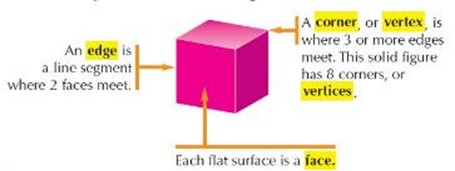
Sketching solids
To draw a reasonable sketch of a solid on plain paper, the following ideas are helpful:
Use of isometric projections
In this method the following points should be observed:
- Each edge should be drawn to the correct length.
- All rectangular faces must be drawn as parallelograms.
- Horizontal and vertical edges must be drawn accurately to scale.
- The base edges are drawn at an angle with the horizontal lines.
- Parallel lines are drawn parallel.
Examples
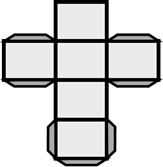
Cube net
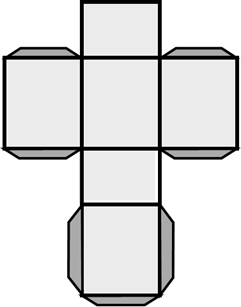
Cuboid net
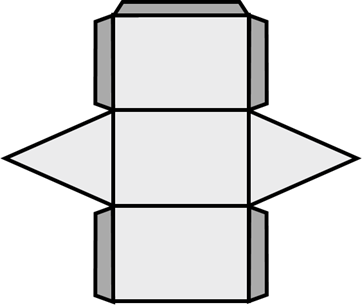
Triangular prism net
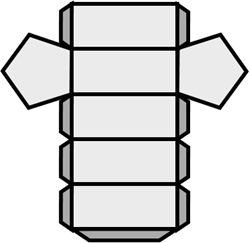
Pentagonal prism
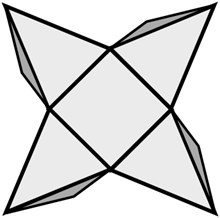
Square base pyramid
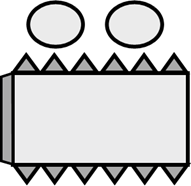
Cylinder net
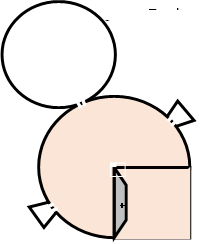
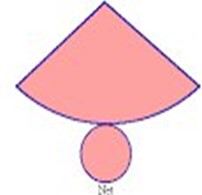
Cone net
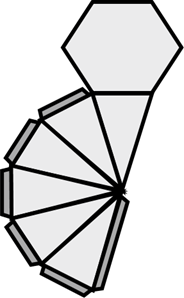
Hexagonal prism
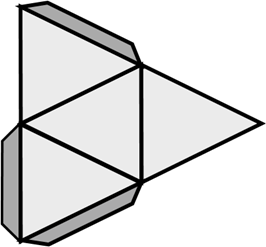
Tetrahedron
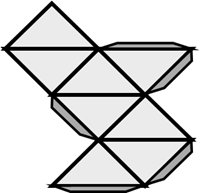
Octahedron
Dodecagon
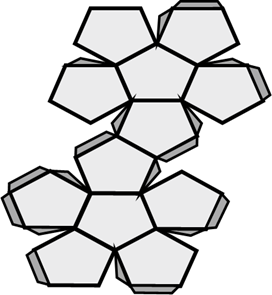
Example
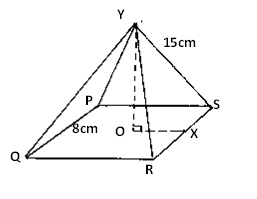 An ant moved from Y to X, the midpoint of RS, through P in the right pyramid below.





Draw the net of the pyramid showing the path of the ant; hence find the distance it moved.
Solution

Distance = 15 +  = 27.649 cm
Example
Draw the net of the solid below.
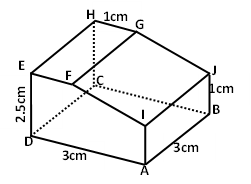
| Image | Label | Comments |
|---|---|---|
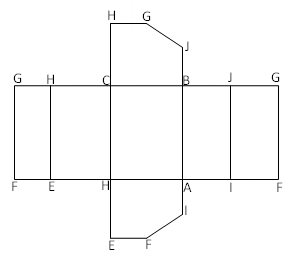 | B1 B1 B1 | Scale drawing Correct labeling Correct measurement of GJ and FI |
End of topic
Did you understand everything? If not, ask a teacher, friends, or anybody and make sure you understand before going to sleep! |
Past KCSE Questions on the topic
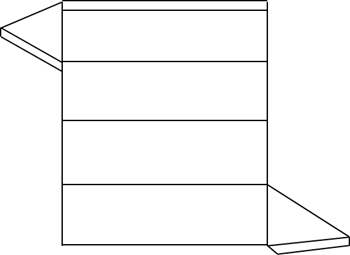
The figure below shows a net of a prism whose cross-section is an equilateral triangle.
a) Sketch the prism
b) State the number of planes of symmetry of the prism.
The figure below represents a square-based solid with a path marked on it.
Sketch and label the net of the solid.
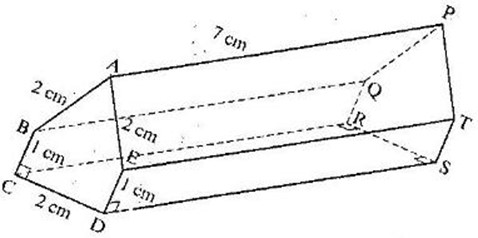
The figure below represents a prism of length 7 cm.
AB = AE = CD = 2 cm and BC = ED = 1 cm
Draw the net of the prism (3 marks)
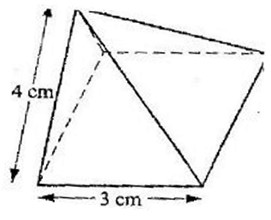
The diagram below represents a right pyramid on a square base of side 3 cm. The slant height of the pyramid is 4 cm.
(a) Draw a net of the pyramid (2 marks)
(b) On the net drawn, measure the height of a triangular face from the top of the pyramid (1 mark)
(a) Draw a regular pentagon of side 4 cm (1 mark)
(b) On the diagram drawn, construct a circle which touches all the sides of the pentagon (2 marks)
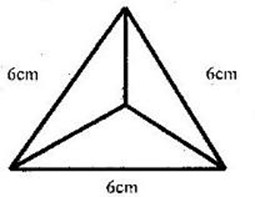
The figure below shows a solid regular tetrapack of sides 6 cm.
(a) Draw a net of the solid
(b) Find the surface area of the solid
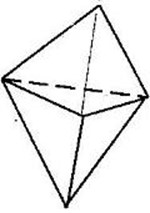
The figure below shows a solid made by pasting two equal regular tetrahedrons.
(a) Draw a net of the solid
(b) If each face is an equilateral triangle of side 5 cm, find the surface area of the solid.
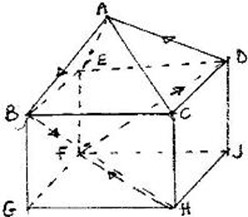
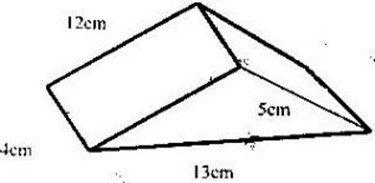
Sketch the net of the prism shown below.
(b) Find the surface area of the solid


1 Comment