
Specific Objectives
By the end of the topic, the learner should be able to:
- Find the area of a quadrilateral.
- Find the area of other polygons (regular and irregular).
Content
- Area of quadrilaterals
- Area of other polygons (regular and irregular)
Introduction
Quadrilaterals
Quadrilaterals are four-sided figures, such as rectangles, squares, rhombuses, parallelograms, trapeziums, and kites.
Area of Rectangle
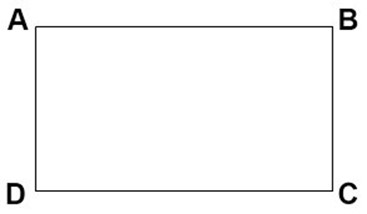
AB and DC represent the lengths, while AD and BC represent the widths of the rectangle.
Area of Parallelogram
A parallelogram is a figure whose opposite sides are equal and parallel.
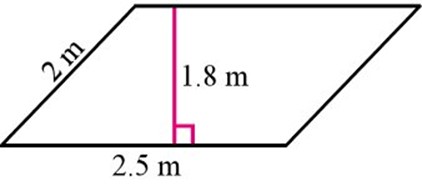
The area of a parallelogram is calculated as:
Area = base × height
Area of a Rhombus
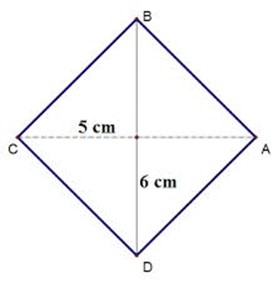
A rhombus is a figure with all sides equal, and its diagonals bisect each other at right angles. In the figure below, BC = CD = DA = AB = 4 cm, while AC = 10 cm and BD = 12 cm. Find the area.
Solution
First, find half of each diagonal:
- Half of AC = 10 cm ÷ 2 = 5 cm
- Half of BD = 12 cm ÷ 2 = 6 cm
The area is given by:
Area = (1/2) × (diagonal 1) × (diagonal 2) = (1/2) × 10 × 12 = 60 cm²
Area of Trapezium
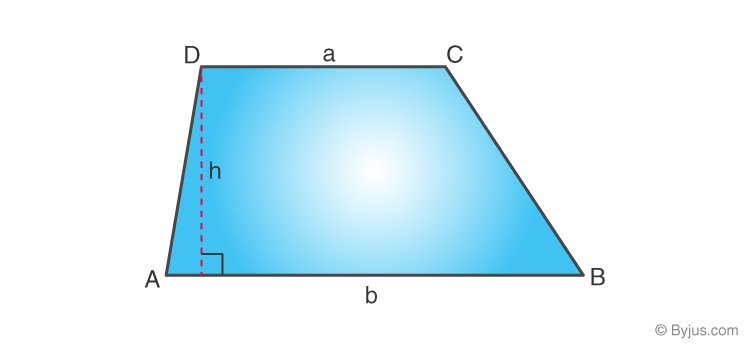
A trapezium is a quadrilateral with only two of its opposite sides parallel. The area is calculated as:
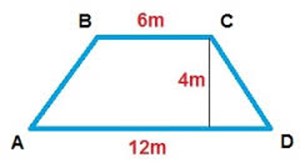
Area = (1/2) × (sum of parallel sides) × height
Example
Find the area of the trapezium shown above.
Solution:
Area = (1/2) × (sum of parallel sides) × height
Note:
You can use the sine rule to find the height if you know the hypotenuse and an angle.
Alternatively, use the acronym SOHCAHTOA to calculate the height in right-angled triangles.
Rhombus
Example
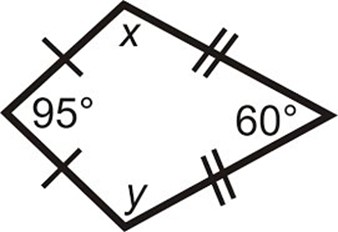
In the figure above, the lines marked // measure 7 cm, while the lines marked / measure 5 cm. Find the area.
Solution
Join points X to Y.
Find the area of the two triangles formed:
(Triangle one)
(Triangle two)
Then add the areas of the two triangles to get the total area.
Area of Regular Polygons
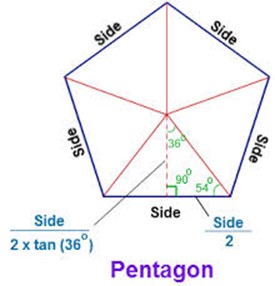
Any regular polygon can be divided into isosceles triangles by joining the vertices to the center. The number of triangles formed is equal to the number of sides of the polygon.
Example
If the radius of a pentagon is 6 cm, find its area.
Solution
Divide the pentagon into five triangles, each with area:
Area of one triangle = 17.11 cm²
There are five triangles; therefore,
Total area = 5 × 17.11 = 85.55 cm²
End of topic
Did you understand everything? If not, ask a teacher, friends, or anybody and make sure you understand before going to sleep! |
Past KCSE Questions on the Topic
1.) The diagram below, not drawn to scale, is a regular pentagon circumscribed in a circle of radius 10 cm at centre O.
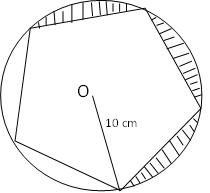
Find:
- (a) The side of the pentagon (2 marks)
- (b) The area of the shaded region (3 marks)
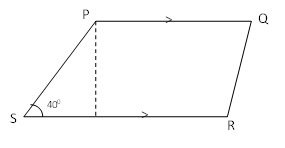
2.) PQRS is a trapezium in which PQ is parallel to SR, PQ = 6 cm, SR = 12 cm, ∠PSR = 40°, and PS = 10 cm. Calculate the area of the trapezium. (4 marks)

3.) A regular octagon has an area of 101.8 cm². Calculate the length of one side of the octagon. (4 marks)
4.) Find the area of a regular polygon with radius 10 cm and side n, given that the sum of interior angles of n : n – 1 is in the ratio 4 : 3.
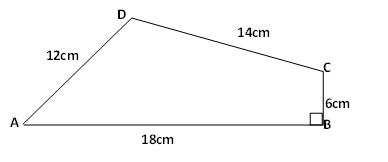
- Calculate the area of the quadrilateral ABCD shown: