

Specific Objectives
By the end of this topic, the learner should be able to:
- Define locus;
- Describe common types of loci;
- Construct:
- Loci involving inequalities;
- Loci involving chords;
- Loci involving points under given conditions;
- Intersecting loci.
Content
- Common types of loci
- Perpendicular bisector loci
- Locus of a point at a given distance from a fixed point
- Angle bisector loci
- Other loci under given conditions including intersecting loci
- Loci involving inequalities
- Loci involving chords (constant angle loci)
Introduction
A locus is defined as the path, area, or volume traced out by a point, line, or region as it moves according to some given laws.

In construction, the opening between the pencil and the point of the compass is a fixed distance, which is the length of the radius of a circle. The point on the compass determines a fixed point. If the length of the radius remains the same or unchanged, all of the points in the plane that can be drawn by the compass form a circle. Any points that cannot be drawn by the compass do not lie on the circle. Thus, the circle is the set of all points at a fixed distance from a fixed point. This set is called a locus.
Common Types of Loci
Perpendicular Bisector Locus
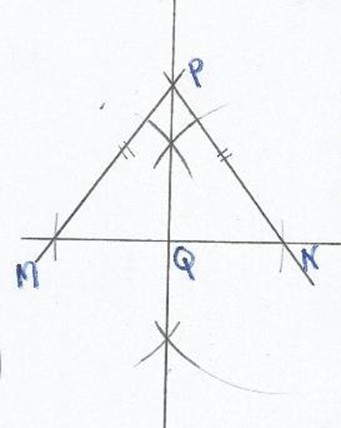
The locus of points equidistant from two fixed points is the perpendicular bisector of the straight line joining the two fixed points. This locus is called the perpendicular bisector locus.
To find the point equidistant from two fixed points, you simply find the perpendicular bisector of the segment joining the two points, as shown below.
Q is the midpoint of M and N.
In Three Dimensions
In three dimensions, the perpendicular bisector locus is a plane at right angles to the line segment and bisecting it into two equal parts. The point P can lie anywhere on this plane, provided it is equidistant from the two fixed points.

The Locus of Points at a Given Distance from a Given Straight Line
In Two Dimensions
In the figure below, each of the lines from the middle line is marked ‘a’ centimeters on either side of the given line MN.
The ‘a’ centimeters on either side from the middle line represent the perpendicular distance.

The two parallel lines describe the locus of points at a fixed distance from a given straight line.
In Three Dimensions
In three dimensions, the locus of points ‘a’ centimeters from a line MN is a cylindrical shell of radius ‘a’ cm, with MN as the axis of rotation.
Locus of Points at a Given Distance from a Fixed Point
In Two Dimensions
If O is a fixed point and P is a variable point ‘d’ cm from O, the locus of P is the circle with center O and radius ‘d’ cm, as shown below.

All points on a circle describe a locus of a point at a constant distance from a fixed point. In three dimensions, the locus of a point ‘d’ centimeters from a point is a spherical shell centered at O with radius d cm.
Angle Bisector Locus
The locus of points equidistant from two given intersecting straight lines is the pair of lines which bisect the angles between the given lines.
Conversely, a point that lies on a bisector of a given angle is equidistant from the lines forming that angle.

Line PB bisects angle ABC into two equal parts.
Example
Construct triangle PQR such that PQ = 7 cm, QR = 5 cm, and angle PQR = 60°. Construct the locus L of points equidistant from RP and RQ.
Solution
L is the bisector of angle PRQ.
P L
L
Constant Angle Loci
A line PQ is 5 cm long. Construct the locus of points at which PQ subtends an angle of 60°.
Solution
- Draw PQ = 5 cm.
- Construct TP at P such that angle QPT = 60°.
- Draw a perpendicular to TP at P (radius is perpendicular to tangent).
- Construct the perpendicular bisector of PQ to meet the perpendicular in step (iii) at O.
- Using O as the center and either OP or OQ as radius, draw the locus.
- Transfer the center to one side of PQ and complete the locus.
- Transfer the center to the opposite side of PQ and complete the locus as shown below.

- Both loci are of the same radius.
- Angles subtended by the same chord on the circumference are equal.
- This is called the constant angle locus.
Intersecting Loci
- Construct triangle PQR such that PQ = 7 cm, QR = 5 cm, and angle PQR = 30°.
- Construct the locus of points equidistant from P and Q to meet the locus of points equidistant from Q and R at M. Measure PM.
Solution
In the figure below:
- is the perpendicular bisector of PQ.
- is the perpendicular bisector of QR.
- By measurement, PM is equal to 3.7 cm.

Loci of Inequalities
An inequality is represented graphically by showing all the points that satisfy it. The intersection of two or more regions of inequalities gives the intersection of their loci.
Remember to shade the unwanted region.
Example
Draw the locus of points (x, y) such that x + y < 3 and y – x > 2.
Solution
Draw the graphs of x + y = 3, y – x = 4, and y = 2 as shown below.
The unwanted regions are usually shaded. The unshaded region marked R is the locus of points (x, y) such that x + y < 3 and y – x > 2.
The lines representing greater than or equal to (≥) and less than or equal to (≤) are always solid, while the lines representing greater than or less than (>, <) are always broken.

Example
P is a point inside rectangle ABCD such that AP = PB and angle DAP = angle BAP. Show the region on which P lies.

Draw the perpendicular bisector of AP = PB and shade the unwanted region. Bisect ∠DAB (∠DAP = ∠BAP) and shade the unwanted region. The region lies in the unshaded area.
Example
Draw the locus of a point P which moves such that AP = 3 cm.
Solution
- Draw a circle with center A and radius 3 cm.
- Shade the unwanted region.

Locus Involving Chords
The following properties of chords of a circle are used in the construction of loci:
- The perpendicular bisector of any chord passes through the center of the circle.
- The perpendicular drawn from the center of a circle bisects the chord.
- If chords of a circle are equal, they are equidistant from the center of the circle and vice versa.
- In the figure below, if chord AB intersects chord CD at O, with AO = x, BO = y, CO = m, and DO = n, then:

End of topic
Did you understand everything? If not, ask a teacher, friends, or anybody and make sure you understand before going to sleep! |
Past KCSE Questions on the Topic
1. Using a ruler and a pair of compasses only,
- Construct a triangle ABC such that angle ABC = 135°, AB = 8.2 cm, and BC = 9.6 cm.
- Given that D is a position equidistant from both AB and BC and also from B and C:
- Locate D.
- Find the area of triangle DBC.
2. (a) Using a ruler and a pair of compasses only, construct triangle XYZ such that XY = 6 cm, YZ = 8 cm, and ∠XYZ = 75°.
(b) Measure line XZ and ∠XZY.
(c) Draw a circle that passes through X, Y, and Z.
(d) A point M moves such that it is always equidistant from Y and Z. Construct the locus of M and define the locus.
3. (a) (i) Construct a triangle ABC in which AB = 6 cm, BC = 7 cm, and angle ABC = 75°.
Measure:
- Length of AC
- Angle ACB
(b) Locus of P is such that BP = PC. Construct P.
(c) Construct the locus of Q such that Q is on one side of BC, opposite A, and angle BQC = 30°.
(d) (i) Locus of P and locus of Q meet at X. Mark x.
(ii) Construct locus R in which angle BRC = 120°.
(iii) Show the locus S inside triangle ABC such that XS ≥ SR.
4. Use a ruler and compasses only for all constructions in this question.
a) (i) Construct a triangle ABC in which AB = 8 cm, BC = 7.5 cm, and ∠ABC = 112½°.
ii) Measure the length of AC.
b) By shading the unwanted regions, show the locus of P within the triangle ABC such that:
- AP ≤ BP
- AP > 3 cm
Mark the required region as P.
c) Construct a normal from C to meet AB produced at D.
d) Locate the locus of R in the same diagram such that the area of triangle ARB is ¾ the area of triangle ABC.
5. On a line AB which is 10 cm long and on the same side of the line, use a ruler and a pair of compasses only to construct the following:
a) Triangle ABC whose area is 20 cm² and angle ACB = 90°.
b) (i) The locus of a point P such that angle APB = 45°.
(ii) Locate the position of P such that triangle APB has a maximum area and calculate this area.
6. A garden in the shape of a polygon with vertices A, B, C, D, and E. AB = 2.5 m, AE = 10 m, ED = 5.2 m, and DC = 6.9 m. The bearing of B from A is 030º, and A is due east of E, while D is due north of E, angle EDC = 110º.
a) Using a scale of 1 cm to represent 1 m, construct an accurate plan of the garden.
b) A foundation is to be placed nearer to CD than CB and no more than 6 m from A:
- Construct the locus of points equidistant from CB and CD.
- Construct the locus of points 6 m from A.
c) (i) Shade and label R, the region within which the foundation could be placed in the garden.
ii) Construct the locus of points in the garden 3.4 m from AE.
iii) Is it possible for the foundation to be 3.4 m from AE and in the region?
7. a) Using a ruler and compasses only, construct triangle PQR in which QR = 5 cm, PR = 7 cm, and angle PRQ = 135°.
b) Determine ∠PQR.
c) At P, drop a perpendicular to meet QR produced at T.
d) Measure PT.
e) Locate a point A on TP produced such that the area of triangle AQR is equal to one and a half times the area of triangle PQR.
f) Complete triangle AQR and measure angle AQR.
8. Use ruler and a pair of compasses only in this question.
(a) Construct triangle ABC in which AB = 7 cm, BC = 8 cm, and ∠ABC = 60°.
(b) Measure (i) side AC (ii) ∠ACB.
(c) Construct a circle passing through the three points A, B, and C. Measure the radius of the circle.
(d) Construct ∆PBC such that P is on the same side of BC as point A and ∠PCB = ½ ∠ACB, ∠BPC = ∠BAC. Measure ∠PBC.
9. Without using a set square or a protractor:
(a) Construct triangle ABC in which BC is 6.7 cm, angle ABC is 60°, and ∠BAC is 90°.
(b) Mark point D on line BA produced such that line AD = 3.5 cm.
(c) Construct:
- (i) A circle that touches lines AC and AD.
- (ii) A tangent to this circle parallel to line AD.
Use a pair of compasses and ruler only in this question;
(a) Draw acute-angled triangle ABC in which angle CAB = 37½°, AB = 8 cm, and CB = 5.4 cm. Measure the length of side AC (hint: 37½° = ½ × 75°).
(b) On the triangle ABC below:
- (i) On the same side of AC as B, draw the locus of a point X so that angle AXC = 52½°.
- (ii) Also draw the locus of another point Y, which is 6.8 cm away from AC and on the same side as X.
(c) Show by shading the region P outside the triangle such that angle APC ≥ 52½° and P is not less than 6.8 cm away from AC.


1 Comment