

Specific Objectives
By the end of this topic, the learner should be able to:
- Find average rates of change and instantaneous rates of change;
- Find the gradient of a curve at a point using a tangent;
- Relate the delta notation to rates of change;
- Find the gradient function of a function of the form y = xn (where n is a positive integer);
- Define the derivative of a function, derived function of a polynomial, and differentiation;
- Determine the derivative of a polynomial;
- Find equations of tangents and normals to curves;
- Sketch a curve;
- Apply differentiation in calculating distance, velocity, and acceleration;
- Apply differentiation in finding maxima and minima of a function.
Content
- Average and instantaneous rates of change
- Gradient of a curve at a point
- Gradient of y = xn (where n is a positive integer)
- Delta notation (Δ) or δ
- Derivative of a polynomial
- Equations of tangents and normals to the curve
- Stationary points
- Curve sketching
- Application of differentiation in calculation of distance, velocity, and acceleration
- Maxima and minima
Introduction
Differentiation is generally concerned with the rate of change of one quantity with respect to another. It is a fundamental concept in calculus that allows us to find how a function changes at any given point.
Example
To find the gradient of the curve y = x2 at a general point (x, y), note that a general point on the curve has coordinates (x, x2). The gradient at this point can be established as follows.
Consider a small change in x, denoted by h. This gives a new point on the curve with coordinates ((x + h), (x + h)2). Let point Q be ((x + h), (x + h)2) and point P be (x, x2).
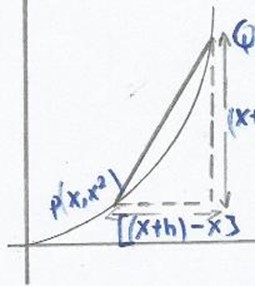
To find the gradient of PQ:
Change in y = (x + h)2 – x2
Change in x = (x + h) – x = h
Gradient =
= [(x + h)2 – x2] / h
= [x2 + 2xh + h2 – x2] / h
= (2xh + h2) / h
= 2x + h
As Q moves closer to P, h becomes very small and can be ignored. Thus, the gradient approaches 2x. Therefore, at the general point (x, y) on the curve y = x2, the gradient is 2x.
2x is called the gradient function of the curve y = x2. This function can be used to determine the gradient of the curve at any point.
In general, the gradient function of y = xn is given by nxn-1, where n is a positive integer. This gradient function is called the derivative or derived function, and the process of obtaining it is called differentiation.
Delta Notation
A small increase in x is usually denoted by Δx; similarly, a small increase in y is denoted by Δy. Consider points P(x, y) and Q((x + Δx), (y + Δy)) on the curve y = f(x).
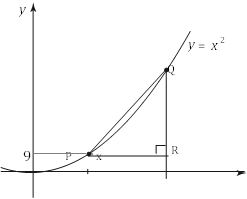
Note:
- Δx is a single quantity, not a product of Δ and x.
- Similarly, Δy is a single quantity.
The gradient of PQ is:
= Δy / Δx
= 2x + Δx
As Δx tends to zero:
- Δx can be ignored.
- This gives the derivative, denoted by dy/dx.
- Thus, dy/dx = 2x.
When we find dy/dx, we say we are differentiating with respect to x. For example, given y = x2, then dy/dx = 2x.
In general, the derivatives of y = xn are given by dy/dx = nxn-1.
Derivative of a Polynomial
A polynomial in x is an expression of the form anxn + an-1xn-1 + … + a1x + a0, where ai are constants.
To differentiate a polynomial function, multiply the coefficients of each variable term by their corresponding exponents, subtract one from each exponent, and omit any constant terms.
Steps involved in differentiating polynomial functions:
- Identify the variable and constant terms.
A variable term contains a variable, while a constant term is a number without a variable. For example, in y = 5x3 + 9x2 + 7x + 3:- Variable terms: 5x3, 9x2, 7x
- Constant term: 3
- Multiply the coefficients by their respective powers.
For example:- 5x3 → 5 × 3 = 15
- 9x2 → 9 × 2 = 18
- 7x → 7 × 1 = 7
- Subtract one from each exponent.
Reduce each exponent by one. - Replace the old coefficients and exponents with the new ones.
The derivative of constants is zero, so omit constant terms.
The derivative of y = 5x3 + 9x2 + 7x + 3 is:
dy/dx = 15x2 + 18x + 7
In general, the derivative of a sum of terms is the sum of the derivatives of each term.
Examples
Find the derived function of each of the following:
- S = tb
- A = … (Incomplete in original)
Equations of Tangents and Normals to a Curve
The gradient of a curve at a point is the same as the gradient of the tangent to the curve at that point. This principle is used to find the equation of the tangent to a curve at a given point.
Find the equation of the tangent to the curve y = 3x2 + 2x at x = 1.
Solution
At x = 1, the gradient is dy/dx = 6x + 2 = 6(1) + 2 = 8.
The point on the curve at x = 1 is y = 3(1)2 + 2(1) = 3 + 2 = 5, so the point is (1, 5).
Using the point-gradient form of a line:
y – 5 = 8(x – 1)
A normal to a curve at a point is a line perpendicular to the tangent at that point.
Since the gradient of the tangent at (1, 5) is 8, the gradient of the normal is the negative reciprocal, -1/8.
The equation of the normal is:
y – 5 = -1/8 (x – 1)
Example
Find the equation of the normal to the curve y = x2 – 3x at the point (1, -2).
Solution
At (1, -2), the gradient of the tangent is dy/dx = 2x – 3 = 2(1) – 3 = -1.
The gradient of the normal is the negative reciprocal, which is 1.
The equation of the normal is:
y – (-2) = 1(x – 1)
y + 2 = x – 1
y = x – 3
Stationary Points
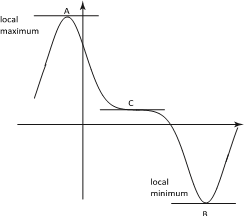
Note:
- At points A, B, and C, the tangent is horizontal, meaning the gradient is zero, so dy/dx = 0.
- Any point where the tangent to the graph is horizontal is called a stationary point. Stationary points can be found by solving dy/dx = 0.
Turning Points
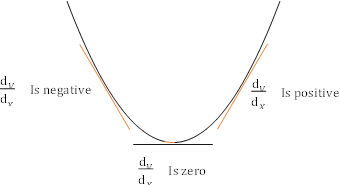
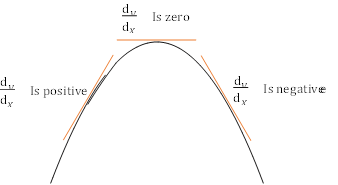
A turning point is where the gradient changes sign. If the gradient changes from negative through zero to positive, the point is a minimum. If it changes from positive through zero to negative, the point is a maximum. In the figure above, A is a maximum and B is a minimum.
Minimum Point
The gradient moves from negative through zero to positive.
Maximum Point
The gradient moves from positive through zero to negative.
Maximum and minimum points are called turning points.
A point where the gradient changes from positive through zero to positive or from negative through zero to negative is called a point of inflection.
Example
Identify the stationary points on the curve y = x3 – 3x2 + 4. For each point, determine whether it is a maximum, minimum, or a point of inflection.
Solution
At stationary points, dy/dx = 0.
dy/dx = 3x2 – 6x
Set dy/dx = 0:
3x2 – 6x = 0
3x(x – 2) = 0
Stationary points are at x = 0 and x = 2.
Find corresponding y-values:
At x = 0, y = 0 – 0 + 4 = 4
At x = 2, y = 8 – 12 + 4 = 0
Therefore, stationary points are (0, 4) and (2, 0).
Consider the sign of the gradient to the left and right of x = 2:
| x | 1 | 2 | 3 |
|---|---|---|---|
| dy/dx | -3 | 0 | 3 |
| Diagrammatic representation | / |
Therefore, (2, 0) is a minimum point.
Consider the sign of the gradient to the left and right of x = 0:
| x | -1 | 0 | 1 |
|---|---|---|---|
| dy/dx | 9 | 0 | -3 |
| Diagrammatic representation | / | ___ |
Therefore, (0, 4) is a maximum point.
Example
Identify the stationary points on the curve y = x3 – 6x2 + 9x + 1. Determine the nature of each stationary point.
Solution
y = x3 – 6x2 + 9x + 1
dy/dx = 3x2 – 12x + 9
At stationary points, dy/dx = 0:
3x2 – 12x + 9 = 0
x2 – 4x + 3 = 0
(x – 3)(x – 1) = 0
Stationary points are at x = 1 and x = 3.
Find corresponding y-values:
At x = 1, y = 1 – 6 + 9 + 1 = 5
At x = 3, y = 27 – 54 + 27 + 1 = 1
Therefore, stationary points are (1, 5) and (3, 1).
By analyzing the second derivative or gradient signs, (1, 5) is a point of inflection and (3, 1) is a maximum point.
Application of Differentiation in Calculation of Velocity and Acceleration
Velocity
If the displacement S is expressed as a function of time t, then the velocity v is given by v = dS/dt.
Example
The displacement S (in metres) of a moving particle after time t seconds is given by S = 4t3 + 8t2 – 8t.
Find:
- Velocity at t = 2 and t = 3
- The instant at which the particle is at rest
Solution
S = 4t3 + 8t2 – 8t
The velocity function is:
v = dS/dt = 12t2 + 16t – 8
- Velocity:
- At t = 2: v = 12(2)2 + 16(2) – 8 = 48 + 32 – 8 = 72 m/s
- At t = 3: v = 12(3)2 + 16(3) – 8 = 108 + 48 – 8 = 148 m/s
- The particle is at rest when v = 0:
12t2 + 16t – 8 = 0
Divide through by 4:
3t2 + 4t – 2 = 0
Using the quadratic formula:
t = [-4 ± √(16 + 24)] / 6 = [-4 ± √40] / 6
t = [-4 ± 2√10] / 6
t = (-2 ± √10) / 3
Only the positive value is valid: t = (-2 + √10) / 3 seconds.
Acceleration
Acceleration is found by differentiating the velocity function with respect to time. If velocity v is expressed as a function of time t, then acceleration a is given by a = dv/dt.
Example
A particle moves in a straight line such that its velocity v (m/s) after t seconds is given by v = 3 + 10t – t2.
Find:
- The acceleration at t = 1 second and t = 3 seconds
- The instant at which acceleration is zero
Solution
- Acceleration a = dv/dt = 10 – 2t
- At t = 1 second, a = 10 – 2(1) = 8 m/s2
- At t = 3 seconds, a = 10 – 2(3) = 4 m/s2
- Acceleration is zero when 10 – 2t = 0, hence t = 5 seconds.
Example
A closed cylindrical tin is to have a capacity of 250π ml. If the area of the metal used is to be minimum, what should the radius of the tin be?
Solution
Let the total surface area of the cylinder be A, radius r cm, and height h cm.
Then, A = 2πr2 + 2πrh
Volume = πr2h = 250π
Making h the subject, h = 250 / r2
Substitute h into the surface area expression:
A = 2πr2 + 2πr(250 / r2) = 2πr2 + 500π / r
To minimize surface area, differentiate A with respect to r and set to zero:
dA/dr = 4πr – 500π / r2 = 0
Multiply both sides by r2:
4πr3 = 500π
r3 = 125
r = 5 cm
Therefore, the minimum surface area occurs when r = 5 cm.
Example
A farmer has 100 metres of wire mesh to fence a rectangular enclosure. What is the greatest area he can enclose with the wire mesh?
Solution
Let the length of the enclosure be x m. Then the width is (50 – x) m.
The area A of the rectangle is given by:
A = x(50 – x) = 50x – x2
To find the maximum area, differentiate A with respect to x and set to zero:
dA/dx = 50 – 2x = 0
Thus, 50 – 2x = 0
x = 25 m
The area is maximum when x = 25 m.
Therefore, A = 25(50 – 25) = 25 × 25 = 625 m2.


