


Specific Objectives
By the end of this topic, the learner should be able to:
- Identify an arc, chord, and segment of a circle.
- Relate and compute the angle subtended by an arc at the circumference.
- Relate and compute the angle subtended by an arc at the centre and at the circumference.
- State the angle in a semi-circle.
- State the angle properties of a cyclic quadrilateral.
- Find and compute angles of a cyclic quadrilateral.
Content
- Arc, chord, and segment.
- Angle subtended by the same arc at the circumference.
- Relationship between angle subtended at the centre and angle subtended on the circumference by the same arc.
- Angle in a semi-circle.
- Angle properties of a cyclic quadrilateral.
- Finding angles of a cyclic quadrilateral.
Introduction
Arc, Chord and Segment of a Circle
Arc
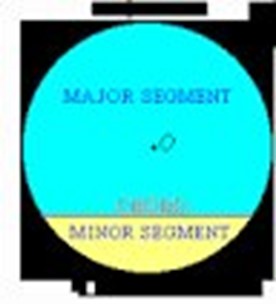
An arc is any part of the circumference of a circle. There are two types of arcs: the major arc, which is the larger part of the circumference between two points, and the minor arc, which is the smaller part between the same two points, as shown below.

Chord
A chord is a straight line joining any two points on the circumference of a circle. A chord divides the circle into two regions called segments: the larger region is the major segment, and the smaller region is the minor segment.
Angle at the Centre and Angle on the Circumference
The angle subtended by a chord at the centre of the circle is twice the angle subtended by the same chord at any point on the circumference.


Angle in the Same Segment
Angles subtended on the circumference by the same arc and lying in the same segment are equal. Additionally, equal arcs subtend equal angles at the circumference.

Cyclic Quadrilaterals
A cyclic quadrilateral is a four-sided figure whose vertices all lie on the circumference of a circle.
Angle Properties of a Cyclic Quadrilateral
- The opposite angles of a cyclic quadrilateral are supplementary; that is, they add up to 180°.
- If a side of a cyclic quadrilateral is extended, the exterior angle formed is equal to the interior opposite angle.


Example
In the figure below, find the required angles:

Solution
Using the property that if a side of a quadrilateral is extended, the interior angle is equal to the opposite exterior angle, we find:
Angles formed by the diameter to the circumference are always 90°.

Summary
- The angle in a semicircle is a right angle (90°).
- The angle at the centre is twice the angle at the circumference subtended by the same arc.
- Angles in the same segment are equal.
- Opposite angles in a cyclic quadrilateral are supplementary.
Example
1. In the diagram, O is the centre of the circle and AD is parallel to BC. Given that ∠ACB = 50° and ∠ACD = 20°:
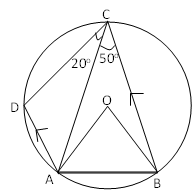
Calculate:
- ∠OAB
- ∠ADC
Solution
i) ∠AOB = 2 × ∠ACB = 2 × 50° = 100°
∠OAB = (180° – 100°) / 2 = 40° (base angles of isosceles triangle)
ii) ∠BAD = 180° – 70° = 110°
End of topic
Did you understand everything? If not, ask a teacher, friends, or anybody and make sure you understand before going to sleep! |
Past KCSE Questions on the Topic
- The figure below shows a circle with centre O and a cyclic quadrilateral ABCD. Given AC = CD, ∠ACD = 80°, and BOD is a straight line. Giving reasons for your answers, find the size of:


C
(i) Angle ACB
(ii) Angle AOD
(iii) Angle CAB
(iv) Angle ABC
(v) Angle AXB
 In the figure below, CP = CQ and ∠CQP = 160°. If ABCD is a cyclic quadrilateral, find ∠BAD.
 In the figure below, CP = CQ and ∠CQP = 160°. If ABCD is a cyclic quadrilateral, find ∠BAD.
- In the figure below, AOC is a diameter of the circle with centre O; AB = BC and ∠ACD = 25°. EBF is a tangent to the circle at B. G is a point on the minor arc CD.
 In the figure below, AOC is a diameter of the circle with centre O; AB = BC and ∠ACD = 25°. EBF is a tangent to the circle at B. G is a point on the minor arc CD.
(a) Calculate the size of:
(i) ∠BAD
(ii) The obtuse ∠BOD
(iii) ∠BGD
(b) Show that ∠ABE = ∠CBF. Give reasons.
- In the figure below, PQR is the tangent to the circle at Q. TS is a diameter and TSR and QUV are straight lines. QS is parallel to TV. Angles SQR = 40° and TQV = 55°.
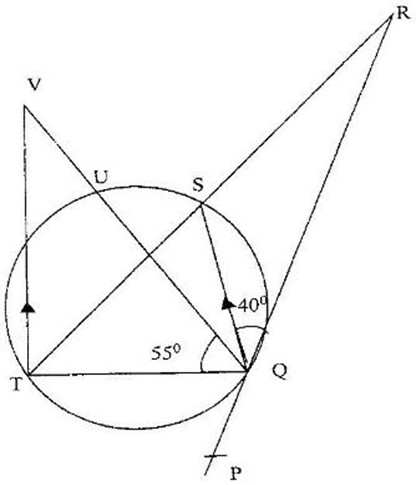 In the figure below, PQR is the tangent to the circle at Q. TS is a diameter and TSR and QUV are straight lines. QS is parallel to TV. Angles SQR = 40° and TQV = 55°.
Find the following angles, giving reasons for each answer:
- QST
- QRS
- QVT
- UTV
- In the figure below, QOT is a diameter. QTR = 48°, TQR = 76°, and SRT = 37°.
 In the figure below, QOT is a diameter. QTR = 48°, TQR = 76°, and SRT = 37°.
Calculate:
(a) ∠RST
(b) ∠SUT
(c) Obtuse ∠ROT
- In the figure below, points O and P are centres of intersecting circles ABD and BCD respectively. Line ABE is a tangent to circle BCD at B. Angle BCD = 42°.
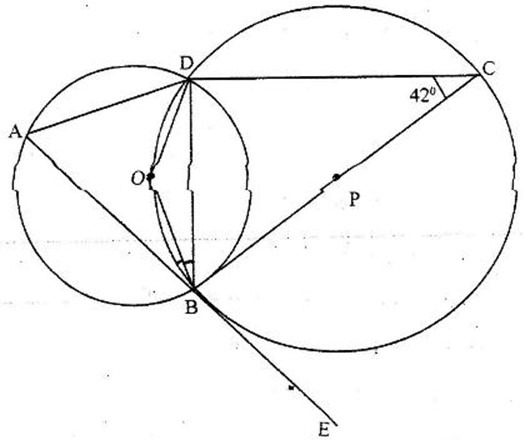
(a) Stating reasons, determine the size of:
(i) ∠CBD
(ii) Reflex ∠BOD
(b) Show that ∆ABD is isosceles.
- The diagram below shows a circle ABCDE. The line FEG is a tangent to the circle at point E. Line DE is parallel to CG, ∠DEC = 28°, and ∠AGE = 32°.
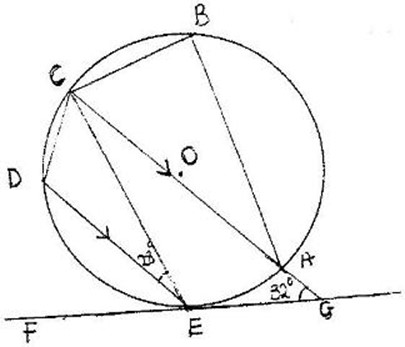
Calculate:
(a) ∠AEG
(b) ∠ABC
- In the figure below, R, T, and S are points on a circle with centre O. PQ is a tangent to the circle at T. POR is a straight line and ∠QPR = 20°.
Find the size of ∠RST.


