

Specific Objectives
By the end of the topic, the learner should be able to:
- Define and draw the unit circle;
- Use the unit circle to find trigonometric ratios in terms of coordinates of points for 0° < θ < 360°;
- Find trigonometric ratios of negative angles;
- Find trigonometric ratios of angles greater than 360° using the unit circle;
- Use mathematical tables and calculators to find trigonometric ratios of angles in the range 0° < θ < 360°;
- Define radian measure;
- Draw graphs of trigonometric functions y = sin x, y = cos x, and y = tan x using degrees and radians;
- Derive the sine rule;
- Derive the cosine rule;
- Apply the sine and cosine rule to solve triangles (sides, angles, and area);
- Apply the knowledge of sine and cosine rules in real-life situations.
Content
- The unit circle
- Trigonometric ratios from the unit circle
- Trigonometric ratios of angles greater than 360° and negative angles
- Use of trigonometric tables and calculators
- Radian measure
- Simple trigonometric graphs
- Derivation of sine and cosine rule
- Solution of triangles
- Application of sine and cosine rule to real situations
The Unit Circle
The unit circle is a circle with a radius of one unit and its center at the origin O (0, 0) on the coordinate plane.
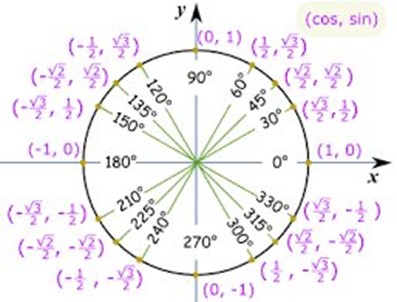
An angle measured anticlockwise from the positive direction of the x-axis is considered positive, while an angle measured clockwise from the positive direction of the x-axis is negative.

In general, on a unit circle:
- The coordinates of a point on the unit circle are (cos θ, sin θ).
- The radius is 1 unit.
- The angle θ is measured from the positive x-axis.

Trigonometric Ratios of Negative Angles
In general, the trigonometric ratios for negative angles are given by:
- sin(-θ) = -sin θ
- cos(-θ) = cos θ
- tan(-θ) = -tan θ

Use of Calculators
Example:
Use a calculator to find tan 30°.
Solution:
- Key in tan
- Key in 30
- The screen displays 0.5773502
- Therefore, tan 30° ≈ 0.5774
To find the inverse of sine, cosine, and tangent:
- Key in shift
- Then either sine, cosine, or tangent
- Key in the number
Note: Always consult the manual for your calculator because calculators work differently.
Radians
One radian is the measure of an angle subtended at the center of a circle by an arc whose length is equal to the radius of the circle.
Since the circumference of a circle is 2πr, there are 2π radians in a full circle. Degree measure and radian measure are related by the equation 360° = 2π radians, or equivalently, 180° = π radians.
The diagram below shows equivalent radian and degree measures for special angles from 0° to 360° (0 radians to 2π radians). It is helpful to memorize the equivalent degree and radian measures of special angles in the first quadrant, as all other special angles are multiples of these.

Example:
Convert 125° into radians.
Solution:
1° = π/180 radians ≈ 0.01745 radians
Therefore, 125° = 125 × π/180 = 2.182 radians (to 4 significant figures)
Example:
Convert the following degrees to radians, giving your answer in terms of π:
Solution:
Use the formula radians = degrees × π/180.
Example:
What is the length of the arc that subtends an angle of 0.6 radians at the center of a circle of radius 20 cm?
Solution:
Arc length = radius × angle = 20 × 0.6 = 12 cm.
Simple Trigonometric Graphs
Graphs of y = sin x
The graphs can be drawn by choosing suitable values of x and plotting the corresponding values of y against x.

The black portion of the graph represents one period of the function and is called one cycle of the sine curve.
Example:
Sketch the graph of y = 2 sin x on the interval [–π, 4π].
Solution:
Note that y = 2 sin x = 2(sin x) indicates that the y-values for the key points will have twice the magnitude of those on the graph of y = sin x.
| x | 0 | π/2 | π | 3π/2 | 2π |
|---|---|---|---|---|---|
| y = 2 sin x | 0 | 2 | 0 | -2 | 0 |
To get the values of y, substitute the values of x into the equation y = 2 sin x.
Note:
- You can convert radians into degrees to simplify calculations.
- By connecting these key points with a smooth curve and extending the curve in both directions over the interval [–π, 4π], you obtain the graph shown below.

Example:
Sketch the graph of y = cos x using an interval of π/6.
Solution:
The values of x and the corresponding values of y are given in the table below:
| x | 0 | π/6 | π/3 | π/2 | 2π/3 | 5π/6 | π | 7π/6 | 4π/3 | 3π/2 |
|---|---|---|---|---|---|---|---|---|---|---|
| y = cos x | 1 | 0.8660 | 0.5 | 0 | -0.5 | -0.8660 | -1 | -0.8660 | -0.5 | 0 |

Graph of Tangents
Note:
- As the value of x approaches π/2 and 3π/2, tan x becomes very large.
- Hence, the graph of y = tan x approaches the lines x = π/2 and x = 3π/2 without touching them.
- Such lines are called asymptotes.


Solution of Triangles
Sine Rule
If a circle of radius R is circumscribed around triangle ABC, then the diameter of the circle is 2R.
The sine rule applies to both acute and obtuse-angled triangles.

Example:
Solve triangle ABC, given that ∠CAB = 42°, c = 14.6 cm, and a = 11.4 cm.
Solution:
To solve a triangle means to find the sides and angles not given.
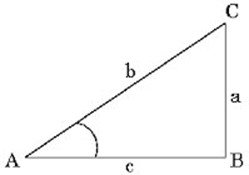
sin C = 0.8720
Therefore, C = 60.6°
Note: The sine rule is used when we know:
- Two sides and a non-included angle of a triangle;
- All sides and at least one angle;
- All angles and at least one side.
Cosine Rule

Example:
Find AC in the figure below, if AB = 4 cm, BC = 6 cm, and ∠ABC = 70°.

Solution:
Using the cosine rule:
AC² = AB² + BC² – 2(AB)(BC) cos ∠ABC
AC² = 16 + 36 – 48 × cos 70°
AC² = 52 – 48 × 0.3420 = 52 – 16.416 = 35.584
AC = √35.584 ≈ 5.97 cm
Note: The cosine rule is used when we know:
- Two sides and an included angle;
- All three sides of a triangle.
End of topic
Did you understand everything? If not, ask a teacher, friends, or anybody and make sure you understand before going to sleep! |
Past KCSE Questions on the Topic
- Solve the equation sin 5θ = -1 for 0° ≤ θ ≤ 180°.
- Given that sin θ = 2/3 and θ is an acute angle, find:
- tan θ giving your answer in surd form;
- sec² θ.
- Solve the equation 2 sin²(x – 30°) = cos 60° for –180° ≤ x ≤ 180°.
- Given that sin(x + 30°) = cos 2x for 0° ≤ x ≤ 90°, find the value of x. Hence find the value of cos² 3x.
- Given that sin a = 1/√5 where a is an acute angle, find without using mathematical tables:
- cos a in the form a√b, where a and b are rational numbers;
- tan (90° – a).
- Given that x° is an angle in the first quadrant such that 8 sin² x + 2 cos x – 5 = 0, find:
- cos x;
- tan x.
- Given that cos 2x = 0.8070, find x when 0° ≤ x ≤ 360°.
- The figure below shows a quadrilateral ABCD in which AB = 8 cm, DC = 12 cm, ∠BAD = 45°, ∠CBD = 90°, and ∠BCD = 30°.
Find:
- The length of BD;
- The size of the angle ADB.
- The diagram below represents a school gate with double shutters. The shutters are opened through an angle of 63°. The edges of the gate, PQ and RS, are each 1.8 m.
Calculate the shortest distance QS, correct to 4 significant figures.
- The figure below represents a quadrilateral piece of land ABCD divided into three triangular plots. The lengths BE and CD are 100 m and 80 m respectively. Angle ABE = 30°, ∠ACE = 45°, and ∠ACD = 100°.
- Find to four significant figures:
- The length of AE;
- The length of AD;
- The perimeter of the piece of land.
- The plots are to be fenced with five strands of barbed wire leaving an entrance of 2.8 m wide to each plot. The type of barbed wire to be used is sold in rolls of length 480 m. Calculate the number of rolls of barbed wire that must be bought to complete the fencing of the plots.
- Find to four significant figures:
- Given that x is an acute angle and cos x = 2/√5, find without using mathematical tables or a calculator, tan (90° – x).
- In the figure below, ∠A = 62°, ∠B = 41°, BC = 8.4 cm, and CN is the bisector of ∠ACB.
Calculate the length of CN to 1 decimal place.
- In the diagram below, PA represents an electricity post of height 9.6 m. BB and RC represent two-storey buildings of heights 15.4 m and 33.4 m respectively. The angle of depression of A from B is 5.5°, while the angle of elevation of C from B is 30.5°, and BC = 35 m.
- Calculate, to the nearest metre, the distance AB;
- By scale drawing find:
- The distance AC in metres;
- ∠BCA and hence determine the angle of depression of A from C.
More Questions
- Solve the equation:
 for .
for . (a) Complete the table below, leaving all your values correct to 2 decimal places for the functions y = cos x and y = 2 cos (x + 30°).
X° 0° 60° 120° 180° 240° 300° 360° 420° 480° 540° cos X 1.00 -1.00 0.50 2 cos (x + 30) 1.73 -1.73 0.00 (b) For the function y = 2 cos (x + 30°), state:
- The period;
- The phase angle.
(c) On the same axes, draw the waves of the functions y = cos x and y = 2 cos (x + 30°) for
. Use the scale 1 cm represents 30° horizontally and 2 cm represents 1 unit vertically.(d) Use your graph above to solve the inequality
.- Find the value of x in the equation cos(3x – 180°) = √3/2 in the range 0° < x < 180°.
- Given that and θ is an acute angle, find without using tables cos (90° – θ).
- Solve for θ if -¼ sin (2x + 30) = 0.1607, 0° ≤ θ ≤ 360°.
- Given that cos q = 5/13 and that 270° ≤ q ≤ 360°, work out the value of tan q + sin q without using a calculator or mathematical tables.
- Solve for x in the range 0° ≤ x ≤ 180°: -8 sin² x – 2 cos x = -5.
- If tan x = 12/5 and x is a reflex angle, find the value of 5 sin x + cos x without using a calculator or mathematical tables.
- Find q given that 2 cos 3q – 1 = 0 for 0° ≤ q ≤ 360°.
- Without a mathematical table or a calculator, simplify: cos 300° × sin 120° giving your answer in rationalized surd form.
- Express in surd form and rationalize the denominator:
(sin 60° × sin 45°) – sin 45° - Simplify the following without using tables: tan 45° + cos 45° sin 60°.
 for
for  .
. . Use the scale 1 cm represents 30° horizontally and 2 cm represents 1 unit vertically.
 .
. and θ is an acute angle, find without using tables cos (90° – θ).


