

Specific Objectives
By the end of this topic, the learner should be able to:
- Define vector and scalar quantities.
- Use vector notation correctly.
- Represent vectors both individually and combined, using geometric methods.
- Identify equivalent vectors.
- Add vectors accurately.
- Multiply vectors by scalars.
- Define position vectors and column vectors.
- Calculate the magnitude of a vector.
- Find the midpoint of a vector.
- Define translation as a geometric transformation.
Content
- Vector and scalar quantities
- Vector notation
- Representation of vectors
- Equivalent vectors
- Addition of vectors
- Multiplication of a vector by a scalar
- Column vectors
- Position vectors
- Magnitude of a vector
- Midpoint of a vector
- Translation vector
Introduction
A vector is a quantity that has both magnitude and direction. Examples include acceleration, velocity, and force. In contrast, a scalar quantity has only magnitude without direction, such as mass, temperature, and time.
Representation of Vectors
A vector can be represented by a directed line segment as shown below:
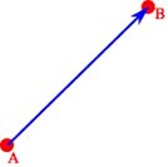
The arrow indicates the direction of the vector.
The magnitude of the vector is the length of segment AB.
The vector from point A to point B is denoted as AB.
The magnitude is represented by |AB|.
Point A is the initial point, and point B is the terminal point.
Equivalent Vectors
Two or more vectors are said to be equivalent if they have:
- Equal magnitude
- The same direction

Addition of Vectors
Movement along a straight line from point A to B can be represented by a vector. This movement is called displacement.
Consider the displacement from A to B followed by B to C.
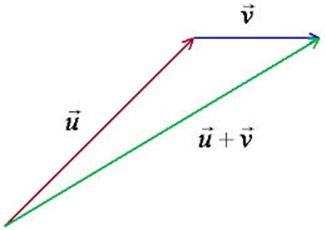
The resulting displacement is written as AC = AB + BC.
Zero Vector
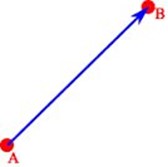
Consider a displacement from A to B and then back to A. The total displacement is zero, denoted by 0.
This vector is called the zero or null vector.
AB + BA = 0
If a + b = 0, then b = -a or a = -b.
Multiplication of a Vector by a Scalar
Positive Scalar
If AB = BC = CD = a,
A______B______C______D>
Then AD = a + a + a = 3a
Negative Scalar
Subtraction of one vector from another is performed by adding the corresponding negative vector. That is, if we seek a − b, we form a + (−b).
DA = (-a) + (-a) + (-a) = -3a
Zero Scalar
When vector a is multiplied by 0, its magnitude becomes zero times that of a. The result is the zero vector.
a·0 = 0·a = 0
Multiplying a Vector by a Scalar
If k is any positive scalar and a is a vector, then ka is a vector in the same direction as a but k times longer. If k is negative, ka is a vector in the opposite direction to a and k times longer.
More Illustrations
A vector is represented by a directed line segment, which is a segment with an arrow at one end indicating the direction of movement. Unlike a ray, a directed line segment has a specific length. The direction is indicated by an arrow pointing from the tail (the initial point) to the head (the terminal point). If the tail is at point A and the head is at point B, the vector from A to B is written as: |
|


The length (magnitude) of a vector v is written as |v|. Length is always a non-negative real number. As shown in the diagram on the right, the length of a vector can be found by forming a right triangle and applying the Pythagorean Theorem or by using the Distance Formula. The vector at the right translates 6 units to the right and 4 units upward. The magnitude of the vector is
|
|
 calculated using the Pythagorean Theorem or the Distance Formula:
 |
|
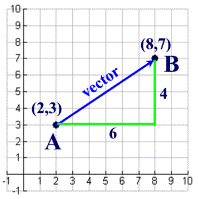
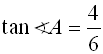
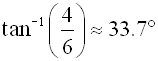
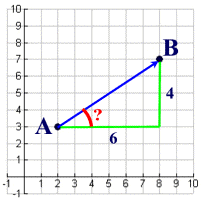
The direction of a vector is determined by the angle it makes with a horizontal line. In the diagram on the right, to find the direction of the vector (in degrees), we use trigonometry. The tangent of the angle formed by the vector and the horizontal line (drawn parallel to the x-axis) is 4/6 (opposite/adjacent).
|
|
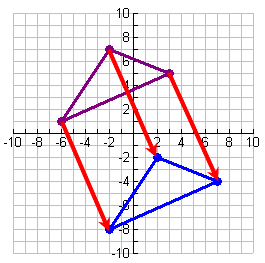
A free vector is an infinite set of parallel directed line segments and can be thought of as a translation. Notice that the vectors in this translation, which connect the pre-image vertices to the image vertices, are all parallel and have the same length. You may also hear the terms “displacement vector” or “translation vector” when working with translations. | |
Position Vector: Unlike a free vector, a position vector is “tied” or “fixed” to the origin. A position vector describes the spatial position of a point relative to the origin. Translation Vector A translation vector moves every point of an object by the same amount in the given vector direction. It can be defined as the addition of a constant vector to every point.
Example: The points A (-4, 4), B (-2, 3), C (-4, 1), and D (-5, 3) are vertices of a quadrilateral. If the quadrilateral is given the translation T defined by the vector… |
 or
or 
Summary on Vectors
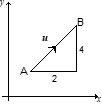
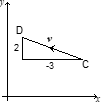
Components of a Vector in 2 Dimensions: To get from point A to point B, you would move:
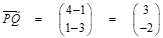
The components of the vector are these moves expressed as a column vector. Thus, the vector can be written as |
A 2-dimensional column vector is of the form Similarly: |
Magnitude of a Vector in 2 Dimensions: We write the magnitude of u as |u|.
The magnitude of a vector is the length of the directed line segment representing it. Use Pythagoras’ Theorem to calculate the length of the vector. | The magnitude of vector u is |u| (the length of PQ).
and so |
Examples:
| Solutions: 1. 2. Q is (2 + 4, 1 + 3) → Q(6, 4)
3. |
Vector: A quantity which has both magnitude and direction. Scalar: A quantity which has magnitude only. | Examples: Displacement, force, velocity, acceleration. Examples: Temperature, work, width, height, length, time of day. |
 or
or 

 or
or 
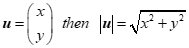
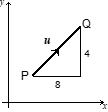 The length of PQ is written as
 then
then 



 and P is (2, 1), find coordinates of Q.

Did you understand everything? If not, ask a teacher, friends, or anybody and make sure you understand before going to sleep! |
Past KCSE Questions on the Topic
1. Given that  and
and 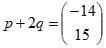 , find:
(i)
 (3 marks)
- || (3 marks)
- |
- Show that points A (1, -1), B (3, 5), and C (5, 11) are collinear (4 marks)
 (3 marks)
 | (3 marks)
2. Given the column vectors 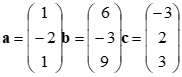 and that
 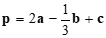 ,
,
- (i) Express p as a column vector (2 marks)
- (ii) Determine the magnitude of p (1 mark)
3. Given the points P(-6, -3), Q(-2, -1), and R(6, 3), express PQ and QR as column vectors. Hence show that points P, Q, and R are collinear. (3 marks)
4. The position vectors of points x and y are  and
and  respectively. Find xy as a column vector (2 marks)
5. Given that  (3 marks)


6. The position vectors of A and B are 2 and 8 respectively. Find the coordinates of M which divides AB in the ratio 1:2. (3 marks)
7. The diagram shows the graph of vectors  and
and  .
.
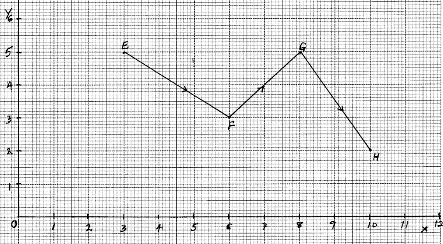
Find the column vectors;
(a)  (1 mark)
(b) | | (2 marks)
8.  . Find
  (2 marks)
9. Find scalars m and n such that


m 4 + n -3 = 5
3 2 8
10. Given that p = 2i – j + k and q = i + j + 2k, determine
(a) │p + q│ (1 mark)
(b) │½ p – 2q │ (2 marks)


MATHEMATICS (121)
PAPER TWO
ALTERNATIVE A
Introduction
- Questions in this paper will mainly test topics from Form 3 and 4. However, knowledge and skills acquired in Form 1 and Form 2 will also be required.
- The time allocated for this paper is 2½ hours.
- The paper consists of a total of 100 marks.
- The paper is divided into two sections: Section I and Section II.
Section I
This section carries 50 marks and contains sixteen (16) compulsory short-answer questions.
Section II
This section carries 50 marks and offers a choice of eight (8) open-ended questions, from which candidates must answer any five (5). Students should note that any attempted questions in this section will be marked unless cancelled.


