


Specific Objectives
By the end of this topic, the learner should be able to:
- a) Rewrite a given formula by changing its subject.
- b) Define direct, inverse, partial, and joint variations.
- c) Determine constants of proportionality.
- d) Form and solve equations involving variations.
- e) Draw graphs to illustrate direct and inverse proportions.
- f) Use variations to solve real-life problems.
Content
- Change of the subject of a formula
- Direct, inverse, partial, and joint variation
- Constants of proportionality
- Equations involving variations
- Graphs of direct and inverse proportion
- Formation of equations on variations based on real-life situations
Formulae
A formula is an expression or equation that expresses the relationship between certain quantities.
For example, the formula to find the area of a circle of radius r units is:
From this formula, we understand the relationship between the radius and the area of a circle. The area of a circle varies directly as the square of its radius. Here is the constant of variation.
Changing the Subject of a Formula
Terminology
In the formula C = d,
Subject: C – What you are trying to find.
Rule: multiply by diameter.
The variable on the left is known as the subject: what you are trying to find.
The formula on the right is the rule, which tells you how to calculate the subject.
If you want a formula or rule that lets you calculate d, you need to make d the subject of the formula.
This means changing the subject of the formula from C to d.
In the case above where C = d,
We get C by multiplying by the diameter.
To calculate d, we need to divide the circumference C by the appropriate value.
So d is now the subject of the formula.
Method
A formula is simply an equation that you cannot solve until you replace the letters with their values (numbers). It is known as a literal equation.
To change the subject, apply the same rules as for normal equations:
- Add the same variable to both sides.
- Subtract the same variable from both sides.
- Multiply both sides by the same variable.
- Divide both sides by the same variable.
- Square both sides.
- Take the square root of both sides.
Examples
Make the letter in brackets the subject of the formula:
x + p = q [x]
(subtract p from both sides)
x = q – p
y − r = s [y]
(add r to both sides)
y = s + r
P = RS [R]
(divide both sides by S)
R = P / S
A = LB [A]
(multiply both sides by B)
A = LB
2w + 3 = y [w]
(subtract 3 from both sides)
2w = y − 3
(divide both sides by 2)
w = (y − 3) / 2
P = Q [Q]
(multiply both sides by 3 to get rid of fraction)
3P = Q
T = k [k]
(multiply both sides by 5 to get rid of fraction)
5T = 2k
(divide both sides by 2)
k = (5T) / 2
A = r [r]
(divide both sides by p)
(take the square root of both sides)
L = h − t [h]
(multiply both sides by 2)
2L = h − t
(add t to both sides)
2L + t = h
Example
Make d the subject of the formula G =
Solution
Squaring both sides.
Multiply both sides by d − 1.
Expand the left-hand side (L.H.S).
Collect the terms containing d on the L.H.S.
Factorize the L.H.S.
Divide both sides by the appropriate expression.
Variation
In a formula, some elements that do not change (fixed) under any condition are called constants, while those that change are called variables. There are different types of variations.
- Direct Variation: both variables increase or decrease together.
- Inverse or Indirect Variation: when one variable increases, the other decreases.
- Joint Variation: more than two variables are related directly.
- Combined Variation: involves a combination of direct or joint variation and indirect variation.
Examples
- Direct: The number of money I make varies directly (or proportionally) with how much I work.
- Direct: The length of the side of a square varies directly with the perimeter of the square.
- Inverse: The number of people I invite to my bowling party varies inversely with the number of games they might get to play (or is proportional to the inverse of).
- Inverse: The temperature in my house varies indirectly (same as inversely) with the amount of time the air conditioning is running.
- Inverse: My school marks may vary inversely with the number of hours I watch TV.
Direct or Proportional Variation
When two variables are related directly, the ratio of their values is always the same. So as one increases, so does the other, and if one decreases, so does the other. Think of linear direct variation as a “y = mx” line, where the ratio of y to x is the slope (m). With direct variation, the y-intercept is always 0; this is how it is defined.
Direct variation problems are typically written as:
→ y = kx where k is the ratio of y to x (the slope or rate).
Some problems ask for the k value (called the constant of variation or constant of proportionality); others give 3 out of 4 values for x and y, allowing you to set up a ratio to find the missing value.
Remember the example of making Ksh 1000 per week (y = 10x)? This is an example of direct variation, since the ratio of how much you make to how many hours you work is always constant.
Direct Variation Word Problem
The amount of money raised at a school fundraiser is directly proportional to the number of people who attend. Last year, the amount raised for 100 attendees was $2500. How much money will be raised if 1000 people attend this year?
Solution:
Let’s solve this problem using both the Formula Method and the Proportion Method:
Formula method Explanation

Proportional method Explanation

Direct Square Variation Word Problem
A Direct Square Variation occurs when y is proportional to the square of x, or  .
.
Example:
If y varies directly with the square of x, and y = 4 when x = 3, what is y when x = 2?
Solution:
Let’s solve this using the formula method and the proportion method:
Formula method notes

Proportional method notes

Example
The length (l) cm of a wire varies directly as the temperature t. The length of the wire is 5 cm when the temperature is 65. Calculate the length of the wire when the temperature is 69.
Solution
l = kt
Substituting l = 5 when t = 65:
5 = k × 65
k = 5 / 65
Therefore, l = (5 / 65) × t
When t = 69:
l = (5 / 65) × 69
Direct Variation Graph

Inverse or Indirect Variation
Inverse or Indirect Variation refers to relationships where two variables move in opposite directions. For example, consider how your driving speed affects the time it takes to get to work. The faster you drive, the earlier you arrive. So as speed increases, time decreases, and vice versa.
The formula for inverse or indirect variation is:
→ y = k / x or k = xy, where k is a constant.
(Note that there can also be an Indirect Square Variation or Inverse Square Variation, such as y = k / x² or k = xy².)
Inverse Variation Word Problem
Consider this problem:
The value of y varies inversely with x, and y = 4 when x = 3. Find x when y = 6.
This can also be written as:
Let x = 3, y = 4, and y = 6. Let y vary inversely as x. Find x.
Solution
We can solve this problem in two ways, as shown. These methods are used when three of the four values for x and y are given.

Product Rule Method

Inverse Variation Word Problem
For the club, the number of tickets Moyo can buy is inversely proportional to the price of the tickets. She can afford 15 tickets that cost $5 each. How many tickets can she buy if each costs $3?
Solution
Let’s use the product method:

Example
If 16 women working 7 hours a day can paint a mural in 48 days, how many days will it take 14 women working 12 hours a day to paint the same mural?
Solution
The three different values are inversely proportional; for example, the more women you have, the fewer days it takes to paint the mural, and the more hours in a day the women paint, the fewer days they need to complete the mural:

Joint Variation and Combined Variation
Joint variation is similar to direct variation but involves more than one other variable. All variables are directly proportional, taken one at a time. Consider this joint variation problem:
Suppose x varies jointly with y and the square root of z. When x = –18 and y = 2, then z = 9. Find y when x = 10 and z = 4.

Combined variation involves a combination of direct or joint variation and indirect variation. These equations can be more complex, so it is often easier to plug in all variables, solve for k, and then solve for the unknown. Here is an example problem you may encounter:
(a) y varies jointly as x and w and inversely as the square of z. Find the equation of variation when y = 100, x = 2, w = 4, and z = 20.
(b) Then solve for y when x = 1, w = 5, and z = 4.
Solution

Example
The volume of wood in a tree (V) varies directly as the height (h) and inversely as the square of the girth (g). If the volume of a tree is 144 cubic meters when the height is 20 meters and the girth is 1.5 meters, what is the height of a tree with a volume of 1000 and girth of 2 meters?
Solution

Example
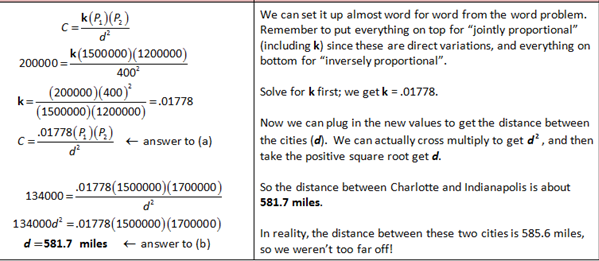
The average number of phone calls per day between two cities has been found to be jointly proportional to the populations of the cities and inversely proportional to the square of the distance between the two cities. The population of Charlotte is about 1,500,000 and the population of Nashville is about 1,200,000, and the distance between the two cities is about 400 miles. The average number of calls between the cities is about 200,000.
(a) Find k and write the equation of variation.
(b) The average number of daily phone calls between Charlotte and Indianapolis (which has a population of about 1,700,000) is about 134,000. Find the distance between the two cities.
Solution
It may be easier to take it one step at a time:
Example
A varies directly as B and inversely as the square root of C. Find the percentage change in A when B is decreased by 10% and C increased by 21%.
Solution
A = K (B / √C)
A change in B and C causes a change in A.
Substituting values:
Percentage change in A =
= -18%
Therefore, A decreases by 18%.
Partial Variation
The general linear equation y = mx + c, where m and c are constants, connects two variables x and y. In such a case, we say that y is partly constant and partly varies as x.
Example
A variable y is partly constant and partly varies as x. If x = 2 when y = 7 and x = 4 when y = 11, find the equation connecting y and x.
Solution
The required equation is y = kx + c where k and c are constants.
Substituting x = 2, y = 7 and x = 4, y = 11 in the equation gives:
7 = 2k + c …………………..(1)
11 = 4k + c …………………(2)
Subtracting equation (1) from equation (2):
4 = 2k
Therefore, k = 2
Substituting k = 2 in equation (1):
c = 7 – 4
c = 3
Therefore, the required equation is y = 2x + 3.
End of topic.
Did you understand everything? If not, ask a teacher, friends, or anybody and make sure you understand before going to sleep! |
Past KCSE Questions on the Topic
- The volume V cm3 of an object is given by:
- Make V the subject of the formula:
- Given that y = b – bx2, make x the subject:
- Given that log y = log (10n), make n the subject.
- A quantity T is partly constant and partly varies as the square root of S.

V = 2 π r3 (1 – 2/3) sc2
Express in terms of π, r, s, and V.
T = (1/2) m (u2 – v2)
cx2 – a
- Using constants a and b, write down an equation connecting T and S.
- If S = 16 when T = 24 and S = 36 when T = 32, find the values of the constants a and b.
p = xy / (x – y)
P2 = (P – q)(P – r)
When the mass of the ball is 500 g and the radius is 5 cm, its density is 2 g/cm3.
Calculate the radius of a solid spherical ball of mass 540 g and density 10 g/cm3.

√P = r (1 – as2)
- Write down a formula connecting y, x, n, and k.
- If x = 2 when y = 12 and x = 4 when y = 3, write down two expressions for k in terms of n. Hence, find the value of n and k.
- Using the value of n obtained in (a)(ii) above, find y when x = 51/3.
When r = 1, the volume is 54.6 cm3 and when r = 2, the volume is 226.8 cm3.
- Find an expression for V in terms of r.
- Calculate the volume of the solid when r = 4.
- Find the value of r for which the two parts of the volume are equal.
P = xy / (z + x)
- Write an expression for c in terms of N.
- When 100 people attended, the charge is Kshs 8700 per person while for 35 people the charge is Kshs 10000 per person.
- If a person had paid the full amount, the charge is refunded. A group of people paid but ten percent of the organizer remained with Kshs 574000. Find the number of people.
A = −EP / √(P2 + N)


