


Specific Objectives
By the end of this topic, the learner should be able to:
- Factorize quadratic expressions;
- Identify perfect squares;
- Complete the square;
- Solve quadratic equations by completing the square;
- Derive the quadratic formula;
- Solve quadratic equations using the formula;
- Form and solve quadratic equations from roots and given situations;
- Make tables of values from a quadratic relation;
- Draw the graph of a quadratic relation;
- Solve quadratic equations using graphs;
- Solve simultaneous equations (one linear and one quadratic) analytically and graphically;
- Apply the knowledge of quadratic equations to real-life situations.
Content
- Factorization of quadratic expressions
- Perfect squares
- Completion of the square
- Solution of quadratic equations by completing the square
- Quadratic formula x = -b ±
- Solution of quadratic equations using the formula
- Formation of quadratic equations and solving them
- Tables of values for a given quadratic relation
- Graphs of quadratic equations
- Simultaneous equations – one linear and one quadratic
- Application of quadratic equations to real-life situations
Perfect Square
Expressions that can be factorized into two equal factors are called perfect squares. These expressions have a special form and are useful in simplifying quadratic expressions and solving quadratic equations.
Completing the Square
Any quadratic expression can be simplified and written in the form ax2 + bx + c, where a, b, and c are constants and a ≠ 0. We use this expression to create a perfect square, which helps in solving quadratic equations.
We first consider expressions where the coefficient of x2 is 1.
Example
What must be added to x2 + 10x to make it a perfect square?
Solution
- Let the number to be added be a constant c.
- Then x2 + 10x + c is a perfect square.
- Using the formula (b/2)2 = c, where b = 10, we get c = (10/2)2 = 25.
- Therefore, 25 must be added.
Example
What must be added to x2 + bx + 36 to make it a perfect square?
Solution
- Let the term to be added be bx, where b is a constant.
- Then x2 + bx + 36 is a perfect square.
- Using b = ±12, since (±6)2 = 36.
Now, consider cases where the coefficient of x2 is not 1.
In such cases, we use the expression involving a and c to make perfect squares where a ≠ 1 and a ≠ 0.
Example
What must be added to ax2 + bx + 9 to make it a perfect square?
Solution
- Let the term to be added be bx.
- Then, ax2 + bx + 9 is a perfect square.
- The term to be added is determined accordingly.
Example
What must be added to ax2 – 40x + 25 to make it a perfect square?
Solution
- Let the term to be added be a constant a.
- Then, ax2 – 40x + 25 is a perfect square.
Solutions of Quadratic Equations by Completing the Square Method
Example
Solve x2 + 5x + 1 = 0 by completing the square.
Solution
x2 + 5x + 1 = 0 (Original equation)
x2 + 5x = -1 (Rearranged)
Add (5/2)2 = 6.25 to both sides:
x2 + 5x + 6.25 = -1 + 6.25
(x + 2.5)2 = 5.25 (Left side factorized)
Take square roots of both sides:
x + 2.5 = ±√5.25
Solve for x:
x = -2.5 ± 2.291
Therefore, x ≈ -0.209 or -4.791
This equation cannot be solved by simple factorization.
Example
Solve x2 + 4x + 1 = 0 by completing the square.
Solution
x2 + 4x = -1 (Rearranged)
Add (4/2)2 = 4 to both sides:
x2 + 4x + 4 = -1 + 4
(x + 2)2 = 3
Take square roots:
x + 2 = ±√3
Solve for x:
x = -2 ± √3
The Quadratic Formula
Example
Using the quadratic formula, solve 2x2 – 5x – 5 = 0.
Solution
Comparing this equation to the general form ax2 + bx + c = 0, we get: a = 2, b = -5, c = -5.
Substituting into the quadratic formula:
Calculations lead to:
x = 3 or x = -(frac{5}{2})
Formation of Quadratic Equations
Peter travels to his uncle’s home, 30 km away from his place. He cycles for two-thirds of the journey before his bicycle develops mechanical problems, and he has to push it for the rest of the journey. If his cycling speed is 10 km/h faster than his walking speed and he completes the journey in 3 hours 30 minutes, determine his cycling speed.
Solution
Let Peter’s cycling speed be x km/h, then his walking speed is (x – 10) km/h.
Distance cycled = (2/3) × 30 = 20 km
Distance walked = 30 – 20 = 10 km
Time taken cycling = 20 / x
Time taken walking = 10 / (x – 10)
Total time = 3.5 hours
Therefore,
(frac{20}{x} + frac{10}{x – 10} = 3.5)
Multiplying both sides by (x(x – 10)):
20(x – 10) + 10x = 3.5x(x – 10)
20x – 200 + 10x = 3.5x^2 – 35x
30x – 200 = 3.5x^2 – 35x
Rearranged:
3.5x^2 – 65x + 200 = 0
Dividing through by 0.5:
7x^2 – 130x + 400 = 0
Solving this quadratic gives the realistic cycling speed as 15 km/h.
Example
A positive two-digit number has digits whose product is 24. When the digits are reversed, the new number is greater than the original by 18. Find the number.
Solution
Let the ones digit be y and the tens digit be x.
Then, xy = 24.
The reversed number is 10y + x.
Given:
(10y + x) – (10x + y) = 18
9y – 9x = 18
Dividing both sides by 9:
y – x = 2
Substituting into the product equation:
x(x + 2) = 24
x2 + 2x – 24 = 0
Solving this quadratic gives x = 4 (positive root).
Therefore, y = 4 + 2 = 6.
The number is 46.
Graphs of Quadratic Functions
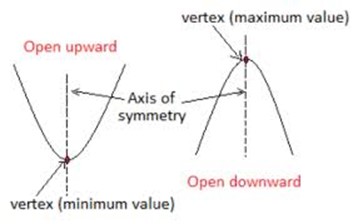
A quadratic function has the form y = ax2 + bx + c, where a ≠ 0. The graph of a quadratic function is U-shaped and is called a parabola. For example, the graphs of y = x2 and y = –x2 are shown below. The origin (0, 0) is the lowest point on the graph of y = x2 and the highest point on the graph of y = –x2. The lowest or highest point on the graph of a quadratic function is called the vertex.
The graphs of y = x2 and y = –x2 are symmetric about the y-axis, called the axis of symmetry. In general, the axis of symmetry for the graph of a quadratic function is the vertical line through the vertex.
Note: The graph of y = x2 opens upwards, and the graph of y = –x2 opens downwards.
Example
Draw the graph of y = -2x2 + 3.
Solution
Make a table showing corresponding values of x and y.
| X | -1 | 0 | 1 | 2 | 3 |
|---|---|---|---|---|---|
| Y | -8 | -1 | 2 | 1 | -4 |
Note: To get the values, substitute the value of x into the equation to find the corresponding value of y.
For example:
y = -2(-1)2 + 3 = -2(1) + 3 = 1
y = -2(0)2 + 3 = 3

Example
Draw the graph of y = -2x2 + 3x – 4.
| x | 0 | 1 | 2 | 3 | 5 | 7 |
|---|---|---|---|---|---|---|
| y | 2 | -4 | -8 | -10 | -8 | 2 |

Graphical Solutions of Simultaneous Equations
Consider simultaneous equations where one is linear and the other is quadratic.
Example
Solve the following simultaneous equations graphically:
Solution
Corresponding values of x and y for the quadratic equation:
| x | -2 | -1 | 0 | 1 | 2 | 3 | 4 |
|---|---|---|---|---|---|---|---|
| y | 9 | 4 | 1 | 0 | 1 | 4 | 9 |
Using this table, draw the graph of the quadratic equation. On the same axes, draw the line y = 5 – 2x. The points where the line and the curve intersect give the solutions. The points are (-2, 9) and (2, 1). Therefore, when x = -2, y = 9, and when x = 2, y = 1.
End of topic
Did you understand everything? If not, ask a teacher, friends, or anybody and make sure you understand before going to sleep! |
Past KCSE Questions on the Topic
The table shows the height in metres of an object thrown vertically upwards varying with time t seconds.
The relationship between s and t is represented by the equation s = at2 + bt + 10, where a and b are constants.
t 0 1 2 3 4 5 6 7 8 9 10 s 45.1 (i) Using the information in the table, determine the values of a and b. (2 marks)
(ii) Complete the table. (1 mark)
(b)(i) Draw a graph to represent the relationship between s and t. (3 marks)
(ii) Using the graph, determine the velocity of the object when t = 5 seconds.
(a) Construct a table of values for the function y = x2 – x – 6 for -3 ≤ x ≤ 4.
(b) On graph paper, draw the graph of the function y = x2 – x – 6 for -3 ≤ x ≤ 4.
(c) By drawing a suitable line on the same grid, estimate the roots of the equation x2 + 2x – 2 = 0.
(a) Draw the graph of y = 6 + x – x2, taking integral values of x in -4 ≤ x ≤ 5. (The grid is provided.) Using the same axes, draw the graph of y = 2 – 2x.
(b) From your graphs, find the values of x which satisfy the simultaneous equations y = 6 + x – x2 and y = 2 – 2x.
(c) Write down and simplify a quadratic equation which is satisfied by the values of x where the two graphs intersect.
(a) Complete the following table for the equation y = x3 – 5x2 + 2x + 9.
x -2 -1.5 -1 0 1 2 3 4 5 x2 -3.4 -1 0 1 27 64 125 -5x2 -20 -11.3 -5 0 -1 -20 -45 2x -4 -3 0 2 4 6 8 10 9 9 9 9 9 9 9 9 9 99 y -8.7 -3 9 7 (b) On the grid provided, draw the graph of y = x3 – 5x2 + 2x + 9 for -2 ≤ x ≤ 5.
(c) Using the graph, estimate the root of the equation x3 – 5x2 + 2 + 9 = 0 between x = 2 and x = 3.
(d) Using the same axes, draw the graph of y = 4 – 4x and estimate a solution to the equation x2 – 5x2 + 6x + 5 = 0.
(a) Complete the table below for the function y = 2x2 + 4x – 3.
x -4 -3 -2 -1 0 1 2 2x2 32 8 2 0 2 4x – 3 -11 -3 5 y -3 3 13 (b) On the grid provided, draw the graph of the function y = 2x2 + 4x – 3 for -4 ≤ x ≤ 2 and use the graph to estimate the roots of the equation 2x2 + 4x – 3 = 0 to 1 decimal place. (2 marks)
(c) To solve graphically the equation 2x2 + x – 5 = 0, a straight line must be drawn to intersect the curve y = 2x2 + 4x – 3. Determine the equation of this straight line, draw it, and hence obtain the roots.
(a) (i) Complete the table below for the function y = x3 + x2 – 2x. (2 marks)
x -3 -2.5 -2 -1.5 -1 -0.5 0 0.5 1 2 2.5 x3 15.63 -0.13 1 x2 4 0.25 6.25 -2x 1 -2 y 1.87 0.63 16.88 (ii) On the grid provided, draw the graph of y = x3 + x2 – 2x for the values of x in the interval –3 ≤ x ≤ 2.5.
(iii) State the range of negative values of x for which y is also negative.
(b) Find the coordinates of two points on the curve other than (0, 0) at which the x-coordinate and y-coordinate are equal.
The table shows some corresponding values of x and y for the curve represented by Y = ¼ x3 – 2.
X -3 -2 -1 0 1 2 3 Y -8.8 -4 -2.3 -2 -1.8 0 4.8 On the grid provided below, draw the graph of y = ¼ x3 – 2 for -3 ≤ x ≤ 3. Use the graph to estimate the value of x when y = 2.
A retailer planned to buy some computers from a wholesaler for a total of Kshs 1,800,000. Before the retailer could buy the computers, the price per unit was reduced by Kshs 4,000. This reduction enabled the retailer to buy five more computers using the same amount of money as originally planned.
(a) Determine the number of computers the retailer bought.
(b) Two of the computers purchased got damaged while in store. The rest were sold, and the retailer made a 15% profit. Calculate the profit made by the retailer on each computer sold.
The figure below is a sketch of the graph of the quadratic function y = k(x + 1)(x – 2).

Find the value of k.
(a) Draw the graph of y = x2 – 2x + 1 for values -2 ≤ x ≤ 4.
(b) Use the graph to solve the equations x2 – 4 = 0 and the line y = 2x + 5.
(a) Draw the graph of y = x3 + x2 – 2x for -3 ≤ x ≤ 3, taking a scale of 2 cm to represent 5 units on the horizontal axis.
(b) Use the graph to solve x3 + x2 – 6x – 4 = 0 by drawing a suitable linear graph on the same axes.
Solve graphically the simultaneous equations 3x – 2y = 5 and 5x + y = 17.


1 Comment