

Specific Objectives
By the end of the topic, the learner should be able to:
- Recall and define trigonometric ratios;
- Derive the trigonometric identity sin²x + cos²x = 1;
- Draw graphs of trigonometric functions;
- Solve simple trigonometric equations analytically and graphically;
- Deduce from the graph amplitude, period, wavelength, and phase angles.
Content
- Trigonometric ratios
- Deriving the relation sin²x + cos²x = 1
- Graphs of trigonometric functions of the form:
- y = sin x, y = cos x, y = tan x
- y = a sin x, y = a cos x, y = a tan x
- y = a sin bx, y = a cos bx, y = a tan bx
- y = a sin(bx ± θ), y = a cos(bx ± θ), y = a tan(bx ± θ)
Introduction
Consider the right-angled triangle OAB.
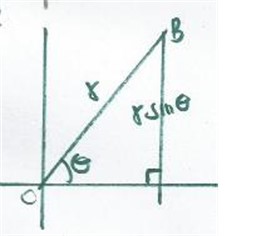
AB = r
OA = r
Since triangle OAB is right-angled, by the Pythagorean theorem, the sides satisfy the relation:
Divide both sides by r gives the normalized ratios.
Example
If tan x, show that;
Solution
Factorize the numerator and since…
But…
Therefore, … = …
Example
Show that…
Removing the brackets from the expression gives…
Using…
Also…
Therefore…
Example
Given that…
Solution using the right angle triangle below.
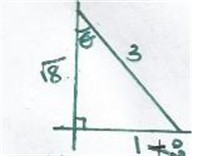
- cos θ therefore = …
- = …
- = 1
Waves
Amplitude
This is the maximum displacement of the wave above or below the x-axis. It represents the height of the wave crest or the depth of the trough from the equilibrium position.
Period
The period is the interval after which the wave repeats itself. It is the length of one complete cycle of the wave, usually measured in degrees or radians.
Transformations of waves
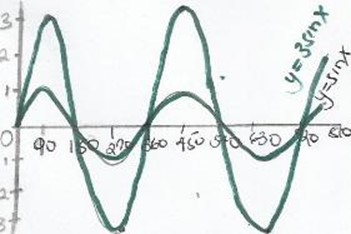
The graphs of y = sin x and y = 3 sin x can be drawn on the same axis. The table below gives the corresponding values of sin x and 3 sin x for various angles.
| 0 | 30 | 60 | 90 | 120 | 150 | 180 | 210 | 240 | 270 | 300 | 330 | 360 | |
| Sin x | 0 | 0.50 | 0.87 | 1.00 | 0.87 | 0.50 | 0 | -0.50 | -0.87 | -0.50 | -0.87 | -0.50 | 0 |
| 3 sin x | 0 | 1.50 | 2.61 | 3.00 | 2.61 | 1.50 | 0 | -1.50 | -2.61 | -1.50 | -2.61 | -1.50 | 0 |
The wave of y = 3 sin x can be obtained directly from the graph of y = sin x by applying a stretch scale factor 3, with the x-axis invariant. This means the amplitude is multiplied by 3, but the period remains unchanged.
Note:
- The amplitude of y = 3 sin x is 3, which is three times that of y = sin x, which is 1.
- The period of both graphs is the same, that is 360° or 2π radians.
Example
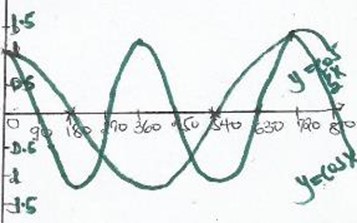
Draw the waves y = cos x and y = cos ½ x. We obtain y = cos ½ x from the graph y = cos x by applying a stretch of factor 2 with the y-axis invariant. This transformation affects the period of the wave.
Note:
- The amplitudes of the two waves are the same.
- The period of y = cos ½ x is 720°, which is twice the period of y = cos x.
Trigonometric Equations
In trigonometric equations, there are an infinite number of roots. We therefore specify the range of values for which the roots of a trigonometric equation are required to find meaningful solutions.
Example
Solve the following trigonometric equations:
- Sin 2x = cos x, for 0° ≤ x ≤ 360°
- Tan 3x = 2, for 0° ≤ x ≤ 360°
Solution
Sin 2x = cos x
Sin 2x = sin (90° – x)
Therefore 2x = 90° – x
x = 30°
For the given range, x = 30°.
Tan 3x = 2
From calculator, 3x = 63.4°
In the given range;
End of topic
Did you understand everything? If not, ask a teacher, friends, or anybody and make sure you understand before going to sleep! |
Past KCSE Questions on the topic
1. (a) Complete the table for the function y = 2 sin x
| x | 0° | 10° | 20° | 30° | 40° | 50° | 60° | 70° | 80° | 90° | 100° | 110° | 120° |
| Sin 3x | 0 | 0.5000 | -0.8660 | ||||||||||
| y | 0 | 1.00 | -1.73 |
(b) (i) Using the values in the completed table, draw the graph of y = 2 sin 3x for 0° ≤ x ≤ 120° on the grid provided.
(ii) Hence solve the equation 2 sin 3x = -1.5
2. Complete the table below by filling in the blank spaces
| X° | 0° | 30° | 60° | 90° | 120° | 150° | 180° | 210° | 240° | 270° | 300° | 330° | 360° | |
| Cos x° | 1.00 | 0.50 | -0.87 | -0.87 | ||||||||||
| 2 cos ½ x° | 2.00 | 1.93 | 0.52 | -1.00 | -2.00 |
Using the scale 1 cm to represent 30° on the horizontal axis and 4 cm to represent 1 unit on the vertical axis, draw on the grid provided the graphs of y = cos x° and y = 2 cos ½ x° on the same axis.
(a) Find the period and the amplitude of y = 2 cos ½ x°
(b) Describe the transformation that maps the graph of y = cos x° on the graph of y = 2 cos ½ x°
- (a) Complete the table below for the value of y = 2 sin x + cos x.
| X | 0° | 30° | 45° | 60° | 90° | 120° | 135° | 150° | 180° | 225° | 270° | 315° | 360° |
| 2 sin x | 0 | 1.4 | 1.7 | 2 | 1.7 | 1.4 | 1 | 0 | -2 | -1.4 | 0 | ||
| Cos x | 1 | 0.7 | 0.5 | 0 | -0.5 | -0.7 | -0.9 | -1 | 0 | 0.7 | 1 | ||
| Y | 1 | 2.1 | 2.2 | 2 | 1.2 | 0.7 | 0.1 | -1 | -2 | -0.7 | 1 |
(b) Using the grid provided, draw the graph of y = 2 sin x + cos x for 0° ≤ x ≤ 360°. Take 1 cm to represent 30° on the x-axis and 2 cm to represent 1 unit on the y-axis.
(c) Use the graph to find the range of x that satisfy the inequality 2 sin x + cos x > 0.5.
4. (a) Complete the table below, giving your values correct to 2 decimal places.
| x | 0 | 10 | 20 | 30 | 40 | 50 | 60 | 70 |
| Tan x | 0 | |||||||
| 2x + 30° | 30 | 50 | 70 | 90 | 110 | 130 | 150 | 170 |
| Sin (2x + 30°) | 0.50 | 1 |
(b) On the grid provided, draw the graphs of y = tan x and y = sin (2x + 30°) for 0° ≤ x ≤ 70°. Take scale: 2 cm for 10° on the x-axis and 4 cm for 1 unit on the y-axis. Use your graph to solve the equation tan x – sin (2x + 30°) = 0.
5. (a) Complete the table below, giving your values correct to 2 decimal places.
| X° | 0 | 30 | 60 | 90 | 120 | 150 | 180 |
| 2 sin x° | 0 | 1 | 2 | 1 | |||
| 1 – cos x° | 0.5 | 1 |
(b) On the grid provided, using the same scale and axes, draw the graphs of y = sin x° and y = 1 – cos x° for 0° ≤ x ≤ 180°. Take the scale: 2 cm for 30° on the x-axis and 2 cm for 1 unit on the y-axis.
(c) Use the graph in (b) above to:
- Determine the range of values x for which 2 sin x° > 1 – cos x°
6. (a) Given that y = 8 sin 2x – 6 cos x, complete the table below for the missing values of y, correct to 1 decimal place.
| X | 0° | 15° | 30° | 45° | 60° | 75° | 90° | 105° | 120° |
| Y = 8 sin 2x – 6 cos x | -6 | -1.8 | 3.8 | 3.9 | 2.4 | 0 | -3.9 |
(b) On the grid provided, below, draw the graph of y = 8 sin 2x – 6 cos x for 0° ≤ x ≤ 120°. Take the scale 2 cm for 15° on the x-axis and 2 cm for 2 units on the y-axis.
(c) Use the graph to estimate:
(i) The maximum value of y
(ii) The value of x for which 4 sin 2x – 3 cos x = 1
7. Solve the equation 4 sin (x + 30°) = 2 for 0 ≤ x ≤ 360°
8. Find all the positive angles not greater than 180° which satisfy the equation:
Sin² x – 2 tan x = 0
Cos x
9. Solve for values of x in the range 0° ≤ x ≤ 360° if 3 cos² x – 7 cos x = 6
10. Simplify 9 – y² where y = 3 cos θ
11. Find all the values of Ø between 0° and 360° satisfying the equation 5 sin Ø = -4
12. Given that sin (90° – x) = 0.8, where x is an acute angle, find without using mathematical tables the value of tan x°
13. Complete the table given below for the functions y = -3 cos 2x° and y = 2 sin (3x/2° + 30°) for 0 ≤ x ≤ 180°
| X° | 0° | 20° | 40° | 60° | 80° | 100° | 120° | 140° | 160° | 180° |
| -3 cos 2x° | -3.00 | -2.30 | -0.52 | 1.50 | 2.82 | 2.82 | 1.50 | -0.52 | -2.30 | -3.00 |
| 2 sin (3x° + 30°) | 1.00 | 1.73 | 2.00 | 1.73 | 1.00 | 0.00 | -1.00 | -1.73 | -2.00 | -1.73 |
Using the graph paper, draw the graphs of y = -3 cos 2x° and y = 2 sin (3x/2° + 30°).
(a) On the same axis. Take 2 cm to represent 20° on the x-axis and 2 cm to represent one unit on the y-axis.
(b) From your graphs, find the roots of 3 cos 2x° + 2 sin (3x/2° + 30°) = 0.
14. Solve the values of x in the range 0° ≤ x ≤ 360° if 3 cos² x – 7 cos x = 6.
15. Complete the table below by filling in the blank spaces.
| x° | 0° | 30° | 60° | 90° | 1° | 150° | 180° | 210° | 240° | 270° | 300° | 330° | 360° | |
| Cos x° | 1.00 | 0.50 | -0.87 | -0.87 | ||||||||||
| 2 cos ½ x° | 2.00 | 1.93 | 0.5 |
Using the scale 1 cm to represent 30° on the horizontal axis and 4 cm to represent 1 unit on the vertical axis, draw on the grid provided the graphs of y = cos x° and y = 2 cos ½ x° on the same axis.
(a) Find the period and the amplitude of y = 2 cos ½ x°
Ans. Period = 720°. Amplitude = 2
- Describe the transformation that maps the graph of y = cos x° on the graph of y = 2 cos ½ x°


