


Specific Objectives
By the end of this topic, the learner should be able to:
- Locate a point in two- and three-dimensional coordinate systems;
- Represent vectors as column and position vectors in three dimensions;
- Distinguish between column and position vectors;
- Represent vectors in terms of i, j, and k;
- Calculate the magnitude of a vector in three dimensions;
- Use the vector method in dividing a line proportionately;
- Use vector methods to show parallelism;
- Use vector methods to show collinearity;
- State and use the ratio theorem;
- Apply vector methods in geometry.
Content
- Coordinates in two and three dimensions
- Column and position vectors in three dimensions
- Column vectors in terms of unit vectors i, j, and k
- Magnitude of a vector
- Parallel vectors
- Collinearity
- Proportional division of a line
- Ratio theorem
- Vector methods in geometry
Vectors in 3 dimensions
Three-dimensional vectors can be represented on a set of three axes at right angles to each other (orthogonal), as shown in the diagram below.
Note that the z-axis is the vertical axis.
To get from point A to point B, you would move:
- 4 units in the x-direction (x-component)
- 3 units in the y-direction (y-component)
- 2 units in the z-direction (z-component)
In component form:  =
= 
 In general:
  =
= 
Column and position vectors
In three dimensions, a displacement is represented by a column vector of the form where p, q, and r are the changes in the x, y, and z directions respectively.
Example
The displacement from A (3, 1, 4) to B (7, 2, 6) is represented by the column vector,
The position vector of A, written as OA, is where O is the origin.
Addition of vectors in three dimensions is done in the same way as in two dimensions.
Example
If a = then
- 3a + 2b =
- 4a – ½ b =
Column Vectors in terms of unit Vectors
In three dimensions, the unit vector in the x-axis direction is = , that in the direction of the y-axis is , while that in the direction of the z-axis is .
Diagrammatic representation of the vectors

Three unit vectors are written as i =
Express vector in terms of the unit vectors i, j, and k.
Solution
5 = 5i – 2j + 7k
Note:
The column vector can be expressed as a i + b j + c k.
Magnitude of a 3 dimensional vector
Given the vector AB = xi + y j + 2 k, the magnitude of AB is written as |AB| =

This represents the length of the vector.
Use Pythagoras’ Theorem in 3 dimensions.
AB2 = AR2 + BR2 = (AP2 + PR2) + BR2 = 
and if u =  then the magnitude of u, |u|, equals the length of AB.
Distance formula for 3 dimensions
Recall that since:  =
=  , then if
  then
then 
Since x =

Example:
1. If A is (1, 3, 2) and B is (5, 6, 4), find 
2. If  find
find 
Solution


Parallel vectors and collinearity
Parallel vectors
Two vectors are parallel if one is a scalar multiple of the other. That is, vector a is a scalar multiple of b, i.e., a = k b, then the two vectors are parallel.
Note:
Scalar multiplication is simply multiplication of a regular number by an entry in the vector.
Multiplying by a scalar
A vector can be multiplied by a number (scalar). For example, multiplying a by 3 is written as 3a. Vector 3a has three times the length but is in the same direction as a. In column form, each component is multiplied by 3.
We can also factor out a common factor from a vector in component form. If a vector is a scalar multiple of another vector, then the two vectors are parallel and differ only in magnitude. This is a useful test to determine if lines are parallel.

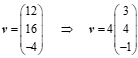 Example if

Collinear Points
Points are collinear if one straight line passes through all the points. For three points A, B, and C, if the line AB is parallel to BC, and since B is common to both lines, A, B, and C are collinear.
Test for collinearity
Example
A is (0, 1, 2), B is (1, 3, –1), and C is (3, 7, –7). Show that A, B, and C are collinear.

 are scalar multiples, so AB is parallel to BC. Since B is a common point, then A, B, and C are collinear.
In general, the test of collinearity of three points consists of two parts:
- Showing that the column vectors between any two of the points are parallel;
- Showing that they have a point in common.
Example
A (0,3), B (1,5), and C (4,11) are three given points. Show that they are collinear.
Solution
AB and BC are parallel if AB = k BC, where k is a scalar.
AB = BC =
Therefore AB // BC and point B (1,5) is common. Therefore A, B, and C are collinear.
Example
Show that the points A (1,3,5), B (4,12,20), and C are collinear.
Solution
Consider vectors AB and AC
AB =
AC =
Hence k =
AC =
Therefore AB // AC and the two vectors share a common point A. The three points are thus collinear.
Example
In the figure above, OA = a, OB = b, and OC = 3OB.

- Express AB and AC in terms of a and b;
- Given that AM = ¾ AB and AN =, express OM and ON in terms of a and b;
- Hence, show that OM and ON are collinear.
Solution
- AB = OA + OB = -a + b
AC = -a + 3b - OM = OA + AM = OA + ¾ AB = a + ¾ (-a + b) = a – b = b
ON = OA + AN = OA + AC = a + (-a + 3b) = 3b - OM = b, ON = 3b. Comparing the coefficients of a; 0 = 0. Thus, OM = ON.
Thus two vectors also share a common point O. Hence, the points are collinear.
Proportional Division of a line
In the figure below, the line is divided into 7 equal parts.

The point R lies 4/7 of the way along PQ. If we take the direction from P to Q to be positive, we say R divides PQ internally in the ratio 4 : 3.
If Q to P is taken as positive, then R divides QP internally in the ratio 3 : 4. Hence, QR : RP = 3 : 4 or 4 QR = 3 RP.
External Division
In internal division, we look at the point within a given interval, while in external division, we look at points outside a given interval.
In the figure below, point P is produced on AB.

The line AB is divided into three equal parts with BP equal to two of these parts. If the direction from A to B is taken as positive, then the direction from P to B is negative.
Thus AP : PB = 5 : -2. In this case, we say that P divides AB externally in the ratio 5 : -2 or P divides AB in the ratio 5 : -2.
Points, Ratios and Lines
Find the ratio in which a point divides a line
Example:
 The points A(2, –3, 4), B(8, 3, 1), and C(12, 7, –1) form a straight line. Find the ratio in which B divides AC.
Solution


 B divides AC in the ratio of 3 : 2.
Points dividing lines in given ratios
Example:
P divides AB in the ratio 4:3. If A is (2, 1, –3) and B is (16, 15, 11), find the coordinates of P.

Solution:

3(p – a) = 4(b – p)
3p – 3a = 4b – 4p
7p = 4b + 3a

Points dividing lines in given ratios externally
Example:
Q divides MN externally in the ratio of 3:2. M is (–3, –2, –1) and N is (0, –5, 2). Find the coordinates of Q.
Note: QN is shown as –2 because the two line segments are MQ and QN, and QN is in the opposite direction to MQ.


–2(q – m) = 3(n – q)
–2q + 2m = 3n – 3q
q = 3n – 2m
 P is P(10, 9, 5)
The Ratio Theorem
The figure below shows a point S which divides a line AB in the ratio m : n.

Taking any point O as origin, we can express s in terms of a and b, the position vectors of A and B respectively.
OS = OA + AS
But AS = (n/(m+n)) AB
Therefore, OS = OA + (n/(m+n)) (OB – OA)
Thus S = a + (n/(m+n)) (b – a)
= a – (n/(m+n)) a + (n/(m+n)) b
= (1 – (n/(m+n))) a + (n/(m+n)) b
= (m/(m+n)) a + (n/(m+n)) b
This is called the ratio theorem. The theorem states that the position vector s of a point which divides a line AB in the ratio m: n is given by the formula:
S = (m a + n b) / (m + n), where a and b are position vectors of A and B respectively. Note that the sum of the coefficients is 1.
Thus, in the above example, if the ratio m : n = 5 : 3, then m = 5 and n = 3, or
r = a + (3/8)(b – a)
Example
A point R divides a line QR externally in the ratio 7 : 3. If q and r are position vectors of points Q and R respectively, find the position vector of P in terms of q and r.

QP : PR = 7 : -3
Substituting m = 7 and n = -3 in the general formula;
OP = (7 r – 3 q) / (7 – 3)
P = (7 r – 3 q) / 4
Vectors can be used to determine the ratio in which a point divides two lines if they intersect.
Example
In the figure below, OA = a and OB = b. A point P divides OA in the ratio 3:1 and another point O divides AB in the ratio 2 : 5. If OQ meets BP at M, determine:
- OM : MQ
- BM : MP

Let OM : MQ = k : (1 – k) and BM : MP = n : (1 – n).
Using the ratio theorem:
OQ = (1 – k) OB + k OA
OM = n OP + (1 – n) OB
But OP = a
Therefore, OM = n a + (1 – n) b
Equating the two expressions:
(1 – k) b + k a = n a + (1 – n) b
Comparing the coefficients:
k = n
2 = 10 : 3
End of topic
Did you understand everything? If not, ask a teacher, friends, or anybody and make sure you understand before going to sleep! |
Past KCSE Questions on the topic
The figure below is a right pyramid with a rectangular base ABCD and VO as the height. The vectors AD= a, AB = b and DV = v.

Express
(i) AV in terms of a and c
(ii) BV in terms of a, b and c
(b) M is a point on OV such that OM: MV=3:4. Express BM in terms of a, b and c.
Simplify your answer as far as possible.
In triangle OAB, OA = a, OB = b and P lies on AB such that AP: BP = 3:5.
- Find the terms of a and b for the vectors:
- AB
- AP
- BP
- OP
- Point Q is on OP such that AQ = 8a + 40b. Find the ratio OQ: QP.
The figure below shows triangle OAB in which M divides OA in the ratio 2:3 and N divides OB in the ratio 4:1. AN and BM intersect at X.
(a) Given that OA = a and OB = b, express in terms of a and b:
(i) AN
(ii) BM
(b) If AX = s AN and BX = t BM, where s and t are constants, write two expressions for OX in terms of a, b, s and t.
Find the value of s.
Hence write OX in terms of a and b.
The position vectors for points P and Q are 4i + 3j + 6k and 6k respectively. Express vector PQ in terms of unit vectors i, j and k. Hence find the length of PQ, leaving your answer in simplified surd form.
In the figure below, vector OP = p and OR = r. Vector OS = 2r and OQ = 3/2 p.
(a) Express in terms of p and r (i) QR and (ii) PS.
(b) The lines QR and PS intersect at K such that QK = m QR and PK = n PS, where m and n are scalars. Find two distinct expressions for OK in terms of p, r, m and n. Hence find the values of m and n.
(c) State the ratio PK: KS.
Point T is the midpoint of a straight line AB. Given the position vectors of A and T are i – j + k and 2i + 1½ k respectively, find the position vector of B in terms of i, j and k.
A point R divides a line PQ internally in the ratio 3:4. Another point S divides the line PR externally in the ratio 5:2. Given that PQ = 8 cm, calculate the length of RS, correct to 2 decimal places.
The points P, Q, R and S have position vectors 2p, 3p, r and 3r respectively, relative to an origin O. A point T divides PS internally in the ratio 1:6.
(a) Find, in the simplest form, the vectors OT and QT in terms of p and r.
(b) (i) Show that the points Q, T, and R lie on a straight line.
(ii) Determine the ratio in which T divides QR.
Two points P and Q have coordinates (-2, 3) and (1, 3) respectively. A translation maps point P to P’ (10, 10).
- Find the coordinates of Q’, the image of Q under the translation.
- The position vectors of P and Q in (a) above are p and q respectively given that mp – nq = -12.
Find the value of m and n.
Given that q i + 1/3 j + 2/3 k is a unit vector, find q.
In the diagram below, the coordinates of points A and B are (1, 6) and (15, 6) respectively. Point N is on OB such that 3 ON = 2 OB. Line OA is produced to L such that OL = 3 OA.
(a) Find vector LN.
(b) Given that a point M is on LN such that LM: MN = 3:4, find the coordinates of M.
(c) If line OM is produced to T such that OM: MT = 6:1
(i) Find the position vector of T.
(ii) Show that points L, T and B are collinear.
In the figure below OQ = q and OR = r. Point X divides OQ in the ratio 1:2 and Y divides OR in the ratio 3:4. Lines XR and YQ intersect at E.
- Express in terms of q and r:
- (i) XR
- (ii) YQ
- (b) If XE = m XR and YE = n YQ, express OE in terms of:
- (i) r, q and m
- (ii) r, q and n
- (c) Using the results in (b) above, find the values of m and n.
Vector q has a magnitude of 7 and is parallel to vector p. Given that p = 3i – j + 1½ k, express vector q in terms of i, j, and k.
In the figure below, OA = 3i + 3j and OB = 8i – j. C is a point on AB such that AC:CB = 3:2, and D is a point such that OB // CD and 2OB = CD.
Determine the vector DA in terms of i and j.
In the figure below, KLMN is a trapezium in which KL is parallel to NM and KL = 3NM.
Given that KN = w, NM = u and ML = v. Show that 2u = v + w.
The points P, Q and R lie on a straight line. The position vectors of P and R are 2i + 3j + 13k and 5i – 3j + 4k respectively; Q divides SR internally in the ratio 2:1. Find the:
(a) Position vector of Q
(b) Distance of Q from the origin
Coordinates of points O, P, Q and R are (0, 0), (3, 4), (11, 6) and (8, 2) respectively. A point T is such that the vectors OT, QP and QR satisfy the vector equation OT = QP + ½ QT. Find the coordinates of T.
In the figure below OA = a, OB = b, AB = BC and OB: BD = 3:1.
- Determine
- (i) AB in terms of a and b
- (ii) CD in terms of a and b
(b) If CD: DE = 1 : k and OA: AE = 1 : m determine
- (i) DE in terms of a, b and k
- (ii) The values of k and m
The figure below shows a grid of equally spaced parallel lines.
AB = a and BC = b.
(a) Express
(i) AC in terms of a and b
(ii) AD in terms of a and b
(b) Using triangle BEP, express BP in terms of a and b.
(c) PR produced meets BA produced at X and PR = 1/9 b – 8/3 a. By writing PX as k PR and BX as h BA and using the triangle BPX determine the ratio PR: RX.
The position vectors of points x and y are x = 2i + j – 3k and y = 3i + 2j – 2k respectively. Find XY.
Given that X = 2i + j – 2k, y = -3i + 4j – k and z = 5i + 3j + 2k and that p = 3x – y + 2z, find the magnitude of vector p to 3 significant figures.

 The position vectors of P and Q in (a) above are p and q respectively given that mp – nq = -12.


