

Specific Objectives
By the end of the topic the learner should be able to:
- Define gradient of a straight line
- Determine the gradient of a straight line through known points
- Determine the equation of a straight line using gradient and one known point
- Express a straight line equation in the form y = mx + c
- Interpret the equation y = mx + c
- Find the x- and y-intercepts from an equation of a line
- Draw the graph of a straight line using gradient and x- and y-intercepts
- State the relationship of gradients of perpendicular lines
- State the relationship of gradients of parallel lines
- Apply the relationship of gradients of perpendicular and parallel lines to get equations of straight lines
Content
- Gradient of a straight line
- Equation of a straight line
- The equation of a straight line of the form y = mx + c
- The x and y intercepts of a line
- The graph of a straight line
- Perpendicular lines and their gradient
- Parallel lines and their gradients
- Equations of parallel and perpendicular lines
Gradient
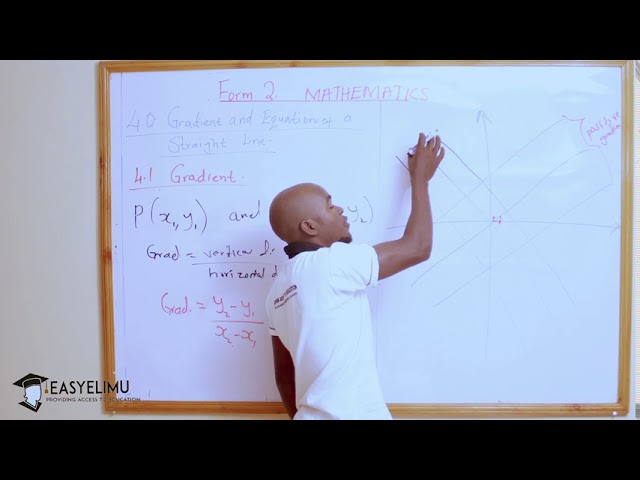
The steepness or slope of an area is called the gradient. Gradient is the change in y axis over the change in x axis.


Note:
If an increase in the x coordinates also causes an increase in the y coordinates, the gradient is positive.
If an increase in the x coordinates causes a decrease in the value of the y coordinate, the gradient is negative.
If, for an increase in the x coordinate, there is no change in the value of the y coordinate, the gradient is zero.
For a vertical line, the gradient is not defined.
Example
Find the gradient.

Solution:
Gradient =
=
Equation of a straight line
Given two points
Example
Find the equation of the line through the points A (1, 3) and B (2, 8).
Solution
The gradient of the required line is 5.
Take any point P (x, y) on the line. Using points P and A, the gradient is
Therefore 5.
Hence y = 5x – 2.
Given the gradient and one point on the line:
Example
Determine the equation of a line with gradient 3, passing through the point (1, 5).
Solution
Let the line pass through a general point (x, y). The gradient of the line is 3.
Hence the equation of the line is y = 3x + 2.
We can express linear equation in the form:
Illustrations
For example, 4x + 3y = -8 is equivalent to y = … In the linear equation below, gradient is equal to m while c is the y intercept.

Using the above statement we can easily get the gradient.
Example
Find the gradient of the line whose equation is 3y – 6x + 7 = 0.
Solution
Write the equation in the form y = mx + c.
M = 2 and also gradient is 2.
The y-intercept
The y-intercept of a line is the value of y at the point where the line crosses the y axis, which is C in the above figure. The x-intercept of a graph is the value of x where the graph crosses the x axis.
To find the x intercept, we must find the value of y when x = 0 because at every point on the y axis x = 0. The same is true for y intercept.
Example
Find the x intercept of y = 2x + 10. On putting y = 0, we have to solve this equation:
2x + 10 = 0
2x = -10
x = -5
X intercept is equal to –5.


Perpendicular lines
If the product of the gradients of two lines is equal to –1, then the two lines are perpendicular to each other.
Example
Find if the two lines are perpendicular.
Solution
The gradients are M = 1/3 and M = -3.
The product is -1.
The answer is -1; hence they are perpendicular.
Example
Y = 2x + 7
Y = -2x + 5
The product is -4; hence the two lines are not perpendicular.
Parallel lines
Parallel lines have the same gradients, e.g.
Both lines have the same gradient which is 2; hence they are parallel.
End of topic
Did you understand everything? If not, ask a teacher, friends, or anybody and make sure you understand before going to sleep! |
Past KCSE Questions on the topic
- The coordinates of the points P and Q are (1, -2) and (4, 10) respectively.
A point T divides the line PQ in the ratio 2:1.
(a) Determine the coordinates of T.
(b) (i) Find the gradient of a line perpendicular to PQ.
- Hence determine the equation of the line perpendicular to PQ and passing through T.
- If the line meets the y-axis at R, calculate the distance TR, to three significant figures.
- A line L1 passes through point (1, 2) and has a gradient of 5. Another line L2 is perpendicular to L1 and meets it at a point where x = 4. Find the equation for L2 in the form y = mx + c.
- P (5, -4) and Q (-1, 2) are points on a straight line. Find the equation of the perpendicular bisector of PQ, giving the answer in the form y = mx + c.
- On the diagram below, the line whose equation is 7y – 3x + 30 = 0 passes through the points A and B. Point A is on the x-axis while point B is equidistant from x and y axes.

Calculate the coordinates of the points A and B.
- A line with gradient of -3 passes through the points (3, k) and (k, 8). Find the value of k and hence express the equation of the line in the form ax + by = c, where a, b, and c are constants.
- Find the equation of a straight line which is equidistant from the points (2, 3) and (6, 1), expressing it in the form ax + by = c where a, b, and c are constants.
- The equation of a line is (-frac{3}{5}x + 3y = 6). Find the:
(a) Gradient of the line (1 mark)
(b) Equation of a line passing through point (1, 2) and perpendicular to the given line.
- Find the equation of the perpendicular to the line x + 2y = 4 and passing through point (2,1).
- Find the equation of the line which passes through the points P (3,7) and Q (6,1).
- Find the equation of the line whose x-intercept is -2 and y-intercept is 5.
- Find the gradient and y-intercept of the line whose equation is 4x – 3y – 9 = 0.


