

Introduction
- Cattle production is a widely distributed enterprise in Kenya, playing a significant role in the agricultural sector.
- Most farming communities choose between exotic and local breeds or their crosses depending on environmental conditions and production goals.
- The backbone of the beef industry in Kenya consists mainly of indigenous animals and their crosses, typically found in drier areas, while the dairy industry is primarily based on exotic breeds and their crosses, common in wetter regions.
- Regardless of the type of production, the returns depend largely on the level of management provided to the animals.
- A productive herd begins with good management of the young stock, ensuring healthy growth and development.
Raising of Young Stock
The young one of cattle is known as a calf. Proper care and management of calves are essential for the future productivity of the herd.
Feeding Dairy Calves
Newborn calves should be given colostrum within the first 3-5 days of life. Colostrum is the first milk produced by the cow after calving and is crucial for the calf’s health and immunity.
Colostrum is important for the following reasons:
- It is highly digestible, making it easy for the newborn calf to absorb nutrients.
- It contains antibodies that provide passive immunity to the calf, protecting it from diseases.
- It is highly nutritious, supplying essential proteins, vitamins, and minerals.
- It serves as a natural laxative, helping to clear the calf’s digestive tract.
- It is highly palatable, encouraging the calf to feed.
- Calves can be fed using the natural method (direct suckling) or artificially through bucket feeding.
Natural Method
In this method, calves suckle directly from their mothers.
Advantages
- The calf receives milk at body temperature, which is ideal for digestion.
- The milk is free from contaminants, reducing the risk of infections.
- There are fewer problems with scouring (diarrhea).
Disadvantages
- There is a risk of underfeeding if the calf does not suckle adequately.
- Cows may not let down milk if the calf dies or is absent.
- It is difficult to keep accurate production records.
Artificial/Bucket Feeding
The calf is trained to feed from a bucket immediately after birth.
Training the Calf
- Well-measured milk is placed in a clean bucket.
- The index finger is gently inserted into the calf’s mouth to stimulate sucking.
- The calf’s head is slowly lowered into the bucket until it starts to drink.
- The finger is withdrawn gradually as the calf continues to drink.
- This procedure is repeated until the calf becomes accustomed to bucket feeding.
Advantages
- It is easy to keep accurate production records and monitor milk yields.
- The amount of milk given to the calf can be regulated precisely.
- The cow does not require the presence of the calf to let down milk.
- High hygiene standards can be maintained more easily.
Disadvantages
- It is labor-intensive and requires more time.
- The calf may be given cold milk if not warmed properly.
- Dirty equipment or handlers can lead to scours and infections.
Preparation of Artificial Colostrum
Ingredients Used
- A fresh egg whipped in 0.86 litres of warm water.
- One litre of warm water.
- One teaspoonful of cod liver oil.
- One tablespoonful of castor oil.
- Note: Artificial colostrum is fed to calves three times a day for the first 4 days of life, then twice a day thereafter.
Weaning of Calves
Early Weaning
In early weaning, the calf is fed whole milk up to the tenth week, after which it is gradually weaned off milk.
- The calf is given milk equal to 10% of its body weight up to the 8th week.
- After the 8th week, milk is reduced gradually by 1 kg until complete weaning.
- The calf is introduced to early weaning concentrates and soft forage to supplement its diet.
| Age in weeks | Whole milk (kg/day) | Concentrates (kg/day) |
|---|---|---|
| 1 | Colostrum ad libitum | – |
| 2-3 | 5 | – |
| 4-5 | 6 | 0.25 kg/day |
| 6-7 | 6 | 0.5 kg/day |
| 8-9 | 5 | 0.75 kg/day |
| 10-11 | 4 | 1.00 kg/day |
| 12-13 | – | 1.50 kg/day |
| 14-15 | – | 2.00 kg/day |
| 16 | – | 2.00 kg/day |
Late Weaning
In late weaning, the calf is fed whole milk up to the 3rd week, after which milk is gradually replaced with skim milk.
- At 3 weeks, the calf is introduced to calf pellets or pencils and green fodder.
- The calf is provided with plenty of clean water to encourage hydration.
- Additional skim milk is given up to 14 weeks, when the maximum amount is reached.
- Skim milk is then gradually reduced from 14 to 16 weeks, when weaning is completed.
| Age in weeks | Whole milk (kg/day) | Concentrates (kg/day) | Skim milk (kg/day) |
|---|---|---|---|
| 1 | Colostrum ad libitum | – | – |
| 2 | 3.5 | – | – |
| 3 | 4 | – | – |
| 4 | 4.5 | 0.25 kg/day | 1 |
| 5 | 4.0 | 0.5 kg/day | 3 |
| 6 | 3.0 | 0.75 kg/day | 5 |
| 7 | – | 1.00 kg/day | 7 |
| 8-14 | – | 2.00 kg/day | 8 |
| 15 | – | 2.00 kg/day | 4 |
| 16 | – | 2.00 kg/day | 4 |
Rearing of Replacement Stock
The replacement stock includes young heifers and bulls selected for breeding to replace older animals in the herd. Proper management of these animals ensures the sustainability and improvement of the herd.
Management Practices
- Parasite control: Regular spraying against external parasites and deworming against internal parasites is essential to maintain animal health.
- Disease control: Calves are routinely vaccinated against common diseases such as:
- Blackquarter at 4 months old.
- Anthrax and Blackquarter at 6 months old.
- Brucellosis between 3-8 months old (heifers).
- Castration: Male calves not selected for breeding are castrated to improve management and meat quality.
- Identification: Suitable methods such as ear tagging or branding are used to allow proper record keeping and animal tracking.
- Removal of Extra Teats:
- Supernumerary teats can make milking difficult and are clipped off using teat clippers.
- Dehorning/Disbudding: The removal of horn buds using appropriate methods to prevent injury to other animals and handlers.
Calf Housing
Requirements of a Calf Pen
- The pen should be clean and easy to clean to prevent disease.
- It should be warm and dry to provide comfort and prevent chilling.
- Adequate space should be provided to allow exercise and feeding.
- The pen should be properly lit and allow sunlight exposure for Vitamin D synthesis.
- Proper drainage is necessary to avoid dampness and related health issues.
- The pen should be draught-free to prevent chilling of the calves.
- Good ventilation is essential to allow fresh air circulation.
Types of Pens
Calf pens can be:
- Permanent
- Mobile or movable
Permanent Pens
- Have a solid floor raised above the ground to prevent dampness.
- The floor should be slanted to facilitate drainage.
- Usually constructed near the milking parlour for convenience.
Mobile/Movable Pens
- Have an open floor to allow grass to grow inside the pen.
- Can be easily moved to avoid soiling and maintain hygiene.
- Typically kept outdoors in pastures to allow calves to graze.
Single Housing
- Calves should be housed singly up to 3 weeks of age, after which they can be grouped.
- This prevents them from licking each other and swallowing hairs that form indigestible balls.
Milk and Milking
Milk is the white, lacteal secretion produced by the mammary glands of female mammals. It is a vital source of nutrition for young mammals and an important product in agriculture.
Composition of Milk
- Protein: Mainly casein and whey proteins.
- Fat: Butterfat, which provides energy and flavor.
- Carbohydrates: Primarily lactose, the sugar found in milk.
- Minerals: Mainly calcium and phosphorus, essential for bone development.
- Water: The major component, making up about 87% of milk.
Factors Affecting Milk Composition
- Age of the animal.
- Health and condition of the animal.
- Stage of lactation and pregnancy.
- Completeness of milking.
- Breed type.
- Season of the year.
- Type of feed consumed.
- Physiological conditions such as diseases.
Milk Secretion and Milk Let-down
- Milk is secreted by the mammary glands, which are accessory glands of the reproductive system.
- The mammary gland of a cow is called the udder.
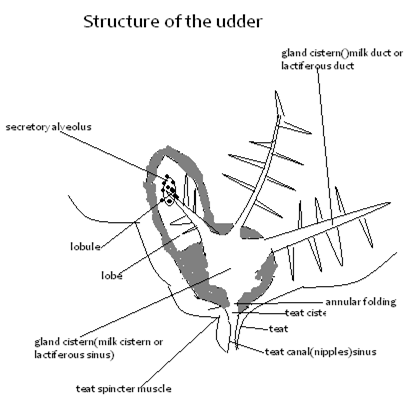
Structure of the Udder
The udder is composed of the following parts:
- Alveolus cells: Synthesize and secrete milk.
- Lobule: A group of alveolus cells.
- Lobe: Several lobules grouped together, drained by lactiferous ducts.
- Gland cistern: Space where milk collects from the lobes.
- Teat cistern: Space where milk collects before emission.
- Teat: An organ that drains each quarter of the udder.
Milk Secretion
- The process of milk secretion is called lactogenesis.
- Digested food nutrients are transported to the udder via blood vessels.
- Within the udder, nutrients are metabolized in alveolus cells to produce milk.
- The hormone prolactin, secreted by the pituitary gland, stimulates lactogenesis.
- Milk is stored in the upper parts of the udder until it is released.
Milk Let-Down
- Milk let-down occurs naturally when the animal is stimulated, such as by the presence of the calf or milker.
- Milk moves from the alveolar region through ducts to the gland cistern.
- Oxytocin, a hormone secreted by the pituitary gland, causes contraction of udder muscles, forcing milk down the teats.
- Oxytocin remains active in the bloodstream for 7-10 minutes, so fast milking is important to withdraw milk efficiently.
- Milk is withdrawn from the teats by gently squeezing them during hand milking.
Factors Influencing Milk Let-Down
- Presence of the calf.
- Presence of the milkman or milker.
- Rattling of milking equipment.
- Feeding the animal.
- Massaging or washing the udder.
- Sight of the milking parlour.
Factors Inhibiting Milk Let-Down
- Inflicting pain or beating the animal.
- Presence of strangers or other animals, such as dogs.
- Poor milking techniques.
- Absence of the calf, especially if the cow is accustomed to its presence.
Clean Milk Production
To produce clean milk, the following factors are essential:
- A healthy lactating cow free from infections.
- A healthy and hygienic milker.
- A clean and properly constructed milking parlour.
- Clean and disinfected milking equipment.
- Proper handling and storage of milk after milking.
Milking Procedure
- Animals are brought near the milking parlour 15-20 minutes before milking to calm them and prepare for milking.
- Milking materials such as equipment, feed, ropes, stools, and salve are collected and placed near the parlour.
- Animals are allowed into the milking stall one by one, and the milking process proceeds as follows:
- The animal is restrained in the stall.
- Feed is weighed and placed into the feed trough to keep the animal occupied.
- The udder is thoroughly washed, disinfected, and dried with a clean cloth to prevent contamination.
- A strip cup is used to test for mastitis on each quarter before milking.
- Milking proceeds by squeezing the teats with the full hand. In machine milking, teat cups are placed on the teats.
- For hand milking, start with the hindquarters and finish with the forequarters.
- Fast milking should take about 8 minutes, ending with stripping the udder to remove residual milk.
- The milk is weighed and recorded for production monitoring.
- The animal is then released back to the holding area or pasture.
Dry Cow Therapy
- This involves infusing antibiotics into the teat canal of a cow preparing for drying off.
- It prevents bacterial infections that can lead to mastitis during the dry period.
Milk Products
- Pasteurized milk: Milk that is heated to a specific temperature and then cooled immediately to kill pathogens.
- Ultra Heat Treated (UHT) milk: Milk heated to 130-135°C, packed aseptically, and cooled for long shelf life.
- Butter: Milk butterfat separated by churning.
- Cream: A layer of fat that collects at the top of milk when left to stand.
- Cheese: Milk proteins compressed and processed into solid form.
- Ghee: Clarified milk fat made by heating cream or butter.
- Skim milk: Milk with the butterfat removed.
Marketing of Milk
- The Kenya Dairy Board regulates the production and sale of milk and milk products through various Dairy Co-operative Societies.
- Major processors and distributors of milk and milk products include:
- KCC (Kenya Cooperative Creameries)
- Brookside Dairies
- Tuzo
- Delamere Dairies
- Limuru Dairies
Marketing of Beef
Beef marketing is conducted through various channels, including:
- Individual farmers selling through local slaughterhouses.
- Livestock marketing divisions.
- Kenya Meat Commission (KMC).
- Private companies such as Farmer’s Choice.


