

CHAPTER EIGHT – HEATING EFFECT OF AN ELECTRIC CURRENT
When current flows, electrical energy is transformed into other forms of energy, such as light, mechanical, and chemical energy.
Factors Affecting Electrical Heating
The energy dissipated by current or work done as current flows depends on:
- Current
- Resistance
- Time
This formula summarizes these factors as E = I2 R t, E = I V t, or E = V2 t / R.
Examples
An iron box has a resistance coil of 30 Ω and takes a current of 10 A. Calculate the heat in kJ developed in 1 minute.
Solution:
E = I2 R t = 102 × 30 × 60 = 18 × 104 = 180 kJ
A heating coil providing 3,600 J/min is required when the p.d. across it is 24 V. Calculate the length of the wire making the coil given that its cross-sectional area is 1 × 10⁻⁷ m2 and resistivity 1 × 10⁻⁶ Ω m.
Solution:
E = P t hence P = E / t = 3,600 / 60 = 60 W
P = V2 / R therefore R = (24 × 24) / 60 = 9.6 Ω
R = ρ l / A, so l = (R A) / ρ = (9.6 × 1 × 10-7) / 1 × 10-6 = 0.96 m
Electrical Energy and Power
In summary, electrical power consumed by an electrical appliance is given by:
P = V I
P = I2 R
P = V2 / R
The SI unit for power is the watt (W).
1 W = 1 J/s and 1 kW = 1,000 W.
Examples
What is the maximum number of 100 W bulbs which can be safely run from a 240 V source supplying a current of 5 A?
Solution:
Let the maximum number of bulbs be ‘n’. Then 240 × 5 = 100 n
So, n = (240 × 5) / 100 = 12 bulbs.
An electric light bulb has a filament of resistance 470 Ω. The leads connecting the bulb to the 240 V mains have a total resistance of 10 Ω. Find the power dissipated in the bulb and in the leads.
Solution:
Req = 470 + 10 = 480 Ω, therefore I = 240 / 480 = 0.5 A.
Power dissipated in the bulb = I2 R = (0.5)2 × 470 = 117.5 W
For the leads alone, R = 10 Ω and I = 0.5 A
Power dissipated in the leads = (0.5)2 × 10 = 2.5 W.
Applications of Heating of Electrical Current
Filament lamp – the filament is made of tungsten, a metal with a high melting point (3,400 °C). It is enclosed in a glass bulb with air removed and argon or nitrogen injected to avoid oxidation. This extends the life of the filament.
Fluorescent lamps – when the lamp is switched on, the mercury vapour emits ultraviolet radiation, causing the powder in the tube to fluoresce, i.e., emit light. Different powders emit different colours.

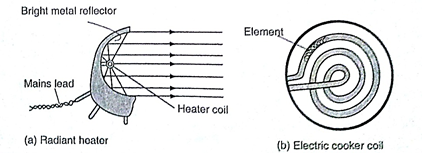
Electrical heating – electrical fires, cookers, etc. Their elements are made of nichrome (an alloy of nickel and chromium), which is not easily oxidized when it turns red hot.
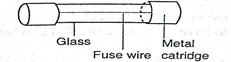
Fuse – this is a short length of wire made of a material with a low melting point (often thinned copper) which melts when the current through it exceeds a certain value. Fuses are used to avoid overloading.



4 Comments