


CHAPTER TWO
MEASUREMENT II
Measuring length using vernier callipers
Vernier callipers are used when higher accuracy in measurement is required and this cannot be achieved using a metre rule.
Vernier callipers have two scales: main scale and vernier scale. The outside jaws are used to measure both lengths and external diameters, the inside jaws for measuring internal diameters, while the tail is used for measuring depths of cavities. The main scale is divided into cm and mm. The vernier scale is divided into 10 equal divisions of 0.9 mm each. The accuracy of vernier callipers is 0.10 mm.
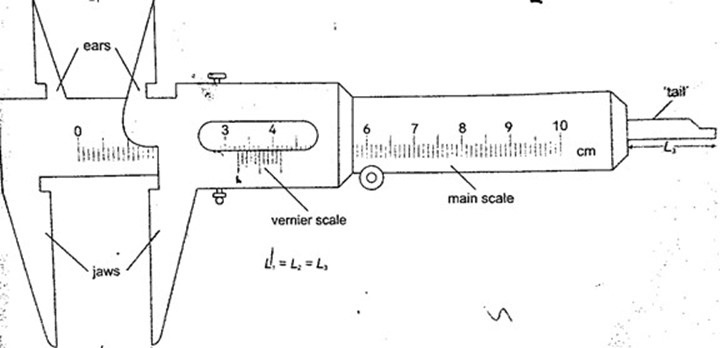
The reading is taken in two steps:
- The main scale is read at the zero mark of the vernier scale. The values are given in cm.
- The vernier scale is read at the position where a mark on the vernier scale exactly lines up with a mark on the main scale. The values are given as two decimals of a cm.
Examples
Give the reading in the following diagram.

Solution
Main scale reading: 2.7 cm
Vernier scale reading: 0.04 cm
Adding both, we get 2.74 cm.
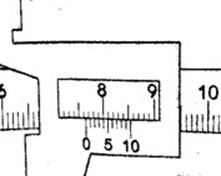
What is the reading of the vernier callipers shown below?
Solution
Main scale reading: 7.6 cm
Vernier scale reading: 0.04 cm
Adding both readings, we get 7.64 cm.

Micrometer screw gauge
It is a device used to measure small lengths. It has an accuracy of 0.01 mm. It has two scales: the sleeve scale and the thimble scale. The sleeve scale is divided into upper and lower scales with the upper division in mm and lower divisions in 0.5 mm. The thimble scale is divided into 50 equal divisions, each division consisting of 0.01 mm.

The reading is taken in two steps:
- The reading on the sleeve scale is read at the point where it touches the edge of the thimble in mm and half mm.
- The thimble scale is read at the point where the centre line of the sleeve is parallel to the thimble scale division.
Examples
Give the reading in the following.
Solution
Sleeve reading: 3.5 mm
Thimble reading: 0.45 mm
Adding up, we get 3.95 mm.
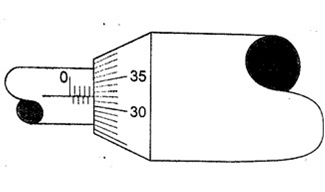
What is the reading in the following micrometer screw gauge?
Solution
Sleeve scale reading: 4.0 mm
Thimble scale reading: 0.32 mm
Adding up the two, we get 4.32 mm.
Calculating the size of a molecule
Both the volume and area of a drop can be calculated using the following formulas: Volume = (4/3) πr3 and Area = πr2h.
Examples
A drop of olive oil, whose volume is 0.12 mm3, was placed on a surface of clean water. The oil spread and formed a patch of area 6.0 × 104 mm2. Estimate the size of the olive oil molecule.
Solution
Volume = 0.12 mm3. Area of the oil patch = 6.0 × 104 mm2.
Volume = area × thickness of the patch, therefore:
Thickness of the oil patch = volume / area
= 0.12 / 6.0 × 104 = 2.0 × 10⁻⁶ mm or 2.0 × 10⁻⁹ m.
Suppose an oil drop has a volume of 0.10 mm3 and forms a film with a radius of 10 cm. Calculate the thickness of the oil film.
Solution
Area of the film = πr2 = 3.14 × 10 × 10 = 314 cm2 = 31,400 mm2.
Thickness of the oil film = volume / area, hence 0.10 / 31,400 = 3.0 × 10⁻⁶ mm.
(The thickness of the oil film is called the upper limit to the size of a molecule because the molecule cannot be bigger than the thickness of the oil film.)


