


ELECTRICITY & Electronics Questions
1. State one advantage of a lead-acid accumulator over a dry cell
2. State one defect of a simple cell and explain how it can be corrected.
3. Study the circuit below:
Determine the current flowing in the circuit
4. When the time base of a cathode ray oscilloscope is turned on, there is a horizontal trace
across the screen as shown in the figure:-
(i) An alternating potential difference of constant frequency and constant amplitude is then connected
to the Y-input of the oscilloscope. Sketch on the same diagram above the trace which might
be obtained
(ii) The time base is switched off but the alternating potential difference is left connected. Describe
what would be observed on the screen
5. The figure below shows the wiring in a modern mains appliance
Identify the wires Y and Z
6. State two ways of decreasing capacitance
7. (a) The figure below represents part of an electric cooker coil.
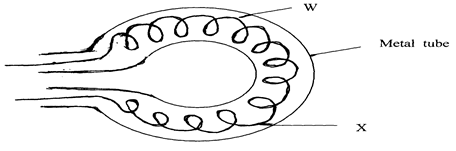
(i) State why the part labeled W is coiled
(ii) State the property of material X that makes it suitable for its use
(b) State the advantage of transmitting power at:-
(i) Very high voltage
(ii) Alternating voltage
(c) Aluminium wires are commonly used in power transmission than copper wires. Give two
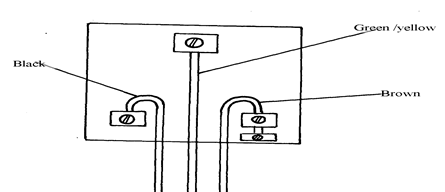
advantages of aluminum as transmission lines (d) The diagram below shows a wrongly wired three pin plug.
(i) Indicate in the diagram above the correct colors for the wiring
(ii) State the use of device marked X
(e) A household uses a 1.5Kw water heater for 2 hours a day for 30 days. If the cost of
electricity is shs.6.70 per Kwh, how much will they pay for this consumption?
8. The diagram below shows a simple cell:-

(a) (i) Name z and solution y
(ii) Name and explain the defect that occurs at plate z
(iii) Give one method of preventing the defect that occurs at the copper plate
(b) (i) Explain how P-type semi-conductor is formed
(ii) The figure below shows a circuit diagram for full wave rectification
(I) Draw the diodes D3 and D4 on the diagram to complete the circuit
(II) On the axes below sketch a voltage –time graph observed when a C.R.O is connected
 at points
(a)PQ (b) ST
(iii) On the circuit diagram (b) (ii) above, draw a capacitor which can be used to smoothen
the output voltage
9. Explain how conductivity of a semi conductor changes with increase in temperature
10. With the time base switched on; the following trace was obtained on the screen of a CRO as
shown in the figure below:
Draw a circuit diagram that can be used to produce the wave above
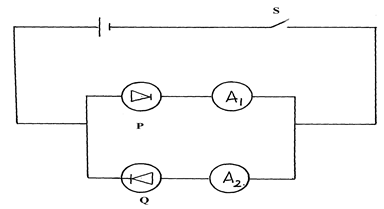 11. Figure 4 below shows a circle with two diodes P and Q and a cell:-

Explain the observation which would be made if S is closed
12. Explain why eight 1.5V cells arranged in series to give a total of 12V cannot be used to start
a car. But car battery of 12V starts a car
13. a) i) Distinguish between a p- type and an n- type extrinsic semi conductors
ii) The figure below shows a bridge rectifier
A capacitor has been connected across the resistors as shown. Sketch on the axes below the
 wave form when a C-R-O is connected across the resistor; R
Sketch on the same axes above the wave form when a C-R-O is connected across the resistor R
and capacitor c removed
iii) Figure shows a voltmeter connected across the cell. The voltmeter reads 1.5V when the
switch S, is open and 1.25V when the switch is closed.
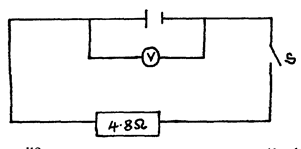
i) What is the e.m.f of the cell?
ii) What is the terminal voltage of the cell?
iii) Calculate the internal resistance of the cell
14. What is the use of a fuse in an electric circuit?
15. Distinguish between Topping and Dopping
16. The figure below shows the set up for a simple cell.
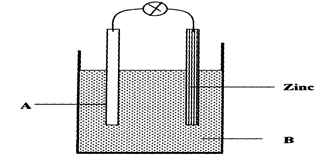
a) Name the Electrode A and the solution B
b) State two reasons why the bulb goes off after a short time
17. The figure 2 shows a simple cell made of copper and zinc electrodes dipped in dilute
sulphuric acid
a) Identify the cathode
b) If a voltmeter is connected across the rods the reading is observed to reduce with time.
State two causes of this observation
18. State one reason why colour televisions have a higher power rating than black and white televisions
19. Explain two factors that affect the capacitance of a parallel-plate capacitor
20. a) A girl opened up a used up dry cell and found the following:
i) The zinc casing was ‘eaten away’
ii) The cell was watery
Name the cell defect
b) Three identical bulbs are connected in series with a battery of dry cells. At first the bulbs
shine brightly but gradually become dimmer. Using the same cells, explain how you
would increase the brilliance of the bulbs
21. Figure 9 below shows a diagram of an n – p – n transistor.
- Complete the diagram by showing the connections of two batteries suitable for biasing the
transistor in the common- emitter mode.
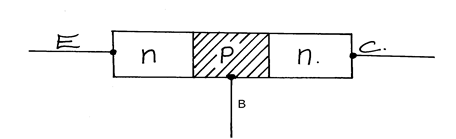 Figure 9
22. State the purpose of introducing an impurity in a semi conductor.
23. In an attempt to establish the relationship between current through a junction diode and the p.d
across it, a student connected a diode to an e.m.f source as in figure 3 below:-
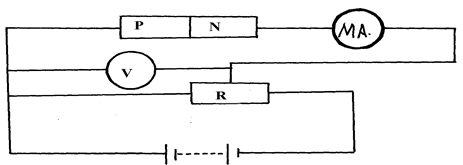
fig. 3
(a) State whether the diode is forward biased or reverse biased (b) Briefly describe how she obtained her readings
(c) Sketch a graph to represent the relationship between current (y-axis) and the p.d across the
diode
24. Figure 8 shows a circuit where a battery of emf 4.5V, switches A and B, two capacitors
. C1= 0.3 µF and C2 = 0.5 µF and a voltmeter are connected
a) Determine the charge on C1 when switch A is closed and switch B is open
b) What is the effective capacitance CT when both switches A and B are closed?
c) State what is observed on the voltmeter when;
i) Switch A is closed and switch B is open
ii) Switch A is closed and opened and then B is closed
iii) Explain the observation made in c(ii) above
25. (a) Define capacitance
(b) Two aluminium plates A and B of same dimensions are each mounted on an insulating stand.
Plate A is charged to high voltage and connected to uncharged electroscope while plate B is
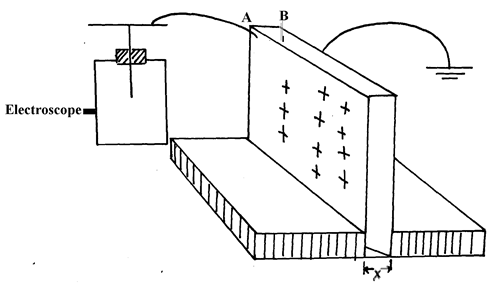 earthed. The two plates are placed side by side as in the diagram figure 4 below:-

fig . 4


(i) Indicate on the diagram the position of the leaf and charge distribution on the electroscope
(ii) State and explain the observation on the electroscope when the distance (x) of separation
between the plates is increased while keeping the area of overlap the same
(c) A 12f capacitor is charged with a 200V source then placed in parallel with uncharged 8.0f
capacitor as shown in fig 5 below:-
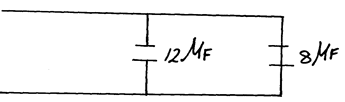 fig. 5


Determine:
(i) The initial charge on the 12f capacitor
(ii) The final charge on each capacitor
(d) The diagram figure 6 below shows a pear shaped charged conductor on an insulating stand
(charges not shown on the diagram)
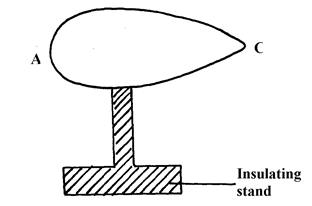 fig. 6
Part A is touched using a proof-plane and then the proof-plane is brought next but not touching
the cap of a leaf electroscope (not shown on the diagram). The same experiment is repeated for
part C of the conductor.
(i) State the expected observation in the above experiments
(ii) Explain the observations made in (d) (i) above
(iii) Name any one application of the above phenomenon
26. a) State two factors that affect the capacitance of a parallel plate capacitor
b) The diagram below shows an arrangement of capacitors in a circuit
- Determine the total charge in the circuit
27. a) What is doping as used in electronics
b) Distinguish between intrinsic and extrinsic semi-conductors.
c) What would be observed in the diagram below when switch S is closed, B1 and B2 are
identical torch bulbs
b) The diagram below shows the north pole of a magnet approaching a solenoid
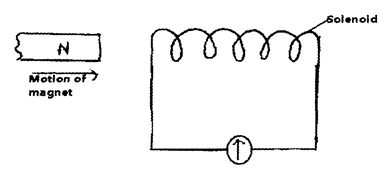
i) Using Lenz’s law, indicate the direction of current through the galvanometer
ii) Explain the observation made when:
I The magnet is moved away from the solenoid
II The magnet is placed stationary in the solenoid
c) A transformer is designed as shown in the figure below. If the primary coil has 2400 turns and
the secondary has 200 turns calculate the p.d across BC assuming there are no energy losses in
the transformer
d) The figure shows a cross- section of a bicycle dynamo. The wheel is connected by an axle
to a permanent cylindrical magnet and is rotated by the bicycle tyre
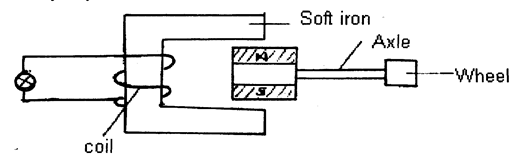
i) Explain why the bulb lights
ii) How can the bulb be made brighter
29. A car battery requires topping up with distilled water occasionally. Explain why this is
necessary and why distilled water is used
30. Draw appropriate symbol of a circuit diagram of a junction diode in reverse bias
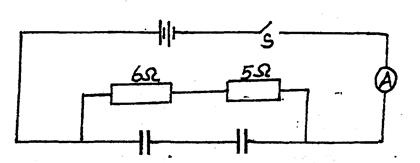 of 0.5Ω. The capacitance of each capacitor is 1.4F.
Fig.5
i) When the switch S is closed determine the ammeter reading.
ii) When the switch S is closed determine the charge on each capacitor.
b) The diagram in Fig. 6 represents two parallel plates of a capacitor separated by a distance d.
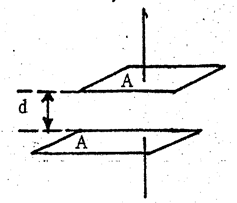 Each plate has an area of a square unit. Suggest two adjustments that can be made so as to
increase the effective capacitance.
Fig.6
c) Complete the table to describe the function of the parts of a lighting conductor.
Port | Function |
Spike | |
Thick copper rod | |
Earthed metal plate |
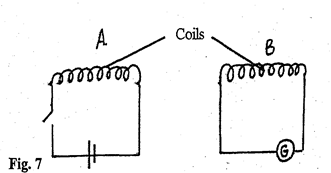 32. The circuits in Fig. 7 shown are close to each other.
Fig. 7
a) When the switch is closed, the galvanometer shows a reading and then returns to zero.
When the switch is then opened, the galvanometer shows a reading in the opposite
direction and then returns to zero. Explain these observations.
b) Energy losses in a transformer are reduced by having a laminated soft iron core. State and
explain two other ways of reducing energy loses in a transformer.
or rotates is represented in the graph in
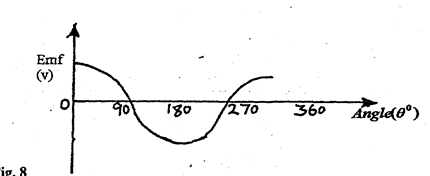 Fig. 8.
i) Give reasons for the changes in the e.m.f as the coil rotates from 00 to 900 and 900 to1800.
ii) Sketch on the same diagram a similar graph if the generator was a direct current one.
33. State one advantage of:
i) A lead-acid accumulative over a dry cell
ii) A dry cell over lead-acid accumulator
34. Three identical cells of e.m.f. 2.0v and of negligible internal resistance are connected as shown
in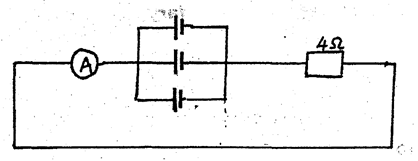 figure below. Determine the ammeter reading.
35. State one advantage of:
i) A lead-acid accumulative over a dry cell
ii) A dry cell over lead-acid accumulator
36. Compare the property of material used to make a fuse wire to one used to make the filament of
a torch bulb.
37. State two reasons why the CRO is a more accurate voltmeter than a moving coil voltmeter.
38. The strip below represents part of the electromagnetic spectrum. C is the visible part of the spectrum. A is the region of the shortest wave length and F the highest

Name the sections which represent:
(i) X-rays (ii) Infra-red (iii) T.V waves
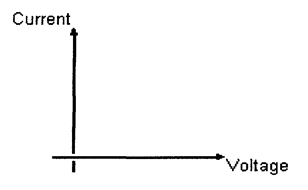 39. Sketch a forward bias characteristics of a P – N junction diode in the axis below
ELECTRICITY & Electronics Answers
1. From acceleration a = V-u and making V the subject V = at + u or V = ut + at
2. Polarisation 1 – Corrected by adding a depolarizer 1
Or local adic – Corrected by amalgamation or use of pure zinc.
3. RT = 4.5(4.5)
9
= 2.25
I = V
R1
= 6
2.25
= 2.667A
4. i)
ii) Straight vertical line observed since Y- gain is connected leading to vertical deflection
5. Y – Neutral Z – Live
6. – Decreasing area of overlap
– Removal of dielectric
– Increasing separation distance
 (i) For W to occupy a smaller space(ii) Ofers high resistance
- (i) To reduce power loss for long distance power transmission


(ii) To be able to step it up or down depending on need

- – High current/charge carrying capacity/density

– Lighter
- (i)


(ii) Melts and breaks the current if there is an overload to protect the load connected to the
main output
- Power consumed for 30days
 = 1.5 x 2 x 30 = 90KW
 Cost of the electricity cnsumed
 = 90KW x 6.70= Kshs.603
 8. (a) (i) Z – Zinc plate
 Y – Dilute sulphuric acid
(ii) – Local action
- Occurs due to the reaction between Zinc plate and dilute sulpuric acid thus Zinc is eaten away

(iii) Use of depolariser (Potassium dichromate)
(b) (i) Doping intrinsic semi-conductor with group III elements
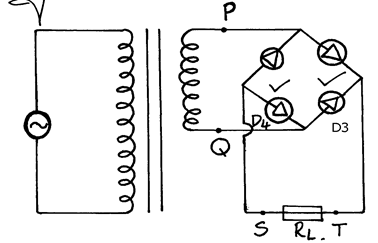
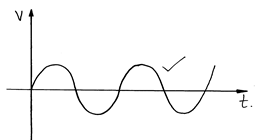
(ii) PQ
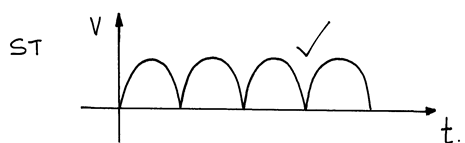
(iii)
 9. Conductivity increases with increase in temperature. Increase in temperature makes valance electrons gain kinetic energy and jump to the conduction band
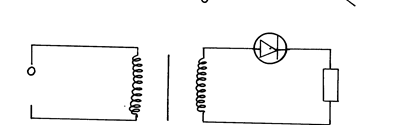 10. (all diagram correct) (2mks)


11. A 1 shows a deflection while A2 doesn’t. This is because diode P is forward biased while Q is
reverse biased i.e it offers high resistance.
12. – Eight dry cells have a very high internal resistance compared to the car battery hence very little current can be drawn from the dry cells.
13. a)i) p –type :- it is obtained by dopping an intrinsic semi conductor using a group 3 impurity.
n– type :- it is obtained by dopping an intrinsic semi conductor using a group 5 impurity
ii) The figure below shows a bridge rectifier
A capacitor has been connected across the resistors as shown. Sketch on the axes below the wave form when a C-R-O is connected across the resistor; R
b) e.m.f = 1.5 v
ii)Terminal voltage = 1.25v
iii) Calculate the internal resistance of the cell
e = I (r +R) I = 1.25
I .5v= 1r + 1.25 4.8
I r = 1.5 -1.25 = 0.2604Λ
I r = 0.25v r = 0.25
0.2604
But I = 1.25 = 0.96
R
14. A fuse is a safety device is used to disconnect the circuit when excess current flows
through it, it melts.
15. Distinguish between Topping and Dopping
Topping:- The addition of distilled water into a lead acid accumulator to improve on the ion
concentration.
Dopping:- Addition of impurities to an intrinsic semiconductors to improve on its conductivity.
16. a) A is Copper B is a dilute acid (hydrochloric or sulphuric acid)
b) – Polarization
– Local Action
17. a) Cathode:- Zinc
b) two causes of this observation.
- Due to defects that the cell suffers. These are
- Local action. The eating away of Zinc (cathode) by the acid.
Polarization:- the formation of H2 bubbles at the anode insulating it.
 18. –Colour televisions have three electron guns compared to one in black and white televisions
19. – Capacitance is inversely proportional to the distance of separation between the plates (1mk)
– Capacitance is directly proportional by the area of overlap between he plates (1mk)
20. a) i) Local action
ii) Polarization
b) – Connect the three bulbs in parallel so that their infernal resistance is reduced.
– This arrangement increases the current making the bulbs very bright
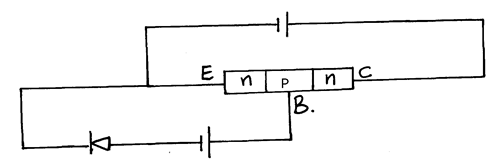 21.
21.
22. To increase the conductivity of a semi-conductor

 23. (a) Forward biased
 (b) Resistance in the circuit is varied by moving the jockey along R.
– A series of values of voltage for the corresponding values of current are obtained
(c) (iii) They are not deflected by both electric and magnetic fields

 (iv) Alpha particles are heavy (massive)
(v) The sheets are brought in turns between radioactive source and the counter.

 – The count rate is a measure of the thickness of the metal sheet.
24. a) Q1 = CV = 0.3 F X 4.5 = 13.5c
b) CT = C1 + C2
(0.3 + 0.5) F= 0.8F
c) i) 4.5V
ii) Voltmeter reads less than 4.5V
iii) The drop of p.d in C (ii) is because the charge on C1 is because is distributed to C2.
Since values of C1 and C2 remain constant when Q on C1 reduces, the Q = C1V
implies V must reduce also, hence reading reduced
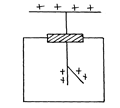 25. (a) Ability of a capacitor to store charge
(b) (i) For charge distribution
Raised leaf
(ii) The leaf divergence increased.
The potential on of increases due to reduced capacitance since distance of separation
is increased.
(iii) They are not deflected by both electric and magnetic fields

 (iv) Alpha particles are heavy (massive)
(v) The sheets are brought in turns between radioactive source and the counter.
- The count rate is a measure of the thickness of the metal sheet.

26. a) – Area of the plates
– Distance of separation of the plates
– The electric constant
b) – Capacitors in parallel
1F + 2F + 3F = 6F
– Capacitors in series:
1/6MF + 1/3MF = 2F
Q = CV
= 2.0 x 10-6 F x 10v
= 2.0 x 10⁻⁵ C
27. a) – The process in which an impurity is introduced into a pure semi- conductor
b) – Intrinsic – pure semi- conductors where charge carriers come from within
– Extrinsic – pure semi- conductor which has been doped
c) Bulb B2 lights
28. a) Define Eddy currents
- These are current loops that develop in the core there is a change in the magnetic field linking with the core.
b) i) Using Lenz’s law indicate the direction of current through the galvanometer
ii) I. The magnet is moved away from the solenoid
- The deflection of the galvanometer changes since direction of current is opposite the previous one
II. The magnet is placed stationary in the solenoid.
- The galvanometer does not deflect since no current flows
c)The p.d a cross the primary coil is 240V
Np = Vp = 240 VBC = 6 X 20V
Ns Vs Vs 9
12 = 240 =120
Vs 9
Vs = 240 = 13.33
12
= 20V
d) i)It lights because during the rotation of the wheel there is an indication of part (i)
the coil creating a current that flows through the bulb and it lights
ii) By making the wheel rotate faster or by making bicycle more faster
29. Evaporation and cell reaction cause loss of water. Distilled water does not introduce impurities
to the cell
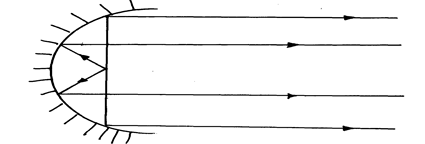 30.
30.


