CHAPTER SIX
MAGNETIC EFFECT OF AN ELECTRIC CURRENT
Introduction: Oersted’s Discovery
Hans Christian Oersted discovered the magnetic effect of a current in 1819. The direction of the magnetic field depends on the direction of the current. This discovery led to the development of electric bells, electric motors, telephone receivers, and radios.
Determining the Direction of the Lines of Force
The direction of the lines of force can be determined using a simple rule called the right-hand screw rule. This rule states that “if a right-hand screw advances in the direction of the current, then the rotation of the screw is in the direction of the field.”
Another rule is the right-hand grip rule, which states that “if the wire carrying a current is gripped with the right hand, using the thumb along the conductor and pointing in the direction of the current, then the direction of the curled fingers is the direction of the lines of force.”

Magnetic Field Due to a Solenoid: The Rule for Polarity
A solenoid is a cylindrical coil of wire acting as a magnet when carrying electric current.
The direction of the field can be determined using the following rule: “If the coil (solenoid) is viewed from one end and the current flows in an anticlockwise direction at that end, then that end is the North Pole. If the current flows in a clockwise direction, then that end is the South Pole.”
Electromagnets
An electromagnet is a soft metal core made into a magnet by passing an electric current through a coil surrounding it. They only maintain their magnetism if current continues to flow; if switched off, they lose their magnetism.
Factors Affecting the Strength of an Electromagnet
- Increasing current through the coil.
- Increasing the number of turns of the coil.
- Using iron of C-core shape which brings both magnetic poles together.
Some Applications of Electromagnets
- Electric bell
 When the switch is closed, the current passing through the solenoids magnetizes them and they pull the soft iron armature, which makes the hammer hit the gong, producing sound. When the hammer hits the gong, the contact between the spring and the screw is broken, stopping the current flow. The soft iron core loses its magnetism and releases the armature, which is then pulled back by the spring. The contact between the spring and the screw is regained, and the process repeats continuously, causing the gong to be struck repeatedly.
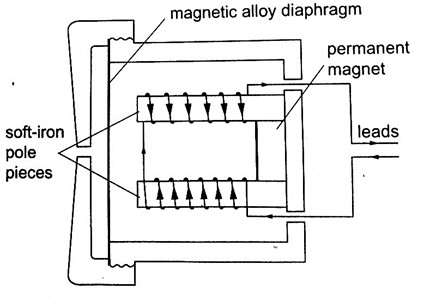
- Telephone receiver
It consists of a U-magnet made by attaching two soft-iron bars to the ends of a short permanent magnet. The solenoids are wound in opposite directions around the bars. When the phone is lifted, the current flows through the solenoids depending on the microphone on the other end of the line. These varying current pulses induce magnetism of varying strengths in the iron bars, which in turn causes the magnetic alloy diaphragm to vibrate differently, producing sound.
Force on a Current-Carrying Conductor in a Magnetic Field
When a conductor carries a current in a magnetic field, a force acts on it. The direction of the force depends on the directions of the field and current.
The factors affecting the magnitude of the force are:
- The current flowing in the conductor.
- The strength of the magnet.
- The length of the conductor in the magnetic field.
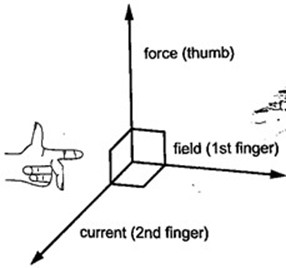
The directions of the current, field, and force are mutually perpendicular. This relationship is summarized in a law called Fleming’s left-hand rule or the motor rule. This rule states that “if you hold the first finger, the second finger, and the thumb of your left hand mutually perpendicular to each other, so that the first finger points in the direction of the magnetic field and the second finger points in the direction of the current in the conductor, then the thumb points in the direction of the force acting on the conductor.”
Applications of the Force on a Conductor
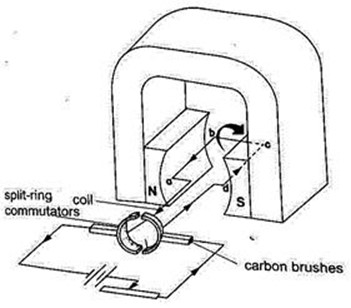
Simple D.C. Motor
Consists of a rectangular coil of wire mounted on an axle which can rotate between the poles of a magnet. For continuous rotation, the ends of the coil are connected to half-rings called split-ring commutators. The battery terminals are attached to brushes which slide on these half-rings. D.C. motors are useful as car starter motors, hand drills, machine motors, fans, etc.