


BUTERE DISTRICT CHEMISTRY PRACTICAL QUESTIONS
CONFIDENTIAL
INSTRUCTIONS
Each student should be provided with:
- 100 cm3 of solution M2
- 80 cm3 of solution M1
- 50 cm3 of solution M3
- Pipette (25 ml)
- Burette (50 mls)
- Methyl Orange indicator with a dropper
- Two conical flasks
- Filter funnel
- Measuring cylinder (10 mls)
- Measuring cylinder (50 mls)
- Thermometer (-10 to 1100c)
- 100 mls plastic beaker
- 3 test tubes in a test tube rack
- 1 Boiling tube
- Solid W. (One spatula full)
Access to:
- 2M NaOH(aq) with a dropper
- 2M NH3 (aq) with a dropper
- 1M BaCl2 with a dropper
- 2M HNO3 with a dropper
- Distilled water in a wash bottle
Note:
- Solution M1 is prepared by mixing 53g of Sodium Carbonate and 42g of Sodium Chloride solid and dissolved to make one litre solution.
- M2 is 1M Hydrochloric acid.
- M3 is 1M Sodium Hydroxide.
- Solid W is Aluminium Nitrate
1. You are provided with the following solutions:-
– M1 containing 95g of a mixture of sodium carbonate and sodium chloride per litre of solution.
– M2 which is 1M HCL.
You are to determine the percentage of sodium chloride in the mixture.
Proceed as follows:
Pipette 25 cm3 of M1 and titrate with M2 from burette using 3 – 4 drops of methyl orange
indicator. Stop titrating when a permanent pink colour appears. Repeat the experiment and
complete the table below.
TABLE 1
I | II | III | |
Final burette reading (cm3) | |||
Initial burette reading (cm3) | |||
Volume of M2 used (cm3) |
a) Determine the average volume of M2 used. Show your workings.
b) Determine the number of moles of M2 used.
c) Write down an ionic equation for the substances that react.
d) Determine the number of moles of the base used.
e) Calculate the concentration of sodium carbonate.
f) Determine the mass of sodium carbonate in 1 litre of the solution.
(Na = 23, C = 12, O = 16)
g) Determine the percentage of sodium chloride in the mixture.
2. You are provided with the following solutions:-
– 1 M HCl solution M2
– 1 M NaOH solution M3
You are expected to determine the molar heat of neutralization of hydrochloric acid.
Proceed as follows:
Measure 23 cm3 of M2 and put in a 100 ml beaker. Measure its temperature and record in the
table below under first column. By use of a measuring cylinder measure 5 cm3 of M3 and to M2 in
the beaker. Stir with the thermometer and record the final steady temperature. Continue adding
5 cm3 at a time and recording the temperature till 35 cm3 has been added, complete the table
below.
a) TABLE II
Volume of M2 added (cm3) | 0 | 5 | 10 | 15 | 20 | 25 | 30 | 35 |
Temperature (0c) |
b) Plot a graph of temperature (vertical axis) against volume of NaOH added.
c) From your graph determine:-
(i) Volume of 1M NaOH needed to neutralize 23 cm3 of 1M HCl
(ii) Rise in temperature ∆T.
d) Calculate the amount of heat evolved in the above reaction. Take specific heat capacity of
solution to be 4.2. J/g/k, density of solution. 1g/cm3.
e) Calculate the number of moles of HCl used.
f) Hence determine the Molar heat of neutralization of hydrochloric acid.
3. You are given solid W. Carry out the tests below and answer accordingly.
a) Take a spatula endful of W and put in a boiling tube. Add about 8cm3 of water and shake.
Keep the mixture for the tests below.
b) To about 2 cm3 of solution of W add sodium hydroxide (2M NaOH) drop wise till in excess.
c) To about 2 cm3 of solution W, add Ammonia solution (2M NH2aq) drop wise till in excess.
d) To about 2 cm3 of solution W, add about 5 drops of Nitric acid (HNO3 (aq)) followed by 2 drops
of Barium chloride.
BUTERE DISTRICT CHEMISTRY PRACTICAL ANSWERS
TABLE 1
1. Complete table
Penalties
- Unrealistic burette reading.
- Arithmetic error
- Inverted table.
N/B Penalize ½ mk each to a max. of ½ mk
2. Use of decimal.
– Consistent 1 d.pt. or 2 d.pt. –
– If 2 d.pt. the last digit must be zero or five.
– Otherwise award 0
– Accept the consistency of zero.
3. Accuracy
– Tied to the school value.
– Check any of the titre readings.
(i) If any of them is within + 0.1 from S.V. award
(ii)If within + 0.2 unit award – (½ mk).
(iii) If outside + 0.2 unit award zero.
4. Principle of Averaging.
(i) 3 consistent values average –
(ii) 2 consistent values averaged – (½ mk)
(iii) Otherwise award 0.
Penalties
(i) Answer should be at least 2 d.p. unless divided exactly.
b) No. of moles M2 = ans(a) x 1
1
1000
Correct ans. 1
c) 2H+ (aq) + CO32-(aq) H2O(l) + CO2(g)
- Balancing = ½ mk
- States (correct) = ½ mk
- Moles of base = ½ x ans. (b) 1 mk
= correct answer 1 mk
- Concentration = answer in (d) x 1000
1 mk25
= Correct answer 1 mk
f) Mass of Na2CO3 = 106 x ans. (e) 1 mk
= Correct answer 1 mk
g) Mass of NaCl = 95 – ans. (f) (½)
% of NaCl = 95 – ans. (f) x 100
95
= Correct answer ½
2. a) TABLE 2
(i) Complete table 1 mk
(ii) Accuracy to S.V. 1 mk
(iii) Decimal 1 mk
(iv) Trend. 1 mk
b) Graph
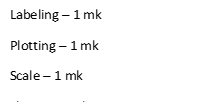
c) (i) – Shown in graph (½ mk)
– Correct reading (½ mk)
(ii) ∆T shown in graph – (½ mk )
Correct answer from graph – (½ mk)
d) ∆H = MC∆T = (23 + c(i) x 4.2 x c (ii) 1 mk
Correct answer
e) Moles = 1 x 23
½ = 0.023 moles ½
1000
f) Molar heat = 1 x ans. (d) 1
ans. (e)
= Correct answer. 1
Observation | Inferences | |
a) | Colourless solution forms 1 | Soluble salt/ Absence of coloured ions /Fe2+, Fe3+, Cu2+ absent 1 |
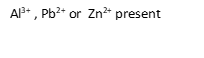
b) | White ppt 1 soluble 1 in excess | Ba2+, Pb2+, Zn2+, or Al3+ present.1 |
c) | White ppt. insoluble in excess. 1 | Ba2+, Pb2+, or Al3 present. 1 |
d) | No white ppt. // no ppt. 1 | SO42- absent. 1 |
 CALCULATIONS
b. (i) Moles of soltn P = average titre x 0.2 ½ mk
 1000
1000
= correct Ans. ½mk
 b. (ii) NaOH(aq) + HCL(aq) Nacl (aq) + H2O (l)
 Mole ratio= NaOH: HCl is 1:1
Moles of NaOH soln S = 1 x Ans. b(i) ½mk
1
= corr. Ans.
b. (iii) 25cm3 soltn. S = Moles in Ans. b(ii)
100cm3 soltn. S = ?
= 100 x Ans. b(ii) ½mk
 25
25
=Correct Ans. ½mk

 (c) 100cm3 soltn S Moles in Ans. b(iii)
200cm3 Soltn S 200 x moles in Ans. b(iii) ½mk
100
moles in 25cm3 NaOH = 200 x moles in Ans. b.(iii) ½mk
 100
100
 = 2 x moles n Ans. b(iii)
= Correct Ans. ½mk
(f) Moles of R in 25cm3 = Ans. (e)
Moles of R in 1000 = ?
= 1000 x Ans (e) ½mk
25
= corr. Ans. ½mk
(g) (i) Molar mass of H2SO4 = 49 x 1
Moles in (f)
= Corr. Ans.
(g) (ii) Let R.A.M of A be equal to a
2 + a = Ans. g(i)
a = Ans. g(i) – 2
= Corr. Ans.
2. (a) Table III…………………………………….. .
– Distributed as follows:-
Complete table …………………
– All columns filled 1mk
– Any 4 correctly filled ½mk
– Otherwise penalize fully
Accuracy……………..
Compare candidate’s initial temperature with S.V; if with 0.2 units award 1mk,
otherwise penalize fully.
Trend……………………1mk
Award 1mk for, increase then constant
(b) Award 4mks distributed as follows
Correct labelling……………1mk
Correct plotting……………1mk
Curve/line…………………….1mk
Appropriate scale…………1mk
. 4mks
(c) (i) Award 1mk for correct reading
(ii) Highest temperature-initial temp = corr.ans.
 (d) Heat change = MCT (½mk)
= corr Ans (½mk)
(e) No. Vol. from highest temp change
(f) Moles used = vol. in (e) x 10
1000
 = Corr. Ans.
Moles in (f) produce heat change (d)
I mole = ?
= 1 x Heat change in (d)
 Moles in (f)
= Correct answer (½mk)
3. (a) Observations Inferences
 – Dissolves ½mk to form a colourless – Absence of coloured ions e.g. Cu2+, Fe2+, Fe3+
Solution ½mk
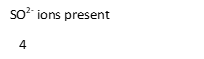
i) To the first portion, add Nitric acid followed by Barium nitrate solution.
Observations Inferences




ii) To the second portion, add Nitric acid, followed by lead(ii) Nitrate solution

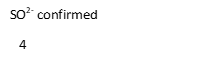 Observations Inferences
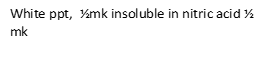


 iii) To the third portion, add a few drops until in excess

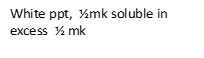 Observations Inferences

iv) To the fourth portion, add a few drops until in excess

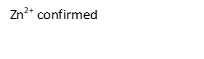
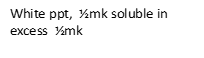 Observations Inferences


1 Comment