
CHAPTER SEVEN HEAT TRANSFER
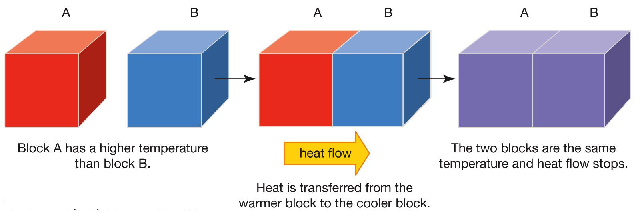
Heat is transferred in matter through the following methods: conduction, convection, and radiation.
Conduction
This is the transfer of heat in solids. The rate of conduction depends on:
- Amount of temperature – the higher the temperature, the higher the rate of transfer.
- Cross-sectional area – the larger the cross-sectional area, the higher the transfer.
- Length of material – the shorter the material, the higher the rate of transfer.
- Type of material – different materials transfer heat at different rates.
Good and bad conductors
Conductivity is the ability of a material to conduct heat. Good conductors of heat are those materials which are able to transfer heat easily and steadily. Bad conductors are those which do not conduct heat well.
Experiment: Comparing thermal conductivity of metals
Procedure
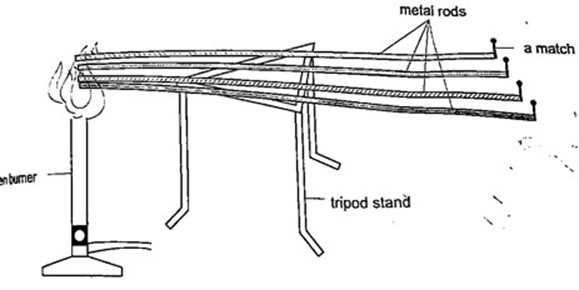
- Obtain four identical rods of copper, iron, aluminium, and brass.
- At one end of each rod, attach a matchstick using paraffin wax and let it solidify.
- Place the rods on a tripod stand with the free ends close to one another as shown.
- Heat the free ends strongly with a Bunsen burner.
- Observe what happens.
Discussion
When done correctly and carefully, the matchsticks will fall off in the following order: copper, aluminium, brass, and finally iron. This shows that different metals conduct heat at different rates.
NOTE – On a cold morning, a metallic chair feels cold compared to a wooden chair at the same temperature because the metallic chair absorbs heat from your body, whereas wood is a poor conductor of heat.
Applications of conductors
Good conductors
- Used to manufacture cooking utensils.
- Used as liquids suitable for thermometers, e.g., mercury.
- Used as heat sinks (metal clips) when soldering delicate components in a circuit board, e.g., transistors.
Poor conductors
- Used as insulators in handles of cooking utensils.
- Used in making good winter clothes, e.g., wool.
- Hot water cylinders are lagged with fiberglass since glass is a poor conductor of heat.
- Houses in cold countries have double walls with air trapped in them to keep them warm.
Convection
This is the transfer of heat through fluids (liquids and gases). This occurs when part of the fluid is heated: it becomes less dense and rises above the cold fluid. As it moves, it carries heat with it. In convection, we observe streams of moving fluid called convectional currents.
Convection in air
Experiment: model chimney (smoke box)
Procedure
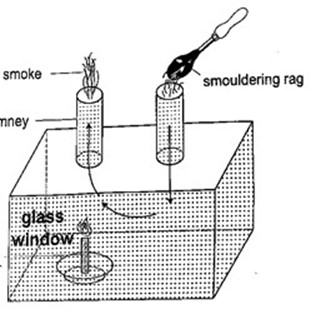
- Obtain a model chimney system or construct one as shown.
- Place a lighted candle under one of the chimneys.
- Place a smouldering cloth near the other chimney and observe what happens.
Discussion
Smoke will be seen going into the chimney and coming out through the other chimney. The air above the candle gets heated and rises up the chimney causing convectional currents which carry the smoke out with them.
Experiment: revolving paper-vane
Procedure
- Make a paper-vane by cutting a thin card as shown.
- Put a string through the hole in the centre and hold it above a lighted Bunsen burner.
- Observe what happens.
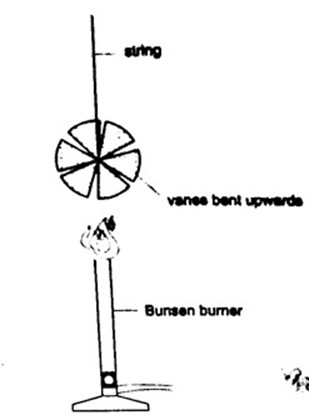
Discussion
As the air above the flame gets heated, convectional currents are formed and rise upwards. As these currents brush against the paper-vane, it rotates.
Convection in liquids
Experiment: heating water in a beaker
Procedure
- Put water in a beaker until it is three quarters full and place it on a tripod stand.
- Drop a crystal of potassium permanganate through a tube to settle at one corner at the bottom of the beaker.
- Heat the water gently using a Bunsen burner and observe the movement of streams of colour.
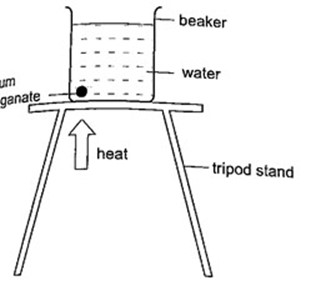
Discussion
A stream of colour will be seen moving upwards and downwards again at the other side of the beaker. This will continue gradually until all the water becomes coloured. This shows that convectional currents also exist in liquids.
Experiment: model of hot water system
Procedure
- Obtain two flat-bottomed flasks and set up the apparatus as shown below.
- Hold the flasks in place using clamp stands.
- Heat the bottom of the lower flask and observe what happens.
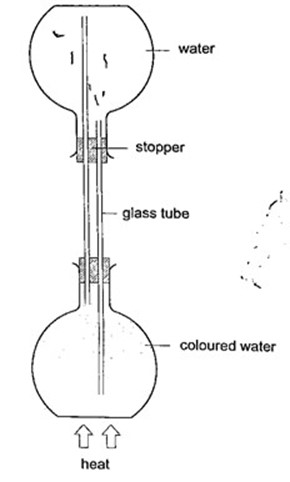
Discussion
When the water in the lower flask becomes hot, it rises up to the upper flask. After some time, the water in the upper flask will become hot due to convectional currents.
Applications of convection
- Brings about the land and sea breezes.
- Can be used to explain weather phenomena.
- Used in car radiators.
- Used in immersion water heaters by placing them at the bottom.
Radiation
This is simply the flow of heat from one point to another by means of electromagnetic waves.
Radiation from different surfaces
We use the Leslie cube to determine radiation of different surfaces. It is a rectangular metal container of square base with a small opening at the top. One side is coated with polished silver, another dull black (candle flame soot), the other grey, and the fourth white.
Experiment: Radiation from different surfaces
Procedure
- Place a Leslie cube on a tripod stand and attach a thermometer on each of the four sides.
- All thermometers should be at least 5.0 cm from the surface and should read the same temperature.
- Pour hot water (about 80 0C) until it is full and note the reading of each thermometer after 1 minute.
- Repeat the above procedure using boiling water (100 0C).
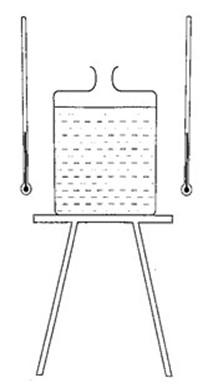
Discussion
The thermometer against the black surface records the highest temperature, followed by the one on the grey side, then the white surface, while the polished side recorded the lowest temperature. The readings when the water is boiling were higher, indicating that radiation depends on temperature. It also depends on the nature of the surface.
Applications of radiation
- Electric kettles have a chrome coat to reduce radiation.
- Electric irons are silver coated to minimize radiation.
- Greenhouses use radiation (heat trap) to grow crops.
- Clouds reflect radiation back to the earth; hence cloudy nights are warmer than clear nights.
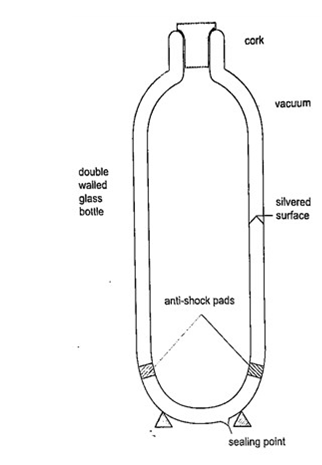
Vacuum flask
It was developed by Sir James Ivar in 1890. It keeps a liquid hot or cold (depending on what is put in). The liquid stays at the temperature it is poured in, either hot or cold. It has the following principal features:
- The vacuum between the double walls.
- The two interior walls coated with silver.
- Insulating cork supports (anti-shock pads).
- Insulating cork stopper at the top.