

Metals Questions
1. The following diagram represents extraction of sodium by the Down’s cell
(a) Why is the anode made of graphite in this case instead of steel which is a better conductor
of electricity?
(b) How are the electrolytic products separated from reacting?
(c) Give reasons why large quantities of electricity is required for this process
2. a) Give one environmental hazard associated with the extraction of zinc metal
b) Suggest one manufacturing plant that can be set up near zinc extraction plant. Give
reasons for your answer
c) What properties of aluminium and its alloys make it suitable for use in making aircraft parts
3. Aluminium is used in making overhead cables. State two properties of aluminium that
makes it suitable for this use
4. The stages shown in the following diagram can be used to extract zinc from its oxide:-
Name the stage and the process taking place in it:-
Name each sage and the process taking place in it:
Stage 1…………………………………………………………………………………………………………….
Stage 2…………………………………………………………………………………………………………….
Stage 3…………………………………………………………………………………………………………………..
5. Study the flow chart below and answer the questions that follow:
(a) Name gas Q …………………………………………………………… .
(b) With the help of diagram, describe how step (V) is carried out
6. Name the following compounds using IUPAC system
(i) CCl4
(ii) HOCl
7. Study the information provided:-
Element | Atomic radius (nm) | Ionic radius (nm) | Melting point of oxide (oC ) |
W Y Z | 0.381 0.733 0.544 | 0.418 0.669 0.489 | -117 849 1399 |
(a) Explain why the melting point of the oxide of W is lower than that of the oxide of Z
8. The flow chart below shows steps used in the extraction of zinc from one of its ores.
(a) Name the process that is used in step 2 to concentrate the ore
(b) Write an equation for the reaction which takes place in step 3
(c) Name one use of lead
9. Name the chief ores from which the following metals are extracted
a)Aluminium ……………………………………………………………………
b) Copper ………………………………………………………………………
10. The diagram below represents the second stage in extraction of aluminium metal
i) On the diagram label the: Anode, cathode and the electrolyte region (s)
ii) The melting point of aluminium oxide is 2054ºC, but the electrolysis is carried out at between
800-900ºC
a) Why is the electrolysis not carried out at 2054ºC
b) What is done to lower the temperature?
iii) The aluminium which is produced is tapped off as a liquid .What does this suggest about its
melting points?
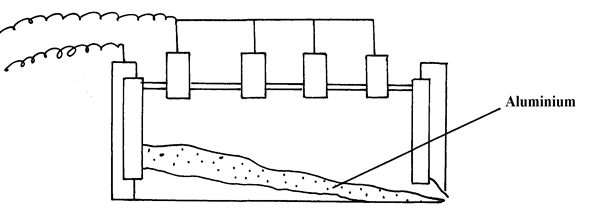
11. The extraction of aluminium from its ore takes place in 2 stages. Purification stage and electrolysis stage. Below is set-up for the electrolysis stage:-
(a) (i) Name the chief ore from which aluminium is extracted
(ii) Name one impurity which is removed at the purification stage
(b) (i) Label on the diagram each of the following:-
I – Anode
II- Cathode
III- Region containing electrolyte
(ii) The melting point of aluminium oxide is 2054oC but the electrolysis is carried out at between
80oC and 900oC
I. Why is not carried out at 2050oC
II. What is done to lower the temperature
12. Aluminium is the most abundant metal in the earth crust and it is widely extracted for
its wide range of uses.
(i) Name one major ore of aluminium and give its formula
(ii) Name two main impurities found in the ore
(iii)Aluminium oxide is heated first before it is electrolysed. Explain
(iv) Electrolysis of aluminium oxide is done as shown below:
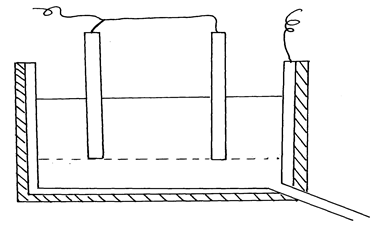
(a) Identify the anode and cathode on the diagram
(b) What is the role of electrolyte in the extraction ?
(c) Write half equations for the reactions that occur at the anode and cathode
(d) State two uses of aluminium
13. The diagram below is a flow chart for the extraction of copper. Study it and answer the questions
that follow:

(a) Write the formula of the major ore of copper metal
(b) Name process II
(c) Give an equation for the reaction that occurs in stage III
(d) Explain what happens in stage IV
(e) Write half cell equations occurring at the anode and cathode in stage VII
(f) Draw a simple diagram showing the set-up that is used in electrolytic purification
of copper
(g) A green rocky materials suspected to be the ore malachite CuCO3. Cu (OH)2.
14. The flow chart below illustrates the extraction of Zinc. Study it and answer the questions that follow:
a) Name:-
i) Gas Q …………………………………………………………………..
ii) Liquid R .……………………………………………………………………………………………………..
(iii) Residues S ………………………………………………………………………………………………..
b) Name the sulphide ore used
c) Before the ore is roasted, it is first concentrated;
(i) Explain why it is necessary to concentrate the ore
(ii) Explain briefly the process of concentrating the ore
d) Write an equation for the reaction that takes place in the:-
(i) Roaster
(ii) Reaction chamber
(e) (i) Name one major impurity present in the sulphide ore used
(ii) Write an equation to show how the impurity in (e)(i) above is removed
f) Given that the sulphide ore contains only 45% Zinc sulphide by mass, calculate :
(i) The mass in grams of Zinc sulphide that would be obtained from 250kg of the ore.
(ii) The volume of Sulphur (IV) oxide that would be obtained from the mass of sulphide
ore at room temperature and pressure
(Zn = 65.4, S = 32.0, O= 16.0, I mole of gas occupies 24.0 liters at r.t.p)
15. The flow chart below represents the extraction of zinc from its ore and a by-product used in the
manufacture of sulphuric (VI)acid. Study it and use it to answer the questions that follow:-
a) Name;
i) The suitable zinc ore used.
ii) The main impurity in the ore
b) Describe how zinc ore is concentrated
c) Write an equation for the reaction taking place in the roasting furnace
d) Describe what happens in the reduction chamber
e) Identify substances:-
W…………………………………(½mk) M………………… (½mk)
f) Write the equation for the reaction that occurs in chamber N.
g) Explain why sulphur (VI) oxide is not dissolved directly in water
h) Explain the danger caused by this process to the environment
(2 marks)
16. The diagram below is for extraction of Aluminium from its ore. It takes place in stages.
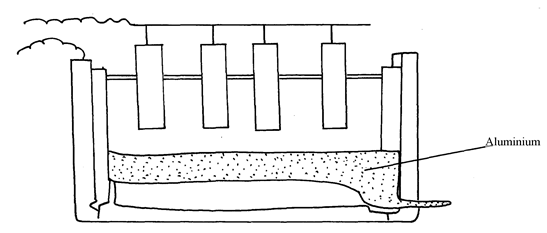 Use it to answer the questions that follow:-
(a) Name the two stages mentioned above *
(b) Name:-
(i) The ore from which Aluminium is extracted
(ii) The impurities removed during the extraction of Aluminium *
(c) On the diagram label:-
(i) The electrodes *
(ii) The region containing the electrolyte *
(d) Molten cryolite is added to Aluminium Oxide during extraction. Explain *
17. A current of 3A was passed through fused aluminium oxide for 10minutes. Calculate
the mass of Aluminium obtained at one electrode (Al = 27.0, IF = 96500C) *
18. (a) Name one ore that can be used to commercially extract Zinc metal
(b) The flow chart below illustrates the extraction of zinc and preparation of zinc sulphate
crystals.
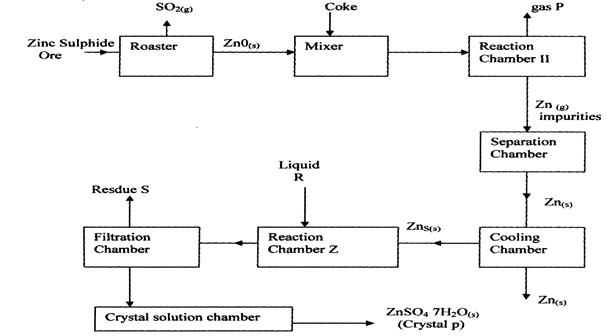

(i) Name :
(1) Gas P …………………………………………………………………………………..
(11) Liquid R ………………………………………………………………………………..
(III) Residue S ………………………………………………………………………………..
(ii) What is the role of coke in the above process?
(iii)Name the main impurity removed in the separation chamber
(iv) Write an equation for the reaction that takes place in
(1). Roaster
(11). Reaction chamber II
(v) Write an equation for the reaction that takes place between Zinc metal and liquid R
(vi) Given that zinc Suiphide ore contains only 45% of zinc Suiphide by mass, calculate
the mass in grams of zinc Sulphide that would be obtained from 250kg of the ore .
(vii) Give one commercial use of Zinc metal
Study it and answer the questions that follow:-
a) In step 1, excess 3M hydrochloric acid was added to 0.5g of Zinc powder
i) State two observations which were made when the reaction was in progress
ii) Explain why hydrogen gas is not liberated when dilute nitric acid is used in step 1
iii) a) Write the equation for the reaction that took place in step 1
b) Calculate the volume of 3M hydrochloric acid that was needed to react completely with
0.5g of Zinc powder (Zn = 65.0)
20. The diagram below is a simplified apparatus for extraction of sodium. Study it and answer the
 equations that follow:-
(a) Which substances come out at:- P & Q
(b) What is the role of the diaphragm
(c) Write the equation of the reaction forming sodium
21. The set-up below was used to investigate electrolysis of a certain molten compound;-

(a) Complete the circuit by drawing the cell in the gap left in the diagram
(b) Write half-cell equation to show what happens at the cathode
(c) Using an arrow show the direction of electron flow in the diagram above
22. (a) Name two ores from which Zinc metal is mostly extracted
(b) One of the steps in the extraction of Zinc metal from its ore is roasting of the ore in excess
oxygen. Write equations for the reactions that take place when the ore in (a) above is roasted
23. Aluminum metal is mainly extruded from molten Bauxite by electrolysis.
a) Name the main impurity in this ore.
b) Briefly describe how the impurity is removed from the ore before electrolysis process. (2 mks)
24. (a) In the extraction of aluminium form its ore by the use of electrolysis, explain the
following observations:-
(i) the graphite anode is replaced from time to time
(ii) the steel tank which can also serve as an electrode is also lined with graphite cathode
(b) Sodium and aluminium metals both conduct electricity, but aluminium is a better
conductor of electricity than sodium. Explain
5. Metals Answers

 1. a) chlorine gas would react with steel anode
b) Hood and steel gauze prevent chlorine sodium, from anode and cathode from mixing
and reacting.
- Sodium metal is less dense, floats on motten brine where it is siphoned out.
c) -To Whom It May Concern: melt the ore, rock salt
– For electrolysis of the molten ore
2. a) SO2(g) is produced as a by- product, this mixes with rain water producing acid rain which
may corrode buildings and affect plants ½
SO2(g) is poisonous when inhaled ½
b) – H2SO4 manufacture – to make use of SO2 (g)
– Manufacture of dry cells – make use of zinc
– Production of iron sheets which are galvanized using zinc (Any one with an explanation)
c) Low density, does not corrode easily, duchle, malleable (Any 2 each ½ mark)
 3. Aluminium is lighter/low density. (any)
It is a good conductor of electricity

 4. Stage 1 – oxidation; Coke is oxidized to CO

 Stage 2 – Reduction: zinc is reduced to Zinc metal
Stage 3;- Recycling stage; CO2 is reduced to regenerate CO
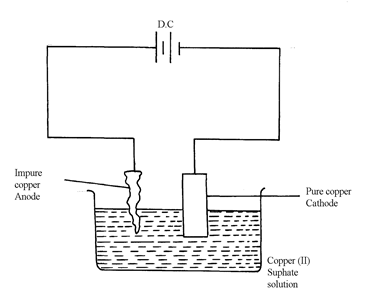 5. a) Q is sulphur (IV) oxide SO2(g). √1
b)
– Impure copper is the while pure copper is cathode. During electrolysis impure copper is purified and pure copper deposited on the cathode as shown in the half electrode reaction below;
CATHODE EQUATION:
Cu2+ + 2e Cu(s) √½
- The cathode is therefore removed and replaced after an interval.
6. (i) I-I-I-tetrachloromethane /Tetrachloromethane
 (ii) Chloric (I) acid
7. Oxide of W has simple molecular structure while that of Z has giant ionic structure
8. (a) Froth floatation. √1 (1 mk)
(b) PbCO3(s) PbO(s) + CO2(g) (1 mk)
(c) Making of pipes/lead acid accumulators. √1 (any one) 3
9. a) bauxite√
b) Copper pyrites √
10. i)
ii) I It’s uneconomic// Expensive// a lot of energy is required to produce this
high temperature
II Addition of cryolite ½ mark
iii) The melting point is below 800 C ½ mark
11. (a) (i) Bauxite
 (ii) Iron (III) Oxide
Silica (any one)
 (b)(i) On the diagram
 (ii) It is expensive /a lot of energy will be used
(iii) The ore is dissolved in cryolite (NaAlF6)
12. (i) Bauxite – Al2O3. H2O
(ii) Iron II oxide
– Silica
(iii) Being ionic, it is only an electrolyte in its molten state. Heating helps to melt it.
(iv) (a) – The two rods represent the anode.
– Cathode is the inner lining of the wall.
(b) As an impurity, lowering the melting point of aluminium oxide.
(c) Anode 2O2-(l) O2(g) + 4e–
Cathode Al3+ + 3e– Al(l)
d) – manufacture of household utensils
– making cables for electricity transmission
– making foils used as wrappers
– extraction of some metals e.g. manganese
– Making aeroplane parts
Describe how you would establish the presence of copper in the ore
13. (a) CuFes2
(b) Froth floatation
(c) 2CuFeS(s) + 4O2
(g) + Cu2S + 2FeO(s) + 3SO2 (g)
(d) Silica is added which reacts with iron (II) Oxide to form iron (II) silicate which forms
part of slag or SiO2 is added
(e) Anode Cu(s) Cu2+(aq) + 2e–
Cathode Cu2+(aq) + 2e- Cu(s)
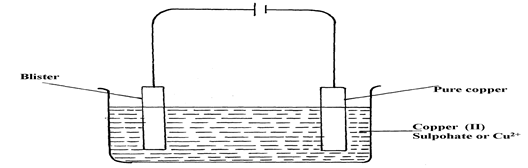
(g) – Add HNO3 to the ore
– Filter and place small portion of the filtrate into a test tube
Add NH4OH until in excess – deep blue solution confirms the presence of Cu2+ions
14. (a) (i) Gas Q- Carbon (II) Oxide
(ii) Liquid R- dilute sulphuric acid
(iii) Residue S – excess Zinc metal
(b) Zinc blende
(c) (i) To increase percentage of Zinc in the ore
(ii) The ore is crushed, mixed with water and oil and then air is blown into the mixture.
(d) (i) 2ZnS(s) + 3O2(g) ZnO(s) + 2SO2(g)
(ii) Zn(s) + H2SO4(aq) ZnSO4(aq) + H2(g)
(e) (i) – Lead (II) sulphate //Pbs
– Silica //silicon (IV) oxide// SiO2
(ii) Lead (II) sulphide
2PbS(s) + 3O2(g) 2PbO(s) + 2SO2(g)
(f) (i) 45 x 250000
100
= 112,500g of ZnS
(ii) Rmm of ZnS = (65.4 + 32) – 97.4g
From the equation
The mole ration of Zn of ZnS: SO2 = 1:1
97.4g of ZnS = 24dm3 of SO2 at r.t.p
112,500g of ZnS = 112,500 x 24
97.4
= 27,720. 73920dm3 of SO2
15. a) i) Zinc Blende (Penalize for formula only)
ii) Lead II Sulphide
b) It is concentrated by froth floatation where the ore is crushed or ground, a detergent
added and the mixture agitated. Zinc sulphide floats and is collected
c) 2ZnS(g) + 3 O2(g) __________ 2 ZnO(g) + 2SO2(g)
d) Zinc oxide is reduced by both carbon and carbon (ii) Oxide to zinc vapour. Lead (ii) Oxide is
also reduced by both carbon and carbon (ii) Oxide to lead liquid
Accept equations
ZnO(g) + C(s) ___________ Zn(g) + CO (g)
ZnO(g) + CO(g) __________ Zn(g) + CO2(g)
PbO(g) + C(s) ____________ Pb(L) + CO(g)
PbO(s) + CO _____________ Pb(L) + CO2(g)
e) W = Sulphur (vi) Oxide // SO3(g)
M= Conc. Sulphuric (Vi) acid // H2SO4(L)
f) H2S2O7(L) + H2O(L) ___________ 2H2SO4(L)
g) The process is highly exothermic and heat produced boils the acid leading to acid mist
which cannot be condensed easily because it is highly unstable
h) The sulphur (iv) Oxide dissolves in water to form acid rain which corrodes buildings and
affects aquatic life
16. (a) Purification and concentration.
(b) (i) Bauxite
(ii) Iron (III) Oxide /Silicon (IV) Oxide
(c) On diagram
(d) Lowers the melting point of the ore from 20150c – 9000c.
17. ) Q = It = 3 x 10 x 60 = 1800
3F = 3x 96500c = 27g
1800c = 1800 x 27
3 x 96500
= 0.16788g
18. a) Zinc blende
b) i)
I- carbon IV oxide
II – Dil sulphuric acid
III – unreacted zinc
ii) To reduce zinc oxide to zinc metal
iii) Silica
iv)
I 2ZnS + 30 ________ 2ZnO(s) + 250 2(g)
II 2ZnO(q) + C(g) ________ 2Zn(q) + CO2(g)
v)Zn(g) + H2SO4(aq) ________ ZnSO4(aq) + H2(g)
vi) 45/100 x 250 = 112.5×1000 = 112500g
= 112.5 Kg
vii) – Used to make brass
– Used to make electrodes in dry cells
– Galvanize iron sheets
19. a) i) – Effervescence, a colorless gas is produced
– Grey solid dissolves, a colorless solution is formed
ii) Nitric acid is a strong oxidizing agent. It will oxidize the hydrogen gas formed to
form water instead
iii) I Zn(g) + 2HCl(aq) _________ ZnCl2(aq) + H2(g)
II Moles of Zn = 0.5g = 0.007692
65.0
Moles of HCL = 0.007692 X 2 = 0.015384
3 moles of HCl has 1000 cm3
0.015384 moles has 0.015384 X 1000cm3
3
= 5.182cm3
20. (a) P – Chlorine ( ½ )
Q – Sodium (½)
(b) Prevent reaction between sodium and chlorine
(c) Na+(l) + e– Na(l)
 21. (a)
(b) Pb2+ (l) + 2e– Pb(s)
 (c)
(c)
22. a) zinc blende√ ½
Calcium √ ½
b)2ZnS(s) + SO2(g) 2 ZnO (s) + 2 SO2 (g)√ 1 (penalize ½ if states are missing)
ZnCO3 (s) ZnO (s) + CO2(g)√1 (penalize ½ if states are missing)
23. a) Iron III hydroxide
b) Concentrated sodium hydroxide is added at 4 atm pressure to the Bauxite at 160C
AL203 dissolves in the sodium hydroxide leaving the iron III oxide as a solid
24. a) i) The oxygen produced at the anode reacts with hot carbon to form carbon (iv) oxide hence
corrodes it therefore needs replacement
ii) Graphite is inert and a poor conductor of heat hence helps to conserve heat
b) Aluminum has more number of valency electrons which are delocalized


