


Introduction to chemistry Questions
1. Wooden splints F and G were placed in different zones of a Bunsen burner flame.
The diagram below gives the observations that were made
(a) Explain the difference between F and G
(b) Name the type of flame that was used in the above experiment
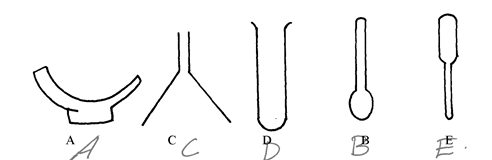 2. The diagrams below represent a list of apparatus which are commonly used in a chemistry laboratory:-

(a) Give the correct order of the apparatus, using the letters only, to show the correct arrangement
that can be used to prepare and investigate the nature of PH of a sample of onion solution
(b) Name one chemical substance and apparatus that is needed in this experiment
3. (a) When the air-hole is fully opened, the bunsen burner produces a non-luminous flame.
Explain
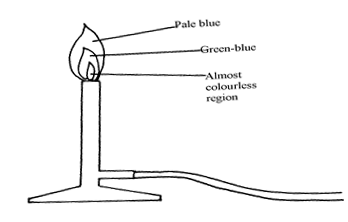
(b) Draw a labelled diagram of anon-luminous flame
4. (a) What is a drug?
(b) Give two drugs that are commonly abused by the youth.
5. The diagram below shows three methods for collecting gases in the laboratory
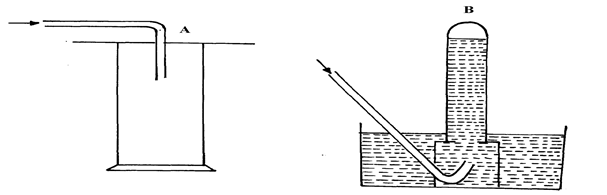
(a) Name the methods A and B
(b) From the methods above, identify one that is suitable for collecting sulphur (IV) oxide.
Explain
6. A mixture of hexane and water was shaken and left to separate as shown in the diagram below:
State the identity of;
(i) P ………………………………..…….. (ii) W ………………………………….….
7. The diagrams below are some common laboratory apparatus. Name each apparatus and
state its use
Diagram | Name | Use |
| (½mk ) | (½mk) |
| (½mk) | (½mk) |
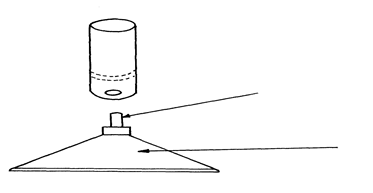 8. The diagram below shows some parts of a Bunsen burner


Explain how the parts labelled T and U are suited to their functions
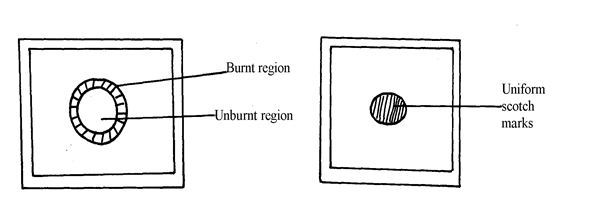 9. The diagram below shows the appearance of two pieces of paper placed in different parts of a
non-luminous flame of a Bunsen burner and removed quickly before they caught fire.
(a) What do the experiments show about the outer region of the flame?
(b) From the above experiment, which part of the flame is better to use for heating?Give a reason
10. A crystal of copper (II) sulphate was placed in a beaker of water. The beaker was left standing for
two days without shaking. State and explain the observations that were made.
11. Study the information in the table below and answer questions that follow.
(Letters given are not real symbols)
Ions | Electron arrangement | Ionic radius (nm) |
A+ B+ C2+ | 2.8 2.8.8 2.8 | 0.95 0.133 0.065 |
Explain why the ionic radius of :-
(a) B+ is greater than that of A+
(b) C2+ is smaller than the of A+
1. Introduction to chemistry Answers
1. a) F is place in the middle of the flame while G is placed at the upper region of the flame
b) Non- luminous flame
2. . A,D,C,B, and C all correct
A,D,C,D correct answers are exclusive
A,D,C ½ mk otherwise penalize
3. a) The laboratory gas burns in excess oxygen
OR burns completely or produces CO2 and H2O only
– No unburnt carbon remains
 OR No soot is formed// Produced.
b)
4. a) a substance which when taken alters the body chemistry
b) – alcohol
– Tobacco
 5. (a) A- Downward delivery /upward displacement of air
B – Over water
(b) A – Denser than air
6. (i) P – Haxane
(ii) W – Water
7. Name – Mortar. √½
Use – Holding solid substances being crushed. √½
Name – Crucible √½
Use – Holding solid elements being heated strongly. √½
 8. T – has a very small hole which releases the gas in small quantities /in form of a jet.
U – It is heavy for stability
9. (a) It is very hot. (1 mk) √1
(b) The upper√1 part. Because all the gases undergo complete √1 combustion. √1 (2 mk) 3
10. The crystal dissolved√ ½ . Blue colour spreads in water √ ½ . The crystal broke up into
smaller particles of copper (ii) sulphate and diffused in all direction
11. (a) W has more energy levels than S. √1
(b) C has got (12) protons pulling the 10 electrons while A has 11 protons
2 pulling 10 electrons. √1


