


Hooke’s law Questions
1. The following results were recorded in an experiment where different masses were hung on the
end of a long spring whose other end was firmly fixed. The length of the spring and the mass
hanging from it were recorded as below. Original length of spring was 40cm.
Length of spring (cm) | 44 | 48 | 52 | 56 | 60 | 65 | 70 | 74 |
Mass attached (kg) | 0.15 | 0.30 | 0.45 | 0.60 | 0.75 | 0.90 | 1.05 | 1.20 |
Force (load) on the spring (N) | ||||||||
Extension of spring (m) |
(a) Complete the table for load and corresponding extensions
(b) Plot a graph of extension of the spring against load on the spring on the grid provided
(c) Determine the spring constant using the linear section of the graph
(d) Give an explanation why the slope of the graph changes when a mass greater than 0.75kg is
attached to the spring
(e) From the list of quantities below, select quantities that are vector quantities:-
speed, density, force, acceleration and current
2. Sketch a graph of length of a helical spring against compressing force until the coils of the
spring are in contact
3. The three springs shown in figure 2 are identical and have negligible weight. The extension
produced on the system of springs is 20cm

Determine the constant of each spring
4. The graphs in figure 8 represents the relations between extension e and mass, m added on two springs x and y

Given that the two springs are made from the same material, give a reason why the graphs
are different
5. A single light spring extends by 3.6cm when supporting a load of 2.5kg. What is the total extension in the arrangement shown below. (Assume the springs are identical)
6. Three identical springs with proportionality constant of 50N/m. each are connected as shown
below and support a load of 60N
Calculate;
(a) The extension in one spring
(b) The extensive proportionality constant of the springs
7. When a load of 20N is hung from a spring, the spring has a length of 15 cm. The same spring
has a length of 17 cm when supporting a load of 25N. Determine the spring length when
supporting no load.
The figure below shows a U-tube manometer. Use it to answer question 5 and 6. Density of
water = 100 kgm-3.
8. The diagram below shows three identical springs which obey Hooke’s law.

(i) Determine the length X.
Hook’s law Answers
Mass attached (kg) | 0.15 | 0.30 | 0.45 | 0.60 | 0.75 | 0.90 | 1.05 | 1.20 |
Force (load) on the spring(N) | 1.5 | 3.0 | 4.5 | 6.0 | 7.5 | 9.0 | 10.5 | 12.0 |
Extension of spring (m) | 0.04 | 0.08 | 0.12 | 0.16 | 0.20 | 0.25 | 0.30 | 0.34 |
1. 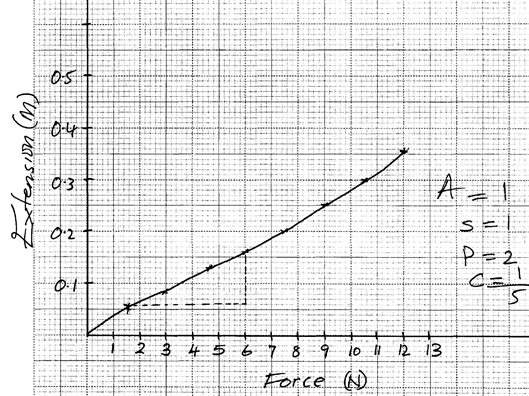
(c) slope = 0.16 – 0.05 = 0.11 = 0.02683
6.0 – 1.9 4.1
Spring constant = 1
0.02683 = 37.27Nm-1
(e) – Force
– Acceleration
2.
3. F1 = Ke1 = 40 = Ke1
e1 = 40
K
F2 = Ke2 = 20 = Ke2
K K
e2 = 20
K
 but e1 + e2 = 20
40 + 20 = 20cm
K K
 60 = 20k
K = 3N/cm
4. Diameter of coils/ Thickness/ No. of turns per unit length / length of spring are different 1
5. Upper springs, e = 3.6
3
Middle springs , e = 3.6 = 18cm
2
Lower springs, e = 3.6 = 3.6cm
1
Total extension = 1.2 + 1.8 + 3.6
= 6.6cm
6. a) Load on each spring = 60/3
= 20N
Extension (e) in one spring = F/K for one spring
= 20/50
= 0.4m
b) The effective constant (K)
= K1 + K2 + K3
= 3(50)
= 150N/M
7. A load of (25 – 20)N causes extension of (17 – 15) cm.
i.e. 5N causes extension of 2 cm 1
20N = ?
20 N x 2 cm = 8 cm 1
 5 N
5 N
When no mass is hung.
Length of the spring = 15cm – 8ch
= 7 cm 1
a) Uniform velocity :- The change in displacement for equal time intervals is the same.
Uniform acceleration:- Change in velocity for equal time intervals is the same.
b) Determine the acceleration of the trolley pulling the tape
Va = 2 = 100cm/s Vb = 3 = 150 cm/s a = V-U
0.02 0.02 t
= (150 -100)/ (7X0.02 – 0.02)
a = 416.67 cm/s2
c) i) Determine the motion of the ball relating it to its different positions along the following
I AB the body is projected upwards and at B V = O
II BC the body falls back to the starting point (moving in the opposite direction)
III CE the body be rebounds on the ground (at starting point) and starts moving up again
ii) From the graph calculate the acceleration due to gravity
a = v-u a = -10m/s2
t = 10m/s2
= 0-20
2


