


WAEC WASSCE [SSCE] SYLLABUS FOR HEALTH EDUCATION
- PREAMBLE
This examination syllabus is drawn from the Senior School Health Education curriculum and directed towards empowering students to have correct, adequate and timely information that will make them acquire attitude and practices which will restore, maintain and promote positive health.
Since Health Education is skill-based and involves knowledge, belief, attitude and practices, evidence of involvement in practical work will be determined through practical test. It is therefore, essential that the examination syllabus is used in conjunction with the Teaching curriculum.
- OBJECTIVES
This examination syllabus is designed to assess the extent to which candidates have been able to:
- acquire basic knowledge of the human body and necessary skills for maintenance of health;
- acquire positive health practices in the school and community;
- identify and show the ecological relationship between man and his environment as a basis for preventing diseases;
- make observations and draw inferences from practical experiences that ay have implications for health;
- develop readiness necessary for professional training in health related careers.
3. SCHEME OF EXAMINATION
There will be three papers – Papers 1, 2, and 3, all of which must be taken. Papers 1 and 2 will be a composite paper to be taken at one sitting.
PAPER 1 – Will consist of fifty multiple choice objective questions, all of which must be taken in 1hour for 50 marks.
PAPER 2 – Will consist of two sections, Sections A and B.
Section A will consist of six short-structured questions, all of which must be answered for 30 marks.
Section B will consist of three essay questions out of which candidates will be required to answer two questions for 40 marks. The paper will last 1 hour.
PAPER 3 – Will be a practical test for school candidates and an alternative test of practical work for private candidates. The paper will last for 1¾ hours and carry 80 marks.
DETAILED SYLLABUS
CONTENTS | NOTES |
Organs and Systems. CONTENTS
circulation
(c) Digestive system
CONTENTS
(d) Excretory System
(e) Respiratory System
CONTENTS
(f) Nervous System:
Location of the different endocrine glands, the hormones produced and their functions.
4. Posture and Postural Defects.
(iii) Determination of correct postures (iv) Types of postural defects: Flat foot; scoliosis, kyphosis and lordosis CONTENTS
(v) Effects of incorrect posture on physical appearance, position and functions of body organs.
(ii) Neurosensory impairment (iii) Disorder of the skin (iv) Care of the eye, ear and skin.
| Students should visit to observe community, health facility and work place base, health education programmes and services. Structure of a typical animal cell and functions of its parts should be discussed. Differences between mitosis and meiosis should be emphasized. Mention should be made of epithelial, connective and muscular tissue, an organ and a system should be explained. NOTES
Accommodation should be discussed. Process of hearing and balancing should be discussed A chart/model of a human skeleton should be examined. Types of bones that make up the mammalian skeleton should be identified.
The three different types of muscles should be discussed in relation to their functions. Reference should be made to origin and insertion of muscles in relation to movement. NOTES Candidates should examine the heart of a dissected mammal. Pulse rate should be counted. The web of a toad/frog should be examined with a hand lens to observe the capillaries. The importance of lymph nodes should be mentioned. Prepared slides of blood should be observed under microscope. Pulmonary and systemic circulation should be emphasized. The relevance of these factors in relation to blood transfusion should be mentioned.
Candidates should examine the alimentary canal of a dissected mammal.The location and function of accessory organs of digestion should be emphasized. Digestive enzymes should be discussed in relation to substrates and end-product. NOTES
Importance of proper eating habits and the effects of over-eating and under-eating should be discussed.
Reference should be made to the excretory functions of the lungs. The use of dialysis machine for kidney failure should be mentioned. Candidates should examine the respiratory organs of a dissected mammals. Experiment to demonstrate the inhalation and exhalation of air should be performed. Total, compIemental and residual air should be explained. Experiment to show that expired air contains more carbon dioxide and water vapour should be performed. NOTES The brain, spinal cord and nerves should be discussed. The reflex arc should be studied.
Posture should be related to the following: sitting; standing; walking and lifting. The roles of nutrition and exercise as determinants of correct posture should be discussed.
Care of body parts including the teeth, mouth, hair, hands and nails should be discussed. The use of snellen chart for vision screening should be mentioned. The roles of eye specialist in the correction of the defects should be discussed. Otitis media should be mentioned The use of tuning fork; audiometer, guitar strings and wrist watch in auditory screening should be mentioned. Also, mention should be made of the sign language. NOTES Structure and functions of the different types of teeth should be discussed. Advantages and disadvantages of traditional medicine should be mentioned. Awareness campaign should be discussed. Both physical and biological environment should be discussed.
|






|
Antenatal care, immunization, oral rehydration therapy (ORT), breast feeding and safe motherhood should be discussed. Candidates should be able to define epidemiology, vital statistics and population dynamics. The importance and use of health records should be stressed. Effects of poor sanitation and pest infestation in home should be discussed. Effects of substandard housing on health should be discussed. Sources should include rain, borehole, rivers, streams, springs, well pond, pipe borne water Advantages and disadvantages of each method should be discussed. |
(i) Classes, sources and functions of food nutrients. (ii) Caloric value of food nutrients
(i) Components (ii) Effects of smoking on health.
(i) Air-borne/Respiratory diseases Common cold, measles, whooping cough, poliomyelitis, tuberculosis and cerebro-spinal meningitis, diphtheria. (ii) Water/food-borne diseases: Dysentery, cholera, typhoid fever and schistosomiasis, guinea worm (iii) Insect-borne diseases: Malaria, yellow fever, trypanosomiasis and filariasis (iv) Worm infection: (i) Ascarislumbricoides (round worm) (ii) Taeniasolium (tape worm) (iii) Ancylostomaduodenale (Hook worm) (iv) Dracunculusmedinensis (Guinea worm) (v) Animal-borne diseases rabies, leptospoirosis (vi) Contact diseases diseases;Gonorrhoea, syphilis, Tineapedis (athlete/foot), Taeniacapitis (ringworm) leprosy, scabies and Acquired immune Deficiency Syndrome (AIDS) (c) Factors necessary for communicable diseases to occur: (i) Causative agent (ii) Susceptible host; (iii) Transmission route (environment) (d) Non-communicable diseases: Types (i) Deficiency (scurvy, pellagra, rickets, Kwashiorkor, anaemia, beriberi etc) (ii) Diseases due to growth in cells, heredity and normal disorders (cancer, diabetes, epilepsy, haemophilia, heart disease, hypertension. Ulcer, mental illness, sickle cell, rheumatism, infertility, asthma, albinism etc.
| The need for health care and rehabilitation should be discussed. The need for health insurance schemes should be stressed. Students should be able to identify to differentiate between pests and vectors. Tests for starch, simple and complex sugars, proteins and fats should be carried out. Local example of sources of food nutrients should be mentioned. Caloric needs in relations to age, occupation and health condition should be discussed. Food deficiency diseases should be emphasized. Factors responsible for unbalanced diet and effects associated with poor diet should be discussed. Factors should include: availability, religion education, age, belief, health condition and cost The role of water in relation to nutrition should be discussed. Negative and positive effects should be stressed. Nutritional value of non-alcoholic beverages should be stressed. Charts should be used to show diets for the different groups of people. |
CONTENTS | NOTES |
5. Population Education (a) Meaning of population and population education. (b) Census and its problems (c) Small and large population
| Candidates should be able to distinguish between family planning and safe motherhood. Candidates should be able to distinguish between population and census. Advantages of accurate census should be discussed. Meaning and the interrelationship between emotional health and social health should be discussed. The attributes of emotional and social health should be discussed. Candidates should be able to identify personal problems and proffer solutions. Candidates should be able to state factors that promote mental health. Types, causes prevention and management of mental health should be discussed. Importance of mental and social health should be discussed.
Various agencies promoting consumers health should be discussed. Mention features of genuine products and services |




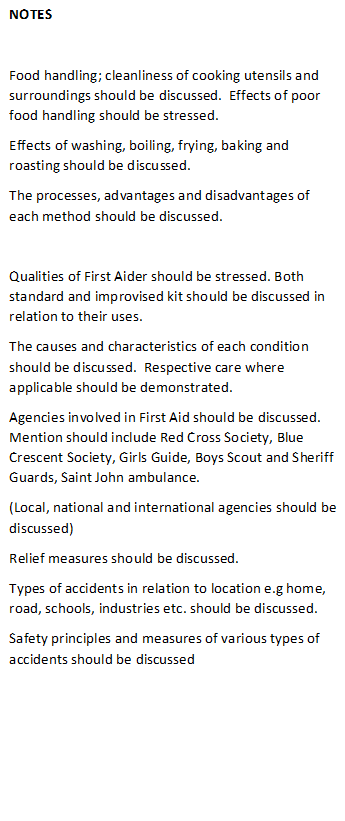


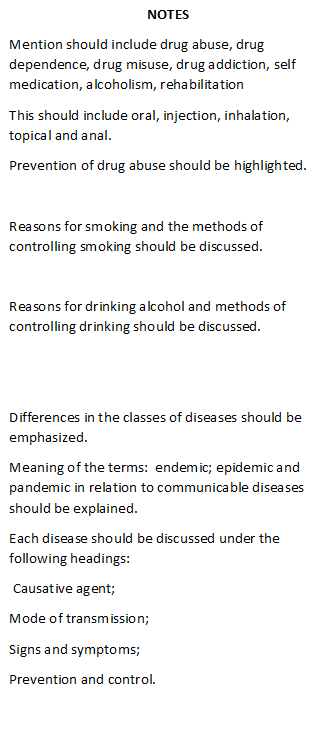


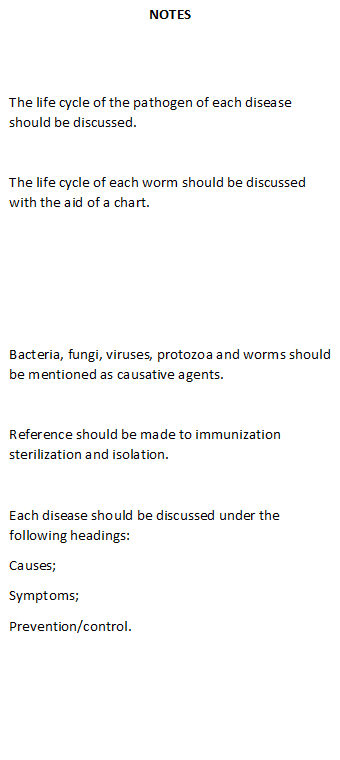


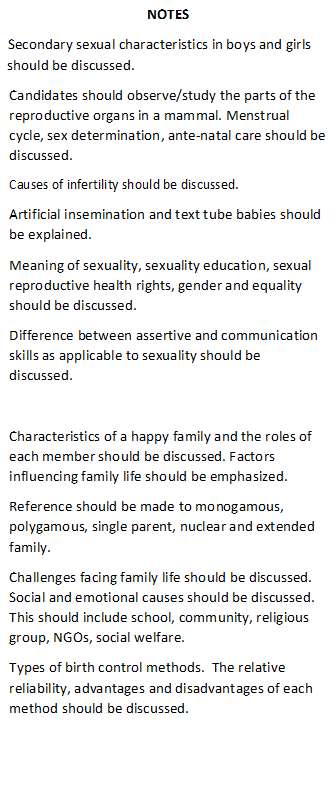


CONTENTS | NOTES |
| Various types of health services: traditional medicine, orthodox medicine, alternative methods of healing (acupuncture, yoga and faith healing) should be discussed.
Types should include:
|
Materials needed in Health Education Laboratory/Examination
- Models of various organs of the body;
- Models of various parts of the body e.g. tooth;
- Human skeleton;
- Bones of the body;
- Contraceptive devices;
- Reagents for testing of starch, protein, fat;
- Road safety signs;
- Different types of safety elements;
- Posters/charts of systems of the body e.g. reproductive, digestive, excretory;
- First aid box and kits;
- Fire extinguisher;
- Sand bucket;
- Photographs of health facilities and workers e.g. doctors , nurses, dentist at work;
- Photographs of methods of sewage and refuse disposals;
- Microscope
- Stethoscope
- Preserved worms;
- Preserved pests and vectors
- Photographs/posters of various types of communicable and non-communicable diseases;
- Model/poster showing parts of the body;
- Materials for personal hygiene e.g. toothpaste, comb, toothbrush;
- Dissecting set
- Photographs/posters of accident scenes;
- Photographs/posters showing methods of food preservation
- Photographs/posters showing disaster scenes;
- Safety;
- Photographs/posters of drugs commonly misused/abused
- Tobacco products;
- Hand lens;
- Real objects/photographs/poster/charts of classes of food;
- Photographs/posters showing correct postures
- Photographs/posters showing postural abnormalities;
- Poster/real object of sphygmomanometer, thermometer, litmus paper snellen chart.


