

Specific Objectives
By the end of this topic, the learner should be able to:
- Carry out the process of differentiation;
- Interpret integration as the reverse process of differentiation;
- Relate integration notation to the sum of areas of trapezia under a curve;
- Integrate a polynomial;
- Apply integration to find the area under a curve;
- Apply integration in kinematics.
Content
- Differentiation
- Reverse differentiation
- Integration notation and sum of areas of trapezia
- Indefinite and definite integrals
- Area under a curve by integration
- Application in kinematics
Introduction
The process of finding functions from their gradient (derived) functions is called integration. It is essentially the reverse of differentiation.
For example, suppose we differentiate the function y = x2. We obtain:

Integration reverses this process, so the integral of 2x is:
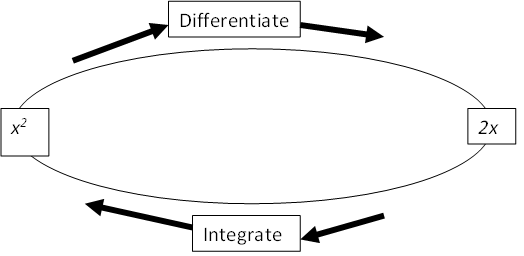
From differentiation, we know that the gradient is not always a constant. For example, if dy/dx = 2x, then this comes from a function of the form y = x2 + c, where c is a constant.
Example
Find y if dy/dx is:
Solution
Then, y =
Then, y =
Note
To integrate, we reverse the rule for differentiation. In differentiation, we multiply by the power of x and reduce the power by 1. In integration, we increase the power of x by one and divide by the new power.
If dy/dx = nxn-1, then y = (xn)/(n) + c, where c is a constant and n ≠ -1. Since c can take any value, we call it an arbitrary constant.
Example
Integrate the following expressions:
- 2x + 4
Solution
A.)
Then, y =
=
=
B.)
Then, y =
=
= –
C.) 2x + 4
Then, y =
=
=
Example
Find the equation of a line whose gradient function is dy/dx = 6x + 2 and passes through (0,1).
Solution
Since dy/dx = 6x + 2, the general equation is y = 3x2 + 2x + c. The curve passes through (0,1). Substituting these values into the general equation, we get 1 = 0 + 0 + c.
Therefore, c = 1.
Hence, the particular equation is y = 3x2 + 2x + 1.
Example
Find v in terms of h if dv/dh = 10h and V = 9 when h = 1.
Solution
The general solution is:
V = 5h2 + c
Given that V = 9 when h = 1, we substitute to find c:
9 = 5 + c
Therefore, c = 4.
Hence, the particular solution is:
V = 5h2 + 4
Definite and Indefinite Integrals
This section deals with finding exact areas under curves.
Estimate the area shaded beneath the curve shown below:
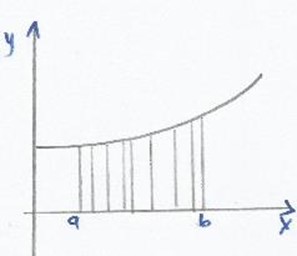
The area is divided into rectangular strips as follows:
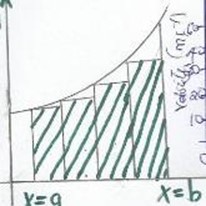
The shaded area in the figure above shows an underestimated and an overestimated area under the curve. The actual area lies between the underestimated and overestimated areas. The accuracy of the area can be improved by increasing the number of rectangular strips between x = a and x = b.
The exact area beneath the curve between x = a and x = b is given by:
∫ab y dx
The symbol ∫ means to integrate the expression for y with respect to x.
The expression ∫ab y dx, where a and b are limits, is called a definite integral. ‘a’ is called the lower limit while ‘b’ is the upper limit. Without limits, the expression is called an indefinite integral.
Example
The following steps help us to solve it:
- Integrate with respect to x, giving ∫ y dx = F(x) + c.
- Place the integral in square brackets and insert the limits, thus [F(x)]ab.
- Substitute the limits:
- Subtract the result of the lower limit from that of the upper limit, that is;
X = 6 gives F(6)
x = 2 gives F(2)
(F(6) + c) – (F(2) + c)
We can summarize the steps in short form as follows:
= F(6) – F(2)
= 150
Example
- Find the indefinite integral ∫ (x2 – 3x + 2) dx.
- Evaluate ∫13 (x2 – 3x + 2) dx.
Solution
Evaluate:
- (27 – 18 + 15) – (1 – 3 + 2)
- = 14
Area under the Curve
Find the exact area enclosed by the curve y = x2, the axis, and the lines x = 2 and x = 4.
Solution
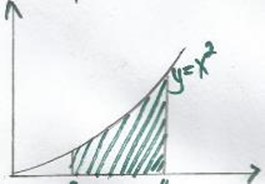
The area is given by:
∫24 x2 dx
Example
Find the area of the region bounded by the curve y = x2 – 4x + 4, the x-axis, and the lines x = 1 and x = 2.
Solution
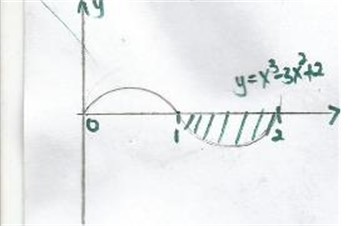
The area is given by:
= (4 – 8 + 4) – (1 – 4 + 4)
= 0 – 1 = -1
Note
The negative sign shows that the area is below the x-axis. We disregard the negative sign and give it as positive. The answer is 1.
Example
Find the area enclosed by the curve y = x3 – 6x2 + 9x, the x-axis, and the lines x = 4 and x = 10.
Solution
The required area is shaded below.
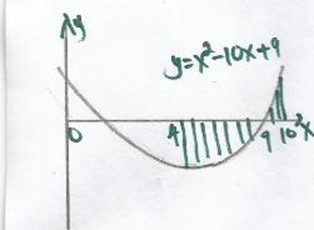
Area = ∫410 (x3 – 6x2 + 9x) dx
Example
Find the area enclosed by the curve y = x2 and the line y = x.
Solution
The required area is:
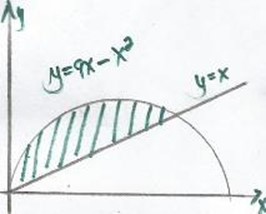
To find the limits of integration, we must find the x-coordinates of the points of intersection when y = x2 and y = x.
The required area is found by subtracting the area under y = x from the area under y = x2.
The required area = ∫ (x2 – x) dx
Application in Kinematics
The derivative of displacement S with respect to time t gives velocity v, while the derivative of velocity with respect to time gives acceleration a.
Differentiation and Integration:
- Displacement → velocity → acceleration (differentiation)
- Acceleration → velocity → displacement (integration)
Note
Integration is the reverse of differentiation. If we integrate velocity with respect to time, we get displacement, while if we integrate acceleration with respect to time, we get velocity.
Example
A particle moves in a straight line through a fixed point O with velocity v = 4t – 1 m/s. Find an expression for its displacement S from this point, given that S = 4 when t = 0.
Solution
Since v = 4t – 1,
S = ∫ v dt = ∫ (4t – 1) dt = 2t2 – t + c
Substituting S = 4, t = 0 to find c:
4 = 0 + 0 + c
Therefore, c = 4.
Hence, S = 2t2 – t + 4.
Example
A ball is thrown upwards with a velocity of 40 m/s.
- Determine an expression in terms of t for:
- Its velocity
- Its height above the point of projection
- Find the velocity and height after:
- 2 seconds
- 5 seconds
- 8 seconds
- Find the maximum height attained by the ball. (Take acceleration due to gravity to be 10 m/s²)
Solution
- Acceleration a = -10 m/s² (since the ball is projected upwards)
- The expression for velocity is v = 40 – 10t.
- Since v = 40 – 10t,
- Find velocity and displacement at given times:
Therefore, v = ∫ a dt = -10t + c
When t = 0, v = 40 m/s
Therefore, 40 = 0 + c
Hence, c = 40.
S = ∫ v dt = ∫ (40 – 10t) dt = 40t – 5t2 + C
When t = 0, S = 0
Therefore, C = 0.
The expression for displacement is S = 40t – 5t2.
- When t = 2:
- When t = 5:
- When t = 8:
v = 40 – 10(2) = 40 – 20 = 20 m/s
S = 40(2) – 5(2)2 = 80 – 20 = 60 m
v = 40 – 10(5) = 40 – 50 = -10 m/s
S = 40(5) – 5(5)2 = 200 – 125 = 75 m
v = 40 – 10(8) = 40 – 80 = -40 m/s
S = 40(8) – 5(8)2 = 320 – 320 = 0 m
Thus, 40 – 10t = 0
t = 4 seconds
Maximum height S = 40(4) – 5(4)2 = 160 – 80 = 80 m
Example
The velocity v of a particle is 4 m/s. Given that S = 5 when t = 2 seconds:
- Find the expression of the displacement in terms of time.
- Find the:
- Distance moved by the particle during the fifth second.
- Distance moved by the particle between t = 1 and t = 3.
Solution
S = 4t + c
Since S = 5 m when t = 2:
5 = 4(2) + c
5 – 8 = c
Therefore, c = -3.
Thus, S = 4t – 3.
I.) Distance moved during the fifth second:
II.) Distance moved between t = 1 and t = 3:


1 Comment