


SECOND TERM E-LEARNING NOTE
SUBJECT: MATHEMATICS CLASS: SS2
SCHEME OF WORK
WEEKS | TOPICS |
1 | Inequalities – Review of Linear Inequality in One Variable and Graph of Linear Inequality. |
2 | Inequalities in Two Variables: Graphs of Linear Inequalities in Two Variables; Maximum and Minimum Values of Simultaneous Linear Inequalities. |
3 | Application of Linear Inequalities in Real Life; Introduction to Linear Programming. |
4 | Algebraic Fractions: Simplification; Operation of Fractions. |
5 | Algebraic Fractions: Substitution in Fractions; Simultaneous Equations Involving Fractions; Undefined Fractions. |
6 | Review of the First Half Term Work an Periodic Test. |
7 | Logic: Meaning of Simple and Compound Statements; Logical Operations and the Truth Tables; Conditional Statements and Indirect Proofs. |
8 | Deductive Proof of Circle Geometry. |
9 | Circle Theorems: Theorem and Proofs Relating to Circle Theorem. |
10 | Tangent from an External Point. |
REFERENCE BOOKS
1.New General Mathematics SSS2 by M.F. Macraeetal.
2. Essential Mathematics SSS2 by A.J.S. Oluwasanmi.
WEEK ONE DATE: __________
TOPIC: LINEAR INEQUALITIES IN ONE VARIABLE
CONTENT
-Linear Inequalities
-Inequalities with Reversing Symbols
-Representing the Solutions of Inequalities on a Number Line and on Graphs
-Combining Inequalities
LINEAR INEQUALITIES
There are different signs used in inequalities.
> Greater than
< Less than
≥ Greater or equal to
≤ Less or equal to
 = Not equal to
Example 1
Consider a bus with x people in it.
(a)If there are 40 people then x= 40, this is an equation not inequality.


 (b)If there are less than 30 people in the bus then x 30 where means less than this is an inequality. It literally means that the no of people in the bus is not up to 30.
Example 2
Find the range of value of x for which
7x – 6 ≥ 15
7x ≥ 15 + 6
7 x ≥ 21
x≥ 3
Example 3:Solve the inequality
12x -7≥ 13 + 2x
12x-2x≥13+7
10x≥20
x≥2
Evaluation
Solve the inequalities
1. 3x -10 < 2
2.Given that x is an integer, find the three greatest values of x which satisfies the inequality 7x+15≥2x
Inequalities with Reversing Symbols
Anytime an inequality is divided or multiplied by a negative value, the symbol is reversed to satisfy the inequality.
Example
Solve: 14- 2a < 4
– 2a < 4 – 14
– 2a < -10
Divide both sides by -2 and reverse the sign (symbols).
a > 5
Check:
If a > 5,then possible values of a are : 6,7,8,…
Substituting, a=6
14 – 2(6) < 4
14 -12 < 4
2 < 4
 2 2 – 3x ≤ 2(1-x)
3
Multiply through by 3 or put the like terms together
2-9x≤6(1-x)
2 – 9x ≤6-6x
– 9x + 6x ≤ 6-2
– 3x ≤ 4
 x ≥ – 4
3
Evaluation
Solve the inequalities

 1)1+4x – 5 + 2x > x -2
2 7
2)2(x- 3) ≤ 5x
Representing the Solutions of Inequalities on a Number Line and on Graphs.
Example
Represent the solutions (i) x ≥ 4 (ii) x < 3 on number line


 (i) x
(i) x
-1 0 4
(ii)


 x
x
-1 0 3
Note: When it is greater than, the arrow points to the right and vice versa also when “or equal to” is included, in the inequalities, the circle on top is shaded “o” and the “or equal to” is not included the circle is opened “o”
Graphical Representation
Example
 Represent the solutions of the inequalities x > 3 and x ≤ 3 graphically





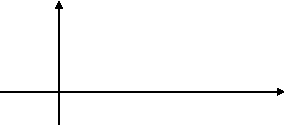
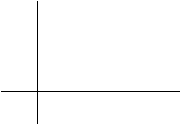


 i) x> 3 ii)


 1 2 3 -1 0 1 2 3 4
Note: Dotted line (broken line) is used to represent either< or > and when or equal to is included e.g ≤ or ≥ full line is used.
Evaluation:
Solve the inequality 2x + 6 ≤ 5 (x-3) and represent the solution on a number and graphically.
Combining Inequalities
Examples
1. x ≥ -3 and x ≤ 4 can be combined together to form a single inequality.
x ≥ -3 is the same as -3 ≤ x


 – 3 ≤ x and x ≤ 4
-3 ≤ x ≤ 4



-4 -3 -2 -1 0 1 2 3 4 5
 2. If 3+ x ≤5 and 8 + x 5 what range of values of x satisfies both inequalities



 Solution

 3 + x ≤ 5 8 + x > 5

 x ≤5-3 x > 5 – 8

 x≤2 x > -3

 or -3 < x


 then, -3 < x ≤ 2
-3 -2 -1 0 1 2 3 4
The shaded region satisfies the inequalities.
Note: When combining inequalities the inequalities having the lesser value is charged and there are some inequalities that cannot be combined e.g x< -3 and x > 4.
Note: The lesser value has the < sign, and the greater value has the > sign there are two inequalities that can never meet or be combined.
Evaluation
1.If 3 + x ≤ 5 and 8 + x ≥ 5,what range of values of x satisfies both inequalities?
2.State the range of values of x represented by each number line in the figure below.






 (a) (b) (c)
-7 -2 -1 0 3 0 -1 4
GENERAL EVALUATION/REVISION QUESTIONS
1.Solve the inequality and sketch a number line graph for its solution
5x-3 – 1-2x ≤ 8 + x
2.If 3 + x ≤5 and 8 + x≥5,what range of values of x satisfies both inequalities?
3.On a Cartesian plane,sketch the region which represent the set of points for which
x<2 and y≥5
4. Solve the equation ( 6x-2 )/3=(5-3x)/4
5. Simplify (2a+b)2-(b-2a)2
WEEKEND ASSIGNMENT
Objectives
1.If x varies over the set of real numbers which of the following is illustrated below




-3 -2 -1 0 1 2 3
(a)-3 > x ≤2 (b) -3 ≤x ≤2 (c) -3 ≤ x < 2 (d) -3∠x < 2
2.Solve the inequalities 3m < 9
(a) m< 3 ( m< 2 (c) 4 > m (d) 2 < m
3.If x is a rational no which of the following is represented on the number line?






-8 -6 -4 -2 0 2 4 6
(a) x: -5 ∠x ∠3) (b) x: -4 x <4) (c) x: - 5 ≤ x < 3) (d) x: -5 < x ≤3)
4.Solve the inequality : 5x + 6 ≥ 3 + 2x (a) x≤ 1 (b) x≥ 1 (c) x≥ -1 (d x≤-1
5.Given that a is an integer,find the three highest values of a which satisfy 2a +5 < 16
(a) 3,4,5 (b) 6,7,8 (c) 1,2,3 (d)8,9,10
Theory
1. If 6x < 2 – 3x and x -7 < 3x what range of values of x satisfies both inequalities (represent the solution on a number line)?
2.Represent the solution of the inequality graphically

 x – (x-3) < 1
3 2
Reading Assignment
New General Mathematics SSS2, page 101,exercise10c, numbers 1-10.
WEEK TWO DATE: ___________
TOPIC: GRAPHICAL SOLUTION OF INEQUALITY IN TWO VARIABLES
CONTENT
-Revision of Linear Equation in Two Variables.
-Graphical Representation of Inequalities in Two Variables.
-Graphical Solution of Simultaneous Inequality in Two Variables.
Revision of Linear Equation in Two Variables.
Examples
Solve and represent the solution on graph
 1. x + y =2
 Choosing values for x:let x=0,1,2
y=2-x
x | 0 | 1 | 2 |
2 | 2 | 2 |
|
-x | -0 | -1 | -2 |
y | 2 | 1 |
|


2. 5x + 2y = 10 0 1 2 3 x
 Using intercept method
 When x = 0
 5(0) + 2y = 10
2y = 10
 y = 5
y = 5

When y = 0
 5x + 2(0) = 10
5x = 10
x = 2


 (0,5) (2, 0)
0 1 2 3 4 x
 3. Draw the linear graph of y = 2

2



0 1 2 x
4.Draw the linear graph of x = 3

 y
y
4 –
2 –
 0 3
0 3
5.Draw the graph of 2x + y =3 using intercept method
When y = 0
2x=3
x = 3/2 = 1.5
When x =0
y = 3 (0, 3) (1.5 , 0)

 y
y
3 – (0, 3)
(1.5, 0)



1 2 x
Evaluation
Sketch the graph of the functions:
1) 4x + 3y = 12
2) y – x = 5
GRAPHICAL REPRESENTATION OF INEQUALITIES IN TWO VARIABLES
Example 1:Show on a graph the region that contains the set of points for which
 2x + y ≤ 3 y
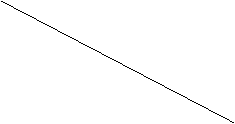
 When x = 0 (0, 3)
 2(0) + y = 3


 y= 3
y= 3
 When y = 0
 2x + 0 = 3


 2x = 3 (1.5. 0)

 x= 3/2 = 1.5 0 x
(0, 3) (1.5, 0)
The unshaded region satisfies the inequalities.
Note: The continuous thick line is used in joining point when the symbols ≥ or ≤ is used and when < or > is used broken line or dotted line is used.
Check: When x = 2, y=1
2 x + y < 3
2 (2) + 1< 3
4 + 1 < 3
4 + 1 < 3
5 < 3 (No)
Therefore the other side is the region that satisfies the inequality.


 Example 2 y

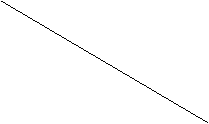 2x + 3y > 6
 When x = 0 (0, 2)
 3y = 6
 y=2
y=2

 When y = 0
2x=6 -2 -1 0 1 2 (3, 0) x
x = 3
( (0, 2) (3, 0)
The shaded region satisfies the inequality
Example 3


 y< 2
y< 2

 y
y
 2
2
 0 x
0 x
Theunshaded region satisfies the inequalities
Evaluation
Represent the following functions graphically.
1. 4x + 3y > 12
2. x +y ≥ 2
Shade the region that does not satisfy the inequality.
Graphical Solution of Simultaneous Inequality
Example I
Show on a graph the region which contains the solutions of the simultaneous inequalities
i 2x +3y < 6

 ii y – 2x ≤ 2

 iii y > – 2 y




 Solution: 2x + 3y < 6 6 - y – 2x 2

 2x + 3y < 6 when y= 0


 2x + 3y < 6 2x = 6 4 -

 When x = 0 x=3
 3y = 6 2 – A

 Y = 2
Y = 2


 -3 -2 -1 0 1 2 3 4
Coordinates: (0, 2) (3,0)


 C -2 D
(ii) y – 2x ≤ 2 y > -2
When x = 0 When y = 0 -4
y = 2 -2x = 2
x = -1
Coordinates; (0, 2) (-1, 0)
(iii) y> – 2 (0,-2)


 The unshaded region ABC satisfies all the inequalities.
Any coordinate within the satisfied region satisfies all the inequalities e.g
(x, y) = (-1,-1) (0,-1) (1,-1) (2,-1)
(3,-1), (-1,0) (0,0) (1,0) (2,0) (0,1) (1,1)
Example 2
Solve graphically the simultaneous inequality and shade the region that does not satisfies the inequality.
-x + 5y≤ 10
3x -4y ≤8
and y > -1
Solution
-x + 5y∠10
When x=0
5y = 10
y = 2
When y = 0
-x = 10
 x =-10
x = -10

 Coordinates: (0,2) (-10, 0)


 3x 4
3x 4

 Solution


 -x + 5y ≤ 10 3


 5y = 10


 y = 2 2

 When y = 0

 -x = 10 1

 X =-10

 X = -10 -10 -8 -6 -4 -2 0 2 4 6 8 10
 (0,2) (-10, 0)


 3x – 4y ≤ 8 -1
 When x = 0
 -4y =8 -2
 y = -2
 When y = 0 -3
3x = 8

 x = 8
x = 8
3
x = 2 2/3
(0, -2) (2 2/3 , 0)
(ii) y> -1
Coodinates: (-1,0)
Evaluation
Solve graphically for integral values of x and y
y ≥ 1 , x – y ≥ 1 and 3x + 4y ≤ 12
GENERAL EVALLUATION/REVISION QUESTIONS
Solve graphically the simultaneous inequalities
1. If (i) x + 3y≤ 12 (ii) y ≥-1 (iii) x > -2 for integral values of x and y
2.y is such that 4y – 7 ≤ 3y and 3y≤5y + 8
a)What range of values of y satisfies both inequalities?
b)Hence express 4y – 7 ≤ 5y + 8 in the form a ≤ y ≤ b,where a and b are both integers
3.If 65x2+x-10=0 find the values of x
4. Solve the equations 2x+y=1 and 25x-y = 125 simultaneously
READING ASSIGNMENT
New General Mathematics SSS2, pages 98-111, exercise10e.
WEEKEND ASSIGNMENTS
Objectives
1.Which of the following number line represents the inequality 2 ≤ x < 9






 (a) (b) (c)
0 9 0 9 0 9



 (d)
(d)
0 9
2.Form an inequality for a distance “d” meters which is more than 18cm but not more
than 23m.
(a) 18 ≤d ≤23 (b) 18< d ≤ 23 (c) 18 ≤ d < 23 (d) d< 18 or d > 23
3. Interprete the inequality represented on the number line






-4 0 5
(a) -4 < x d≤5 (b) -4 d≤x< 5 (c) -4 < x < 5 (d) -4 ≤x d≤5
 4. Solve the inequality 1 (2x-1) < 5
3
(a) x< -6 (b) x < 7 (c) x < 8 (d) x < 16
5.Which of the following could be the inequality illustrated on the shaded portion of the of the sketched graph below.
 y
y

 (0, 3)


 (1, 0)

 x
x
 (a)y ≤ x + 3 (b)y 3x + 2 (c) –y ≤ 3x – 3 (d) –y ≤ 3x + 3
Theory
Show on a graph the area which gives the solution set of the inequalities shading the unrequired region.
- y ≤ 3, x – y 1 and 4x + 3y ≥ 12
2. y – 2x ≤ 4, 3y + x ≥ 6 and y ≥ x-9
WEEK 3 DATE: ___________
TOPIC: INEQUALITIES
CONTENT
-Application of Linear Inequalities in Real Life.
-Introduction to Linear Programming.
APPLICATION OF LINEAR INEQUALITIES IN REAL LIFE.
Greatest and Least Values
Example
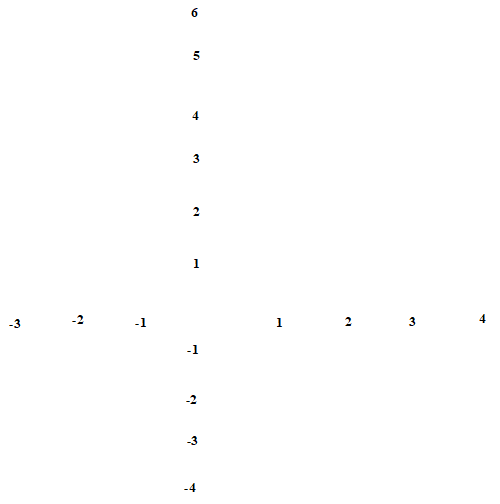
Draw a diagram to show the region which satisfies the following inequalities.
5x + y – 4, x + y 4, y x + 2, y – 2x – 4
Find the greatest and the least value of the linear function F = x + 2y within the region.
Solution
For the inequality 5x + y – 4, first draw the line 5x + y = – 4.
When x = 0, y = 4, when x = -1, y = 1
Add a third point on your own and then draw line 5x + y = -4. You may need to extend the axes to do this:
Now use a test point such as x = 0, y = 0
When x = 0, y = 0, then 0 – 4 is true, so shade the region below the line 5x + y = -4.
For the inequality x + y 4, first draw the line x + y = 4.
When x = 0, y = 4 and when y = 0, x = 4.
So draw a line that passes through (0, 4) and (4, 0).
Test point: (0, 0), so 0 4 is true. Shade the region above the line.
Similarly, for y x + 2 and y – 2x – 4, shade the unwanted regions.
The required region is labeled as R as shown. R is also called the feasible region (i.e. the region that satisfies a set of inequalities).
The greatest (maximum) and the least (minimum) of any linear function such as F = x + 2y occurs at the vertices (corner points) of the region which satisfies the given set of the inequalities.
At A(-1, 1) F = x + 2y
F = -1 + 2 = 1
At B(1, 3) F = x + 2y
F = 1 + 6 = 7
At C(2.67, 1.33) F = x + 2y
F = 2.67 + 2.66 = 5.33
At D(0, -4) F = x + 2y
F = 0 – 8 = -8
F = x + 2y is least at the point D(0, 4).
F = x + 2y is greatest at the point B(1, 3).
Note: The coordinates at point C can also be found by solving the simultaneous equations x + y = 4 and y – 2x = -4,
Which gives x = and y = .











Linear Programming
In many real-life situations in business and commerce there are restrictions or constraints, which can affect decision-making. Typical restrictions might be the amount of money available for a project, storage constraints, or the number of skilled people in a labour force. In this section we will see that problems involving restrictions can often be solved by using the graphs of linear inequalities. This method is called linear programming. Linear programming can be used to solve many realistic problems.
Example 1
A student has N500. She buys pencils at N50 each and erasers at N20 each. She gets at least five of each and the money spent on pencils is over N100 more than that spent on erasers.
Find a. How many ways the money can be spent,
b. The greatest number of pencils that can be bought,
c. The greatest number of erasers that can be bought.
Let the student buy x pencils at N50 and y erasers at N20.
From the first two sentences,
50x + 20y 500
5x + 2y < 50 (1)
Since she gets at least five of each,
x 5 (2)
y 5 (3)
From the third sentence,
5x – 2y > 10
Inequalities (1), (2), (3) and (4) are shown below












- The solution set of the four inequalities is given by the twelve points marked inside the shaded region. For example, the point (7, 6) shows that the student can buy seven pencils and six erasers and still satisfy the restrictions on the two variables. Hence there are twelve ways of spending the money.
- The greatest number of pencils that can be bought is eight, corresponding to the point (8, 5)
- The greates number of erasers is nine, corresponding to the point (6, 9).
Example 2
To start a new transport company, a businessman needs at least 5 buses and 10 minibuses. He is not able to run more than 30 vehicles altogether. A bus takes up 3 units of parking space, a minibus takes up to 1 unit of parking space and there are only 54 units available.
If x and y are the numbers of buses and minibuses respectively,
- Write down four inequalities which represent the restrictions on the businessman
- Draw a graph that shows a region representing possible values x and y.
a. from the first sentence,
x 5
y 10
From the second sentence,
x + y 30
from the third sentence,
3x + y 54
b. in the figure below, R is the region that contains the possible values of x and y.














EVALUATION
- A student needs at least three notebooks and three pencils. Notebooks cost N60 and pencils N36 and the student has N360 to spend. The student decides to spend as much as possible of his N360.
- How many ways can he spend his money?
- Does any of the ways give him change? If so, how much?
- To staff a tailoring company, a businesswoman needs at least 6 cutters and 10 seamstresses. She does not want to employ more than 25 people altogether. To be effective, a cutter needs 2 tables to work on and a seamstress needs 1 table. There are only 40 tables available. If x and y are the numbers of cutters and seamstresses respectively,
- Write down four inequalities that represent the restrictions on the businesswoman,
- Draw a graph that shows a region representing possible values of x and y,
- Find the greatest value of y
GENERAL EVALUATION/REVISION QUESTIONS
1. Draw the graphs of lines y=2x+1 and 2x+2y=7 on the same axes. Find the coordinates of their point of intersection to 1 decimal place.
2. Sketch the graph of the inequalities.
a. 3x+2>3 (b) 8-5x≤ 3 (c) 2x-3≤ 7
3. If x-6≤ 1 and 2x-1> 8, what is the range of values of x which satisfies both inequalities?
READING ASSIGNMENT
New General Mathematics SSS2, pages 98-111, exercise 10g.
WEEKENND ASSIGNMENT
Objectives
1. Given that x is an integer, what is the greatest value of x which satisfies 4-3x >24 ?
A. -7 B. -6 C. -3 D. 6
2. Given that 3x+y =1 and x-7y=19, then x+y= A. -2 B. -3 C. 5 D. 3
3. If 5+x≤7 and 4+x≥3, which of the following statement is true?
A. -3≤x≤3 B. -1≤x<3 C. -1≤x≤2 D. -1≥x≥2
3. Solve the inequality: 8-3x
4. The smallest integer that can satisfy the inequality 30-5x<2x+3 is A. -4 B. 5 C. 3 D. 4
5.Solve the inequality 4y-7<2(3y-1) A. y < -5/2 B. y> -2/5 C. y< -5/3 D. y> -5/2
Theory
1. A supermarket gives a special offer to customers who purchase at least a pack of vests and a pack of T-shirts. The offer is restricted to a total of 7 of these items.
- Write down three inequalities which must be satisfied.
- Draw the graphs of the above conditions and shade the region that satisfies them.
- If the supermarket makes a gain of N5 on each vest and N8 on each T-shirt, find the maximum gain made by the supermarket.
2. A man buys two types of printers. The table below shows the cost and the necessary working space required for each type.
Printer Cost Working space
Type P N15, 000 4000 cm2
Type Q N25, 000 3000 cm2
The man has 48 000cm2 of working space and he can spend up to N290, 000 to buy these machines.
- Write down the inequalities to represent the above constraints.
- Draw the graphs of these inequalities to show the feasible region.
- Use your graph to find the maximum number of printers the man can buy.
WEEK FOUR DATE: __________
TOPIC:ALGEBRAIC FRACTIONS
CONTENT
-Simplification of Algebraic Fractions.
– Operation of Algebraic Fractions.
SIMPLIFICATION OF ALGEBRAIC FRACTIONS.
To simplify an algebraic fraction:
- Factorise the numerator and the denominator of the fraction, where possible.
- Divide the numerator and the denominator by the common factors. This process is sometimes known as cancelling a fraction. When a fraction cannot be reduced any further, we say the fraction is in its lowest or simplestform.
When simplifying a fraction, remember the following facts:
- x2 – y2 = (x + y)(x + y) – difference of two squares.
- (x + y)2 = x2 + 2xy + y2
(x – y)2 = x2 – 2xy + y2 (Perfect Squares)
- = –
- =
- =
- = x = m
- To factorise x2 – 5x + 6, we have:
X2 – 5x + 6 = x2 -2x – 3x + 6
= x(x – 2) – 3(x – 2)
= (x – 2)(x – 3)
Example 1
Simplify the following fractions:
(a) (b)
(c) (d)
Solution
(a) =
Cancel the common factors
=
(b) =
= x + y
(c) = =
(d) =
=
=
=
Notice that in the above y – 2 = – (2 – y)
In general: x – y = -(y – x)
e.g. 10 – 4 = -(4 – 10)
i.e. 6 = -4 + 10
6 = 6
Example 2
Simplify the following fractions:
(a) (b)
(c) (d)
Solution
(a) = =
(b) =
Now factorise the quadratic expressions inside the brackets:
= =
(c) =
Now factorise the quadratic expressions inside the brackets:
= =
(d) =
=
But x – 3y = -(3y – x)
=
=
Algebraic Fractions: Simplification, Operation and Undefined Fractions.
EVALUATION
1. 2. 3.
4. 5. 6.
OPERATION OF ALGEBRAIC FRACTIONS.
Multiplication and Division of Fractions
Factorise fully first, then divide the numerator and denominator by any factors that they have in common.
Example 1
Simplify
Given expression
=
=
The answer should be left in the form given.
Do not multiply out the brackets.
Example 2
Simplify
To divide by a fraction, multiply by its reciprocal.
Given expression
=
Example 3
Simplify
Given expression
=
=
=
Notice that (a – b) divides into (b – a) to give -1.
This is because -1 x (a – b) = (b – a).
EVALUATION
1. 2. 3.
4. 5.
Addition and Subtraction of Fractions
Example 1
Simplify
The denominators are a and 2b. The LCM of a and 2b is 2ab. Express each fraction with denominator of 2ab.
=
=
Example 2
Simplify 2 +
The denominators are 3ab and 2b. the LCM of 3ab and 2b is 6ab. Express each fraction in the expression with a denominator of 6ab.
2 +
=
=
=
=
=
Example 3
Simplify
=
=
=
=
=
Notice that the sign in front of the fraction is changed since (3 – x) = -(x – 3). This give an LCM of x(x – 3)(x + 3).
Example 3
Simplify
=
=
EVALUATION
Simplify the following.
1. 2. 3.
4.
GENERAL EVALUATION/ REVISION QUESTIONS
Simplify the following.
1. 2.
3. 4.
5.
WEEKEND ASSIGNMENT
Objectives
1. Simplify A. B. C. D.
2. Simplify A. B. C. D.
3. Simplify A. B. C. D. x+1
4. Simplify A. B. C. D.
5. Simplify A. B. C. D.
Theory
Simplify the following.
1.(a) (b) (c)
2. (a) (b) (c)
READING ASSIGNMENT
New General Mathematics SSS2, pages 193-195, exercise 17b.
WEEK FIVE DATE: ___________
TOPIC:ALGEBRAIC FRACTIONS
CONTENT
-Substitution in Fractions.
-Undefined Fractions.
SUBSTITUTION IN FRACTIONS
Example 1
Given that x:y = 9:4, evaluate
If x:y = 9:4, then
Divide numerator and denominator of
by y.
=
Substitute for in the expression.
Value of expression
= =
=
Example 2
If x = , express in terms of a.
Substitute for x in the given expression.
Multiply the numerator and denominator by (3a – 2).
=
= or
Example 3
Solve the equation
The LCM of the denominators is 8(3a – 1)(a + 1).
To clear fractions, multiply the terms on both sides of the equation by 8(3a – 1)(a + 1).
If
Then
=
=
8(a + 1) = 16(3a – 1) – 3(3a – 1)(a + 1)
8a + 8 = 48a – 16 – 3(3a2 + 2a – 1)
8a + 8 = 48a – 16 – 9a2 – 6a + 3
8a + 8 – 48a + 16 + 9a2 + 6a – 3 = 0
9a2 – 34a + 21 = 0
(a – 3)(9a – 7) = 0
a = 3 or 9a = 7
a = 3 or 7/9
Check: if a = 3,
and
if a = ,
and
=
=
EVALUATION
1. if , evaluate .
2. If x = , express in terms of a.
UNDEFINED FRACTIONS
If the denominator of a fraction has the value zero, the fraction will be undefined. If an expression contains an undefined fraction, the whole expression is undefined.
Example 1
Find the values of x for which the following frxactions are not defined.
a. b.
a. is undefined when x + 2 = 0
if x + 2 = 0
then x = -2
the fraction is not defined when x = -2.
b. is undefined when 3x – 12 = 0.
If 3x – 12 = 0
Then 3x = 12
x = 4
Example 2
Find the values of x for which the expression
is not defined.
The expression is not defined if any of the fractions has a denominator of 0.
is undefined when x = 0.
(x – 1)(x + 7) = 0
If (x – 1)(x + 7) = 0
Then either (x – 1) = 0 or (x + 7) = 0
i.e. either x = 1 or x = -7
The expression is not defined
When x = 0, 1 or -7
Example 3
a. For what value(s) of x is the expression not defined?
b. Find the value(s) of x for which the expression is zero.
Solution
a. The expression is undefined when its denominator is zero,
i.i. when x – 5 = 0
x = 5
b. let = 0
multiply both sides by x – 5
x2 + 15x + 50 = 0
(x + 5)(x + 10) = 0
Either x + 5 = 0 or x + 10 = 0
i.e. either x = -5 or x = -10
The expression is zero when x = -5 or x = -10.
EVALUATION
For what value(x) of x are the following expressions (i) undefined (ii) equal to zero?
1. 2.
GENERAL EVALUATION/ REVISION QUESTIONS
1. If x = , express in terms of m.
2. If X = , express in terms of a.
3. If h = , Express in terms of m.
4. Solve the following.
a) = a – 2 b.) 5 – 2d = c.) d.)
e.)
WEEKEND ASSIGNMENT
Objectives
1.For what values of x is the expression not defined? A.1, B. -1,-1 C. -1,1 D. 2,1
2.For what values of x is the expression not defined? A. 1,2 B. -1,2 C. -1,-2 D. 1,-2
3.Solve = 0 A. 1 B. 3 C. -3 D. -1
4. Simplify A. B. C. D.
5. For what value of x is the expression equal to zero? A. 0 B. 1 C. 2 D. 3
Theory
1. a. For what value(s) of x is the expression not defined?
b. For what value(s) of x is the expression zero?
2. if a = , express in terms of m.
READING ASSIGNMENT
New General Mathematics SSS2, pages 195-201, exercise 17f and 17g.
WEEK SIX
REVIEW OF FIRST HALF TERM WORK
WEEK SEVEN DATE: ______
TOPIC: LOGIC
CONTENT
-Meaning of Simple and Compound Statements.
– Logical Operations and the Truth Tables.
-Conditional Statements and Indirect Proofs.
SIMPLE AND COMPOUND PROPOSITIONS
A preposition is a statement or a sentence that is either true or false but not both. We shall use upper case letters of English alphabets such as A, B, C, D, P, Q, R, S, …, to stand for simple statements or prepositions. A simple statement or proposition is a statement containing no connectives. In other words a proposition is considered simple if it cannot be broken up into sub-propositions. On the other hand, a compound proposition is made up of two or more propositions joined by the connectives. These connectives are and, or, if …then, if and only if. They are also called logic operators. The table below shows the logic operators and their symbols.
Figure 1
Logic Operator | Symbol |
And | |
or | |
if … then | |
if and only if | |
Not |
- The statement P is known as the negation of P. thus P means not P or ‘it is false that P…’ or ‘it is not true that P…’
- If P and Q are two statements (or propositions), then:
- The statement P Q is called the conjunction of P and Q. thus, P Q means P and Q.
- The statement P Q is called the disjunction of P and Q. thus, P Q means either P or Q or both P and Q. notice that the inclusive or is used.
- The statement P Q is called the conditional of P and Q. a conditional is also known as implication P Q means if P then Q or P implies Q.
- The statement P Q is called the biconditional of P and Q, where the symbol means if and only if (or iff for short). Thus P Q means P Q and Q P.
The Truth Tables
The truth or falsity of a proposition is its truth value, ie. A proposition that is true has a truth value T and a proposition that is false has a truth value F. the truth tables for the logical operators are given below.
Figure 2
P | P |
T | F |
F | T |
If P is true (T), then P is false and if P is false, then P is true.
Recall that other symbols used instead of are P’ or or P.
Figure 3 figure 4
P | Q | PQ |
T | T | T |
T | F | F |
F | T | F |
F | F | F |
P | Q | PQ |
T | T | T |
T | F | T |
F | T | T |
F | F | F |
PQ is true when both PQ is false when both P and Q are false.
P and Q are true
P | Q | PQ |
T | T | T |
T | F | F |
F | T | F |
F | F | T |
Figure 6
Figure 5
P | Q | PQ |
T | T | T |
T | F | F |
F | T | T |
F | F | T |
P Q is false when P is P Q is true when both P and Q are
true and Q is false either both true or both false.
Example 1
Translate the following into symbols and then determine which statements are true or false.
- -5 < 8 and 2 < - 50
- 4 right angles = 360o or opposite angles of any quadrilateral and supplementary.
- If a person is 20 years old, then the person is a teenager.
- 2x – 5 = 9 if and only if x = 7.
Solution
- Let P = (-5 < 8); Q = (2 < -50)
P – -5 < 8 is true (T)
Q = 2 < -50 is false (F)
symbolic for: P Q is false
(see 2nd row of fig 3)
- Let P = (4 right angles = 360o)
Q (opposite angles of any quadrilateral are supplementary).
P is true (T) and Q is false (F)
PQ is true (see 2nd row of fig 4)
- Let P = a person is 20 years old.
Q = a person is a teenager.
P is T and Q is F
PQ is false (see 2nd row of fig 5)
- 2x – 5 = 9 if and only if x = 7
Let P = (2x – 5 = 9) and Q = (x = 7)
When x = 7, 2x – 5 = 2 X 7 – 5
= 14 – 5 = 9 (T)
Both P and W have the same T values.
PQ is true (see 1st row of fig 6)
Converse, Inverse and Contrapositive of Conditional Statement
Converse statement
The converse of the conditional statement ‘if P then Q’ is the conditional statement ‘if Q then P’, i.e. the converse of P Q is Q P.
Inverse statement
The inverse of the conditional statement ‘if P then Q’ is the conditional statement ‘if not P then not Q’.
i.e. the inverse of P Q is P Q.
Contrapositive statement
The converse of the conditional statement ‘if P then Q’ is the conditional statement ‘if not Q then not P’.
i.e. the contrapositive of P Q is P .
Example
Give the (a) converse (b) inverse
(c) contrapositive of the following:
(i) If 9 < 19, then 8 < 5 + 6.
(ii) if two triangles are equiangular, then their corresponding sides are proportional.
Solution
- (i) if 8 < 5 + 6 9 < 19.
(ii) If two triangles have their corresponding sides proportional, then they are equiangular.
- (i) if 9 19 8 5 + 6.
(ii) If two triangles are not equiangular, then their corresponding sides are not proportional
- (i) if 8 + 6 9 19
(ii) if two triangles do not have their corresponding sides proportional, then they are not equiangular
LOGICAL OPERATIONS AND TRUTH TABLES
Example
Construct the truth tables for the following:
(P Q) (P Q)
Solution
Method 1
P | Q | P | (P Q) (P Q) | |||
T | T | F | F | F | F | T |
T | F | F | T | T | T | T |
F | T | T | F | T | F | F |
F | F | T | T | T | F | F |
Explanation
Since there are two variables, P and Q, we will have 4 rows.
- P column: Enter two T’s, then two F’s
- Q column: Enter one T, then one F.
- P column: Enter the negation of P.
- Q column: Enter the negation of Q.
- Fill in the truth values of .
is false when both P and are false according to the table for V.
- Fill in the truth values of P Q is true when both P and Q are true.
- Fill in the truth value of
(P V) (P VQ)
(P V) (P VQ) is false when (P V) is true and (P V) is false.
Method 2
P | Q | (P Q) (P Q) | ||||
T | T | F | F | F | T | F |
T | F | F | T | T | T | T |
F | T | T | F | T | F | F |
F | F | T | T | T | F | F |
(1) (2) (3) (4) (5)
Explanation
Enter P and Q columns as usual.
- fill in the truth values of
- Fill in the truth values of Q.
- Fill in the truth values of (P Q)
- Fill in the truth values of (P Q).
- Now consider the implication () as a whole.
Note: The columns of the truth table are completed in the indicated order
Tautology and Contradiction
When a compound proposition is always true for every combination of values of its constituent statements, it is called a tautology. On the other hand, when the proposition is always false it is called a contradiction.
Example
Construct the truth tables to show that:
(a) P (P) is a tautology
(b) (P Q) [(P) V (Q)] is a contradiction.
Solution
P | P | (P) | P(P) |
T | F | T | T |
F | T | F | T |
The truth table of P (P) is always T, so it is a tautology
P | Q | (P Q) [(P) V(Q)] | |||||
T | T | T | F | F | F | F | |
T | F | F | F | F | T | T | |
F | T | F | F | T | T | F | |
T | F | F | F | T | T | T | |
(1) (5) (2) (4) (3)
Column (5) shows that the truth table of (P Q) [(P) V (Q)] is always F, so it is a contradiction.
Example
Find the truth values of the following when the variables P, Q and R are all true. (a) P Q (b) (P Q) VR
Solution
- P Q
Substituting the truth values directly into the statement P Q, we have T T.
But T is the same as F.
T T gives F F
Simplify the disjunction: F
The compound statement P Q is false.
- (P Q) VR
Substituting the truth values: (T T) VT
Within brackets, negate: (T F) VT
Simplify brackets: F VT
T V F
Simplify disjunction: T
(P Q) VR is true.
Example
Determine the validity of the argument below with premises X1 and X2 and conclusion S.
X1 = All doctors are intelligent
X2: Some Nigerians are doctors
S: Some Nigerians are intelligent
In the Venn diagram
= {all people}
Let I = {intelligent people}
N = {Nigerians}
D = {doctors}

 I N
I N
D
The structure of the argument is shown in figure above. The shaded region represents N I, those Nigerians who are intelligent. The conclusion that some Nigerians are intelligent therefore follows from the premises, and the argument is valid.
Example
In the following argument, find whether or not the conclusion necessarily follows from the premise. Draw an appropriate Venn diagram and support your answer with a reason.
London is in Nigeria
Nigeria is in Africa.
Therefore London is in Africa
The figurebelowshows the data in a Venn diagram.


 Africa
London
From the figure above, the conclusion follows from the premises, L N and N A. the argument is therefore valid.
Notice, however, that the conclusion in untrue because the first premise ‘London is in Nigeria‘ is untrue. Therefore, we may have an argument that is valid but in which the conclusion is untrue.
THE CHAIN RULE
The chain rule states that if X, Y and Z are statements such that X Y and Y Z, then X Z. a chain of statements can have as many ‘links’ as necessary. Example 5 is an example of the chain rule.
When using chain rule. It is essential that the implication arrows point in the same direction. It is not of much value, for example, to have something like X Q R because no useful deductions can be made from it.
Example
In the following argument, determine whether or not the conclusion necessarily follows from the given premises.
All drivers are careful. (1st premise)
Careful people are patient (2nd premise)
Therefore all drivers are patient (conclusion)
If D: people who are drivers
C: people who are careful
P: people who are patient
Then D C (1st premise)
And C P (2nd premise)
If D C and C P
Then D P (chain rule)
The conclusion follows from the premises.
Example
Determine the validity of each of the proposed conclusions if the premises of an argument are
X: Teachers are contented people.
Y: Every doctor is rich
Z: No one who is contented is also rich.
Proposed conclusions
S1: No teacher is rich
S2: Doctors are contented people
S3: No one can be both a teacher and a doctor.
Let C = {contented people}
T = {teachers}
D = {doctors}
R = {rich people}
The figure below is a Venn diagram for the premises.


T D
C R
From the figure, the following conclusions can be deduced.
i. S1 is true, i.e. no teacher is rich. (T R = )
ii. S2 is false, i.e. doctors are contented people is false. (D C = )
iii. S3 is true, i.e. no one can be a teacher and a doctor. (T D = )
CONDITIONAL STATEMENTS AND INDIRECT PROOFS.
Another method we can use to determine the validity of arguments especially the more complex ones is to construct the truth tables as will be seen in the following examples.
Example 1
Write the argument below symbolically and determine whether the argument is valid.
1st premise: if tortoises eat well, then they live long
2nd premise: Tortoises eat well.
Conclusion: Tortoises live long.
Solution
To determine the truth value, the steps are:
- Write the arguments in symbolic forms.
Let P = ‘tortoises eat well’
Q = ‘they live long’.
1st premise becomes P Q.
2nd premise is P and the conclusion is Q.
the argument is written as follows:
P Q (if P happens, then Q will happen)
(P happens)
(Q happens)
- From the conjunction of the two premises. (P Q) P
- Let the conjunction in (2) implies the conclusion Q. i.e. [(P Q) P] Q
P | Q | P Q | (P Q) p | [(P Q) P] Q |
T | T | T | T | T |
T | F | F | F | T |
F | T | T | F | T |
F | F | T | F | T |
Since the compound statement
[(P Q) P] Q is always a tautology, (i.e. has a truth value T), the argument is valid. This type of argument is called direct reasoning or modus ponems
Example 2
Determine whether the following argument is valid.
If you study this book, then you will pass WAEC.
If you pass WAEC, then you will go to university
Therefore, if you study this book, then you will to go university.
Solution
- Let P: you study this book
Q: you will pass WAEC.
R: you will go to university.
If you study this book, then you will pass WAEC becomes P Q.
If you pass WAEC, then you will go to university becomes Q R.
Therefore, if you study this book, then you will go to university becomes P R.
The above may be written as follows:
1st premise: P Q
2nd premise: Q R
Conclusion: P R
- From the conjunction of the premises as (P Q) (Q R)
- Let the conjunction implies the conclusion implies the conclusion. i.e.
[(P Q) (Q R)] (P R)
 P Q R [(P Q) (Q R)] (P R)T T T T TTTT
T T F T F F T F
T F T F F T TT
T F F F F T T F
F T T T TTTT
F T F T F F T T
F F T T TTTT
F F F T TTTT
(1) (3) (2) (5) (4)









Column (5) shows that the compound statement [(P Q) (Q R)] (P R) is always tautology. Therefore, the argument is valid. This type of argument is called transitive reasoning or chain rule or the rule of syllogism.
Note: there are other forms of valid arguments which you can investigate on your own.
EVALUATION
- Choose a letter to represent each simple proportion and then write the following in symbols.
- Determine the truth values of the following:
- Give the negation of the following
- An octagon has eight sides.
- The diagonals of an isosceles trapezium are equal
- 9 – 17 < 7 or 15 < (-6)2.
- Using A and B, write down the inverse, converse and contrapositive of the following:
- Draw a truth tables for the following
(a) (P VQ) (b) (P Q) (c) (P Q) (P R)
- (a) copy and complete the table below:
Cond.
Inv.
Conv
Contr.
P
Q
P
Q
P Q
P Q
Q P
Q P
T
T
T
F
F
T
F
T
Where cond. = conditional, inv. = inverse, conv. = converse, contr. = contrapositive.
(b) what do you notice about
- Converse and inverse statements?
- Conditional and contraposivite statement?
- All warm blooded animals are mammals.
Human beings are warm blooded animals
Therefore, human beings are mammals.
- All professors are meticulous.
Salami is meticulous
Therefore Salami is a professor.
GENERAL EVALUATION/REVISION QUESTIONS
A. Using truth tables, determine the validity of the following arguments:
1. If I love my wife, then I will buy her a gift.
I love my wife.
Therefore, I will buy her a gift.
2. All dogs can bark.
This is not a dog.
Therefore, it cannot bark.
3. If I am your friend, then I will drink alcohol.
I do not drink alcohol.
Therefore, I am your friend.
B. Using tables, determine whether or not the following arguments are valid.
4. 2 + 5 = 9 or 3 + 4 < 2 + 1
2 + 5 9
Therefore, 3 + 4 2 + 1
5. of -12 = – 6 or +
of -12 – 6
Therefore,
6. If 2x + 5 = 15, then x = 5
x 5
Therefore, 2x + 5 15
WEEKEND ASSIGNMENT
Objectives
1. The conditional statement P⇒Q is false when A. both P and Q are true B. P is true and Q is false C. P is false and Q is true D. P is false and Q is false.
2. The negation of PʌQ is A. PʌQ B. PʌQ C. PvQ D. (PvQ)
Given that p is the statement ‘Ayo has determination and q is the statement ‘Ayo willsucced’. Use the information to answer thesequestions.Which of these symbols represent these statements?
3.Ayo has no determination.A. P Þ q B. ~pÞ q C. ~p
4.If Ayo has no determination then he won’t succeed.A. ~p Þ~ q B. p Þ~ q C.pÞ q
D. p Þ~ q
5. If Ayo wont succeed then he has no determination.A. ~q Þ p B. ~q Þ~qC.~q Þp
D. q Þ p
Theory
- Using truth tables, determine the validity of the following arguments:
- When the weather is very hot you sweat profusely.
When you sweat profusely your clothes get dirty.
Therefore, when the weather is very hot your clothes get dirty.
- If it was an accident, something would have been broken
Nothing was broken
Therefore, it was not an accident.
- If you study mathematics, then you become an engineer.
If you become an engineer, then you will be comfortable.
Therefore, if you study mathematics then you will be comfortable.
- The teacher is teaching maths or arts.
The teacher is not teaching maths or arts.
Therefore, the teacher is teaching arts.
- Using tables, determine whether or not the following arguments are valid.
- If a triangle has two equal angles, then it has two equal sides
PQR does not have two equal sides.
Therefore, PQR does not have two equal angles.
- If a triangle has two equal sides,
It is an isosceles
XYZ has two equal sides.
Therefore, XYZ is an isosceles .
3. Determine the validity of each of the following arguments.
- X is a square X is a rectangle.
X is a square X is a rhombus.
Therefore, X is rectangle X is a rhombus.
- X is a whole number x is an integer.
X is an integer X is a rational number.
READING ASSIGNMENT
New General Mathematics SSS2, pages 218-223, exercise 20a and 20b.
WEEK EIGHT DATE: ___________
TOPIC: DEDUCTIVE PROOF OF CIRCLE GEOMETRY
CONTENT
-Definition of Properties of a Circle.
-Problems on Length of Arc and Chords.
-Perimeter and Area of Sector and Segments of a Circle.


 Definition of Properties of a Circle radius
Parts (properties) of a circle are:
1. Centre
2. Circumference
3. Arc
4 Radius
5. Chord
6. Diameter diameter


 7. Segment segment
 8. Sector
1.Circumference:This is the curved outer boundary of a circle.
2.Arc: Arc is a part/portion of the circumference of a circle
3.Major and Minor Arc: The chord which is not a diameter divides the circumference
into two arc of diff sizes: a major and a minor arc.
4.Radius: this is any straight line joining the centre to the circumference of a circle.
5.Diameter: A diameter is a chord which passes through the centre and divides the circle into 3 equal parts.
6.Chord: A chord of a circle is a line segment joining the centre is a line its
circumference.
7.Sector: This is the region between two radii and the circumference.
8.Segment: it is the region between a chord and the circumference.
9.Major and minor Segment: The chord also divides the circle into two segments of difference sizes: major and minor segments
Evaluation
Draw a circle, locate and label all its properties in it
Arcs and Chord
Circumference of a circle (Perimeter) = 2π r
 Lenght of Arc = Ɵ x 2πr
3600
 Perimeter of a sector = 2r + Ɵ × 2πr
3600
Where π= 22/7
Example 1
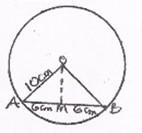 A chord of a circle is 12cm long the radius r of the circle is 10cm calculate the distance of the mid-point of the chord to the center.
O is the center
 AB = 12cm
 AO = radius = 10cm
M = mid –point of AB
∆ AMO
|OA|2 = |OM|2 + |AM|2 (Pythagoras Theorem)
102= OM|2 + 62
|OM|2 = 102 – 62
|OM|2 = 100 -36
|OM|2 = 64
|

 OM = 64 = 8cm
| OM| = 8cm
The mid-point of the chord is 8cm from the centre of the circle
Example 2
A chord of length 24cm is 13cm from the centre. . Calculate the radius of the circle radius of the circle.
Solution
∆ OAC is a right angled triangle
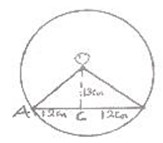 |OA|2 = AC2 + C02
|OA|2 = 122 + 132
|OA|2 = 144 + 169
|OA|2 = 313
 |
|
 OA|= 313 = 17.69
OA = 17.7cm
Example 3
Calculate the length of the minor arc /AB/ in example 2 above
Length of arc = Ɵ × 2πr
3600
Π= 22/7
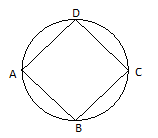
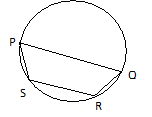
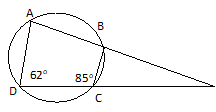
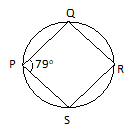
Ɵ = Ɵ= Given: Adj 13 Tan< AOC = 0.9231 Tan-1 (0.9231) =< AOC = 42.70 Length of arc AB = Ɵ x 2πr = 85.40× 2 × 22 × 17.69cm =26.38cm Evaluation 1)A chord of a circle is 9cm long if its distance from the centre of the circle is 5cm, calculate. i.The radius ii.The length of the minor arc. 2) What angle does an arc 5.5cm in length subtend at the centre of a circle diameter 7cm. Perimeter and Area of Sector and Segments of a Circle Area of sector = Ɵ× πr2 360 Area of segment = Area of sector – Area of the included triangle. Perimeter of sector = 2r + length of arc Perimeter of segment = length of chord + length of arc. Example The arc of a circle radius 7cm subtends an angle of 1350 at the centre. Calculate: i the area of the sector ii The perimeter of the sector Area =Ɵ x π r2 3600 = 57. 75 cm Perimeter = 2r + length of arc But Length of arc = Ɵ × 2πr 3600 =1350× 2 × 22 × 7 3600 7 =16. 5cm Perimeter = 2(7) + 16.5 = 14cm + 16.5cm =30.5cm Evaluation 1. Area of the sector 2. Perimeter of the sector 3. Area of the minor segment 4. Perimeter of the minor segment Theorem and Proofs Relating to Angles in a Plane. Theorem I. Theorem: A straight line drawn from the centre of a circle to bisect a chord, which is not diameter is at right angle to the chord. To prove: < AMO = Construction: Join OA and AB Proof: but 2 Example I: The radius of a circle is 10cm and the length of a chord of the circle is 16cm. Calculate the distance of the chord from the centre of the circle. Since ( COA is a right angled triangle, using Pythagoras theorem Solution x2 = 102 – 82 x2 = 100 – 64 x2 = 36 Example 2: The distance of a chord of a circle of radius 5cm from the centre of the circle is 4cm. Calculate the distance of the length of the chord. Chord AB = |AC| + |CB| | AC| = | CB| < AOC is a right angled triangle O Using Pythagoras: 5cm |AC|2 = 52 – 42 = 25 – 16 = 9 A C B |AC|2 = 9cm |AB| = 3 + 3 = 6cm Length of chord AB = 6cm Evaluation Two parallel chords lie on opposite side of the centre of a circle of radius 13cm, their lengths are 10cm and 24cm, what is the distance between the chords? Theorem 2 The angle that an arc of a circle subtends at the centre is twice that which it subtends at any point on the remaining part of the circumference. Given: a circle APB with centre O To prove:< AOB = 2 x x1 = x2 (base angle of isosceles triangle) Similarly, In fig.8.20 (a) = 2x2 + 2y2 = 2(x2 + y2) But, < APB = x2 + y2 Examples: 1.Find the value of the lettered angle. Solution q = 2 × 410 (angle at the centre= 2 × angle at circumference) q= 840 2.Find the lettered angles x = 2 x 1190 = 2380 (angle at centre = 2x angle at circumference) y = 3600 – x (angle at a point) y = 3600 – 2380 = 1220 z = y = 1220= 610 (angle at centre = 2 x angle at circumference) 2 2 (x = 2380 y = 1220 z = 610 Evaluation 1.Find the lettered angles in the diagrams below Theorems and Proofs Relating to Angles on the Same Segments. Angle in the Same Segments Theorem:Angles in the same segment of a circle are equal. A Given: P and Q are any points on the major arc of circle APQB. To proof: APB = AQB Construction: Join A and B to O, the centre of the Circle. Proof: 2x1 = 2x2 = x1 = x2 = ½ (AOB) APB = x1 AQB = x2 Since P and Q are any points on the major arc, all angles in the major segment are equal to each other. The theorem is also true for angles in the minor segments i.e. a = b = c Example a = b = 400 (angle in the same segments) c = 320 (angle in the same segment) Evaluation Find the lettered angles. Theorem and Proof: (The angle in a semi circle is a right angle) Theorem: The angle in a semi circle is a right angle. Given: AB is a diameter on a circle centre O. X is any point on the circumference on the circle. To prove: Proof: AOB = 2 x But < AOB = 1800 (angle on a straight line) 180 = 2 (A X B) 180= A X B 2 In ∆ PQM Example 2: Find i and j. i = 650 (angle on the same segment with PRS) j = 900 – 650( angle in a semicircle) j = 250. Evaluation 1.In the fig. O is the centre of the circle,BOC is a diameter and GENERAL EVALUATION/REVISION QUESTIONS Find the value of the lettered angles 3. In a rectangular tank is 76cm long, 50cm wide and 40cm high. How many litres of water can it hold? 4. A 2160 sector of radius 5cm is bent to form a cone. Find the radius of the base of the cone and its vertical angle. READING ASSIGNMENT Essential Mathematics for SSS2, page135-136, numbers 1-5. WEEKEND ASSIGNMENT : ObjectiveFind the lettered angles 1 (a) 500 (b) 400 (c) 900 (d) 1000 2. (a) 650 (b) 1000 (c) 2600 (d) 500 3.(a) 550 (b) 1100 (c) 1650 (d) 600 4.Two parallel chords lie on opposite sides of the centre of a circle of radius 13cm.Their lengths are 10cm and 24cm.What is the distance between the chords? (a)15cm (b)16cm (C)17cm (d)18cm 5.The distance of a chord of a circle, of radius 5cm from the centre of the circle is 4cm, calculate the length of the chord. (a) 6cm (b) 5cm (c) 4cm (d) 7cm Theory 1.Find w, x, y, z. 2.There are two chords AB and CD in a circle. AB=10cm, CD=8cm and the radius of the circle is 12cm.What is the distance of each chord from the centre of the circle? WEEK NINE DATE: ____________ TOPIC: THEOREMS AND PROOF RELATING TO CYCLIC QUADRILATERAL CONTENT -Definition of Cyclic Quadrilateral -Theorems and proof relating to cyclic quadrilateral -Corrolary from Cyclic Quadrilateral -Solving problems on Cyclic Quadrilateral CYCLIC QUADRILATERAL Definition: A cyclic quadrilateral is described as any quadrilateral having its vertices lying on certain parts of the circumferences of a circle. i..e its four vertices. Note: that opposite angles of a cyclic quadrilateral lies in opposite segment of a circle. Theorem: The opposite angle of a cyclic quadrilateral are supplementary “or angle in opposite segment are supplementary i.e. They sum up to 1800. Given: A cyclic quadrilateral ABCD. To prove:< BAD +< BCD = 1800 Construction: join B and D to O the centre Proof:< BOD = 2y (angle of centre = 2 x angle at circumference) Reflex< BOD = 2x (angle at centre = 2x angle at circumference) 2x + 2y = 3600 (angle at a point) 2(x + y) = 3600 x + y = 3600 2 x + y = 1800 Example:Find the value of x x + 720=1800 (opp. Angle of a cyclic quadrilateral) x = 1800-720 = 1080 Evaluation Corollary from Cyclic Quadrilateral Theorem: The exterior angle of a cyclic quadrilateral to the interior opposite angle. Proof: Given: A cyclic quadrilateral ABCD To Prove: x1 = x2 or x2 = x1 Construction: Extend DC to x Proof: x1 + y = 1800 (opp. Angle in a cyclic quad) x2 + y = 1800 (angle in a straight line) x1 = x2 = (180-y) < BCX =< BAD Example: In the fig. below PQRS are points on a circle centre O. QP is produced to x if< XPS = 770 and < QPS = 1800 – 770 = 1030 (angle on a straight line) PQO = 3600 – 3250 PQO = 350 BEC is a triangle BCE = 1800 – 850 (angle on a straight line) CBE = 620 (exterior angle of cyclic quadrilateral) x =< BEC = 1800 – (620 + 950) [sum of angles in a ∆ ] 1800 – 1570 = 230 Evaluation In the figure below AB is a diameter of semi circle ABCD. If 2. In the fig, A,B,C,D are points on a circle such that Application of Cyclic Quadrilateral [Circle Geometry] Solution < NOM = 180 – (20 + 20)[ sum of angle in a triangle 1800 – 400 = 1400] 2 Evaluation Find the marked angle. GENERAL EVALUATION/REVISION QUESTIONS Find the marked angle in each of the following.Where a point O is the centre of the circle. 3. A right pyramid on a base 8cm square has a slant edge of 6cm, calculate the volume of the pyramid. 4. Calculate the volume and total surface area of a cylinder which has a radius of 12cm and height 6cm READING ASSIGNMENT Essential Mathematics SSS2, pages 143-144, Exercise10.5,numbers 6-10. WEEKEND ASSIGNMENT Objective 1.In the diagram below, O is the centre of the circle, Calculate 2.In the diagram |PS| is a diameter of circle PQRS. |PQ| =|QR|and (a) 320 (b) 370 (c) 480 (d) 530 3.In the diagram below, O is the centre of the Circle PQRS and 4.In the diagram below: PQRS is a cyclic quadrilateral, 5.In the diagram below; 0 is the centre of the circle. If Theory 1.In the fig.Calculate the value of x giving a reason for each step in your answer. 2. I n the diagram below, WEEK TEN DATE: _____ TOPIC:TANGENTS FROM AN EXTERNAL POINT Theorem: The tangents to a circle from an external point are equal. Given: a point T outside a circle, centre O, TA and TB are tangents to the circle at A and B. To prove: |TA| = |TB| Construction: Join OA, OB and OT In ∆s OAT and OBT |OA| = |OB| (radii) |OT| = |OT| (common side) ∆OAT = ∆OBT (RHS) |TA| = |TB| Note that Example: In ∆TAX AXT = 900 (Symmetry) TAX = 180 – (900 + 390) sum of angles of () 1800 – 1290 = 510 TBX = 510 (symmetry) OR ∆ ATB is an Isosceles triangle |AT| =|BT| (tangents from external point) < ATB = 2(39) = 780 2TBX = 1800 – 780 (sum of angle in a 2 TBX = 1020 TBX= 1020 2 TBX = 510 2.PQR are three points on a circle Centre O. The tangent at P and Q meet at T. If < PTQ = 620 calculate PRQ. Solution Join OP and OQ In quadrilateral TQOP POQ = 3600 – (900 + 900 + 620) sum of angle in a quadrilateral) POQ = 3600 – 2420 POQ = 1180 PRQ = 1180 = 590 (2x angle at circumference = angle at centre) 2 PR1QR is a cyclic quadrilateral R + R1 = 1800 (opp. angles of a cyclic quadrilateral ) R1 = 1800 – R R1 = 1800 – 590 R1 = 1210 PRQ = 590 or 1210 Evaluation 1. ABC are three points on a circle, centre O such that GENERAL EVALUATION/REVISION QUESTIONS 1. AB is a chord and O is the centre of a circle. If AOB = 780 calculate the obtuse angle between AB and the tangent B. 1 The dimension of a cuboid metal is 24cm by 21cm by 10cm, if the cuboid is melted and used in making a cylinder whose base radius is 15cm find the height of the cylinder. 2 The volume of a cylinder is 3600cm3 and its radius is 10cm calculate its (a) curve surface area (b) total surface area READING ASSIGNMENT Essential Mathematics, pages149-151, numbers 11-20. WEEKEND ASSIGNMENT 1.If < ATO = 360 ,calculate < ABO. (a) 360 (b) 720 (c) 180 (d) 440 2.If 3.If< BTO = 440, calculate 4.If |AB| = 18cm and |TB| = 15cm, calculate |TX| (a) 180 (b) 330 (c) 780 (d) 120 5.If < AOT = 470, calculate ABO (a) 470 (b) 940 (c) 1330 (d) 430 1.O is the centre of a circle and two tangents from a point T touch the centre at A and B. BT is produced to C. If 2.AD is a diameter of a circle,AB is a chord and AT is a tangent. a) State the size of b)If BAT is an acute angle of x0,findthe size of DAB in terms of x.
 Tan
Tan  360
360
 3600 7
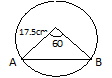 The angle of a sector of a circle radius 17.5cm is 600. AB is a chord. Find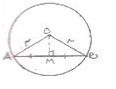
 Given: a circle with centre O and Chord AB.


 OM Such that AM = MB


 OA = OB (radii)


 AM = MB (given)S


 OM = OM
 AMO= BMO (SSS)
 x = √ 36 = 6cm
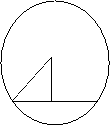 Solution
 |AC| = √9 = 3cm
 Construction: Join PO and produce to any point Q
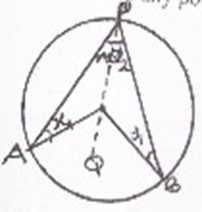 Proof :


 OA = OP ( radii)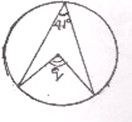
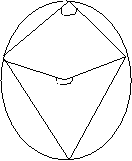

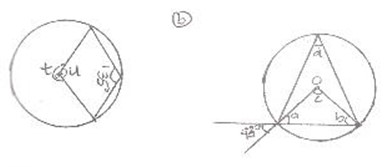 (a) (b)

 Q
Q
 P
P
 O B
O B


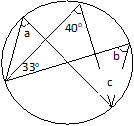


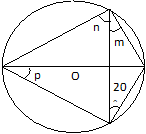
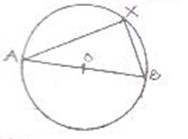
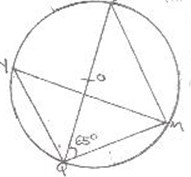 Example: in the fig below: PQ is a diameter of a circle PMQN, centre O if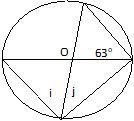
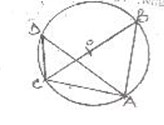
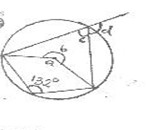
 1. 2.
1. 2.







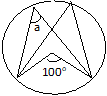
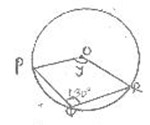
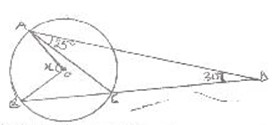
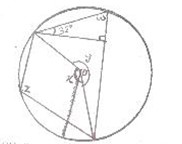
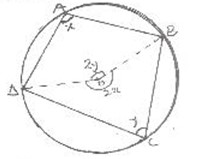 Proof: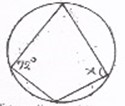
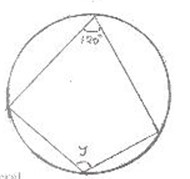 Find x and y
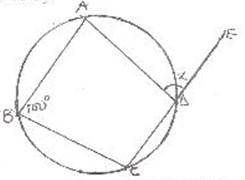 1. 2.
1. 2.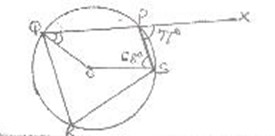
 Example
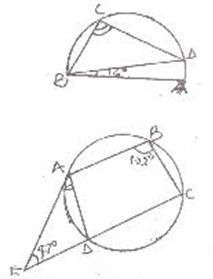 1.
1. 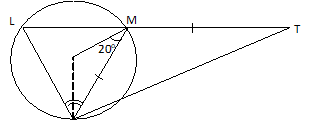 1.
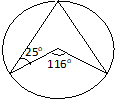
1. 
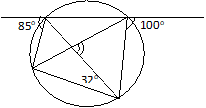
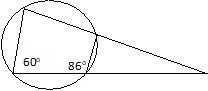 1. 2.
1. 2. (a) 1000 (b) 860 (c) 940 (d) 1440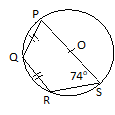
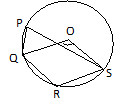 (a) 360 (b) 1440 (c) 720 (d) 1080
  (a) 430 (b) 480 (c) 530 (d)580
 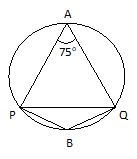 (a) 1050 (b) 750 (c) 150 (d) 1500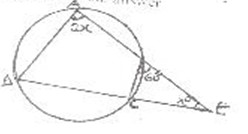
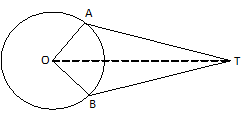

 OAT = OBT = 900 (radius tangent)
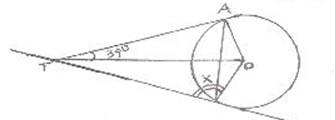 1.In the figure below O is the centre of the circle and the TA and TB are tangents if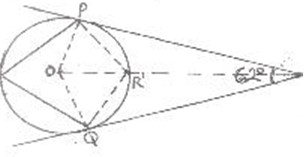
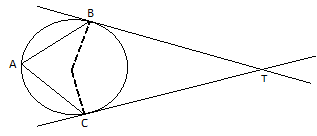
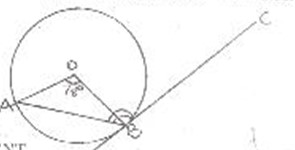
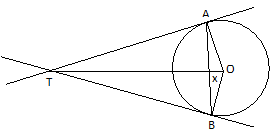 Use the diagram below to answer the questions.
Theory


