


SECOND TERM
SUBJECT: MATHEMATICS CLASS: JSS 3
SCHEME OF WORK
WEEK TOPIC
- Solving Simultaneous Equation by Substitution and elimination method.
- Solving Simultaneous Equation by graphical methods.
- Geometry: similar shapes
- Geometry continued: length, areas and volumes of similar figures
- Areas of plane figures
- Areas of plane figures continued
- Trigonometric ratios
- Angles of elevation and depression
- Bearing
- Scale Drawings.
- Revision
WEEK ONE
SIMULTANEOUS EQUATION
Equation such as 4x + 1=7, has only one solution and one unknown, thus it is called linear equation. Considering equations such as 4x +2y = 24 which contains two unknown quantities (x, y) it cannot be solved unless one of the variables is given or another connecting the variable is given. Hence we have two linear such as x+y=10; and x-y=2, this is known as simultaneous equation. To solve the given equations (simultaneous equation), we need to find the value of x and value of y that will satisfy both equations at the same time.
SUBSTITUTION METHOD OF SOLVING SIMULTANEOUS EQUATION
In using this method, one of the variables is made the subject of the equation. Then the value of the subject of the equation is substituted in the second equation. When the substitution is done, the equation is solved to obtain the value of one of the variables. The value is then substituted in one of the pair of equations to find the second variable.
Example: solve this pair of simultaneous equation using substitution method;
X+6y = -2 3x+2y =10
Solution:
X+6y = -2………(1)
3x+2y=10 ………(2)
From eq (1) x= -2 -6y
Sub x= -2 -6y in eq(2)
3(-2-6y) +2y = 10
-6-18y +2y =10
-16y =10+6
-16y =16
y=16/-16
y=-1
sub y = -1 in eq(1)
x +6y= -2
x +6(-1) = -2
x-6 = -2
x=-2+6
x = 4
Evaluation:
1. x+3y =-4 x +y=-10 2. 5x-y=35; 3x-2y=14
ELIMINATION METHOD OF SOLVING SIMULTANEOUS EQUATION
In the Elimination method, the two simultaneous equations are either added or subtracted so as to eliminate one of the variables. This is very useful to solve simultaneous equation especially when none of the coefficient of the unknown is one (1).
Example: use Elimination method to solve; 6x +5y=2 and x-5y=12
Solution:
6x+5y=2

 X-5y=12
Adding: 7x =14
x=2
sub x=2 in eq(1)
6x+5y=2
6(2)+5y=2
12+5y=2
5y= 2-12; 5y=-10
y= -10/5 y= -2
EVALUATION: simplify using Elimination method;
1. 2y-x=10; y+x=2 2. 4p+3q; 3p-5q=-10
WORD PROBLEMS LEADING TO SIMULTANEOUS EQUATION
To solve such problems:
- Identify the two unknowns and represent them with letters.
- Translate the words into equations.
- Use any convenient method to solve the two unknowns.
Example:
The difference between the ages of Audu and Ojo is 15. if the sum of their ages is 47. How old are they?
Solution: let x represents Audu’s age and y represent Ojo’s age.
x-y =15…………(1)
 x+y =47………..(2)
Adding: 2x = 62
x= 62/2 =31
Substituting: x-y=15
31-y=15
-y=15-31
-y=-16
y=16
EVALUATION:
- The cost of one orange and two apples is 24k. Two orange and three apples cost 44k. How much does each cost?
- Six pencils and three rubbers cost N117. Five pencils and two rubbers cost N92. How much does each cost?
Reading Assignment
Essential mathematics by A.J.S OLUWASANMI Pg 148-152
Exam focus for J.S.S CE Pg 220-222
WEEKEND ASSIGNMENT
- If X=2, the value of y in y=8-4x is A. 1 B. 2 C.3
- If the equation y = mx+c is satisfied by x=1, y=5 and c=0, the value of m is A. 3 B. 5 C. 2
- the solution of x if y=5x+2; and x+2y=15 is A. 1 B. 2 C. 5
- What is the product of the two numbers A. 60 B.45 C. 30
THEORY
- The sum of the ages of a man and his wife is 73yrs. Eight years ago the husband was twice as old as the wife. How old are they now?
-
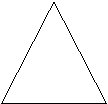
 The below is an equilateral triangle triangle with the dimensions shown:
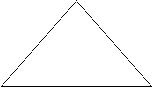
2p 5q-2
p+q+5
Find
- The value of p and q
- The perimeter of the triangle in meters
- The area of the triangle to 3.s.f.g
WEEK TWO
GRAPHICAL METHOD OF SOLVING SIMULTANEOUS EQUATION
Expressions in x written as ax+b where a and b are constants (which can be any number) are known as linear expression. Thus we can draw a graph representing the above expression by equating it to y. to draw a linear graph we select suitable values of x so as to calculate the values of corresponding y. hence to draw a simultaneous equation, we make y the subject in each of the equation. Then find the values of the corresponding y with the selected suitable values of x.
Steps in using graphical method
- Make y the subject in each equation.
- Draw a table of values for each of the linear equations; taking a range of values.
- On a graph paper label the x-axis and y –axis according to the table drawn in step 2(two) above.
- Plot these values and join the points for each of the table of values.
- Take note of the point of intersection of the two lines. At this point trace it to both y and x axes. The values are the only pair of values that satisfy both simultaneous equations.
Example:
Solve graphical the simultaneous equation below
X + y =6 3x –y = 12.
Solution:
1. From eq (1) y= 6- x
From eq (2) y= 3x+2
- Draw the table of values of the equations taking a range of values i.e.
Table for y = 6-x
X | -1 | 0 | 1 | 2 | 3 |
y | 7 | 6 | 5 | 4 | 3 |
Guiding equation: Y=6-x
- when x= -1, Y =6-(-1), Y= 6 +1, Y=7
- when x=0, Y= 6-0, Y= 6
- when x=1, Y= 6-1, Y= 5
- when x=2, Y= 6 -2, Y= 4
- when x=3, Y=6-3, Y= 3
Table for Y=3x+2
Guiding equation: Y=3x+2
X | -1 | 0 | 1 | 2 | 3 |
y | -1 | 2 | 5 | 8 | 11 |
- when x=-1, Y=3(-1) + 2; Y= -3+2; Y= -1
- when x= 0, Y= 3(0) + 2; Y= 0+2 = 2
- when x=1, Y=5
- when x=2, Y=8
- when x=3, Y=3(3) +2; Y=9+2=11
EVALUATION
1. What is a linear equation?
2. Which of these equations are linear? A. a+b B.a2 +b =12 C. x-1 = 2
3. What is the first step in drawing graph?
Further exercises on the use of graph to solve simultaneous equation
In making of table of values for points to be plotted, x is called independent variable while y is the dependent variable. The point where the variable crosses an axis is called an intercept.
Example:
Draw the graph of the given pair of the equation 2x-y=3, x+y=6 and show the point of intercept of the lines on the y-axis.
Solution:
- Make the y subject in each equation. I.e. Y=2x-3; Y=6-x
- Make a table of values for each equation with ranges of Y=2x-3
X | -1 | 0 | 1 | 2 | 3 |
y | -5 | -3 | -1 | 1 | 3 |
- Make the table of value for Y=6-x
X | -1 | 0 | 1 | 2 | 3 |
y | 7 | 6 | 5 | 4 | 3 |
From the graph the points of intercept are -3 and -6.
EVALUATION:
Solve graphically the below simultaneous equation:
- Y-x = -4; Y+3x =12
- 8c +3d = 1; 4c+5d =9
READING ASSIGNMENT:
Essential mathematics for J.S.S 3 Pg 146-147
Exam focus for J.S.S CE Pg 218-219
WEEKEND ASSINMENT
- How many variables do we have in x+y+z-6=128 A.2 B. 1 C. 3
- What axes are used in the plotting of graph? A. P&Q B. X&Y C.P&Y
- when given that Y=2x-1, what is the y if x=-1 A. -3 B. -2 C. 1
- Given that coordinates at the point of intercession of a drawn graph is (-1,3), the values of y is … A.-1 B. 3 C. 2
- Make n the subject in 9m-4n= -36 n A. -36+9m B. 9m+36 C. 36-9m


4 4 4
THEORY
Solve the following pairs of simultaneous equations graphically:
1. 2x + y=8; x+y=5 2. 6x+y=12; x-y=9
WEEK THREE
TOPIC: Geometry
Similar Triangles
One of the following conditions is sufficient to show that two triangles are similar.
- If two angle of one triangle are equal to two angles of the other.
- If two pairs of sides are in the same ration and their included angles are the same.
- If the ratios of the corresponding sides are equal.
Example
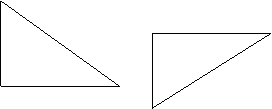
Show that ∆ABC and ∆XYZ shown below are similar and hence find sides AB and XZ.
Solution
In ∆ABC:
< A = 180 – (32 + 38)
= 1100
Similarly, in ∆XYZ
= 380
0 , < B =
Therefore, Triangles ABC and XYZ are similar because they are equiangular
Hence: AB = AC = BC
XY ZY YZ
Substituting the given sides:
AB = 25 = 35
2 XZ 7
Hence: AB = 35 and 25 = 35
2 7 XZ 7
AB = 35 and 25 = 35
2 7 X2 7
7AB = 2 x 35 , 35 XZ = 25 x 7
AB 2 x 35 and XZ = 25 x 7
7 35
AB = 2 x 35 and XZ = 5cm
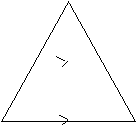 Example 2: A
X 8cm
 D E
D E
6 3/4 cm 4cm
B C
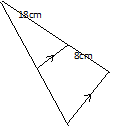
In the diagram shown above, line DE and BC are parallel. AE = 8cm, EC = 4cm, BD = 6 3/4 cm
- Show that triangle ABC and ADE are similar
- Calculate AD
Solution
- ');}
Triangle ADE and ABC are similar because they are equiangular
Let side AD be XcmAD = AE
AB AC
X = 8
X + 27/4 12
12X – 8x = 54
4x = 54 = 13.5cm
4
So X = AD = 13.5cm
READING ASSIGNMENT
Essential Mathematics Page 161
Exercise 18.3; 1-11
WEEKEND ASSIGNMENT
Objectives
- Similar triangles are ____________ A. Equiparallel B. Equiangular C. Parallel
- Ratio of corresponding angles must be A. 1 B. parallel C. constant
X Find x
1110 320 A. 370 B. 320 C. 670
- If AB = 6cm and AD = 8cm. What is the ratio of corresponding sides A. ¾ B. 5/4 C. 4/5
- The sum of angles in a triangle is ____ A. 3600 B. 2700 C. 1800
Theory
- P X Q
10cm
S T
y Find xY
- A
M E
D C Find m
- 2/3cm B
WEEK FOUR
TOPIC: GEOMETRY CONT’D
Areas and Volumes of similar shaped
Scale Factor (Length Ratio)
P 9cm Q A B2 6cm
D 3 C
S R
Scale factor = 9 or 6 = 3
3 2 1
= (3/1)2 = 9/1 or 9.1
If the ratio of the length is X: YThen the ratio of the area is X2 : Y2
Example 1:
In the diagram below, if the area of triangle ABC is 48cm2, find the area of triangle XYZ to 3s.f
A X
550
650 600 600
B 12cm C Y 4cm Z
Solution
In ∆ABC,
In ∆XYZ,
0 Since then corresponding angles are equal, ∆ABC and ∆XYZ are similar
Scale factor = 4 = 1
12 3
Area factor = (1/3)2 = 1/9
Area of ∆XYZ = 1
Area of ∆ABC 9
Area of ∆XYZ = 1
48 9
Area of ∆XYZ = 48
9 = 5.333cm2
Area of ∆XYZ = 5.3 cm2 to 2 s.f.
Volume of Similar Shapes
Volume of factor = (Scale factor)3
If the ratio of the length ix X : Y
Then the ratio of the volume is X3 : Y3
Example 2: The ratio of a cylinder of volume 2970cm3 is 30mm. find the volume of a similar cylinder of radius 40mm.
Solution
Scale factor = 40mm = 4
30mm 3
Volume ratio = 43
33
V = 43
2970 33
Cross-multiply
V = 7040cm3
The volume of the cylinder is 7040 cm3
READDING ASSIGNMENT
Essential Mathematics page 182
Exercise 19.2, 1-14
Exercise 19.1; 1- 19
WEEKEND ASSIGNMENT
- An object has an area of 3.2cm2 on a map is 1: 1000, find the actual area of the object in m2 .
- Two similar circles have corresponding radio in the ratio 4:9. What is the ratio of their area.
Objectives
- If the scale factor is 2:3, what is the area factor A. 4: 6 b. 6: 4 C. 4:9
- If the area factor is 4:9, what is the volume factor A. 8: 27 B. 64:81 C. 27:8
- Area factor is the _____ of scale factor A. cube B. square C. root
- The corresponding altitudes of two similar triangles are 8cm and 5cm. Find the ration of their areas? A. 25:16 B. 64:25 C. 64:10
- If 2 = x find x
3 9 A. 27 B. 18 C. 6
WEEK FIVE AND SIX
TOPIC: Area of Plane Figures
Area of Triangle
B B
h h
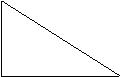
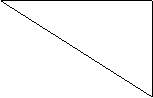
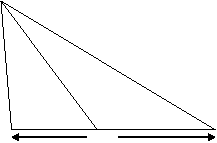
A b C D A b CArea of ∆ABC = ½ base X height = ½ bh
BC h a
A b D C
Sin A = h
C h = c sin A
Area of ∆ABC = ½ bc sin A
Example 1:
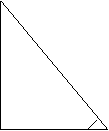
Find the area of triangle PQR if sides PQ = 6cm, PR = 8cm and QR = 10cm
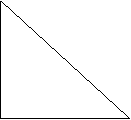
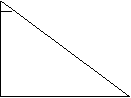
Solution
First, we need to show that ∆PQR is a right angled triangle
PQ2 + PR2 = QR2
62 + 82 = 102
36 + 64 = 100
∆PQR is a right – angled triangle since 6, 8 and 10 Pythagoras triples
Q6cm 10cm
P 8cm R
Area of ∆PQR = ½ X 8 X 6 = 24cm2
Example 2:
Calculate the area of triangle PQR correct to 3 significant figures if p = 8.5cm, q = 6.8cm and R = 65.40
Solution
P r
R 65.40 Q
P 8.5cm
Area of ∆PQR = ½ pq sin 65 . 40
= ½ x 8.5 x 6.8 x sin 65.4
= 26.276cm2
Area = 26.3cm2 to 3 s.f
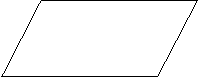
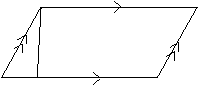
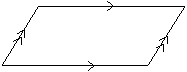
Area of Parallelograms h b
Area of parallelogram = base x height = bh
Consider the parallelogram
D CA E D
In general,
Area of parallelogram = product of adjacent sides x the size of angle between the two sides
Example 3
Find the area of parallelogram with base 12cm and height 7cm
Solution
Area of parallelogram = base x height
= 12cm x 7cm
= 84cm2
Example 4:
Find the area of parallelogram shown in the diagram below
D C550
A 12.5cm B
Area of ABC ∆ = 12.5 x 8.4 x sin 55
= 105 x 0.8192
= 86.061cm2
The area of ABC ∆ = 86.061cm2 to 1 d.p
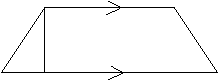
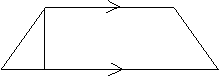
Trapezium
A a BH
D b C
Area of trapezium = ½ of (sum of parallel sides) x height
Area of trapezium = ½ (a + b) h
Rhombus
Area of Rhombus = base x height
= bh
OR Area of Rhombus = ½ of product of diagonals
Example 3:
Find the area of trapezium ABCD shown below if AB = 8cm, BC = 6cm, DC = 12cm and angle BCD = 430
A 8cm B 430
D 12cm C
Solution:
Area of trapezium ABCD = ½ (AB + DC)h
Sin 430 = h/6
h = 6 x sin 430
= 6 x 0.6821 = 4.092
Area of ABCD = ½ (8 + 12) x 4.092
= ½ x 20 x 4.0920 = 40.92cm2
The area of trapezium ABCD = 41cm2 to the nearest cm2.
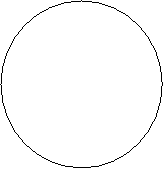
Area of Circles
Area of circle
where r = d/2
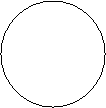
Area of annulus
R Outer Circle r Inner Circle Annulus Area of annulus =
R2 – =
(R2 – r2)READING ASSIGNMENT
Essential Mathematics page 220
Ex 21.5 1 – 23
WEEKEND ASSIGNMENT
- The area of a parallelogram is given as 108cm2. F he height of the parallelogram is 9cm, find the base of the parallelogram A. 13cm B. 9cm C. 12cm
- Find the area of a rhombus of side 20mm and height 10kk A. 20mm2 B. 200mm2 c. 300mm2
- Find the area of a circle of diameter 35cm
- The area of a circle is 1386cm2. Find the diameter of the circle A. 21cm B. 42cm C. 82cm
- A sector of a circle of radius 8cm has an area of 1200 at the centre. Find its perimeter A. 33 B. 34 C. 36
THEORY
- A circle has an area of 144 . Calculate the circumference of the circle, leaving your answer in terms of
- Calculate the area of an annulus, which has an external diameter of 25cm and internal diameter of 15cm.
WEEK SEVEN
TRIGNOMETRICAL RATIO
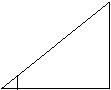
Trignometrical ratio is a ratio of the lengths of two sides of a right-angle triangle. The three trignometrical ratios are sine (sin) cosine (cos) and tangent (tan). The word tri- means three, thus trignometrical ratio deals with three sided figure (triangle).
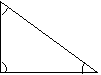
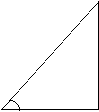
In a right-angled triangle, the longest side is called the hypotenuse (opp the right angle), the side adjacent (next) to the given angle is called the Adjacent while the side opposite to the given angle is called the opposite.
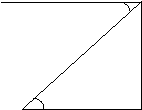
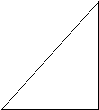
B BOpposite hypotenuse Adj hyp
Fig 1 A Adjacent C Fig 2. A opp C
Note: To be able to know the ratio easily take note of the acronym SOHCAHTOA. Where S stands for sine, C stands for cosine, and T for tangent.
Degree and Minutes
Angles are often measured to the nearest degree. In some state, degree may be subdivided into minutes and.
Note:
10 =60 minutes. This is written as 60/.
To change from minutes to degree, we divide the number by 60.
Example: convert 100 to minutes
Solution: 10 x 60 = 600mins
EVALUATION:
- Convert the following to minutes: A. 160 B. 500
- Rewrite and give your answer in degree to 1.dp A. 460 151 B. 390 251 C. 1400 4
SINE OF ANGLE
In a right-angle triangle, the ratio of opposite to hypotenuse is defined as the sine of the angle under consideration.
From fig 1, sin ø = AB/BC. The ratio does not depend on the size of the triangle but depends only on the size of the angle (ø).
To find sine of the angles, we use of either calculator or the sine table. In use of sine table, since the sine of angle increases as the angle increases, thus the differences will be added.
EVALUATION
Use mathematical table to find
- sin 43
- sin 14.58
- sin 30.6
USE OF SINE IN SOLVING TRIANGLES
Example:
Find the marked side or the angle in each of the following. Give your answer to 2.s.f.g.
Fig 1 x 4cm46ø 9cm
15cm
Fig 2
Solution: From Fig 2
From fig 1 sinø = opp/hyp
Sin46 = 15/x sinø =4cm/9cm
X=15/sin46 sinø = 0.444
X = 15/0.7193 ø = sin1 0.4444
X=20.85, X=21 (2.s.f.g) ø = 26.49, ø= 26 (2.s.f.g)
EVALUATION
What is value of X and ø in the below triangle
28 x
ø10
COSINE OF ANGLES
In a right angled triangle, the ratio of adj/hyp is defined as the angle under consideration.
Using diagram:
ø
adj hyp
opp
Thus Ө = AB/AC
This value of the ratio does not depend on the size of triangle but on the size of angle.
CALCULATIONS OF COSINE OF ANGLES
Find the unknown side or angle in the below triangles
2 5cm
ø
ø 3.5cm
1solution:
2 5cm
ø ø
- 3.5cm
cosø = Adj/hyp cosø = adj/hyp
cosø = ½ cosø = 3.5cm/ 5cm
ø = cos1 0.5 ø = cos1 0.7
ø = 600 ø = 45.67
TANGENT OF ANGLES
The tangent of any angle is the ratio opp/adjacent. In short form, tanӨ = opp/adj
CALCULATING TANGENT OF TRIANGLES
Examples: find the side of the triangle marked x. correct to 2 S.F.G in the figure below.
40
8cm hyp
opp
xcm
solution:
tan ø = opp/adj = xcm/8cm
tan ø = x/8, ø = tan 40 x 8
ø = 0.8391×8
ø = 6.7128; ø = 6.7( 2 s.f.g)
EVALUATION: calculate the side of the triangle marked x
60 19cm
(i) (ii) 75
5 x
x
READING ASSIGNMENT
Essential mathematics for J.S.S 3 Pg 101-116
Exam Focus for J.S.C.E. for J.S.S 3 Pg 224-235
WEEKEND ASSIGNMENT
- Convert 32.40 to degree and minutes. A. 32 42 1 B. 32 441 C. 32 241
- Cos 60 is equal to ——- A. 0.5 B. 0.49 C. 1/25
Calculate the side marked P, Q, and α
Draw:x
5 q
30
p
- the value of P is A. 9.6 B. 8.7 C. 10
- the value of q is — A. 10 B. 8 C. 13
- the value of α is —A. 45 B.60 C. 30
THEORY
x1. Calculate x
16cm
7
A2. ø œ calculate the unknown angles.
20cm 60cm
B 45 C
35cm
WEEK EIGHT
TOPIC: ANGLES OF ELEVATION AND DEPRESSION
CONTENT: i) Horizontal and vertical lines
ii) Angles of elevation
iii) Measuring angles of elevation and depression.
Horizontal and Vertical Lines
Horizontal lines are lines that are parallel to the surface of the earth. For example, the surface of a liquid in a container, floor of a classroom, etc. See the diagram below:
Horizontal lineVertical lines are lines that are perpendicular to the horizontal surface, e.g. wall of a classroom, a swing pendulum, etc.
Vertical line
Evaluation:
Say whether the following are horizontal or vertical or neither.
a) A table top b) A door c) A table leg d) Top edge of a wall.
READING ASSIGNMENT
NGM Bk 2 Chapter 20, Page 165
Essential Mathematics for JSS Bk 2, Chapter 17, Pg 173
Angles of Elevation
The angle of elevation of an object for a given point above the surface of the earth is the angle formed between the horizontal plane and the view point of the object. See the diagram below.
T V FHorizontal plane
V = View point, T = Top where the object is, F = Foot of the vertical plane
e = angle of elevation
Reference:
NGM Bk 2 Chapter 20, Page 165
Essential Mathematics for JSS Bk 2, Chapter 17, Pg 173
Angle of Depression
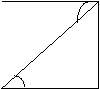
The angle of depression of an object from a given point T is angle from the horizontal line above the earth’s surface and the vertical surface.
Horizontal Th
Thus, the angle of elevation is equal in size to the angle of depression. (alternate angles are equal i.e. d = e)
Measuring Angles of Elevation and Depression
When constructing angles of elevation and depression, the use of scale drawings is necessary in order to have effective construction of angles
Worked Examples
1. Consider the diagram below; find the height of the flagpole to the nearest metre using suitable scale.
F Q 10m T
Solution
By construction, choose a scale of 1cm represent 2m.
The height of the flagpole PT = 3cm, converted to m, will give 2 × 3 = 6.
Example 2: The angle of elevation of the top of a tower to a point 42m away from its base on level ground is 360, find the height of the tower.
Solution T
3 R
42m
By construction, using a suitable scale of 1cm represented by 6m, then PR = 42/6 = 7cm.
The length TR = 5.0cm. Converting back to metre, we have;
Length TR = 5 × 6 = 30m
Example 3: From the top of a building 20m high, the angle of depression of a car is 450, find the distance of the car from the foot of the building.
Solution
Rough sketch: TC 20m F
T = Top of the building, C = Car, F = Foot of the building
CF is the distance of the car from the foot of the building.
Since angle of depression equals angle of elevation;
By construction, using a suitable scale of 1cm represents 5m
For 20m, we have 20/5 = 4cm
Length CF = 4cm
By conversion, length CF = 4 × 5 = 20m.
Evaluation:
- A tower PQ is 10m high, if the distance from point R to P is 50m on the ground, find the angle of elevation of Q from R. Q
10m
P 50m R
2. From the top of a cliff of 200m high, Dele observes that the angle of depression of a boat at sea is 350, find the distance between the boat and the foot of the cliff.
READING ASSIGNMENT
NGM Bk 2 Chapter 20, Page 166 – 169
Essential Mathematics for JSS Bk 2, Chapter 17, Pg 176 – 177.
WEEKEND ASSIGNMENT
Objective
- Calculate the size of the fourth angle if three angles of a quadrilateral are 650, 1150, and 1250 respectively. a) 350 b) 550 c) 450 d) 750
- Calculate the number of sides of a regular polygon whose total angle is 10800. a) 4 b) 6 c) 8 d) 10
- PQRS is a rectangle with sides 3cm and 4cm, if its diagonal cross at O, calculate the length of PO. a) 3.5cm b) 5.0cm c) 2.5cm d) 4.0cm
- If the angles of a pentagon could be x, 2x, 4x and 5x respectively, what would be the value of x? a) 600 b) 900 c) 150 d) 300
THEORY
1. From the top of a building 50m high, the angle of depression of a car is 550, find the distance of the car from the foot of the building.
2. Find the height of the flagpole in the diagram below to the nearest metre.
F20cm
B 8cm C
WEEK NINE
TOPIC: BEARING
BEARING
CONTENT: i) Compass bearing
ii) Three figure bearing
iii) Finding the bearing of a point from another.
Compass Bearing
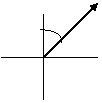
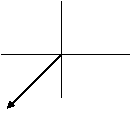
A bearing gives the direction between two points in terms of an angle in degrees. The two types of bearings are compass bearings and three figure bearings.
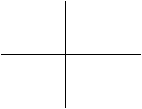
The form major compass directions are North (N), South (S), East (E), and West (W).
NW E
S
In compass bearings, the angles are measured from North or South depending on which one is nearer
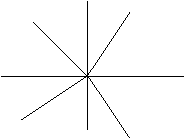
NE N NEW E
SW S SE
Apart from the four main points or directions, there are also four main secondary directions i.e. NE (North East), SE (South East), SW (South West), NW (North West). The angle between each point is 450.
Worked Examples
Draw a sketch to show each of these bearings marking the angles clearly.
a) N 350 W b) N 700 E c) S 580 W.
Solution
a) N 350 W means from N, measures 350 towards the W or 350 W of N.
N 350 W Nb) N 700 E means 700 towards E.
NN 700 E
W E
c) S 580W means from S measures 580 towards W.
NW E
S
S580W
Evaluation:
Find the compass direction of point A from point O in these diagrams.
a) N b) NW E W E
S Sc) N W ES
REFERENCE
NGM Bk 2 Chapter 23, Page 185 – 187.
Essential Mathematics for JSS Bk 2, Chapter 24, Pg 246 – 247.
THREE FIGURE BEARINGS
Three figure bearings are given as the number of degrees from North, measured in a clockwise direction. Any direction can be given as a three figure bearing. Three digits are always given but angles less than 1000 need extra zero to be written in front of the digits e.g. 0000, 0360, 0700 up to 0990.
Worked Examples
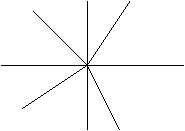
Find the three figure bearings of A, B, C, and D from X.
N AD
W X E
C
S B
Solution
a) The arrow N shows the direction N, NXA = 630. The bearing of A from X is 0630.
b) NXB = 180 – 35 = 1450. The bearing of B from X is 1450.
c) NXC clockwise = 180 + 75 = 2550. The bearing of C from X is 2550.
d) NXD clockwise = 360 – 52 = 3080. The bearing of D from X is 3080.
Evaluation
In the figure below, find the bearings of A, B, C and D from X.
D N AW X E
C
S B
N2
A570
570
B N1
By constructing line N2A
2BA is 570, similarly, N1AB = 570 (alternate angles are equal). From point A, starting from the North, 180 + 57 = 2370. a) The bearing of B from A is 2370
b) The bearing of a from B is 0570.
Evaluation:
1. The bearing of X from Y is 3190. Calculate the bearing of Y from X.
2. In each diagram, calculate (i) the bearing of B from A and (ii) the bearing of A from B
N2 a) b) A 1500 N1N2 BB
2500 A
READING ASSIGNMENT
NGM Bk 2 Chapter 23, Page 189 – 190
Essential Mathematics for JSS Bk 2, Chapter 24, Pg 248 – 250.
WEEKEND ASSIGNMENT
1. If the angle of elevation of P from Q is 380, then the angle of depression of Q from P is_____
a) 190 b) 520 c) 380 d) 1280
2. The compass direction of the diagram below is
N
W E
S
a) S200W b) S600W c) S700 d) S200E
3. Use the diagram below to answer questions 3 to 5.
NI
M
K
L
The bearing of J from X is ___________________
a) 610 b) 1030 c) 420 d) 1880
4. The bearing of L from X is _______________
a) 2600 b) 1600 c) 1000 d) 760
5. The bearing of M from X is ____________
a) 2260 b) 3000 c) 3360 d) 240
THEORY
- Bala stood on one side of a field and finds that the bearing of an orange trees is N75 0 W.
Shortly after, Asiru moved to the foot of the orange tree to spot Bala. Calculate bala’s bearing from asiru. X
2. The bearing of P from Q is 1950, what would be the bearing of Q from P?
WEEK TEN
SCALE DRAWING
Using Scales
A scale is a ratio or proportion that shows the relationship between a length or a drawing and the corresponding length on the actual object.
Thus,
Scale = Any length on scale drawingCorresponding length on actual object
Worked Examples
1. The scale drawing of the length of an advertisement billboard measures 5cm. What is the actual length of the billboard if the scale is 1cm represents 2m?
Solution
1cm represents 2m
5cm represents 5 × 2m = 10m
The actual length of the billboard = 10m.
2. An airport runway measuring 6000m is drawn to a scale of 1cm represents 500m. Find its length on the drawing.
Solution
500m is represented by 1cm
1m is represented by 1/500cm
6000m is represented by 6000 × 1/500 = 12cm
Length on drawing = 12cm
Evaluation:
- Copy and complete the table below in finding the length on drawing giving a suitable scale.
Actual length
Scale
Length on drawing
20m
1cm to 5m
450m
1cm to 100m
65m
1cm to 5m
- Copy and complete the table by finding the actual length.
Length on drawing
Scale
Actual length
11cm
1cm to 5m
8.2cm
1cm to 100m
12.6cm
2cm to 1m
Scale Drawing
Scale drawing is very important to engineers, architects, surveyors and navigators. For an accurate scale drawing, mathematical instruments are needed such as pencils, a ruler and a set-square. Also, the dimensions of the actual objects are written on the drawing.
Worked Examples
- A rectangular field measures 45m by 30m. Draw a plan of the field. Use measurement to find the distance between opposite corners of the field.
Solution
Firstly, make a rough sketch of the plan
45m30m
Secondly, choose a suitable scale
Using 1cm represent5m will give a 9cm by 6cm rectangle.
The distance between the opposite corners of the field is represented by the dotted line. Length of the dotted line = 10.75
Actual distance = 10.75 × 5 = 53.75m = 54m (to the nearest metre)
Example 2:
Points A and B are 178m and 124m from X respectively. The distance between A and B is 108m. Make a scale drawing of the path and find the angle between the paths and X. XSolution
178m 124m
A B
108m
Using a suitable scale of 1cm to 20m, the sides of the triangle in scale drawing will be as follows:
AX = 178/20 = 8.9cm, BX = 124/20 = 6.2cm, AB = 108/20 = 5.4cm.
X178m 124m
A 108m B
Using a protractor, AXB = 370 (to the nearest degree). The angle between the paths is 370.
Evaluation:
- Find the distance between the opposite corners of a rectangular room which is 12m by 9m. Use a scale of 1cm to 3m.
- A triangular plot ABC is such that AB = 120m, BC = 80m and CA = 60m. P is the middle point of AB. Find the length of PC. Use a scale of 1cm to 10m.
Application of Scale Drawing on Related Problems
Worked Examples
- The scale on a map is 1 : 50,000.
- Two villages A and B on the map are 5.5cm apart, find the actual distance in km between A and B.
- If town C is 4km from the village A, what is the distance of C from A on the map?
Solution
Note: Map scale = actual distance/distance on the map.
∴ Distance on map = Actual distance / Map Scale
- 1cm represents 50,000cm
5.5cm represent 50,000 × 5.5 = 275,000cm
To correct to km = 275,000/100,000 = 2.75km.
- 1km = 100,000cm
4km = 100,000 × 4 = 400,000cm.
Since 50,000cm represents 1cm
400,000cm is represented by 400,000/50,000 = 8cm
or Distance on the map = Actual distance / Map Scale
= 400,000 / 50,000 = 8cm.
Example 2:
Two cities are 70km apart. The distance between them is 20cm on the map. What is the scale of the map?
Solution
1km = 100,000cm
∴ 70km = 100,000 × 70 = 7,000,000cm
Map scale = actual distance/distance on map.
= 7,000,000/20 = 350,000
The scale of the map = 1 : 350,000.
Evaluation: Class Work
1. The scale on the map is 1 : 25,000.
a) Find the distance in km between two islands represented by a distance of 20cm on the map.
b) Find the distance between two towns on the map that are 10km apart..
2. The scale of a map is 1: 20,000. Find the actual distance in km represented by the map by a) 5cm b) 10cm
READING ASSIGNMENT:
NGM Bk 2 Chapter 16, Pages 133 – 134.
Essential Mathematics for JSS Bk 2, Chapter 17, Pg 166 – 169
WEEKEND ASSIGNMENT
1. A quadrilateral has angles of 1280, 910, a0 and 2a0. Find the value of a0.
a) 670 b) 470 c) 570 d) 1070
2. The sum of the angles of a polygon is 16200, calculate the number of sides that the polygon has. a) 11 b) 21 c) 16 d) 13
3. In fig. 1, PQRT and TQRS are parallelogram
QR = 3cm and TQ = 4cm, what is PS?
4. Which of the following are Pythagoras triple? I (3, 4, 5) II (5, 12, 13) III (8, 13, 17).
a) III only b) I and II only c) II only d) II and III only.
5. The diagonals of a rhombus measures 8cm y 6cm, what is the length of a side of the rhombus? a) 8cm b) 7cm c) 10cm d) 5cm
THEORY
- The scale on the map is 2cm : 30,000km
Find the distance in km between two islands represented by a distance of 20cm on the map
2. A map of Nigeria shows scale of 1cm representing 75km. how far is it from Ibadan to kano, if the route distance measures 30.5cm on the map

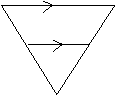


















 R2 –
R2 – 
 (R2 – r2)
 . Calculate the circumference of the circle, leaving your answer in terms of























2 Comments