


SUBJECT: FURTHER MATHEMATICS CLASS: SS1
SCHEME OF WORK
WEEK | TOPIC |
1 | Indices: Basic Laws & Application of indices |
2 | Indicial and Exponential Equations |
3 | Logarithms – Laws and application |
4 | General review of basic concept of set theory |
5 | Operation of sets and Venn diagrams |
6 | Review of First Half Terms Lesson & Periodic Test |
7 | Binary operations and basic laws of binary operations (i) Definition (ii) Solution of simple problems on binary operations (iii) Closure, commutative, associative and distributive laws |
8 | Binary operations continues: (i) Solution to problems on laws of binary operations (ii) Identity and inverse elements of a given binary operations (iii) Addition and multiplication tables for binary operations |
9 | Surds: (i) Definition of surds (ii) Rules and manipulation of surds (iii) Rationalization of surds at the denominator and equality of surds. |
10 | Measures of central tendency: (i) Mean, Median and Mode of grouped and ungrouped data (ii) Estimation of mode from the histogram of a grouped data. |
11 | Revision |
12 | Examination |
REFERENCE(S)
- Further Mathematics project 1 by Tuttuh Adegun et al
- New General Mathematics for SSS1, SSS 2 and SSS 3 by M. F. Macrae et al
WEEK ONE
TOPIC: INDICES
CONTENT
- Basic Concept of Laws of Indices
- Application of Laws of Indices
Basic Concept of Laws of Indices
A number of the form am where a is a real number, a is multiplied by itself m times,
The number a is called the base and the super script m is called the index (plural indices) or exponent.
1. a m x a n = am + n ——————–Multiplication law
Example: p3 x p2 = ( p x p x p) x (p x p) = p 5
Or p3 x p2 = p 3 + 2 = p5
2. am ÷ an = am – n ———————Division law
Example: p6 ÷ p4 = p 6 – 4 = p2
3. (a m )n = amn —————-Power law
Example: (p3)2 = p3 x p3 = p 3 + 3 = p6
Or p3 x 2 = p6
4. am ÷ am = am – m = a0 = 1
am ÷am = am/am = ao = 1
a0 = 1 ………………………Zero Index
Note : Any number raised to power of zero is 1
Example: 3o = 1, co = 1, yo = 1
5. (ab)m = ambm ————-Product power law
e.g. (2xy)2 = 4x2y2
6. a – m = 1/am ————- Negative Index
Example: 2 -1 = ½, and 3 -2 = 1/3 2 = 1/9
7. a1/n = n√a ————– Root power law
Example : 9 ½ = √9 = 3
27 1/3 =3√27 = 3 ie (3)3 = 3
8. a m/n = (a 1/n) m = (n√a)m ———–Fraction Index
or a m/n = (am) 1/n = (n√a)m
Example: 272/3 = 3√27 = 32 = 9.
Evaluation
1. 275/3 2. 10000000000 3. 2x-1 x 22x+2
Application of Laws of Indices
Examples
Solve the following
(i) 32 3/5 (ii) 343 2/3 (iii) 64 2/3 (iv) 0.001 (v) 14 0
Solution:
i) 32 3/5 = (32 1/5) 3 = (5√32) 3
= 2 3 = 8
ii) 343 2/3 = (343 1/3 )2 = (3√343)2
= (7 3)1/3)2
= 72 = 49
iii) 64 2/3 = (64 1/3)2 = (4 3)1/3)2 = 4 2
iv) (0.001)3 = (1/100)3 = (1/10)3)3 = (10 -3)3
= 10 -9 = 1/10 9
v) 14 0 = 1
General Evaluation
Simplify the following (a) 216 4/3 (b) 25 1.5 (c) (0.00001)2 (d) 32 2/5 (e) 81 ¾ (f) 6253/8 x 25
Reading Assignment : Further Mathematics project book 1(New third edition).Chapter 2 pg.4 – 6
Weekend Assignment
1) Evaluate 3 x = 1/81 (a) 4 (b) -4 (c) -2 (d) 2
2) Simplify 2r5 X 9r3 (a) p2 (b) 2p4 (c) P3 (d) 18r8
3) Solve 3-y = 243 (a) -5 (b) 5 (c) 3 (d) -3
4) Solve 25-5n = 625 (a) 1/5 (b) 2/5 (c) 1 1/5 (d) – 2/5
5) Simplify (0.0001)2 (a) 10-5 (b) 10 -3 (c) 10-8 (d) 10-10
Theory
1. 163/2 x 82/3 2. 3x2 x 4x3
321/5 6x7
WEEK TWO
TOPIC: INDICIAL AND EXPONENTIAL EQUATIONS
CONTENT
- Exponential Equation of Linear Form
- Exponential Equation of Quadratic Form
Exponential Equation of Linear Form
Under exponential equation, if the base numbers of any equation are equal, then the power will be equal & vice versa.
Examples
Solve the following exponential equations
a) (1/2) x = 8 b) (0.25) x+1 = 16 c) 3x = 1/81 d) 10 x = 1/0.001 e) 4/2x = 64 x
Solution
a) (1/2) X = 8 b) (0.25) x+1 = 16
(2 -1) x = 2 3 (25/100) x+1 = 42
2 –x = 2 3 (1/4) x+1 = 42
-x = 3 (4-1) x + 1 = 42
x = – 3 4 – x – 1 = 42
– x – 1 = 2
– x = 2 + 1
– x = 3
X = – 3
c) 3x = 1/81 d) 10 x = 1/0.001
3x = 1/34 10 x = 1000
3x = 3 -4 10 x = 10 3
x = -4 10 x = 10 3
x = 3
e) 4/2x = 64 x
4÷2x = 64 x
22 ÷2x = 64 x
2 2-x = (2 6) x
2 2-x = 2 6x
2- x = 6x
2=6x+x
2 = 7x
Divide both sides by 7
2/7 = 7x/7
x = 2/7
Evaluation
Solve the following exponential equations
a) 2 x = 0.125 b) 25 (5x) = 625 c) 10 x = 1/100000
Exponential Equation of Quadratic Form
Some exponential equation can be reduced to quadratic form as can be seen below.
Example:
Solve the following equations.
a) 22x – 6 (2x) + 8 = 0
b) 52x + 4 x 5 x+1 – 125 = 0
c) 32x – 9 = 0
Solution
a) 22x – 6 (2x) + 8 = 0 When y = 4 then, and When y = 2 then,
(2x)2 – 6 (2x) + 8 = 0 2 x = 4 2 x = 2
Let 2x = y 2 x = 2 2 2 x = 2 1
Then y2 – 6y + 8 = 0 x = 2 x = 1
Then factorize x = 1 and 2
y 2 – 4y – 2y + 8 = 0
y (y – 4) -2 (y -4) = 0
(y -2) (y – 4) = 0
y – 2 = 0 or y – 4 = 0
y = 2 or y= 4
y = 2, 4
b) 52x + 4 x 5x+1 – 125 = 0
(5 x) 2 + 4 x (5 x x 51) – 125 = 0
Let 5 x = p
P 2 + 4 x (p x 5) – 125 = 0
P2 + 4 (5p) – 125 = 0
P2 + 20p – 125 = 0
Then, Factorize p2 + 25p – 5p – 125 = 0
p (p + 25) – 5 (p + 25) = 0
(p – 5) (p + 25) = 0
p – 5 = 0 p + 25 = 0
p = 5 or p = – 25
Since 5x = p, p = 5
5x = 5 1
x = 1
5x = -25

c) 3 2x – 9 = 0
(3 x) 2 – 9 = 0
Let 3x = a
a2 – 9 = 0
a2 = 9
a = ±√9
a = ± 3
a = 3 or – 3
Since 3x = a, when a = 3
3 x = 31
x = 1
Since 3x = a, when a = -3
3 x = – 3

Evaluation:
Solve: (a) 3(22x + 3) – 5(2x+2) – 156 = 0 (b ) 92x+1 = (81 x-2/3x)
General Evaluation
Solve the following exponential equations.
a) 22x
+ 1 – 5 (2x) + 2 = 0
b) 32x – 4 (3x+1) + 27 = 0
Reading Assignment: Further Mathematics Project Book 1(New third edition).Chapter 2 pg. 6- 10
Weekend Assignment
- Solve for x : (0.25) X + 1 = 16 (a) -3 (b) 3 (c) 4 (d) -4
- Solve for x : 3(3)X = 27 (a) 3 (b) 4 (c) 2 (d) 5
- Solve the exponential equation : 22x + 2x+1 – 8 = 0 (a) 1 (b) 2 (c) 3 (d) 4
- The second value of x in question 3 is (a) -1 (b) 1 (c) 2 (d) No solution
- Solve for x : 10 -X = 0.000001 (a) 4 (b) 6 (c) -6 (d) 5
Theory
Solve the following exponential equations
(1) (3x)2 + 2(3x)– 3 = 0 (2) 52x+1 – 26(5x) + 5 = 0
WEEK THREE
TOPIC: LOGARITHM – SOLVING PROBLEMS BASED ON LAWS OF LOGARITHM
CONTENT
- Logarithm of numbers (Index & Logarithmic Form)
- Laws of Logarithm
- Logarithmic Equation
- Change of Base
- Standard forms
- Logarithm of numbers greater than one
- Multiplication and divisions of numbers greater than one using logarithm
- Using logarithm to solve problems with roots and powers (no > 1)
- Logarithm of numbers less than one.
- Multiplication and division of numbers less than one using logarithm
- Roots and powers of numbers less than one using logarithm
Logarithm of numbers (Index & Logarithmic Form)
The logarithm to base a of a number P, is the index x to which a must be raised to be equal to P.
Thus if P = ax, then x is the logarithm to the base a of P. We write this as x = log a P. The relationship logaP = x and
ax =P are equivalent to each other.
ax =P is called the index form and logaP = x is called the logarithm form
Conversion from Index to Logarithmic Form
Write each of the following in index form in their logarithmic form
a) 26 = 64 b) 251/2 = 5 c) 44= 1/256
Solution
a) 26 = 64
Log2 64 = 6
b) 251/2 = 5
Log255=1/2
c) 4-4= 1/256
Log41/256 = -4
Conversion from Logarithmic to Index form
a) Log2128 = 7 b) log10 (0.01) = -2 c) Log1.5 2.25 = 2
Solution
a) Log2128 = 7
27 = 128
b) Log10 (0.01) = -2
10-2= 0.01
c) Log1.5 2.25 = 2
1.52 = 2.25
Laws of Logarithm
a) let P = bx, then logbP = x
Q = by, then logbQ = y
PQ = bx X by = bx+y (laws of indices)
Logb PQ = x + y
:. Logb PQ = logbP + LogbQ
b) P÷Q = bx÷by = bx+y
LogbP/Q = x –y
:. LogbP/Q = logbP – logbQ
c) Pn= (bx)n = bxn
Logbpn = nbx
:. LogPn = logbP
d) b = b1
:. Logbb = 1
e) 1 = b0
Logb1 = 0
Example
Solve each of the following:
a) Log327 + 2log39 – log354
b) Log313.5 – log310.5
c) Log28 + log23
d) Given that log102 = 0.3010 log103 = 0.4771 and log105 = 0.699 find the log1064 + log1027
Solution
a) Log327 + 2 log39 – log354
= log3 27 + log3 92 –log354
= log3 (27 x 92/54)
= log3 (271 x 81/54) = log3 (81/2)
= log3 34/
log32
= 4log3 3 – log3 2
= 4 x (1) – log3 2 = 4 – log3 2
= 4 – log3 2
b) log3 13.5 – log3 10.5
= log3 (13.5) – Log310.5 = log3 (135/105)
= log3 (27/21) = log3 27 – log3 21
= log3 33 – log3 (3 x 7)
= 3log3 3 – log3 3 -log37
= 2 – Log3 7
c) Log28 + Log33
= log223+ log33
= 3log22 + log33
= 3 +1 = 4
d) log10 64 + log10 27
log10 26 + log1033
6 log10 2 + 3 log10 3
6 (0.3010) + 3(0.4771)
1.806 + 1.4314 = 3.2373.
EVALUATION
1. Change the following index form into logarithmic form.
(a) 63= 216 (b) 33 = 1/27 (c) 92 = 81
2. Change the following logarithm form into index form.
(a) Log88 = 1 (b) log ½¼ = 2
3. Simplify the following
a) Log512.5 + log52 b) ½ log48 + log432 – log42 c) log381
4. Given that log 2 = 0.3010, log3 0.4770, log5 = 0.6990, find the value of log
6.25 + log1.44
Logarithmic Equation
Solve the following equation:
a) Log10 (x2 – 4x + 7) = 2
b) Log8 (r2 – 8r + 18) = 1/3
Solution
a) Log10 (x2 – 4x + 7) = 2
x2 – 4x + 7 = 102 (index form)
x2 – 4x + 7 = 100
x2 – 4x + 7 – 100 = 0
x2 – 4x – 93 = 0
Using quadratic formula
x = – b ±√b2– 4ac
2a
a = 1, b = – 4, c = – 93
x = – (- 4) ± √(- 4) 2 – 4 x 1 x (- 93)
2 x 1
= + 4 ± √16 + 372
2
= + 4 ± √388/2
= x = 4 +√ 388/2 or 4 – √388/2
x = 11.84 or x = – 7.85
2) Log8 (x2 – 8x + 18) =1/3
x2 – 8x + 18 = 81/3
x2 – 8x + 18 = (2)3X1/3
x2 – 8x + 18 =2
x2 – 8x 18 – 2 = 0
x2 – 8x + 16 = 0
x2 – 4x – 4x + 16 = 0
x(x – 4) -4 (x – 4) = 0
(x – 4) (x – 4) = 0
(x – 4) twice
x = + 4 twice
Change of Base
Let logbP = x and this means P = bx
LogcP = logcbx = x logcb
If x logcb = logcP
x = logcP
logc b
:. logcP = logcP
logcb
Example :
Shows that logab x logba = 1
Logab = logcb
logca
Logba = logca
logcb
:. logab x logba = logcb x logca
logca + logcb = 1
Evaluation
Solve (i) Log3 (x2 + 7x + 21) = 2 (ii) Log10 (x2 – 3x + 12) = 1
(iii) 52x+1 – 26(5x) + 5 = 0 find the value of x
Logarithm of numbers greater than one
Numbers such as 1000 can be converted to its power of ten in the form 10n where n can be term as the number of times the decimal point is shifted to the front of the first significant figure i.e. 10000 = 104
Number Power of 10
- 102
- 101
- 100
- 10-3
- 10-1
Note: One tenth; one hundredth, etc are expressed as negative powers of 10 because the decimal point is shifted to the right while that of whole numbers are shifted to the left to be after the first significant figure.
A number in the form A x 10n, where A is a number between 1 and 10 i.e. 1 < A < 10 and n is an integer is said to be in standard form e.g. 3.835 x 10³ and 8.2 x 10⁻⁵ are numbers in standard form.
Examples
Express the following in standard form
1) 7853 2) 382 3) 0.387 4) 0.00104
Solution
1) 7853 = 7.853 x 10³
2) 382 = 3.82 x 10²
3) 0.387 = 3.87 x 10⁻¹
4) 0.00104 = 1.04 x 10⁻³
Base ten logarithm of a number is the power to which 10 is raised to give that number e.g.
628000 = 6.28 x10⁵
628000 = 100.7980 x 105
= 100.7980
+ 5
= 105.7980

 Log 628000 = 5.7980
Integer
Fraction (mantissa)
If a number is in its standard form, its power is its integer i.e. the integer of its logarithm e.g. log 7853 has integer 3 because 7853 = 7.853 x 10³
Examples: Use tables (log) to find the complete logarithm of the following numbers.
(a) 80030 (b) 8 (c) 135.80
Solution:
(a) 80030 = 4.9033
(b) 8 = 0.9031
(c) 13580 = 2.1329
Multiplication and Division of number greater than one using logarithm
To multiply and divide numbers using logarithms, first express the number as logarithm and then apply the addition and subtraction laws of indices to the logarithms. Add the logarithm when multiplying and subtract when dividing.
Examples: Evaluate using logarithm.
1. 4627 x 29.3
2. 8198 ÷ 3.905
3. 48.63 x 8.53
15.39
Solutions
1. 4627 x 29.3
 No Log
 4627 3.6653
29.3 + 1.4669
 Antilog → 135600 5.1322

\ 4627 x 29.3 = 135600
To find the Antilog of the log 5.1322 use the antilogarithm table:
Check 13 under 2 diff 2 (add the value of the difference) the number is 0.1356. To place the decimal point at the appropriate place, add one to the integer of the log i.e. 5 + 1 = 6 then shift the decimal point of the antilog figure to the right (positive) in 6 places.
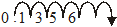
= 135600
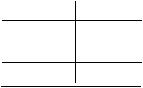 2. 819.8 x 3.905
No Log
819.8 2.9137
3.905 0.5916
antilog →
209.9 2.3221
\ 819.8 ÷ 3.905 = 209.9
3. 48.63 x 8.53
15.39
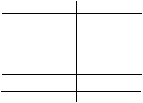 No Log
48.63 1.6869
8.53 +0.9309
2.6178
÷ 15.39 -1.1872
antilog →
26.95 1.4306
\
48.63 ÷ 8.53 = 26.96
15.39
Evaluation:
1. Use table to find the complete logarithm of the following:
(a) 183 (b) 89500 (c) 10.1300 (d) 7
2 Use logarithm to calculate. 3612 x 750.9
113.2 x 9.98
Using logarithm to solve problems with powers and root (numbers greater than one).
Examples:
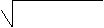
 Evaluate
(a) 3.533 (b) 4 40000 (c) 94100 x 38.2
5.683 x 8.14 correct to 2s.f.
 Solution
No. Log_____
3.533 0.5478 x 3
44.00 1.6434
\ 3.533 = 44.00
 (b) 4 4000

 No. Log_____

4 4000 3.6021 ÷ 4

7.952 0.9005
 \ 4 4000 = 7.952
 (c) 94100 x 38.2
5.6833 x 8.14
Find the single logarithm representing the numerator and the single logarithm representing the denominator, subtract the logarithm then find the anti log.
(Numerator – Denominator).
 No Log

94100 4.9736 ÷ 2 = 2.4868
38.2 1.5821
Numerator 4.0689
→ 4.0689
5.683 0.7543 x 3 = 2.2629
8.14 0.9106
Denominator 3.1735
→
3.1735
7.859 0.8954
 \
\
94100 x 38.2 = 7.859
5.683 x 8.14
~
7.9 (2.sf)
Evaluation:
Evaluate using logarithm.
 95.3 x 318.4
1.295 x 2.03
Logarithm of number less than one
To find the logarithm of number less than one, use negative power of 10 e.g.
0.037 = 3.7 x 10⁻²
10 0.5682 x 10⁻²
10 0.5682 + (-2)
10-2 5682
Log 0.037 = 2 . 5682

 2 . 5682

Integer decimal fraction (mantissa)
Example:
Find the complete log of the following.
(a) 0.004863 (b) 0.853 (c) 0.293
Solution
 Log 0.004863 = 3.6369
 Log 0.0853 = 2.9309
 Log 0.293 = 1.4669
Evaluation
1. Find the logarithm of the following:
(a) 0.064 (b) 0.002 (c) 0.802
Using logarithm to evaluate problems of Multiplication, Division, Powers and roots with numbers less than One
Examples:
1. 0.6735 x 0.928 2. 0.005692 ¸ 0.0943 3. 0.61043

 4. 4 0.00083 5. 3 0.06642
Solution
1. 0.6735 x 0.928
 No. Log.___
0.6735 1.8283
0.928 1.9675

 0.6248 1.7958
\ 0.6735 x 0.928 = 0.6248
2. 0.005692 ¸ 0.0943 
No Log
 0.005692 3.7553
 ¸ 0.0943 2.9745

0.06037 2.7808
 3. 0.61043
No Log_____
 0.61043 1.7856 x 3
 0.2274 1.3568
\ 0.61043 = 0.2274
\ 0.005692 ¸ 0.943 = 0.6037
 4. 4 0.00083
 No. Log._____

 4 0.00083 4.9191 ¸ 4
 0.1697 1.2298

\ 4 0.06642 = 0.1697
 5. 3 0.6642

No. Log.____________


3 0.6642 2.8223 ¸ 3
 2.1 + 1 + 0.8223 ¸ 3
 3 + 1 .8223 ¸ 3
 1 + 0.6074
 0.405 1.6074
 3 0.6642 = 0.405
Note: 3 cannot divide 2 therefore subtract 1 from the negative integer and add 1 to the positive decimal fraction so as to have 3 which is divisible by 3 without remainder.
Evaluation:
Evaluate using logarithm tables:
(1) √12.3 x 0.00343
132.5
(2) 23.97 x 0.7124
-
 x 52.18

General Evaluation
1. Solve the logarithmic equation: Log4 (x2 + 6x + 11) = ½
2. Log2 (x2– 2) =log2(x-1) + 1

3. Evaluate 5 (0.1684)3
 4. 6.28 x 304
981
5. 163/2 x 82/3
321/5
Reading Assignment: Further Mathematics Project Book 1(New third edition).Chapter 2 pg.10- 16
Weekend Assignment
1.) If log81/64 = x, find the value of x (a) 2 (b) 1 (c) -3 (d) -4.
2.) Solve 9(1 – x) = (1/27) x+1 (a) -5 (b) -1 (c) 1 (d) ½
Use table to find the log of the following:
3.) 900 (a) 3.9542 (b) 1.9542 (c) 2.9542 (d) 0.9542
4.) 0.000197 (a) 4.2945 (b) 4.2945 (c) 3.2945 (d) 3.2945
5.) Use antilog table to write down the number whose logarithms is 3.8226.
(a) 0.6646 (b) 0.06646 (c) 0.006646 (d) 66.46
Theory
- Find the value of x for which log10 (4x2 + 1) -2 log10 x – log10 2 = 1 is valid.

(2.) Evaluate using logarithm. 3 69.52 – 30.52
WEEK FOUR
TOPIC: REVIEW OF BASIC CONCEPT OF SET
WEEK FIVE
TOPIC: SETS
- Idea of a set, set notations and applications.
- Disjoint sets , Venn diagram
A. IDEA OF SET, NOTATIONS, APPLICATIONS.
Definitions:
A set can be defined as a group or a collection of well defined objects or numbers e.g collection of books, cooking utensils.
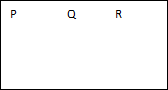
A set is denoted by capital letters such as P, Q, and R e.t.c while small letters are used to denote the elements e.g. a, b, c
Elements of a set: These are the elements or members of a given set. The elements are separated by commas and enclosed by a curly bracket {}
e.g M ={ 1, 3 ,5, 7, 11}, 1 is an element of M.
Example: Write down the elements in each of the following sets.
A = {Odd numbers from 1 to 21}
F = {factors of 30}
M = {Multiples of 4 up to 40}
Solution:
A = { 1,3,5,7,9,11,13,15,17,19,21}
F = {1, 3, 5, 6, 10, 15, 30}
M = {4, 8, 12, 16, 20, 24, 28, 32, 36, 40}
Cardinality of a set: This is the number of elements in a set.
Example: Given that µ= {all the days of the week}, B= {all days of the week whose letter begin with s}
- List all the elements of µ
- List the members of B
- What is n (µ) 4. What is n(µ) + n(B)
Solution:
1.µ = {Sunday, Monday, Tuesday, Wednesday, Thursday, Friday, Saturday}
2. B = {Sunday, Saturday}
3. n (µ) = 7
4. n (µ) + n(B) = 7 + 2= 9
Set notation: A set can be described algebraically using inequality and other symbols. E.g B = {x: -10≤x ≤ 3, x is an integer}
Example: List the members of the following sets
1. A= {x: 5< x< 8} 2. B= {x: 0≤ x≤ 5}
Solution;
1. A = {6, 7} 2. B = {0, 1, 2, 3, 4, 5}
GENERAL/REVISION EVALUATION: If µ= {all positive integers ≤ 30}, M= {all even number ≤ 20},
N = {all integers: 10≤ x≤ 30}
Find 1. n (µ) 2.n (N) 3. n (N) + n(s) 4. n (M) + n(N)
B. Types of sets:
Finite and Infinite set: Finite set is a set in which all its members can be listed.
Infinite set: An infinite set is a set in which all its members cannot be listed.
Empty (Null) set: A set without any member. It is usually denoted by { } or Ø.
Subset and Supersets: If we have 2 sets A and B such that all the elements in A is contained in B, then A is a subset of B. Subset is denoted by C e.g. A C B. If there is at least one element in set B but not in A, then B is a superset of A.
Disjoint set: Two sets are disjoint when there is no common element between them. i.e no intersection.
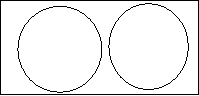 A n B = Ø
A B
Universal set: This is a set that contains all the members under consideration for any given problem. It is denoted by µ or €.
Complementary Set: This is a set that contains the members in the universal set that are not in set A. It is denoted by Ac or A1.
Intersection of sets: This is the set which consists all the common elements in a given two or more sets. It is denoted by n.
Union of sets: This is the set of all members that belong to A or to B or to both A and B. It is denoted by u.
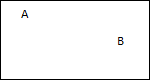
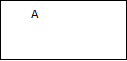
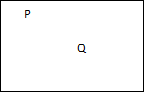
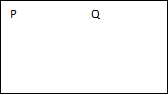
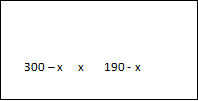
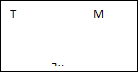
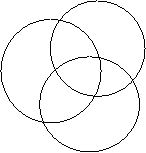
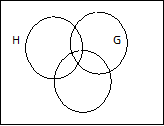
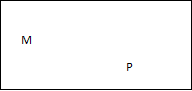
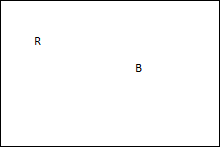
Example: If the universal set µ= {x: 1≤ x ≤ 12} and its subsets D, F and G are given as follows. D = {x: 2 Find (a) D U F (b) D n F (c) G1 (d) (D n G)1 Solution: µ = {1, 2, 3, 4, 5, 6, 7, 8, 9, 10} D = {3, 4, 5, 6, 7} F = {4, 5, 6, 7, 8, 9, 10} G = {2, 3, 4} D n G = {3, 4} (D n G)1 = {1, 2, 5, 6, 7,8, 9,10,11,12} Relationship between union and intersection of sets n(A or B) = n( A) + n( B) –n( A and B)\ or n(AUB) = n(A) + n( B) – n(A n B) Example: If n(A)=23, n(B)= 12, n( AUB) = 35, find n(AnB) and comment on set A and B. Solution n(AUB) = n( A) + n( B) – n(AnB) n(AnB) = 35- 35 n (AnB) = 0 Set A and B are disjoint. Evaluation: 1. A and B are two sets. The number of elements in AUB is 49, the number in A is 22 and the number in B is 34.How many elements are in AnB? 2. The universal set µ ={ set of all integers}, p= {x:x≤ 2}, Q= { x: -7≤ x ≤15}R ={x: -2 ≤x ≤ 19} Find 1. PnQ 2. P n (Q UR1) Venn diagrams: The Venn diagram is a geometric representation of sets using diagrams which shows different relationship between two or more sets. In order words, it is the diagrammatical representation of relationships between two or more sets. The operations of intersection, union and complementation of sets can be demonstrated by using Venn diagrams. Venn diagram representation The rectangle represents the universal set i.e E or U The oval shape represents the subset A. The shaded portion represents the complement of set P i.e p1 or Pc The shaded portion shows the elements common to A and B i.e A∩B or A intersection B. The shades portion shows P intersection Q| i.e P∩Q| The shaded portion shows A Ʋ B i.e A union B This shows that P and Q have no common element. i.e P and Q are disjoint sets i.e P∩Q= Ф P P is a subset of Q i.e P C Q P| ∩ Q| or (P Ʋ Q)|. This shows elements that are neither in P nor Q but are represented in the universal set This shows the element common to set P,Q and R i.e the intersection of three sets P,Q and R i.e P∩Q∩R This shows the elements in P only, but not in Q and R i.e P∩Q|∩R| This shaded region shows the union of the three sets i.e PƲQƲ R Use of Venn diagrams to solve problems involving two sets Examples: Solution n(E)= 400 Let the number of students who offered both Biology and Chemistry be X i.e (B∩C)= X. from the information given in the question n(E)= 400 n(B)= 300 n(C)= 190 n(BƲC)|= 70 since the sum of the number of elements in all region is equal to the total number of elements in the universal sets, then: 300 – x + x +190 – x + 70 =400 560 – x= 400 -x= 400 – 560 X= 160 Number of students offer both Biology and Chemistry= 160 (ii)no of students offering at least one of biology and chemistry from the Venn diagram this includes those who offered biology only, chemistry only and those whose offered both i.e 300 – x + 190 – x + x= 490 490 – 160 (from (i) above)= 330 Solution Let the members who do not like any type of music = X Then, n(TnM)= 3X Also, n(E)= 94 n(M)=60 n(T)= 50 n(MƲT)|= X n(E)= 94 Since the sum of the number of elements in all region is equal to the total number of elements in the universal set, then 60 – 3X + 3X + 50 – 3X = 94 110 – 2X= 94 16= 2X Divide both sides by 2 16= 2X X= 8 Therefore number of member who likes only one type of music are those who like modern music only + those who like traditional music only 60 -3x + 3X + 50 – 3X= 110 110 – 6 x 8 (from above) = 110 – 48 = 62 Two Venn diagram; A B 1 2 3 4 Where 1 = AnBI , 2 = AnB, 3 = AInB, 4 = ( AUB)I Therefore, µ = 1 + 2 + 3 + 4 µ = n( AnBI) + n( AnB) + n( AInB) + n( AUB)I Example 1: In a class of 40 students, every student had to study French or Russian or both subjects. 25 students studied French and 20 studied Russian. Find the number of students who studied both languages. Solution: Let µ = {All the students} F = {French students}, R = {Students studying Russian} µ = 40, n(F)= 25, n(R) = 20 n( Fn R)= x n(FnRI) = 25-x n (Rn FI)= 20- x µ = 25 –x +x + 20-x 40= 45 –x x = 45- 40 x=5, n(FnR) = 5 students. Evaluation Two questions A and B were given to 50 students as class work 23 of them could answer question A but not B. 15 of them could answer B but not A. If 2x of them could answer none of the two questions and 2 could answer both questions. General evaluation U={0,1,2,3,4………….12} A={X: 0≤X7} B= {4,6,8,10,12} C= {1 Reading assignment: NGM bk1 pg 89 – 92 and Ex 8d number 11 pgs 91- 92 Weekend Assignment 1. Given that µ= {-10≤ x ≤ 10}, p= { -10 < x< 10}, Q= { -5 < x ≤ 3}. Which of the following is correct? I PI n Q II P U Q =µ III PI C QI A. I and II only B. I and III only C II and III only 2. P and Q are subsets of the µ={x is an integer and 1< x < 15}, P= { x is odd} and Q= { x is prime}, find n(PI n QI) A. 3 B. 4 C. 5 Use the information below to answer question 3 and 4, µ= {1, 2, 3… 10}, A= {2, 4, 6, 8, 10} B= {1, 3, 9} and C = {2, 5, 7} 3. AI n C is A.{5, 7} B. { 1, 3, 4} C. { 6,7,8,9} 4. BI U C A.{2,4,5,7,8,10} B.{2,4,5,6,7,8,10} C.{ 1, 2,3,4,5, 9} 5. A set contains 7 members; find the number of subsets that can be obtained from it. A. 32 B. 64 C. 128 Theory 1. During one year in a school, 5/8 of the students had measles, ½ had chickenpox and 1/8 had neither. What fraction of the school had both measles and chickenpox? 2. In a class of 50 pupils, 24 like oranges, 23 like apple and 7 like the two fruits. WEEK FIVE TOPIC: OPERATION OF SET AND VENN DIAGRAMS CONTENT: Use of Venn diagrams to solve problems involving three sets Three Venn diagram: A 2 6 B 5 1 4 3 7 8 C 1= AnBnC 5 = AnBInCI 2 = AnBnCI 6 = A1nBnC1 3 = AnBInC 7 = A1nBInC 4 = AInBnC 8 = (AnBnC)1 Example: A school has 37 vacancies for teachers, out of which 22 are for English, 20 for History and 17 for Fine Art. Of these vacancies 11 are for both English and History, 8 for both History and Fine Art and 7 for English and Fine Art. Using a Venn diagram, find the number of teachers who must be able to teach: (a.) all the three subjects (b.) Fine Art only (c.) English and History but not Fine Art. Solution: Let µ = {All vacancies for teachers} E = {English vacancies} H = {History vacancies} F = {Fine Art vacancies} µ = 37, n(E)= 22, n(H)= 20, n(F)= 17, n{EnH}= 11, n(HnF)= 8, n(EnF)= 7 n (EnHInF)= n(E)- (7-y+y+11-y) = 22- (18-y) = 4 + y n(EInHnF) = n(H) – (11-y+y+8-y) = 20- (19-y) = 1+y n(EInH1nF)= n(F) – ( 7-y +y+8-y) = 17 – (15- y) = 2 +y µ= 4+y+11-y+1+y+y+8-y+7-y+2+y 37= 33 + y y = 37- 33 y = 4. n(EnHnF) = 4 teachers (2.) Fine Art only, n(EInHInF) = 2+ y = 2+4 = 6 teachers (3.) English and History but not Fine Art i.e English and History only n(EnHnFI) = 11-y = 11- 4 = 7 teachers. Examples: Solution n (E)= 290 n(E)= 290 n(D)= 181 n(G)= 142 n(D∩G)= 75 n(D∩P)= 60 n(G∩P)= 54 from the venn diagram, readers who read Daily Times only =181 – (160 – X + 75 – X +X) =181 – (135 – X) = 46 + X Punch readers only =117 – (60 – X + 54 – X + X) 117 – (114 – X) 117 – 114 + X =3 +X Guardian readers only =142 – (75 – X + 54 – X + X) =142 – (129 – X) =142 – 129 + X =13 + X Where: X is the number of readers who read all the three papers Since the sum of the number of elements in all regions is equal to the total number of elements in the universal set, then: 46 + X + 75 – X + 13 + X + 60 – X + X + 54 – X + 3 + X = 90 251 + X = 290 X = 290 – 251 X= 39 B(i): number of people who read all the three paper= 39 (ii) from the venn diagram, number of people who read exactly two papers = 60 – X + 75 – X + 54 – X =189 – 3X = 189 – 3(39) from the above =189 – 117 = 72 (iii) also, from the venn diagram, number of people who read exactly only one of the papers =46 + X + 13 + X + 3 +X =162 +3X =162 + 3(39) =162 + 117 = 179 (iv)number of Guardian reader only =13 + X =13 + 39 = 52 Solution Number of students in the group = 20 + 18 + 16 + 4 + 3 + 2 + 7 + 3 = 73 Evaluation N(U) The score of 144 candidates who registered for mathematics, physics and chemistry in an examination in a town are represented in the venn diagram above. General Evaluation follows. 15 drank Fanta, 6 drank both Fanta and coke, 18 drank Coke, 8 drank both Coke and Pepsi, 20 drank Pepsi, and 2 drank all the three types of drink. How many of the teachers drank I Coke only II Fanta and Pepsi but not Coke. Reading Assignment: Read Sets, Further Mathematics Project II, page 1- 13. Weekend Assignment If 8 speak Hausa and Igbo. 11 speak Hausa and Yoruba.6 speak Igbo and Yoruba. How many students speak the three languages? (a) 3 (b) 4 (c) 5 (d) 6 Use the information to answer question 4 and 5 N(U)=61 The venn diagram above shows the food items purchased by 85 people that visit a store one week. Food items purchased from the store were rice, beans and gari. Theory c) How many pupils take; (i.) Both chemistry and government (ii.) Government only WEEK SIX First Half Term Revision Questions 1 . Evaluate the following (a) 323/5 (b) 251.5 (c) (0.000001)2 (d) 3432/3 (e) 190 2 . Solve the following exponential equations (a) 2x = 0.125 (b) 3-x = 243 (c) 25x = 625 (d) 10x = 1/0.001 (e) 4/2x =64x 3 . Solve the following exponential equations (a) 22x -6(2x) + 8 = 0 (b) 22x+1 -5(2x) + 2 = 0 (c) 32x – 4(3x+1) + 27 = 0 (d) 32x – 9 = 0 (e) 72x – 2( 7x) + 1 = 0 4 . Change each of the following index form to their logarithmic form (a) 26 = 64 (b) 3-3 =1/27 (c) 251/2 =5 (d) 35 = 243 (e) (0.01)2 = 0.0001 5 . Change the following logarithmic form into index form (a) log2128 = 7 (b) log1/2(1/4) = 2 (c) log749 = 2 (d) log5 1/125 = -3 (e) log51 = 0 6 . Simplify each of the following (a) log327 + 2log39 –log354 (b) 1/2log48 + log432 – log42 (c) log2√8 + log3√3 (d) logxx9 (e) log512.5 + log52 7 . Solve the following logarithmic equations (a) log10(x2 – 4x + 7) = 2 (b) log8(x2 – 8x + 18) = 1/3 (c) log5(x2 – 9) = 0 (d) log4(x2 + 6x + 11) = ½ 8. If logx27 + logy4= 5 and logx27 – logy4 = 1.find x and y 9 . Use logarithm table to evaluate the following (a) (3.68)2 x 6.705 (b) √0.897 x 3.536 10. 83.67 x 3 0.07124 352.18 WEEK SEVEN TOPIC: BINARY OPERATIONS: BASIC CONCEPT OF BINARY OPEATIONS CONTENT Definition: Binary operation is any rule of combination of any two elements of a given non empty set. The rule of combination of two elements of a set may give rise to another element which may or not belong to the set under consideration. It is usually denoted by symbols such as, *, Ө e.t.c. Properties: A. Closure property: A non- empty set z is closed under a binary operation * if for all a, b € Z. Example; A binary operation * is defined on the set S= {0, 1, 2, 3, 4} by X*Y = x + y –xy. Find (a) 2 * 4 (b) 3* 1 (c) 0* 3. Is the set S closed under the operation *? Solution 2+ 4 – (2×4) = 6-8 = -2. Since -2€ S, therefore the operation * is not closed in S. B. Commutative Property: If set S, a non empty set is closed under the binary operation *, for all a,b€ S. Then the operation * is commutative if a*b= b*a Therefore, a binary operation is commutative if the order of combination does not affect the result. Example; The operation * on the set R of real numbers is defined by: p*q= p3 + q3-3pq. Is the operation commutative? Solution p*q= p3 + q3 -3pq Commutative condition p*q= q*p To obtain q*p, use the same operation q*p, use the same operation p*q but replace p by q and q by p. Hence, q*p= p3+ q3 -3qp In conclusion p*q= q*p, the operation is commutative. C. Associative Property: If a non – empty set S is closed under a binary operation *, that is a*b €S. Then a binary operation is associative if (a*b) * c= a*(b*c) Such that C also belongs to S. Example: The operation Ө on the set Z of integers is defined by; a Ө b = 2a +3b -1. Determine whether or not the operation is associative in Z. Solution Introduce another element C Associative condition: (aӨb) Өc = a Ө (b Өc) (aӨb)Өc = (2a+ 3b- 1) Ө C = 2(2a +3b -1) + 3c -1 = 4a + 6b- 2+ 3c- 1 = 4a +6b+3c- 3. Also, the RHS, a Ө (b Ө c) = a Ө (2b+3c- 1) = 2a+ 3(2b +3c- 1) – 1 = 2a + 6b +9c -3 -1 a Ө (b Ө c) = 2a+ 6b+ 9c -4 Since, (a Ө b) Ө c ≠ a Ө (b Ө c), the operation is not associative in Z. Evaluation 1. An operation* defined on the set R of real numbers is x* y = 3x+ 2y- 1, x,y €R. Determine (a) 2*3 (b) -4* 5 (c) 1 * 1 3 2 is the operation closed. D. Distributive Property: If a set is closed under two or more binary operations (* Ө) for all a, b and c € S, such that: a*(bӨ c) = (a*b )Ө( a*c – Left distributive (BӨc) *a = (b*a) Ө(c*a) – Right distributive over the operation Ө Example: Given the set R of real numbers under the operations * and Ө defined by: a*b = a+ b- 3, aӨb= 5ab for all a, b € R. Does * distribute over Ө. Solution Let a, b,c € R a* ( bӨc) = (a*b) Ө (a*c) a* (bӨc) = a* (5ab) = a+ 5ab -3. (a*b) Ө (a*c) = (a+ b -3) Ө ( a+ c-3) = 5(a +b-3)(a +c -3) From the expansion, it’s obvious that, a* ( bӨc) ≠ (a*b) Ө (a*c) therefore * does not distribute over Ө. Evaluation: 1. A binary operation * is defined on the set R of real numbers by x*y= x +y + 3xy for all x, yɛR. determine whether or not * is: 2. The operation 2 Show that the operation General Evaluation 1. The operation * on the set R of real numbers is defined by: x * y = 3x + 2y – 1, x, yϵR. Determine (i) 2 * 3 (ii) 1/3 * ½ (iii) -4*5 2. The operation * on the set R, of real numbers is defined by; p*q = p3 + q3 – 3pq; p,q ϵR. Is the operation * commutative in R? 3. The operation * and Weekend Assignment number m n find the value of 3 Ө (4 * 5) (a) 60 (b) 57 (c) 54 (d) 42 (b) 1, 2 (c) 2, -2 (d) 1, -2 (a) 59 (b) 19 (c) 67 (d) 38 Theory 1. The operation * is defined on the set R of real numbers by a* b= a+b _ 1 for all a, b €R . 5 Is the operation * commutative in R?. 2. The operation * is defined on the set R of real numbers by x*y = x + y + xy/2 for all x,y €R (a) is the operation * commutative? (b) is the operation * associative over the set R? Reading Assignment: Read Binary Operation, Further Mathematics Project II, page 13 – 22 WEEK EIGHT: TOPIC: BINARY OPERATIONS: IDENTITY AND INVERSE ELEMENTS Identity element and Inverse element CONTENT: Identity Element: Given a non- empty set S which is closed under a binary operation * and if there exists an element e € S such that a*e = e*a = a for all a € S, then e is called the IDENTITY or NEUTRAL element. The element is unique. Example: The operation * on the set R of real numbers is defined by a*b = 2a-1 2 for all a, b € R. Determine the identity element. Solution: a*e= e*a = a a*b= 2a-1 2 a*e = 2a-1 2 2a-1+ 2e = 2a 2e = 2a-2a +1 e = ½. Evaluation Find the identity element of the binary operation a*b = a +b+ab Inverse Element; If x € S and an element x-1 € S such that x*x-1 = x-1*x= e where e is the identity element and x-1 is the inverse element. Example: An operation * is defined on the set of real numbers by x*y = x + y -2xy. If the identity element is 0, find the inverse of the element. Solution; X *y = x+ y- 2xy x*x-1 = x-1*x= e, e = 0 x + x-1– 2xx-1 = 0 x-1 -2xx-1= -x x-1(1-2x) = -x x-1 = -x/ (1-2x) The inverse element x-1 = -x/ (1-2x) Evaluation: The operation ∆ on the set Q of rational numbers is defined by: x∆ y = 9xy for x,y € Q Find under the operation ∆ (I) the identity element (II) the inverse of the element a € Q General Evaluation Reading Assignment: Read Binary Operation, Further Mathematics Project II, page 16 – 22 Weekend Assignment A. -3 B. -2C+3 C. X-3 2C+3 2C 2. An operation is defined by x*y = Logyx , evaluate 10* 0.0001 A. 4 B. -4 C. 3 3. The binary operation * is defined by x*y= xy– 2x -15, solve for x if x*2= 0 A.x= -3 or -5 B. x= -3 or 5 C. x = 3 or 5 4. A binary operation * is defined on the set R of real numbers by m*n = m + n2 for all m, n € R. If k*3 = 7*4, find the value of k A. 8 B.28/3 C.14 5 .Find the inverse function a-1 in the binary operation ∆ such that for all a,b € R a ∆ b = ab/ 5 A. 25/a B.-25/a C. a/5 x*y = x2 + y2+ (b) Solve the equation 6*x = 27 2. Draw a multiplication table for modulo 4. (b) Using your table or otherwise evaluate (2X3) X (3X2) WEEK NINE TOPIC: SURDS CONTENT Rules of Surds Surds are irrational numbers. They are the root of rational numbers whose value cannot be expressed as exact fractions. Examples of surds are: √2, √7, √12, √18, etc. Basic Forms of Surds √a is said to be in its basic form if A does not have a factor that is a perfect square. E.g. √6, √5, √3, √2 etc. √18 is not in its basic form because it can be broken into √ (9×2) = 3√2. Hence 3√2 is now in its basic form. Similar Surds Surds are similar if their irrational part contains the same numerals e.g. Conjugate Surds Conjugate surds are two surds whose product result is a rational number. (i)The conjugate of √3 – √5 is √3 + √5 The conjugate of -2√7 + √3 is 2√7 – √3 In general, the conjugate of √x + √y is √x – √y The conjugate of √x – √y = √x + √y Simplification of Surds Surds can be simplified either in the basic form or as a single surd. Examples Simplify the following in its basic form (a) √45 (b) √98 Solution (a) √45 = √ (9 x 5) = √9 x √5 = 3√5 (b) √98 = √ (49 x 2) = √49 x √2 = 7√2 Examples Simplify the following as a single surd (a) 2√5 (b) 17√2 Solution (a) 2√5 = √4 x √5 = √ (4 x 5) = √20 (b) 17√2 = √289 x √2 = √ (289 x 2) = √578 Addition and Subtraction of Surds Surds in their basic forms which are similar can be added or subtracted. Examples Evaluate the following (a)√32 + 3√8 (b) 7√3 – √75 (c) 3√48 – √75 + 2√12 Solution = √ (16 x 2) + 3√ (4 x 2) =4√2 + 6√2 = 10√2 (b) 7√3 – √75 = 7√3 – √ (25 x 3) =7√3 – 5√3 =2√2 (c) 3√48 – √75 + 2√12 = 3√ (16 x 3) – √ (25 x 3) + 2√ (4 x 3) = 12√3 – 5√3 + 4√3 = 11√3 Evaluation 1. Simplify the following (a) 5√ 12 – 3√ 18 + 4√72 + 2√75 (b) 3√2 – √32 + √50 + √98 2. Simplify the following as a single surd (i) 8√3 (ii) 13√2 Multiplication and Division of Surds Example: Evaluate the following (a) √45 x √28 (b) √24 /√50 Solution (a) √45 x √28 = √ (9 x 5) x √ (4 x 7) = 3√5 x 2√7 = 3 x 2 x √ (5 x 7) = 6√35 (b)√24 / √50 = √ (24 / 50) = √ (12 / 25) = √12 / √25 = √ (4 x 3) / 5 = 2√3 / 5 Evaluation: Simplify 1. √6 x (3 – √5) 2. (2√3 – √7)(2√3 + √7) 2. Multiply the following by their conjugate (a) √3 – 2√5 (b) 3√2 + 2√3 Surds Rationalisation Rationalisation of surds means multiplying the numerator and denominator by the denominator or by the conjugate of the denominator. Solution = 2√3 (√3)2 – (√2)2 = 3√3 – 3√2 3 – 1 = 3√3 – 3√2 1 = 3(√3 -√2) Equality of Surds Given two surds i.e P + √m and q + √n if P +√m = q + √n then √P – q = √n – m the L.H.S Of the equation is a rational number while the L.H.S and R.H.S can only be equal if they are both equal to zero (0) P – q = 0 :. P = q and n – m = 0 i.e. √n = √m Examples: Find the square root of the following? a) 7 + 2√10 b) 14 – 4√6 Solution (a) Let the square root of 7 + 2 √10 be √m + √n (√m + √n)2 = 7 + 2√10 m +√2mn+ n = 7 + 2√10 m + n = 7 (1) 2√mn = 2√10 mn = 10 Squaring both surds we have mn = 10 _______(ii) m + n = 7 ______ (i) m n = 10 _______ (ii) From equation (1) m = 7 – n Put m in (ii) we have (7 – n) n = 10 7n – n2 = 10 In sum; n2 – 7n + 10 = 0 n2 – 2n – 5n + 10 =0 n (n – 2) – 5 (n – 2) = 0 (n -5) (n – 2) = 0 n = 5 or 2 m = 7 – 2, where n = 2 m = 5, m = 7 – 5 , when n = 5 m = 2 m= 5 or 2 The square root of 7 + √10 are 5 & + 2. (b) Let the square root of 14 – 4√6 be √P – √Q The (√P – √Q) 2 =14 – 4√6 P – 2√PQ + Q = 14 – 4 √6 P + Q = 14 …………………… (1) -2√PQ = – 4√6 √PQ = 2√6 (squaring both sides) PQ = (2√6)2 PQ = 4 x 6 ……………………………….. (11) P + Q = 14 ………………………………… (1) PQ = 24 ……………………………………… (11) From equation……………… (1) P = 14 – Q Sub for p in equation ………………… (11) (14 – Q) Q = 24 14Q – Q2 = 24 In turn we have: Q2 – 14Q + 24 = 0 Q2 – 12Q – 2Q + 24 = 0 Q (Q -12) – 2 (Q – 12) = 0 Q = 2 or 12 If P = 14 – Q ,when Q= 12 P = 14 – 12 P = 2 If P = 14 – Q when Q = 2 P = 14 – 2 = 12 (√12 – √2 ) = (2 √ 3 – √2) and (√2 – √12) = (√2 – 2 √3) Evaluation: 1. Express 3√2 – √3 in the form √m where m and n are whole number. 2√3 – √2 √n 2. Express 1 √5 +√3 General Evaluation 1. Simplify 3x2 x 4x3 6x7 2. Evaluate 23.97 x 0.7124 3.877 x 52.18 3. Solve 9(1 – x) = (1/27) x+1 4. Log8 (r2 – 8r + 18) = 1/3 5. Simplify: 2√12 + 3√48 + √75 Reading Assignment: Further Mathematics Project Book 1(New third edition).Chapter 3 pg.19-27 Weekend Assignment 1. Expand (3√2 – 1) (3√2 + 1) (a) 16 (b) 20 (c) 17 (d) 24 2. Simplify √200 in its basic form (a) 10√2 (b) 5√4 (c) 2√10 (d) 2√50 3. Simplify 9/√3 (a) 3√2 (b) 3√3 (c) 1/3 (d) 2√2 4. Express 3√5 as a single surd (a) √40 (b) √55 (c) √45 (d) √35implify 5. Simplify √`128 – 4√8 (a) 0 (b) 1 (c) 2 (d) 3 Theory 1.Express 3√2 – √3 in the form √m where m and n are whole number. 2√3 – √2 √n 2.Express 1 in the form p√5 + q√3, where p and q are rational numbers. √5 +√3 WEEK TEN TOPIC: STATISTICS: MEASURES OF CENTRAL TENDENCY MEASUREMENT OF CENTRAL TENDENCY Measures of central tendency: This is a measure of how the data are centrally placed. The three commonest measures of position, depending on the information required are the arithmetic mean, median and the mode. MEAN: It is most widely used measure and sometimes called the arithmetical averages. The mean of the number x1, x2, x3, x4 …………………xn is given by: X = ∑x where ∑x is the sum of all items. n = number of items n When the data involves frequency; mean = ∑fx/∑f Examples: 1. Calculate the mean of the numbers 15, 17, 19, 21, 23, 25, 27, 29. Solution: Mean (x) = 15 + 17 + 19 + 21 + 23 + 25 + 27 + 29 = 176 = 22 8 8 2. The table shows the number of suitcases possessed by a group of travelers. No of suitcases 0 1 2 3 4 5 Travelers 2 7 7 2 3 9 Calculate the mean to the nearest whole number. Solution: X F FX 0 2 0 1 7 7 2 7 14 3 2 6 4 3 12 5 9 45 Total 30 84 EVALUATION 1. Calculate the mean of the numbers 37.5, 25.5, 30.5, 41.5, 52.5, 28.5. 2. Calculate the mean score of the scores represented in the table below. Scores 10 12 14 16 18 No of Students 5 2 3 4 4 Mode: The mode of a distribution is the value of the variable which occurs most often in the distribution. It is also possible for a distribution to have more than one mode, if there were more than one item having the highest frequency. Example: Median: This is the middle value of a set of data, when arranged in ascending or descending order. Example: Find the median of these numbers: (1). 35, 28, 42, 28, 56, 70, 35 (2) 18, 20, 25, 30, 22, 25, 28, 15 Solution: 2 2 General Example: The table below is the distribution of the test scored in a class: Scores 1 2 3 4 5 6 7 8 9 10 Frequency 1 1 5 3 X 0 6 2 3 4 If the mean score of the class is 6, find the (i) value of x (ii) median score (iii) modal score. Solution: X F FX 1 1 1 2 1 2 3 5 15 4 3 12 5 X 5x 6 0 0 7 6 42 8 2 16 9 3 27 10 4 40 Total 25 + x 155 + 5x 6 = 155 + 5x 25 + x Cross multiplying: 6(25 + x) = 155 + 5x 150 + 6x = 155 + 5x 6x – 5x = 155 – 150 x = 5. (ii)Median score: the median score lies between the 15th and 16th scores, hence: median = (5 + 7)/2 = 6. (iii)Mode: 7 Evaluation: Calculate the mode and median of the scores below; 2, 2, 1, 1, 0, 3, 3, 4, 4, 4, 5, 1, 2, 2. MEAN, MEDIAN AND MODE OF GROUPED DATA Mean: The arithmetic mean of grouped frequency distribution can be obtained using: Class Mark Method: X = Assumed Mean Method: It is also called working mean method. X = A + (∑ fd/∑f) Where, d = x – A, x = class mark and A = assumed mean. Example: The numbers of matches in 100 boxes are counted and the results are shown in the table below: Number of matches 25 – 28 29 – 32 33 – 36 37 – 40 Number of boxes 18 34 37 11 Calculate the mean (i) using class mark (ii) assumed mean method given that the assumed mean is 30.5. Solution: Class interval F X FX d = x – A Fd 25 – 28 18 26.5 477 29 – 32 34 30.5 1037 0 0 33 – 36 37 34.5 1276.5 4 148 37 – 40 11 38.5 423.5 8 88 Total 100 3214 164 = 30. 5 + (164/100) =30.5 + 1.64 = 32.14 = 32 matches per box (nearest whole number) Evaluation: Calculate the mean shoe sizes of the number of shoes represented in the table below using (i) class mark (ii) assumed mean method given that the assumed mean is 42. Shoe sizes 30 – 34 35 – 39 40 – 44 45 – 49 50 – 54 No of Men 10 12 8 15 5 Mode The mode of a grouped frequency distribution can be determined geometrically and by interpolation method. Mode from Histogram: The highest bar is the modal class and the mode can be determined by drawing a straight line from the right top corner of the bar to the right top corner of the adjacent bar on the left. Draw another line from the left top corner to the bar of the modal class to the left top corner of the adjacent bar on the right. Example: The table gives the distribution of ages of students in an institution. Ages(year) 16 – 18 19 – 21 22 – 24 25 – 27 28 – 30 No of Students 18 30 35 24 13 Draw a histogram and use your histogram to estimate the mode to the nearest whole number. Solution: Class Interval (Ages) F Class Boundary 16 – 18 18 15.5 – 18. 5 19 – 21 30 18.5 – 21.5 22 – 24 35 21.5 – 24.5 25 – 27 24 24.5 – 27.5 28 – 30 13 27.5 – 30.5 Histogram 20 15 10 5 Masses(kg) Frequency Cumulative Frequency Upper Class Boundary 10 – 14 3 3 < 14.5 15 – 19 7 10 <19.5 20 – 24 9 19 <24.5 25 – 29 5 24 < 29.5 30 – 34 11 35 < 34.5 35 – 39 6 41 < 39.5 40 – 44 9 50 < 44.5 15.5 18.5 21.5 24.5 27.5 30.5 Modal class = 22 – 24 Mode = 21.5 + 0.9 = 22.4, approximately 22 yrs. MODE FROM INTERPOLATION: The mode can be obtained using the formula. Where Lm = lower class boundary of the modal class. ∆1 = difference between the frequency of the modal class and the class before it. ∆2 = difference between the frequency of the modal class and the class after it. C = class width of the modal class. Example: Using the table given in the example above: Modal class = 22 – 24, ∆1 = 35 – 30 = 5, ∆2 = 35 – 24 = 11, C = 3, Lm = 21.5 5 + 11 = 21.5 + (15/16) = 21.5 + 0.9375 = 22.44, approximately 22 yrs. MEDIAN FROM INTERPOLATION FORMULA fm Where, L1 = lower class boundary of the median class. Cfm = cumulative frequency of the class before the median class. Fm = frequency of the median class. C = class width of the median class and N = Total frequency The median class: 30 – 34, L1 = 29.5, cfm = 24, fm = 11, C = 5 11 = 29.5 + 5 = 30kg Evaluation: Calculate the modal shoe sizes and median of the number of shoes represented in the table below using interpolation method. Shoe sizes 30 – 34 35 – 39 40 – 44 45 – 49 50 – 54 No of Men 10 12 8 15 5 General evaluation: 1. The table below gives the distribution of masses (kg) of 40 people Masses(kg) 1 – 5 6 – 10 11 -15 16 – 20 21 – 25 26 – 30 31 – 35 36 – 40 Frequency 9 20 32 42 35 22 15 5 2. The following table shows the distribution of marks obtained by a class. Marks 0 1 2 3 4 5 6 7 8 9 No of students 1 1 3 4 4 12 7 3 3 2 Using this table, find the (1) median mark (2) modal mark (3) mean of the distribution. Reading Assignment: Further Mathematics Project Book 1(New third edition), pg 328, Exercise18, No 15 -20 Weekend Assignment Marks 3 4 5 6 7 8 Frequency 5 x – 1 x 9 4 1 If the mean is 5, calculate the (a) value of x (b) mode (c) median of the distribution. 2. The table gives the frequency distribution of a random sample of 250 steel bolts according to their head diameter, measured to the nearest 0.01mm. Diameter (mm) 23.06 –23.10 23.11 – 23.15 23.16 –23.20 23.21 –23.25 23.26-23.30 23.31 –23.35 23.36-23.40 23.41-23.45 23.46-23.50 No of bolts 10 20 28 36 52 38 32 21 13
 E or U
 A
A








 U or E
 Q
Q


 U
U











 aa
aa
 2 2
2 2

 µ
µ B∩C
B∩C




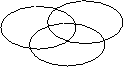


 √0.3581 0.00249
 on the set R of real numbers is defined by a
  b = a+b + ab for abϵR.
 is commutative but not associative on R.
 are defined on the set R of natural numbers by a*b = ab and a
  b = a/b for all a,bϵR (a) Does * distribute over
  ? (b) Does
  distribute over *?
 on real numbers is defined by x
 y = xy + x + y for any two real numbers and y. The value of (-3/4)
 6 is (a) 3/4 (b) -9/2 (c) 45/4 (d) -3/4
┼ b
┼ b
┼ e = a
Theory
xy for all x, y € R. Calculate (a) ( 2*3)* 4 √3 + √2
 (b) 3
(b) 3 = 6 x √3 √3 + √2
 √3 x √3 = 3 (√3 – √2)
 = 6√3 (√3 + √2) (√3 – √2)
 3 = 3√3 – 3√2

 -2 – 2
in the form p√5 + q√3, where p and q are rational numbers.
Mean ( x ) = ∑ fx/∑ f = 84/30 = 2.8 = 3
 where x is the midpoint of the class interval.
 = 3214/100 = 32. 14 = 32 matches per box (nearest whole no)




 35
35

 30
30
 25
25


 0
0 Mode = Lm + ∆1 C
 ∆1 + ∆2
 Mode = 21.5 + 5 x3
 Median = L1 + N/2 – cfm C
 Median = 29.5 + 25 – 24 x 5


