


1. What is the reading on the vernier calipers shown in figure 1?
2.
Figure 2 shows forces F1 and F2 acting on a meter rule such that it is in equilibrium.
Mark on the figure a third force F3 acting on the rule such that equilibrium is maintained.
3.
State how the position of the centre of gravity of a body in stable equilibrium changes to that in the rest position when the body is slightly tilted and then released.
4.
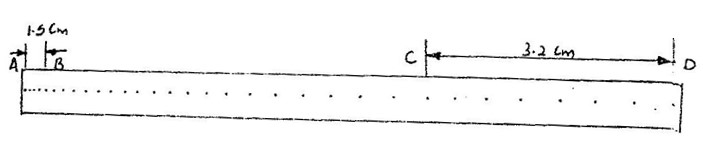
A vacuum pump was used to pump out air from the glass tube immersed in liquids as shown in figure 3.
After some time the level of paranum rose to position A. Mark 1, the corresponding position for the water level. Give a reason for your answer.
5.
Fig. 4 shows a capillary tube placed in a trough of mercury.
Give a reason why the level of mercury in the capillary tube is lower than in the beaker.
6.
Brass expands more than invar when heated equally.
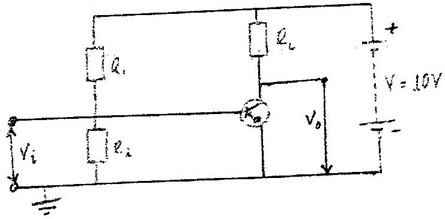
Sketch the bimetallic strip after being cooled several degrees below room temperature.
7.
In an experiment to study the atoms of gold, a beam of α-particles was directed onto a thin sheet of gold. The following observations were made:
- Majority of the particles went straight through undeflected.
- A few particles deflected through varying angles up to 180°.
8.
Figure 6 shows a ray of light incident on a plane mirror at point O.
The mirror is rotated clockwise through an angle 300 about an axis perpendicular to the paper. Determine the angle through which the reflected ray rotated.
9.
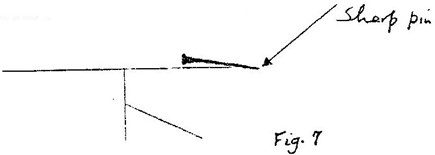
Figure 7 shows a sharp pin fixed on the cap of a leaf electroscope. The electroscope is highly charged and then left for some time.
Explain why the leaf collapses.
10.
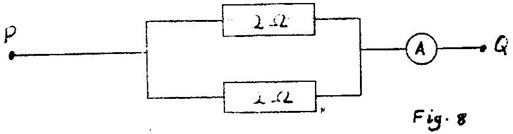
Determine the ammeter reading when a p.d of 3.0 volts is applied across Pq in figure 8.
11.
A wire fixed at one end extends by 4 mm when a load of 20 N is suspended from the other end. Determine the load that would cause an extension of 1.5 mm on the wire (assume elastic limit is not exceeded).
12.
How can it be shown that the strength of a magnet is concentrated at the poles?
The direction is into the paper.

The wire is placed in a magnetic field.
Indicate on the figure the direction of the force acting on the wire.
14.
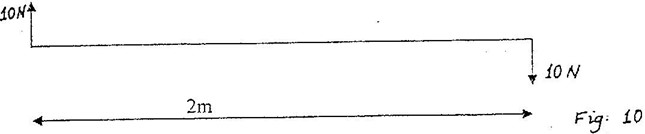
Determine the moment of the couple shown in figure 10.
15.
An industrial trolley of mass 20 kg carrying a mass of 50 kg is acted on by a constant force. The trolley moves along a horizontal smooth surface with an acceleration of 0.5 m/s2. Determine the acceleration of the trolley after the mass falls off.
16.
Figure 11 is a graph which shows how the vertical height through which a machine raises a mass of 20 kg varies with time.
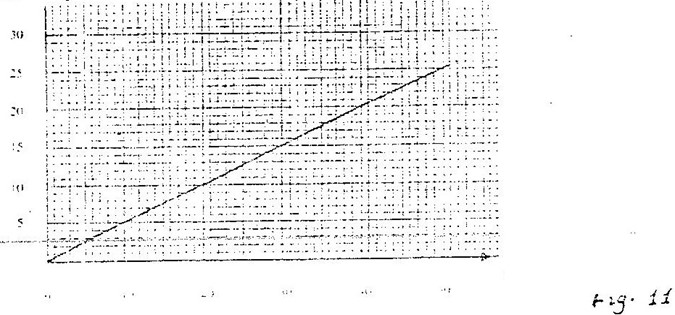
Determine the power output of the machine after 40 seconds.
17.
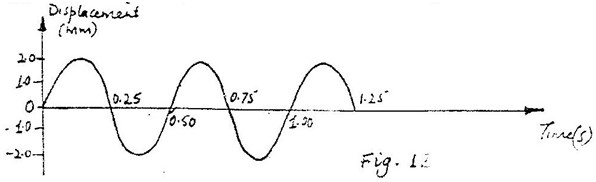
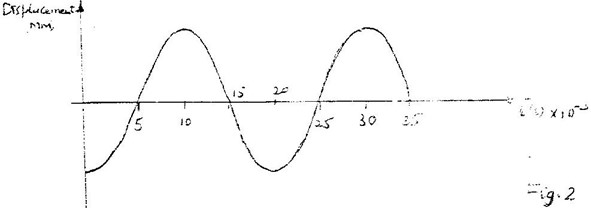
Figure 12 shows how displacement varies with time as a wave passes a fixed point.
Determine the frequency of the waves.
18.
Two tuning forks of frequencies 256 Hz and 258 Hz are sounded simultaneously and then placed close to each other. Calculate the beat frequency.
19.
When a current of 2.0 A flows in a resistor for 10 minutes, 15,000 joules of electrical energy is dissipated. Determine the voltage across the resistor.
20.
A substance of mass 2 kg and specific heat capacity 400 J/kg·K initially at 810C is immersed in water at 200C. If the final temperature is 210C, determine the mass of water. (The specific heat capacity of water is 4200 J/kg·K). Give your answer to 1 decimal place.
21.
A galvanometer of internal resistance 50 Ω gives a full-scale deflection when a current of 10 mA passes through it. Determine the value of the resistance required to convert the galvanometer to a voltmeter with full-scale deflection of 5 volts.
22.
A microscope is focused on a mark on a horizontal surface. A rectangular glass block 30 mm thick is placed on the mark. The microscope is then adjusted 10 mm upwards; to bring the mark back to focus, determine the refractive index of the glass.
23.
State the energy transformation when fast-moving electrons are suddenly stopped by a target in an X-ray tube.
24.
A bullet is fired horizontally at a target. Neglecting air resistance, give a reason why the horizontal acceleration of the bullet is zero.
25.
Figure 13 shows a section of a pipe PQ. A constant pressure difference maintains a streamline flow of a liquid in the pipe.
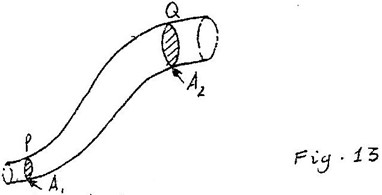
If the cross-sectional area A1 at P is less than A2 at Q, state how the liquid velocity V2 at Q compares with velocity V1 at P.
26.
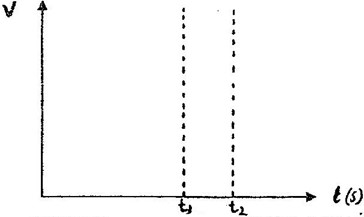
The figure 14 is a resistor-capacitor circuit. At time t=0, the switch is closed at A for some time, and then opened. The switch is then closed at B for some time.
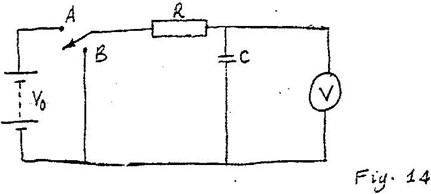
On the axis provided, sketch the graph of voltage V across the capacitor against time t (t1 and t2 represent times for opening at A and closing at B respectively).
27.
Determine the pressure required to compress a gas in a cylinder initially at 200C and at a pressure 1.03 x 10⁵ Pa to one-eighth of its original volume.
28.
Arrange the following in order of increasing frequencies: Gamma radiation, radio waves, infrared, and X-rays.
29.
A concrete block of volume V is totally immersed in seawater of density ρ. Write an expression for the upthrust on the block.
30.
It is observed that when ultraviolet light is shone onto a clean zinc plate connected to the cap of a negatively charged leaf electroscope, the leaf collapses. Explain this observation.
31.
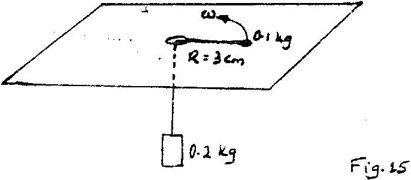
Figure 15 shows two masses 0.1 kg and 0.2 kg connected by a string through a hole on a smooth horizontal surface.
The 0.1 kg mass rotates in a horizontal circle of radius 3 cm. Calculate the angular velocity of the mass when the system is in equilibrium. Use acceleration due to gravity g = 10 m/s2.
32.
Sketch a diagram to show the position of an object when a converging lens is used as a magnifying glass.
33.
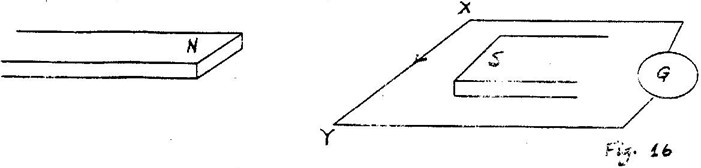
Figure 16 shows a wire XY at right angles to a magnetic field. XY is part of a circuit containing a galvanometer.
XY is moved.
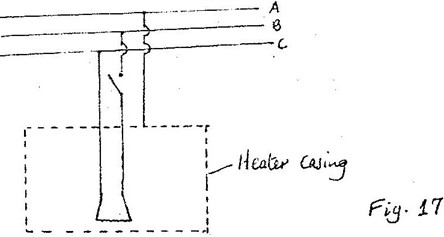
Identify A, B, and C.
35.
A radioactive nuclide of atomic number Z emits a beta particle and gamma rays. State the atomic number of the new nuclide.


