

CHAPTER TWO
UNIFORM CIRCULAR MOTION
Introduction
Circular motion is the motion of bodies travelling in circular paths. Uniform circular motion occurs when the speed of a body moving in a circular path is constant. This can be defined as motion of an object at a constant speed along a curved path of constant radius. When acceleration (variation of velocities) is directed towards the centre of the path of motion, it is known as centripetal acceleration, and the force producing this centripetal acceleration, which is also directed towards the centre of the path, is called centripetal force.
Angular motion
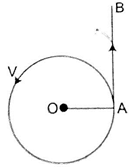
This motion can be described as the motion of a body moving along a circular path by giving the angle covered in a certain time along the path of motion. The angle covered in a certain time is proportional to the distance covered along the path of motion.
The radian
One radian is the angle subtended at the centre of the circle by an arc of length equal to the radius of the circle. Since one circle = 3600 and has 2π radians, therefore 1 radian = 3600 / 2π = 57.2960 or 57.30.
Example
A wheel of radius 50 cm is rolled through a quarter turn. Calculate:
- The angle rotated in radians.
- The distance moved by a point on the circumference.
Solution
A quarter turn = 3600 / 4 = 900. Since 3600 = 2π radians.
Alternatively, since 1 radian = 57.30, hence 900 = 1.57 radians.
A point on the circumference moves through an arc,
Arc = radius × θ (θ in radians)
= 50 cm × 1.57
= 78.5 cm.
Angular velocity
If a body moving in a circular path turns through an angle θ radians in time t, angular velocity ω is defined as the rate of change of the angle θ with time.
ω = θ / t, unit for angular velocity is radians per second (rad s-1). Since the radian measure is a ratio, we can write it as second-1 (s-1). We can establish the relationship between angular velocity ‘ω’ and linear velocity ‘v’ from the relation θ = arc / radius, where arc = radius × θ. Dividing the expression by ‘t’, then arc / t = radius × ω, but arc / t = v (linear velocity). So v = radius × ω. This expression gives us the relationship between angular and linear velocity.
Angular acceleration
If the angular velocity for a body changes from ω1 to ω2 in time t, then the angular acceleration α can be expressed as:
α = (ω2 – ω1) / t
Units for angular acceleration are radians per second squared (rad s-2) or second-2 (s-2). When α is constant with time, we say the body is moving with uniform angular acceleration.
Note: In uniform circular motion, α = 0.
To establish the relationship between angular acceleration and linear acceleration, from the relation v = radius × ω, dividing by t, we get (v / t) = radius × (ω / t).
But v / t = a (linear acceleration) and ω / t = α (angular acceleration). So a = radius × α.
Centripetal force
This is a force which acts on a body by directing the body towards its centre. Since the direction is continuously changing, the velocity therefore cannot be constant.
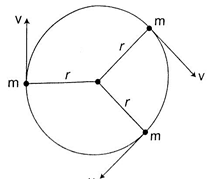
Applying Newton’s law of motion (F = ma), the centripetal force Fc is given by:
Fc = ma = mv2/R. Since v = radius × ω, then
Fc = m v2 / R = m R ω2.
The centripetal acceleration ‘a’ in relation to angular velocity ω is given by a = R ω2.
Motion in a vertical circle
Consider a mass m tied to a string of length r and moving in a vertical circle as shown below.

At position 1 – both weight (mg) and tension T are in the same direction and the centripetal force is provided by both, hence T1 + mg = mv2/r. Therefore, T1 = mv2/r – mg. (The velocity decreases as T1 decreases since mg is constant.) T1 will be zero when mv2/r = mg and thus v =  . This is the minimum speed at position 1 which keeps the body in a circle; at this time when T = 0, the string begins to slacken.
At position 2 – the mg has no component towards the centre and thus plays no part in providing the centripetal force, which is provided by the string alone.
T2 = mv2/r
At position 3 – mg and T are in opposite directions, therefore:
T3 – mg = mv2/r; hence T3 = mv2/r + mg. This indicates that the greatest value of tension is at T3 or at the bottom of the circular path.
Examples
A ball of mass 2.5 × 10⁻² kg is tied to a string and whirled in a horizontal circular path at a speed of 5.0 m/s. If the string is 2.0 m long, what centripetal force does the string exert on the ball?
Solution:
Fc = mv2/r = (2.5 × 10-2) × 52 / 2.0 = 0.31 N.
A car of mass 6.0 × 10³ kg is driven around a horizontal curve of radius 250 m. If the force of friction between the tyres and the road is 21,000 N, what is the maximum speed that the car can be driven at on a bend without going off the road?
Solution:
Fc = force of friction = 21,000 N, also Fc = mv2/r, hence
21,000 = (6.0 × 10³) × v2 / 250,
v2 = (21,000 × 250) / (6.0 × 10³)
A stone attached to one end of a string is whirled in space in a vertical plane. If the length of the string is 80 cm, determine the minimum speed at which the stone will describe a vertical circle. (Take g = 10 m/s2).
Solution:
Minimum speed v =
 = × 10 = 2.283 m/s.
 =
=  × 10 = 2.283 m/s.
The conical pendulum
It consists of a small massive object tied to the end of a thin string fixed to a rigid support. The object is then pulled at an angle and made to whirl in a horizontal circle.

When the speed of the object is constant, the angle θ becomes constant also. If the speed is increased, the angle θ increases; that is, the object rises and describes a circle of bigger radius. Therefore, as the angular velocity increases, r also increases.
The centrifuge
It consists of small metal container tubes which can be electrically or manually rotated in a circle. If we consider two particles of different masses m1 and m2, each requires a centripetal force to keep it in circular motion. The more massive particle requires a greater force and so a greater radius and therefore moves to the bottom of the tube.
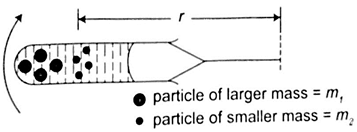
This method is used to separate solids and liquids faster than using filter paper.
Banked tracks
As a vehicle moves round a bend, the centripetal force is provided by the sideways friction between the tyres and the surface, that is:
Centripetal force = mv2/r = frictional force
To enable a vehicle to turn along a bend at high speed, the road is raised on the outer edge to attain a saucer-like shape; this is known as banking, where part of the centripetal force necessary to keep the vehicle on track is provided by the weight of the vehicle. This allows cars to negotiate bends at critical speeds.
Application of uniform circular motion
- Centrifuges – used to separate liquids of different densities, e.g., cream and milk.
- Drying clothes in spin dryer – clothes are placed in a perforated drum rotated at high speed; water is expelled through the holes, making the clothes dry.
- Road banking – especially for racing cars, enabling them to move at critical speed along bends without going off the tracks.
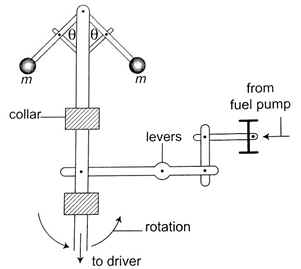
- Speed governor – the principle of the conical pendulum is used here to regulate speed by controlling the fuel intake in the combustion chamber. As the collar moves up and down through a system of levers, it connects to a device which controls the fuel intake.