


CHAPTER ELEVEN
ELECTRONICS
Conductors, Insulators, and Semi-conductors
- An insulator is a material or object that resists the flow of heat (thermal insulator) or electrical charges (electrical insulator). Examples include paraffin, wood, rubber, and plastics.
- Conductors are materials that contain free electrons which carry an electrical charge from one point to another. Examples include metals and non-metals like carbon and graphite.
- Semi-conductors are materials or objects that allow the flow of electrical heat or energy through them under certain conditions, such as temperature. Examples include germanium, silicon, cadmium sulphide, and gallium arsenide.
Electronic Bond Structure
This refers to the series of “allowed” and “forbidden” energy bands that a material contains according to the band theory, which postulates the existence of continuous ranges of energy values (bands) that electrons may occupy (“allowed”) or not occupy (“forbidden”). According to molecular orbital theory, when several atoms are brought together in a molecule, their atomic orbitals split, producing a number of molecular orbitals proportional to the number of atoms. However, when a large number of atoms are brought together, the difference between their energy levels becomes very small, such that some intervals of energy contain no orbitals. This theory assumes that these energy levels are so numerous as to be indistinct.
Number, Size, and Spacing of Bands
Any solid has a large number of bands (theoretically infinite). Bands have different widths based on the properties of the atomic orbitals from which they arise. Bands may also overlap to produce a larger single band.
Valence and Conduction Bands
The valence band is the highest range of electron energies where electrons are normally present at zero temperature. The conduction band is the range of electron energy higher than that of the valence band, sufficient to make electrons free (delocalized) and responsible for the transfer of electric charge. Insulators and semi-conductors have a gap above the valence band followed by the conduction band above it. In metals, the conduction band is the valence band.

Band Structure of a Semi-conductor
Electrons in the conduction band break free of the covalent bonds between atoms and are free to move around, hence conduct charge. The covalent bonds have missing electrons or ‘holes’ after the electrons have moved. The current-carrying electrons in the conduction band are known as free electrons.

Doping of Semi-conductors
Doping is the introduction of impurities in semi-conductors to alter their electronic properties. The impurities are called dopants. Heavy doping may increase their conductivity by a factor greater than a million.
Intrinsic and Extrinsic Semi-conductors
An intrinsic semi-conductor is one that is pure enough such that the impurities in it do not significantly affect its electrical behavior. Intrinsic semi-conductors increase their conductivity with an increase in temperature, unlike metals. An extrinsic semi-conductor is one that has been doped with impurities to modify its number and type of free charge carriers present.
N-type Semi-conductors
In this case, the semi-conductor is given atoms by an impurity known as a donor, so it contains donor atoms (donated electrons).

P-type Semi-conductors
The impurity within the semi-conductor accepts atoms with free electrons (dopants). This forms a ‘hole’ within the semi-conductor.

Junction Diodes
Junction refers to the region where the two types of semi-conductors meet. The junctions are made by combining an n-type and p-type semi-conductor. The n-region is the cathode and the p-region is the anode.
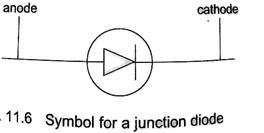


Forward Bias of a P-N Junction
This occurs when the p-type block is connected to the positive terminal and the n-type block is connected to the negative terminal of a battery. The depletion layer of the junction becomes very thin, allowing the flow of electric current.

Reverse Bias of a P-N Junction
The negative terminal of the battery is connected to the p-type region while the n-type is connected to the positive terminal.

The depletion layer widens and resists the flow of electrons to minimal or zero (no current flows through). When the electric field increases beyond a critical point, the diode junction eventually breaks down; at this voltage, it is referred to as the breakdown voltage. Diodes are intended to operate below the breakdown voltage.
Applications of Junction Diodes
They are mainly used for rectification of a.c. current for use by many electrical appliances. Rectification is the conversion of a sinusoidal waveform into a unidirectional (non-zero) waveform.
Half Wave Rectification
In this case, the first half cycle of a sinusoidal waveform is positive, and the inclusion of a reverse-biased diode prevents the current from flowing during the negative half cycle. The current therefore conducts on every half cycle, achieving half wave rectification. The voltage is d.c. and always positive in value, though it is not steady and needs to be smoothed by placing a large capacitor in parallel with the load as shown.

Centre-tap Full Wave Rectification
This is achieved by using a transformer whose output has a centre tap that is taken at two points where one is half the other, as shown.

Bridge Full Wave Rectification
In this case, a bridge rectifier is used to achieve full wave rectification. The current flows in the same direction during both half cycles.

Radio Transmitter and Receiver
Radio waves are produced by circuits that make electrons vibrate; these circuits are known as oscillators and produce varied frequencies. Since radio waves have a greater range in air than sound or even light waves, they are used as carriers of audio (sound) and visual information (TV) waves. The sound is first changed into electrical vibrations by a microphone or other device, then added to the radio carrier wave; this changes the amplitude of the carrier and is called amplitude modulation. The modulated wave is transmitted by the transmitting aerial and received by another aerial in a radio or TV, where it causes vibrations between the earth and the aerial. They are then demodulated by a diode and hence heard as sound or seen as an image.


