



CHAPTER ONE
MAGNETISM
Introduction
Magnets are substances that are able to attract and hold items. Lodestone is the only known natural magnet, discovered by the Chinese 2,000 years ago. Other magnets produced artificially by humans are called artificial magnets.
Magnets and Non-Magnetic Materials
Magnetic materials are those that are strongly attracted by magnets, while non-magnetic ones are not affected by magnets. Iron, steel, cobalt, and nickel are magnetic substances, while wood, glass, and copper are examples of non-magnetic substances. Substances that are repelled by magnets are said to be diamagnetic, whereas those which are strongly attracted, i.e., iron, nickel, cobalt, are called ferromagnetic materials. The materials that are lightly attracted such that the magnet seems to have no effect on them are called paramagnetic materials (mostly non-magnetic materials). Ferrites are a mixture of iron oxide and barium oxide and are the most newly developed magnetic materials. Ceramic magnets or magnadur magnets are made from ferrites and are very strong.
Properties of Magnets
- They are double-poled substances with both the North and South poles.
- Like poles repel and unlike poles attract. Repulsion is a sure method of determining whether two substances are magnets.
- The greatest magnetic force is concentrated around the poles of a magnet.
Magnetic Field Patterns
Magnetic field is the space around a magnet where magnetic force is observed.
Plotting Field Patterns
A line of force gives the direction of the magnetic field at each point along it. Their closeness is a measure of the strength of the magnetic field or of the force that would be exerted by the bar magnet.
Examples of Field Patterns


Watches (non-digital), electron beams in cathode ray tubes, and TV sets are shielded from external magnetic fields by placing a soft-iron cylinder around the neck of the tube or watch. 
Making Magnets
The following are methods used to make magnets:
- Magnetic induction – this is a process by which magnets are made by placing ferromagnetic materials in a magnetic field. Materials like iron lose their magnetism easily and are said to be soft, while others like steel gain magnetism slowly but retain it longer and are therefore said to be hard and are used to make permanent magnets.
- Magnetizing by stroking – the object to be magnetized is placed on a bench, then a bar magnet is dragged along the length of the bar from one end to the other. This is repeated several times and the object becomes magnetized. This method is known as

- Magnetizing using an electric current – this is the use of the magnetic effect of an electric current through a solenoid (insulated wire of many turns).
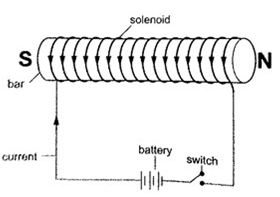
Demagnetizing
Demagnetizing is the process of removing magnetic properties of a magnet. The following methods cause a magnet to lose its magnetism:
- Hammering them hard with their poles facing East-West direction.
- Heating them strongly.
- Placing a magnet inside a solenoid and passing an alternating current through it for a short time.

Caring for Magnets
- Magnets should be stored in pairs with unlike poles adjacent to each other, attached to pieces of soft iron called keepers.

- Magnets should not be hammered, especially with their poles facing East-West direction.
- Magnets should not be heated strongly or dropped roughly on hard surfaces.
- Magnets should not be placed near alternating currents.
- Magnets should be kept dry and clean since rust can make them lose their magnetism.
Uses of Magnets
- Used in making other magnets.
- Used in making loudspeakers.
- Used in making moving coil meters.
- Used in making telephone speakers.
Domain Theory of Magnetism
In ferromagnetic substances, small atomic magnets form large groups called domains. These atomic magnets face one direction, where the direction varies from one domain to another. In an unmagnetized crystal, the directions of these domains are different; hence their resultant

When a magnetic material is placed in a magnetic field, the atomic magnets rotate and eventually all domains face the same direction. When this happens, the material becomes magnetized. When a material is magnetized, we say it is saturated. This means that the magnetism of the material cannot be increased by any other method. This is the domain theory of magnetism.


7 Comments