


CHAPTER FIVE
REFLECTION AT CURVED SURFACES
Concave and convex mirrors
They are also known as spherical mirrors and are formed when a spherical glass is silvered. If the inside is silvered, a concave or converging mirror is formed, while a convex or diverging mirror is formed when the outside is silvered.
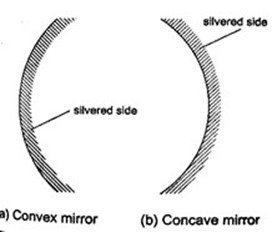
Parts of a spherical mirror
- Centre of curvature (C) – this is the centre of the sphere of which the mirror is part. The centre itself is called the pole (P).
- Principal axis – this is the line joining the centre of curvature (C) to the pole (P).
- Principal focus (F) – is a point on the principal axis through which a ray is reflected when it hits a concave mirror. In a convex mirror, the ray is reflected and appears to originate from this point. F is virtual for a convex mirror and real for a concave mirror.
- Radius of curvature (r) – this is the distance from the pole to the centre of curvature. The distance from the pole to the principal focus is called the focal length (f).
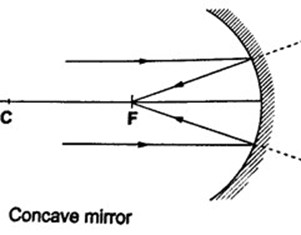
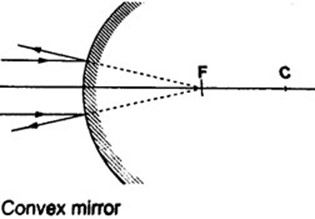
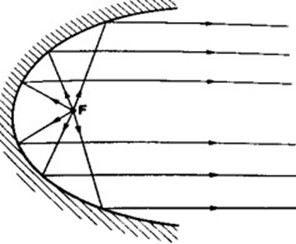
Parabolic mirrors
They produce a wide parallel beam or converge a large beam of light to a point. They are widely used in making car headlights or in spotlights.
Images formed by spherical mirrors
Location of images using ray diagrams
When drawing ray diagrams, the following symbols are used to represent the mirrors.
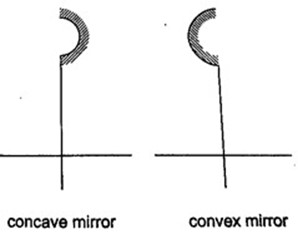
The image is located by drawing any two of the following rays:
- A ray parallel to the principal axis which is reflected through the principal focus.
- A ray through the centre of curvature which is reflected along its own path since it hits the mirror normally.
- A ray through the principal focus which is reflected parallel to the principal axis.
Virtual images are formed when rays diverge and are extended backwards using dotted lines until they meet. The image formed is also dotted since it is not formed by an intersection of real rays. A real image is formed by the intersection of real rays.
Concave mirror
a) Object at infinity: image is formed at F. It is real, inverted, and diminished.

- Object behind C: image is formed between C and F. It is real, inverted, and diminished.
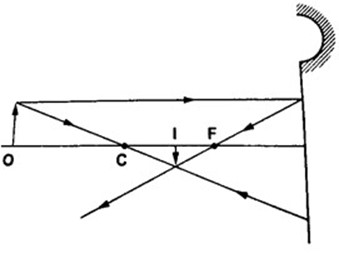
- Object between F and C: Image is formed behind C. It is real, inverted, and magnified.
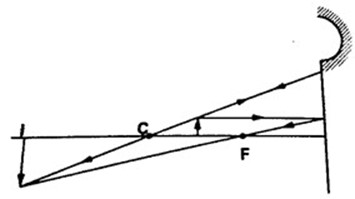
- Object at F: Image formed is at infinity.
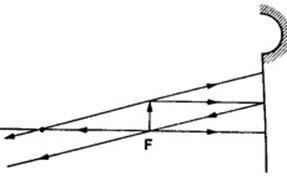
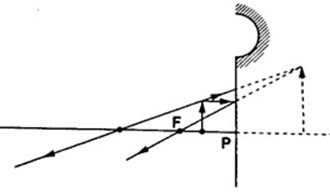
- Object between F and P: Image is formed behind the mirror. It is virtual, erect, and magnified.
Convex mirror
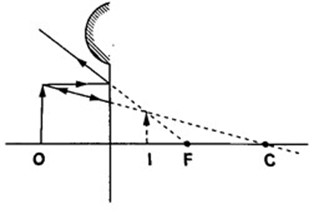
- Image is always formed behind the mirror. It is virtual, erect, and always diminished.
Applications of curved reflectors
- They are used in satellite dishes.
- They are used in making shaving mirrors.
- They are used in telescopes.
- They are used in driving mirrors.
Magnification
Magnification is the ratio of the image size to the object size.
Magnification (M) = height of the image / height of the object.
When the ratio is greater than one, the image is magnified; when less than one, it is diminished.
Also, magnification = image distance from the mirror / object distance from the mirror.
Examples
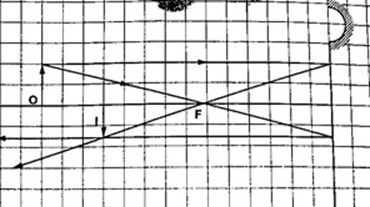
Determine the size, position, and nature of the image of an object 5.0 cm tall, placed on the principal axis of a concave mirror of focal length 15 cm, at a distance 35 cm from the mirror.
Solution
Let 1 cm represent 5 cm. Then the focal length is 3 cm.
Object distance = 7 cm, object height = 1 cm.

From the scale drawing,
Image position = 5.4 cm × 5 = 27 cm in front of the mirror.
Image size = 0.75 cm × 5 = 3.75 cm.
Image is real and inverted.
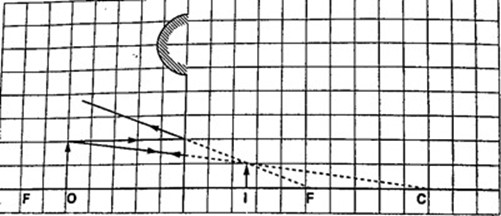
A vertical object 5 cm high is placed 10 cm in front of a convex mirror of focal length 15 cm. Find the position, size, and nature of the image formed. Determine the magnification of the image.
Solution
Let 1 cm represent 5 cm, then the focal length = 3 cm, object size = 1 cm, object distance = 2 cm.
From the scale drawing,
Image position = 1.2 cm × 5 = 6.0 cm behind the mirror.
Image size = 0.6 cm × 5 = 3.0 cm.
The image is virtual and erect.
Magnification = image distance / object distance = 6 / 10 = 0.6 (diminished).


4 Comments