

CHAPTER EIGHT
RECTILINEAR PROPAGATION AND REFLECTION AT PLANE SURFACES
Introduction
Objects that produce their own light are known as luminous objects, e.g., the sun, torch lamps, etc. Objects that do not produce their own light are called non-luminous objects, e.g., the moon. Opaque objects are those which do not allow light to pass through them.
Translucent materials allow light to pass through them but we cannot see clearly through them, e.g., church glass and bathroom glass. Transparent materials allow light to pass through them and we can see through them, e.g., window panes, car windows, etc. A ray is the direction of the path followed by light. A beam is a group of rays travelling together.
Experiment: Light Travels in Straight Lines
Procedure
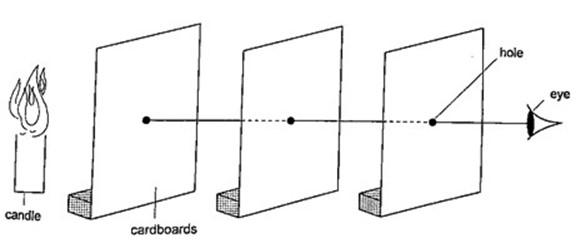
- Obtain three cardboards with a hole at the center and mount them such that they form a straight line.
- Arrange them as shown and place a lighted candle at one end and make sure that you can see the flame from the other end.
- Move any of the cardboards and observe what happens.
Discussion
When one cardboard is displaced or moved slightly, the flame cannot be seen at the other end. This shows that light travels in a straight line. This principle is applied in the following:
Pinhole Camera
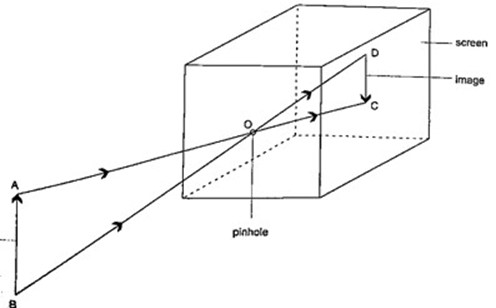
It consists of a closed box with a small hole on one face and a screen of tracing paper or frosted glass on the opposite face as shown. An image will be formed on the screen. Since light travels from one point of the object through the hole, an image will be formed on the opposite screen of the box. If the object is near the hole, it is magnified; if away from the hole, it is diminished. Magnification is therefore the ratio of the image height to object height, expressed as:
Magnification = height of image / height of object or
= distance of image from pinhole / distance of object from pinhole
Shadows
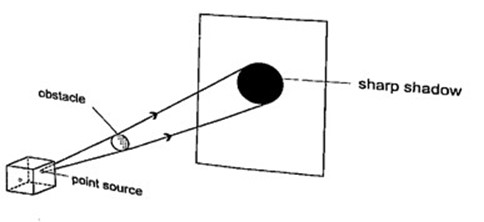
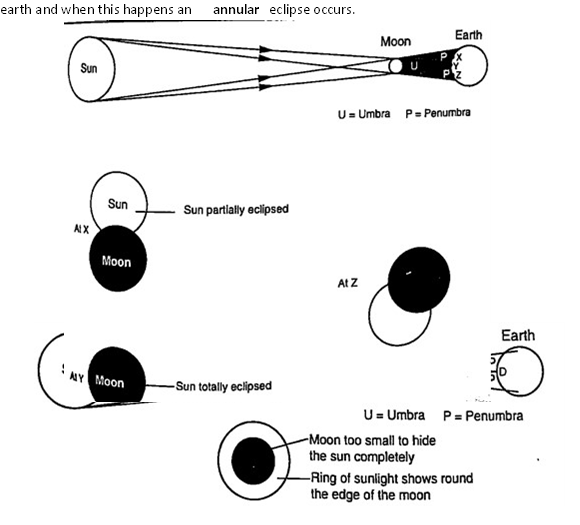
Shadows are formed when an opaque object is placed between a source of light and a screen. When the shadow is large, a dark patch at the centre is formed (umbra) while a surrounding lighter patch called penumbra is formed.
Eclipses
| Annular eclipse |
Eclipse of the Sun (Solar Eclipse)
This occurs when the moon is between the earth and the sun. The shadow of the moon falls on the earth’s surface. Sometimes the distance is too large for the shadow to reach the earth.
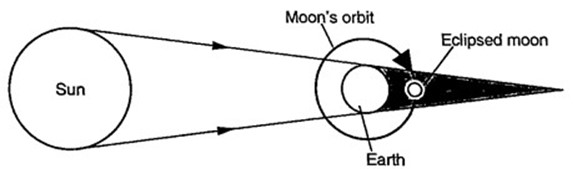
Eclipse of the Moon
Also known as a lunar eclipse, it occurs when the earth is between the sun and the moon. The shadow of the earth falls on the moon.
Examples
Calculate the height of a building 300 m away from a pinhole camera which produces an image 2.5 cm high if the distance between the pinhole and the screen is 5.0 cm.
Solution:
Object distance = 300 m, image height = 2.5 cm, image distance = 5.0 cm.
Object height / image height = object distance / image distance
Object height = (30,000 × 2.5) / 5.0 = 15,000 cm = 150 m.
The length of a pinhole camera is 25.0 cm. An object 2.0 m is placed 10.0 m from the pinhole. Calculate the height of the image produced and its magnification.
Solution:
Image height = (image distance × object height) / object distance
= (25 × 200) / 10 = 500 cm or 5 m.
Magnification = image distance / object distance
= 25 / 10 = 2.5
Reflection from Plane Surfaces
Diffuse and Regular Reflection
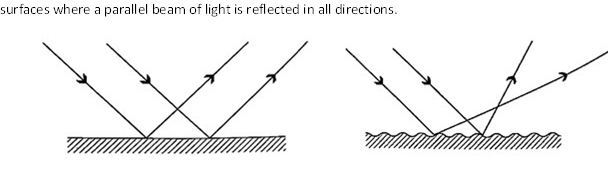
Regular reflection occurs when a parallel beam of light falls on a plane mirror and is reflected as a parallel beam. This occurs on polished surfaces. Diffuse reflection occurs on rough surfaces.
Laws of Reflection
- The incident ray, the normal, and the reflected ray at the point of incidence must lie in the same plane.
 The angle of incidence is equal to the angle of reflection.
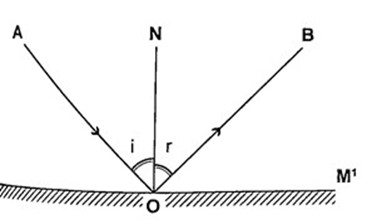 The angle of incidence is equal to the angle of reflection.
Images Formed by Reflection from Plane Surfaces
Characteristics of Images Formed in a Plane Mirror
- The image is the same size as the object.
- The image is the same distance behind the mirror as the object is in front.
- The image is laterally inverted.
- The image is virtual.
- The image is erect.
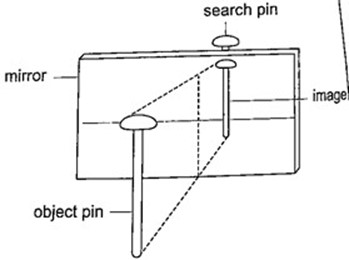
Location of an Image by the Non-Parallax Method
Parallax is the apparent relative motion of two objects due to the movement of the observer. It only occurs when the objects are at a distance from one another. This can be used to find the position of images in plane mirrors.
Experiment: To Find the Position of an Image of a Pin by Non-Parallax Method
Procedure
- Obtain a sheet of paper and draw a mirror line.
- Place the mirror on the line as shown.
- Place the pin at least 5 cm from the mirror and obtain another pin (search pin).
- Move the pin till you get a point where there is no parallax and place your second pin.
- Measure the distances (both image and object) and confirm your results.
Mirrors at an Angle
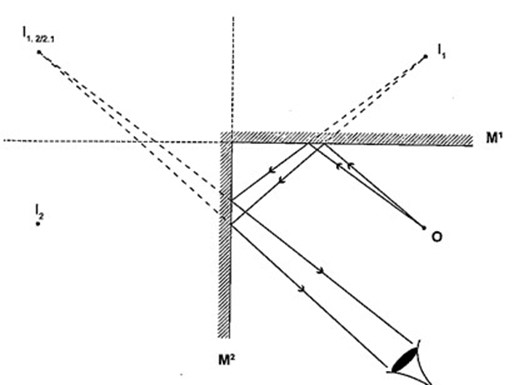
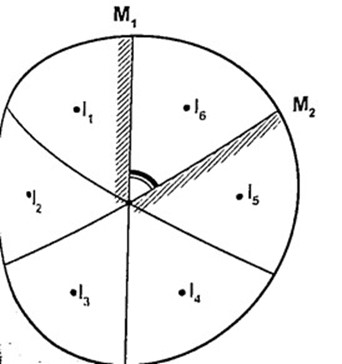
When mirrors are placed at an angle, several images are obtained depending on the angle between them. If the angle is 600, the images formed will be five. We use the following formula to find the number of images:
n = (3600 / θ) – 1
When mirrors are parallel, the images formed are infinite.
Kaleidoscope
It applies the principle of mirrors at an angle. It consists of two mirrors arranged at an angle of 600 to one another inside a tube. The bottom has a ground-glass plate with brightly coloured glass for allowing light. When one observes through the tube, five images are seen.
The Periscope
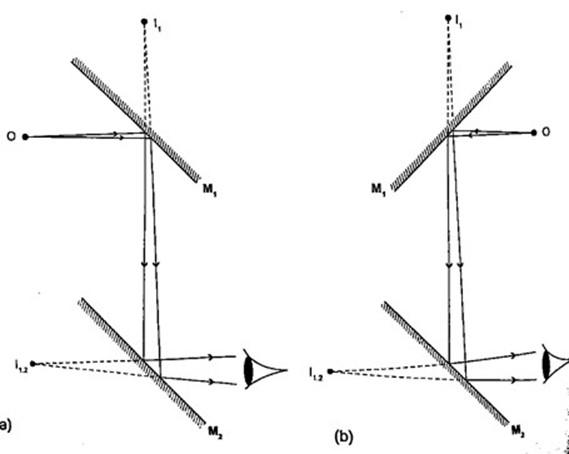
This consists of two mirrors arranged at an angle of 450 as shown. This principle is used in periscopes (prisms) and telescopes.


1 Comment