

Measurement I Questions
1. (a) Distinguish between density and relative density of a substance
(b) A ship of mass 1300 tonnes floats on sea water:
(i) What volume of sea water is displaced (Density of sea water is 1025kg/m3)
(ii) Suppose it sails from sea water to fresh water, what cargo must be removed so that
the same volume of water is displaced? (Density of fresh water = 1000kg/m3
(c) Describe an experiment to verify the law of floatation
2. Define relative density
3. A bathroom shower has 200 holes each 2.5mm2 in area. Water flows from a pipe of cross-section
area of 15cm2 at 5m/s to the shower. Determine the speed of the spray.
4. A piece of metal N of mass 2kg weighs 18N in water and 12N in liquid M. Determine the density of
(i) The metal N
(ii) The liquid M
5. A measuring cylinder contains 50cm3 of light oil at 0oC. When a lump of dried ice is placed in
the oil, the total volume is 72cm3. Determine the density of the ice
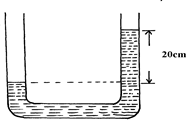
The figure 1 below shows a manometer connected to a gas supply. The pressure of the gas supply above the atmospheric pressure is equivalent to a 20cm column of water. Use this information and the figure to answer questions 2 and 3.
Measurement I Answers
1. (a) Density is the mass per unit volume of a substance, while relative density is the number of
times a substance is denser than water- 2mks of each is defined properly
(b) By law of floatation,
(c) Mass of the ship = mass of water displaced
Mass of water displaced = 1300000kg
Volume of water displaced = mass
Density
= 1,300,000kg
1025kg/m3
= 1268.3m3
(ii) Weight of ship – weight of cargo = upthrust in fresh water
13,000,000kg – W = weight of water displaced in fresh water
13000000 – W = (1268.3 x1000) x10*TEZ*
W = 13,000,000 – 12, 683,000
W = 31,7000N
Cargo removed = 317tonnes
(c) Apparatus
– Measuring cylinder, water, test tube, sand and a weighing balance
Procedure
- A measuring cylinder is half-filled with water and the level recorded
- Then a clean dry test tube is placed into the cylinder and some sand is added to it so that it floats upright. The new level of water is recorded.
- the volume of water displaced is then noted, the test tube is then removed from the cylinder, it is dried and its weight determined
- The experiment is repeated four times, adding a little more sand each time
Observation ½mk for correct observation
The test-tube sinks deeper with each addition of sand. Weight of test-tube with its contents is equal to weight of water displaced.
Conclusion – ½mk for correct conclusion
A floating object displaces its own weight of the fluid in which it floats. This is the fluid in which it floats. This is the law of floatation
2. a) Define relative density
The ration of density of substance to the density of water.
Or Ration of mass of a substance to the mass of equal volume of water.
3. A1V1 = A2V2
200 x 2.5 x 10-6 x V = 15 x 10-4 x5
V = 15 x 10-4 x 5
200 x 2.5 x 10-6
= 75 x10-4
= 7500
500 x 10-6 500
= 15m/s
4. i) Relation density = weight in air
Up thrust in water
= 20 = 20 = 10
20–18 2
Density = 10 x 1000
= 1000kgm-3
(ii) R.d = upthrust in liquid
Upthrust in water
= 20 – 16 = 4 = 2
20 – 18 2
Density = 2×1000
= 2000kg,-3
5. Volume of ice = 72-50= 22cm3
 Volume of water = 70-50=20cm3
Mass of water = mass of ice = volume x density
= 20cm3 x 1gcm-3
= 20g
Density of ice = m = 20 = 0.909
V 22
= 0.91cm-3


