

Fishing in Uganda Notes
Fishing refers to all aspects of man’s pursuit of the aquatic animals from lakes, rivers, swamps and ponds.
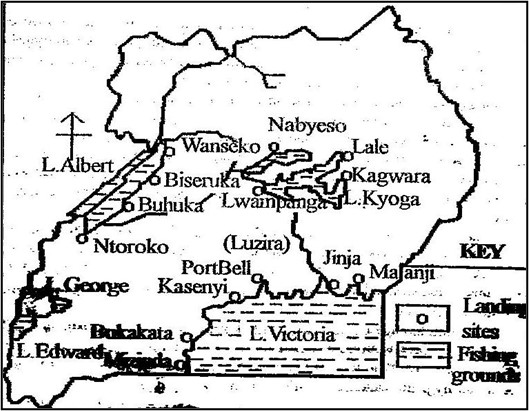
Uganda‘s fishing industry is based on the fresh water fishing grounds of lakes such as Victoria, Kyoga, Edward and George, rivers such as Katonga, Kafu, Nile, and Kagera and Kazinga channel. Also in swamps like Rubigi, Nabajjuzi and Mpologoma and in ponds such as Nkoma ponds in Mbale, Kajjansi ponds in Wakiso, etc.
Major fishing grounds of Uganda
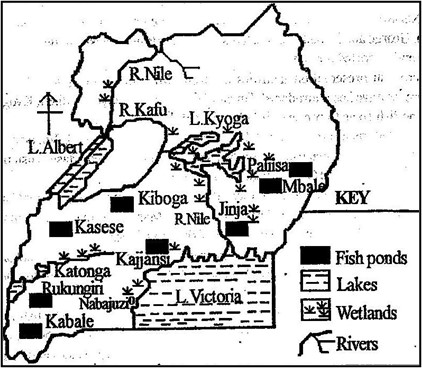
A sketch map showing L. Victoria, L. Albert and L. Kyoga fishing ground
Status of Uganda‘s fishing industry
- Majorly fish in Uganda is caught from L. Victoria contributing 58% of the total catch
- There is an increase in exported fish, fish processing factories and fish exporting companies. Fish is majorly exported to USA and Middle East countries.
- Fish processing and exporting companies include Hwang Sung, Ngenge Limited, Green fields, Four Square, Uganda Marine products, etc.
- The fishing sector has employed many people especially the un-educated.
- 60% of the total fish catch is sold fresh while 40% is processed.
- Traditional methods of fish processing like sun drying and smoking account for 20% though smoking is now illegal.
- Fish caught is transported to market centers through road, water and air depending on the destination.
- Common fish caught include tilapia and Nile perch
Major fish species of Uganda
Nile perch (mputa), Tilapia (ngege), lung fish (mamba), halochromics (nkejje), silver fish (mukene), clarias (male), mud fish (nsonzi), Bagrus (semutundu), cat fish, moon fish, yellow fish, etc. most of the above however are of less economic value except tilapia and Nile perch.
Methods used to catch fish in Uganda
- Baskets and troughs; this is normally used in the shallow water of rivers, swamps and lagoons. Baits such as worms, termites and meat are put in the basket to attract the fish. Also fishermen fence off an area and fish is then caught using baskets.
- The line method; in this method hooks are used, a rope is used with hooks tied on and baits on hooks to attract fish. Once fish is trapped the fishermen pull out the rope and it usually catches large fish like Nile perch.
- Gill netting; this is the most commonly used method where the net is suspended into water floated by floats and weights at the bottom. Here fish is caught by gills.
- Purse-seine; these are
used together with boat engines which are driven on the water and fish is trapped into the net. A bag like net is tied on the boat and suspended into water as the boat is driven in the water, fish is trapped.
NB. Draw the required diagrams to describe the above methods
Major fish preservation methods used in Uganda
- Smoking method; this involves the use of fire to smoke the fish after it has been splint open and placed on the rack.
- Salting method; this involves the splinting open fish and then smear salt on it and put it in the sun shine to dry.
- Freezing method/refrigeration this is the most modern method used, large refrigerated trucks are filled with fish and transported to the fish processing factories or market centers. Sometimes fish mongers carry with them ice blocks which they place in their containers with fish in it.
-
Fish canning/tinning here fish is processed and put into tins or cans, this is specifically used by large fish factories such as Hwang sung fish processing plants.
Factors that have favoured and contributed to rapid development of the fishing industry in Uganda
- Presence of moderate temperature and rainfall which support fish growth and breeding. This has increased on multiplication of fish within the fishing grounds of Uganda like in L. kyoga.
- The fishing grounds of Uganda receive a lot of light and the waters are oxygenated in L. Victoria, such is required for fish growth and multiplication.
- The presence of abundant planktons in the fishing grounds of Edward and George due to alkaline level of the water. Planktons are fish feed thus fish growth.
- Availability of several fishing grounds in Uganda such as Lake Victoria, river katonga, Lumbuye swamp and ponds. All these become source of fish.
- Presence of well sheltered bays on the shoreline of L. Victoria and Kyoga, these are suitable for the development of the fishing activities and setting up of landing sites such as Lambu and Kasenyi on L. Victoria.
- Presence of valuable fish species of Nile perch and Tilapia from Kyoga and Victoria. These are highly demanded by the local population as well as foreign markets. Also silver fish is highly demanded for making animal feeds.
- Supportive government policy of encouraging and accepting of foreign investors to invest in the fishing industry, companies like Hwang Sung have improved on Uganda‘s fishing industry
- The government has also given loans to fishermen and mongers so as to buy modern fishing equipment. It has tried to protect the fishing grounds like Victoria against over fishing and the use of traditional fishing method.
- The rich continental shelf of L. Kyoga and L. Victoria which ease the use of gill netting and fishing gears thus a lot of catch.
- The presence of numerous islands like Ssese, Bubeke, Buvuma in L. Victoria which act as landing sites thus more fish catch.
- Availability of dense forests such as Bugala and kalangala along L. Victoria which has boosted boat construction used in fishing. Also Budongo forest has been a source of wood for smoking fish at Butiaba and Wanseko on L. Albert.
- Improved transport network which access the main fishing grounds of L. Victoria and Kyoga. This has eased fish transportation to market centers like a road from Lambu to Masaka town.
- Improved market potential for fish both internally in Kampala, Jinja, Masaka and externally in USA and Middle East countries, the market returns have been used to develop the industry.
- The availability of cheap labour largely from the dense population concentrations within the Victoria-Kyoga basin of Wakiso, Mukono, Jinja, etc to work in the industry.
- The use of modern fish preservation methods of freeing and canning by fishing companies of Hwang Sung, has improved on the quality of fish thus development of the fishing industry.
- The increasingly use of gill netting and purse- seining especially on L. Albert, Kyoga and Victoria, has led to improved fish catch which has fetched more incomes.
Roles played by the fishing industry in the development of Uganda.
- Fish is source of food as animal and human proteins. Silver fish from L. George and Albert is used as poultry feed and this has supported poultry farming thus more incomes to farmers.
- It earns Uganda foreign exchange through the exportation of fish and fish products especially Nile perch from L. Victoria to EU countries and Middle East countries. Such income is used to establish important infrastructure like roads and health units.
- The industry provides employment opportunities for the local people especially to un-educated youth like at Kasensero and Lwampanga fish landing sites. These are boat makers, fishermen, mongers and exporters as well as processors like in Ngege limited thus improved standards of living.
- Fish provide valuable products such as cooking oil, fertilizers, cosmetics which leads to industrial development. Companies like Hwang Sung, Uganda Marine products exist due to the fishing sector. Such companies are source of jobs and incomes thus high standards of living to Ugandans
- The industry facilitates the development of important infrastructure such as roads like a road from Lambu in Bukakata to transport fish to Masaka town, health units like Kasenyi health centre on L. Victoria, and these have improved on people’s living standards.
- It has led to diversification of the economy of Uganda from over depending on agriculture. Many Ugandans especially un-educated have been employed like at Buvuma, Katunguru, Masese, reducing pressure on land as well as incomes and foreign exchange from fish exports.
- It has led to establishment and development of ports on the fishing grounds; these include Lwampanga on L. Kyoga, Butiaba and Wanseko on L. Albert, and others on L. Victoria. Such ports have been used to develop trade and international relationship.
- Through licenses given to fishing companies like Ngenge Limited, Green fields, Four Square, taxes from fishermen and mongers, Uganda government has earned lot of revenue and used it to set up important infrastructure like roads, health units, etc.
Negative contribution of fishing to Uganda‘s development includes
- Fishing requires boats and canoes and these claim a lot of forest cover for timber. Forests like Ssese and Mabira are getting depleted leading to reduced rainfall and soil erosion. Also on Lake Albert a lot of fire wood is used to smoke fish causing deforestation of Budongo and Bugoma as well as air pollution.
- Fishing is risky since it involves drowning, foristance about 20 fishermen drown into Lake Albert per year. Also dangerous animals like crocodiles especially in L. Kyoga have claimed a lot of people loosing labour force which would have been used for economic development.
- Fishing leads to growth of landing sites like Lambu and Kasenyi on L. Victoria and these are associated with a lot of evils such as prostitution, immorality, robbery, etc. also the activity has encouraged illiteracy since very few people go to school and others drop out of school on landing sites affecting economic development.
- Most of the fish processing and exporting factories like Green field at Entebbe Hwang sung in Ntinda are foreign owned repatriating all the profits got from the industry leading to low development of Uganda.
Problems facing the fishing industry in Uganda
- Limited valuable fish species in Uganda‘s fishing grounds. Many fish species like mud fish, cat fish from L. Albert are less valuable and cannot compete favourably on the international scene.
- The major fishing grounds of Victoria-Kyoga basin have been invaded by a water weed known as water hyacinth which has endangered the life of fish. The weed block oxygen and light penetration into water which is necessary for planktons and fish growth. It also blocks fishing boats and habours snakes which attack fishermen.
- Pollution especially around L. Victoria which emanates from various industries in Jinja and Kampala like Nile breweries and Uganda breweries respectively pour wastes into the lake claiming many fish.
- There is a problem of over fishing by greedy fishermen by using under nets and beach seining on Golo and Buikwe on L. Victoria and Kyoga fishing grounds. This has reduced on fish.
- Prolonged drought condition especially affecting the north, eastern and western Uganda‘s fishing grounds like L. Albert, George, and Edward. Drought reduces water levels, increase water temperature which leads fish death.
- Fish predators like Nile perch which eat other species, crocodiles, snakes and birds on L. Victoria which gradually reduce on fish numbers.
- Limited capital by fishermen to buy modern fishing gears of moto-boats, purse seining nets and preservation facilities which has led to continuous use of traditional methods of poison, beach seining like at Masese and Katunguru on L. Victoria and George respectively thus under exploitation of the fish resource.
- There is limited market for fish and fish products and this is mainly due to competition from international market with other fish producing countries like Peru and Norway. Also local market is affected by poverty in districts of Nakasongola, Moroto and some tribes which take fish as a taboo like the Hima.
- Limited handling facilities both at landing sites like Lambu and Masese on L. Victoria, market levels and storage of fish. This leads to losses since fish is perishable.
- Inefficient transport network especially during rainy seasons where roads like Masaka-Lambu is impassable, and also some fishing grounds like Rwenshama, are located in remote areas which delays perishable fish to reach the market centers thus losses.
- Political instabilities in some fishing grounds like L. Albert and Edward i.e. Kony and ADF wars respectively which limited full exploitation of the fishing grounds. Also wars in Uganda since 1960s have continuously drained government treasury thus low government funding of the industry.
- Water borne diseases like bilharzia which affect the fishermen leading to low exploitation of fish.
- Others include floating vegetation, ragged relief, irregular shorelines, moon light, waterfalls, water currents accidents, limited government support, use of poor fishing methods, remoteness of fishing grounds, reclamation of swamps, corruption, siltation of fishing grounds and limited research.
Measures to curb down the above problems
- Fishermen are encouraged to form co-operatives so as to bargain for loans from financial institution of FINCA, SERUDEF, and purchase preservation facilities and get managerial skills. Such institutions have provided loans to women groups at Lambu, Bukakata and Kasenyi for buying modern fishng gears.
- There has been a search for fish market from abroad and fish processing factories like Hwang Sung have increased on the quality of fish and fish products hence can compete favourably on the world market.
- There has been improvement on both preservation and transport facilities like refrigerated trucks of Ngege limited have helped to reach fish on market and for processing while still fresh. Also roads like Kampala-Ggaba, Kampala-Nakasongola-Lwampanga were tarmaced to access fisheries on L. Victoria and Kyoga.
- The government has tried to carryout training and research into the fisheries so as to maximize on fish production and reduce over fishing. This has been done on fish landing sites of L. Victoria like Lambu, Masese and Kasenyi which has reduced on overfishing.
- There is still a need to restock the over fished grounds like L. Albert and Kyoga by introducing new valuable fish species and protecting them from fish predators. This was done on L. Victoria where Nile perch was introduced.
- Strict laws have been put in place to check on indiscriminate fishing using beach seining and poisoning especially on L. Victoria fishing sites of Golo, Nakiwogo, etc.
- There has been treatment of industrial wastes before dumping into lakes to check on pollution which endangers fish life. Here the government has ensured that Nile breweries in Jinja and Uganda breweries in Luzira treat their wastes before dumping into L. Victoria.
- There has been a fight against the water hyacinth by individual fishermen and companies such as Uganda fishing co-operative union limited (UFCU) using machnes. This has helped to increase on oxygen and light in waters of L. Kyoga thus fish growth.
- Standard gill net size of 125mm has been recommended for use in most fishing grounds in Uganda especially at lwampanga and Nabyeso on L. Kyoga and Gaba and Majanji on L. Victoria. Also regular patrols are under taken on the same lakes by BMU to control pirates, under nets and fish poisoning.
- Creating of conducive political atmosphere by UPDF and peace talks. This has improved on fishing activities on L. Albert and Edward.
- Fish farming has been started in Uganda especially in Mukono and Kajjansi-Wakiso which has increased on fish production.
Note
- L. Victoria is the largest fishing ground in Uganda with several landing sites of Katebo, Ssese, Bukakata, Kasensero, Entebbe, Jinja, Bugadi, Kasenyi, Masese, Ggaba, Majanji, Kigungu, Lamu, Katosi, Sugu, etc.
- Lake Kyoga is the second largest with landing sites of Lwampanga, Mulondo, Nabyeso, Kigingi, etc. This is followed by L. Albert with landing sites of Butiaba, Wanseko, Bulisa, Buhuka, Ntoroko, Kibira, etc
- L. Edward and George are important fishing grounds with landing sites of Rwenshama, Kisenyi, Katwe, Kayanja and Kazinga. Kahendo, Katunguru, Kasenyi and Mahara of L. George.
- Fishing also takes place in rivers and swampy banks of rivers of Uganda mostly catching mud fish using traditional methods of fishing. Such rivers include Mpologoma, Katonga, Sezibwa, Nile, etc.
Fish farming in Uganda
Aquaculture refers to ‘growing’ of fish within the fish ponds and in Uganda it is stationed in Arua, Mukono, Bushenyi, Gulu, Kitanga-Kabale, Kamenyamigo-Masaka, Kisiizi-Rukungiri, Mbale, Kajjansi-Wakiso, etc.
The main species stocked in the ponds include Tilapia, clarias, bagrus, etc.
Factors that have favoured fish farming in Uganda
- Improvement in research on fisheries which provided the need to establish ponds where the studies are carried out like in Kajjansi-Wakiso.
- Supportive government policy of financing fish farming which came up after realizing that the natural fishing grounds like L. Victoria are getting depleted.
- Availability of ready fish market both local in urban areas of Jinja, Kampala, Masaka and foreign in Middle East countries which encouraged farmers to practice fish farming so as to earn a living.
- The presence of cool temperature and reliable rain fall which support the existence of fish and fish growth like in Wakiso and Mukono.
- Availability of various fish species to stock the ponds such as Tilapia, Bagrus and clarias.
- Presence of skilled labour provided by graduates from Makerere University and semi-skilled labour by the locals in populated districts of Mukono, Buikwe, Kamuli, and Mpigi to facilitate the establishment and management of ponds.
- Plenty of fish feeds produced locally by Uganda like maize brand and burnt bread, this support fish growth and multiplication.
Importance of fish farming
- Fish farmers have been provided by food in form of proteins and incomes from fish sales. This has ensured improved standards of living to farmers like in Kamenyamigo-Masaka.
- Skills acquisition by local farmers on how to manage ponds and fish farming at large. Organizations like CARE, NARO, IUCN has trained fish farmers in Arua, Kitgum, Kapchorwa, etc, thus more fish production and improved incomes.
- Fish exports like to South Sudan and USA fetch a lot of foreign exchange to Uganda which is used to set up important infrastructure like roads and health units.
- Fish farming has provided employment opportunities to many Ugandans who would have been un-employed especially in rural areas of Buikwe and Bushenyi. These have earned incomes like Nakapinyi fish farmers group members in Mukono, thus improved living standards.
- It has led to improvement in infrastructure such as research centers, roads and fish processing factories.
Problems facing fish farmers in Uganda
- Limited fish fry to the majority of fish farmers. This makes it expensive to buy fish feeds.
- High cost of pond construction on the part of local fish farmers, this is caused by a lot of poverty in Uganda and high fuel costs.
- Shortage of fish farming inputs like fertilizers and fish feeds as well as seine nets which limit the growth of aquaculture in Uganda.
- Limited capital to invest in fish farming for buying feeds, set up ponds, etc.
- Un controlled fish breeding which results into overcrowding in the ponds. This reduces fish quality.
- Harsh climatic conditions especially prolonged drought conditions which cause water shortage in ponds and sometimes dry up of ponds like in Kapchorwa.
- Fish predators like snakes, birds and other animals which attack the fish ponds and eat up fish. Also fish theft by the local people.
Solutions to above problems
- The government through FIRI (Fisheries Research Institute) under NARO with collaboration with Aquaculture Research and Development Centre at Kajjansi, has taught fish farmers better farming techniques.
- There are established demonstration fish farms at Kajjansi where fish farmers have acquired more skills.
- There are commercialization of fish farming and fry production by the Aquaculture Research and Development Centre at Kajjansi-Wakiso.
- CARE an NGO is training farmers in the districts of Arua and Kitgum. It has also stocked fish ponds to increase on their productivity.
- IUCN is rehabilitating fry centers in Mbale and Kapchorwa and also training fish farmers in Lira and Soroti in fry production and pond management.
- ODA (Over Seas Development Agency) supporting hatcheries in the production of mirror carp fry in various districts of Uganda to improve on fish farming.
- World Bank Unified Agriculture Extension Program has continued to support fish farmers through training, rehabilitation of fry centers, breeding trial demonstration farms, all done to improve fish farming in Uganda.


2 Comments