


SECTION A (25 Marks)
Answer all questions in this section in the spaces provided
1. Figure 1 shows a metal cube of mass 1.75 g placed between the jaws of a micrometer screw gauge. The magnified portion of the scale is also shown. The reading on the gauge when the jaws were fully closed without the cube was 0.012 cm. Use this information and the figure to answer questions 1 and 2.
What is the length of the cube? (1 mark)
2. Determine the density of the metal cube giving your answer correct to three significant figures. (3 marks)
3. Figure 2 shows a tube of varying cross-sectional area.

Arrange the speeds V1, V2, V3, and V4 in decreasing order starting with the highest. (1 mark)
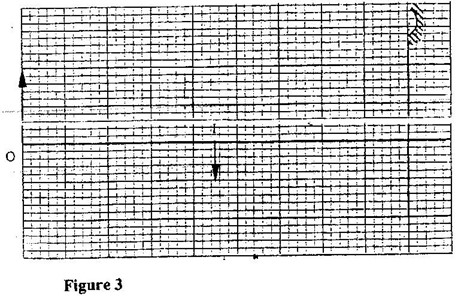
4. Figure 3 shows the levels of two liquids A and B after some air has been sucked out of the tubes through the tap. Use this information and the figure to answer questions 4 and 5.
State the reason for the rise in the levels of the liquids when air is sucked from the tubes.
5. Given that the density of liquid B is 1200 kg/m3, determine the density of liquid A. (3 marks)
6. Figure 4 shows two identical balloons A and B. The balloons were filled with equal amounts of the same type of gas. The balloons are suspended at distances X1 and X2 from a metal cube filled with boiling water and placed on an insulating material. Use this information to answer questions 6 and 7.
State the mode by which heat travels from the cube to the balloons. (1 mark)
7. The face of the cube towards A is bright and shiny and the face towards B is dull black. State with reason the adjustments that should be made on the distances X1 and X2 so that the rate of change of temperature in both balloons is the same. (2 marks)
8. Figure 5 shows a uniform bar of length 1.0 m pivoted near one end. The bar is kept in equilibrium by a spring balance as shown.
Given that the reading of the spring balance is 0.6 N, determine the weight of the bar. (3 marks)
9. The graph shows the velocity of a car in the first 8 seconds as it accelerates from rest along a straight line. Use the graph to answer questions 9 and 10.

Determine the distance traveled 3.0 seconds after the start.
10. Determine the acceleration of the car at 4.0 seconds. (2 marks)
11. State two factors that affect the melting point of ice. (2 marks)
12. The graph in figure 7 shows the relationship between the pressure and temperature for an ideal gas. Use the information in the figure to answer questions 12 and 13.

State the unit of the horizontal axis. (1 mark)
13. Write a statement of the gas law represented by the relationship. (1 mark)

Explain why the bar tilts towards side A when equal amounts of heat are supplied to each beaker. (2 marks)
SECTION B (55 MARKS)
Answer all questions in this section in the spaces provided
15. Brownian motion of smoke particles can be studied by using the apparatus shown in figure 9. To observe the motion, some smoke is enclosed in the smoke cell and then observed through the microscope.
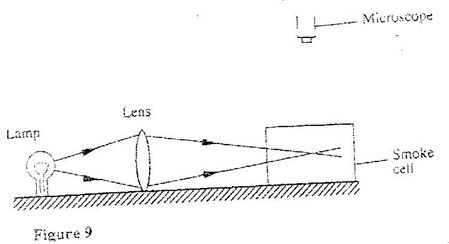
(a) Explain the role of the smoke particle, lens, and microscope in the experiment.
Smoke particles
Lens
(b) State and explain the nature of the observed motion of the smoke particles. (3 marks)
(c) State what will be observed about the motion of the smoke particles if the temperature surrounding the smoke cell is raised slightly. (1 mark)
(b) A wooden block resting on a horizontal bench is given an initial velocity, u, so that it slides on the bench surface for a distance d before coming to a stop. The values of d were measured and recorded for various values of initial velocity. Figure 10 shows the graph of u2 against d.
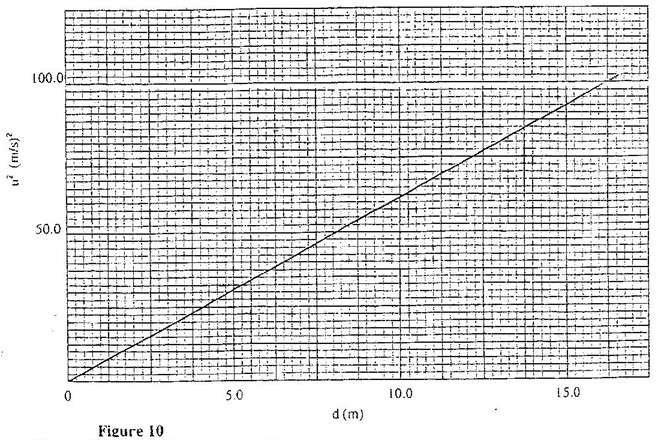
(i) Determine the slope, S, of the graph. (3 marks)
(ii) Given that u2 = 20 kd, where k is a constant for the bench surface, determine the value of k from the graph. (2 marks)
(iii) State how the value of k would be affected by a change in the roughness of the bench surface. (1 mark)
(c) A car of mass 800 kg starts from rest and accelerates at 1.2 m/s2. Determine its momentum after it has moved 400 m from the starting point. (4 marks)

(b) Figure 11 shows the features of a domestic refrigerator. A volatile liquid circulates through the capillary tubes under the action of the compression pump.
(i) State the reason for using a volatile liquid. (1 mark)
(ii) Explain how the volatile liquid is made to vaporize in the cooling compartment and to condense in the cooling fins. (2 marks)
(iii) Explain how cooling takes place in the refrigerator. (3 marks)
(iv) What is the purpose of the double wall? (1 mark)
(c) Steam of mass 3.0 g at 100°C is passed into water of mass 400 g at 10°C. The final temperature of the mixture is T. The container absorbs negligible heat. (Specific latent heat of vaporization of steam = 2260 kJ/kg, specific heat capacity of water = 4200 J/kg·K)
(i) Derive an expression for the heat lost by the steam as it condenses to water at temperature T. (3 marks)
(ii) Derive an expression for the heat gained by water. (2 marks)
(iii) Determine the value of T. (2 marks)
centripetal acceleration
(b) Figure 12 shows masses A, B, and C placed at different points on a rotating table. The angular velocity, ω, of the table can be varied.

(i) State two factors that determine whether a particular mass slides off the table or not. (2 marks)
(ii) It is found that the masses slide off at angular velocities ωA, ωB, and ωC respectively. Arrange the values of ωA, ωB, ωC in decreasing order.
(c) A block of mass 200 g is placed on a frictionless rotating table while fixed to the centre of the table by a thin thread. The distance from the centre of the table to the block is 15 cm. If the maximum tension the thread can withstand is 5.6 N, determine the maximum angular velocity the table can attain before the thread cuts. (4 marks)
19. (a) State the law of floating. (1 mark)

(b) Figure 13 shows a simple hydrometer.
(i) State the purpose of the lead shots in the glass bulb. (1 mark)
(ii) How would the hydrometer be made more sensitive? (1 mark)
(iii) Describe how the hydrometer is calibrated to measure relative density.

(c) Figure 14 shows a cork floating on water and held to the bottom of the beaker by a thin thread.
(i) Name the forces acting on the cork. (3 marks)
(ii) Describe how each of the forces mentioned in (i) above changes when water is added into the beaker until it fills up. (3 marks)


