


SIGNIFICANCE OF OCEANS TO HUMAN LIFE
Positive significance
- Manufacture of drugs and other chemicals from marine organisms. Marine organisms contain many biologically active compounds that are potentially useful for medical purposes.
- Energy: Electricity is generated by using the tidal range. The rising and falling of water can be used to generate electricity. For example, at St. Malo in northwest France, the electrical energy is known as tidal power.
- Parts of the sea can be reclaimed into new land to accommodate more population and provide room for agricultural and industrial expansion.
- Many resources are extracted from seawater. Seawater supplies several materials such as fresh water, salts, bromine, and magnesium when water evaporates. For example, north of Malindi, Kenya.
- Extraction of petroleum and natural gases. These have been formed by decomposition of plant materials, primarily marine plants, hence formed by submerged deposits.
- Oceans are the source of fish everywhere in the world.
- Allow the sailing of large vessels and ships. It serves as an important route connecting widely separated parts of the world.
- Used as a sewage disposal system.
- Tourism: Oceans provide sites for a variety of recreational activities including swimming, surfing, water skiing, sport fishing, and cruising. For example, tropical seas are a tourist attraction because they are warm all year round.
- Port development: Some features on submerged coasts favor the development of deep and well-sheltered natural harbors. For example, the fjord coast in Norway.
Negative significance
- Infertile soils: Some emerged coastal lands are characterized by sand, gravel, and bare rock. Such surfaces cannot support proper plant growth because they are infertile.
- Transport barriers: Deposited sands, sandbars, and coral reefs are barriers to water transport. Sometimes, ships have been wrecked after hitting some of these features.
COASTLINES
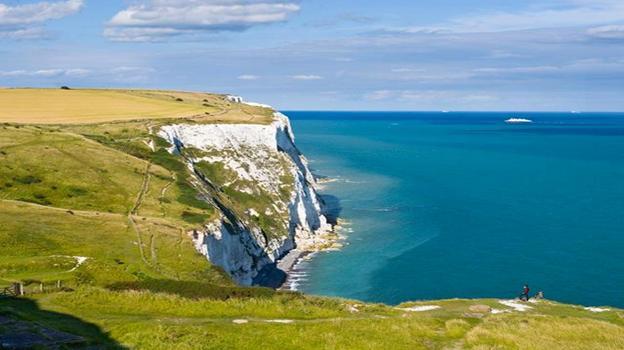
Coast refers to the part of the landmass that is situated immediately after the sea. It is separated from the sea by a shoreline. Shoreline means a piece of land that lies between high tide and low tide levels.
COAST EVOLUTION
Coast evolution means the structural change in the appearance of the coastline. Usually, the structural appearance of coasts varies from place to place or time to time. For example, the structural appearance of Dar es Salaam coast differs from Bagamoyo. The structural appearance of Dar es Salaam coast currently is not the same as it was many years ago. Hence, the phenomenon of the coast changing in its structural appearance place to place or time to time is geographically described as coast evolution.
The evolution of a coastline is brought by one or a combination of two or more of the following factors:
- Wave action
Wave has a considerable impact on coastline structural change through the activities of erosion and deposition. Wave erosion may cause a coastline to have features of marine erosion such as cliffs, notches, stacks, bays, and others. Wave deposition may cause a coastline to develop features of marine deposition such as beaches, barrier beaches, spits, tombolos, and others. - Tectonic forces
Tectonic activities have changed and may continue to change the form and appearance of coastlines through uplifting and sinking relative to sea level. Uplift of a coastline produces emerged coastline. Downwarping produces submerged coastline. - The nature of rocks along the coast
A coastline may change partly because of the nature of rocks along it. For instance, a coastline with alternating rocks of hardness, one subjected to erosion, may change into an indented coastline compared to a coastline of uniform rock hardness. Where the coastal rocks are resistant to erosion, a highland coast is formed with cliffs. - Man activities
Human activities such as land reclamation, harbor construction, and canal construction change the natural appearance of coastlines. For example, land reclamation in the Netherlands has changed the form of appearance of coasts along the North Sea. - Volcanic activities
Eruptions of volcanoes have caused some coasts to change in physical appearance as landforms related to geological phenomena form along the coasts. - Glaciations
Glaciations affect the occurrence of glaciers along the coast, leading to coast evolution in two ways. Firstly, the melting of ice has caused the rise of general sea level, submerging parts of coasts and forming submerged coasts. Secondly, glacier activities of erosion and deposition result in physical features related to glacier erosion and deposition. - Organisms
Marine organisms like coral polyps have caused coasts to change in physical appearance as coral reefs develop along them.
CLASSIFICATION OF COASTS
Coasts are extremely varied due to several determinant factors such as marine action, organisms, earth’s movements, and others. Earth scientists have classified coasts according to their varied considerations. The most striking criteria used to classify coasts include the following:
- Change in sea level (devoted by Johnson 1919)
Neither the level of the land nor the level of the sea remains unchanged. One of these changes produces either submerged or emerged coastlines. Accordingly, coasts are classified into the following forms:Submerged coasts Emerged coasts Neutral coasts Compound coasts
Submerged coasts
These are coastlines whose lower parts are immersed in water due to the rise of the sea level.
Submerged coasts are subdivided into two types:
- Submerged lowland coast
- Submerged highland coast
Lowland submerged coasts form following the flooding of lowland coasts as the sea level rises. Highland coasts are produced after the flooding of highland coastlines due to the rise in sea level.
Emerged coasts
These are coastlines produced after the fall of the sea level and rise of the coastal land. These are also classified into lowland and highland emerged coastlines. Lowland emerged coasts are produced after the lower parts of highland coasts become out of water as sea level falls, while highland coasts are produced after the lower parts of highland coasts become out of water as sea level changes.
Compound coasts
Those with a mixture of at least two or more features of submerged and emerged coasts, i.e., the coastline is observed to have characteristics of both emerged and submerged coastlines.
- According to the structural appearance relative to other coastal features
With respect to this consideration, coastlines are broadly classified into the following types:Discordant coastline Concordant coastline
Discordant coastline
This is a coastline that extends across the trend of mountain ranges and valleys. Usually, the coastline is irregular with many inlets. Discordant coastline has alternative terms of transverse and Atlantic. The latter is because a high proportion of this type of coast is around the Atlantic Ocean.
Concordant coastline
This is a coastline that lies roughly parallel to the mountain ranges and valleys. When such a coast is submerged, it produces the Dalmatian coast. A concordant coast is very common in areas around the Pacific Ocean and is alternatively known as Pacific coasts.
- According to the relationship between coast and other processes of erosion and deposition
This was devoted by Sheppard in 1963. According to this approach, two types of coasts are given:Primary coasts
Coasts where the influence of the sea has been minimal. These coasts are characterized by the presence of features not formed by marine action.Secondary coasts
Coasts where marine processes have been dominant. These coasts are characterized by the presence of depositional and erosion marine features.
- Advancing and retreating coasts (Valentine 1952)
It assumes that a coast can be fitted into two forms:- Advancing coasts
Coastlines whose level rises as a result of marine deposition or uplift of the land. - Retreating coasts
Coastlines that appear to diminish because of marine erosion or submergence of the coastal land.
- Advancing coasts
1.5 CORAL COAST
A coral coast is made up of the skeleton of small marine organisms known as coral polyps, consisting of limestone rocks resulting from the skeletons of marine organisms.
It is a limestone rock which accumulates from the sea to the land.
Coral polyps
Coral polyps are living organisms found in the marine environment and live in sheath-like sacs composed of calcium carbonate (CaCO3) which they extract from ocean water.
Coral
Coral is the limestone rock made up of the skeleton of very small marine organisms called coral polyps.
Characteristics coral polyps thrive under these conditions:
- Found in sea temperatures around 21°C to 30°C.
- Sediment-free salty water.
- Found in lower tides. Sunlight penetrates to a depth of at least 50m.
- Enough supply of oxygen and food (plankton).
- Coral features normally develop at latitudes of 30°N and 30°S because of warm ocean currents.
TYPES OF CORAL REEFS
Coral reefs have various structures and are broadly categorized into three types:
- Fringing
- Barrier
- Atoll
i. FRINGING REEF (Connected to coast)
This consists of a platform of coral connected to and built out from a coast. The platform surface is usually flat or concave and its outer edge slopes steeply to the sea floor.
The lagoon is shallow, separating the coast and edge of the fringing reef. For example, fringing reefs along the coasts of Kenya and Tanzania.



ii. BARRIER REEF
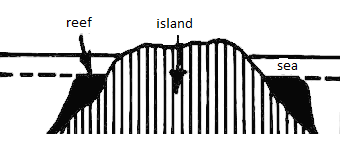
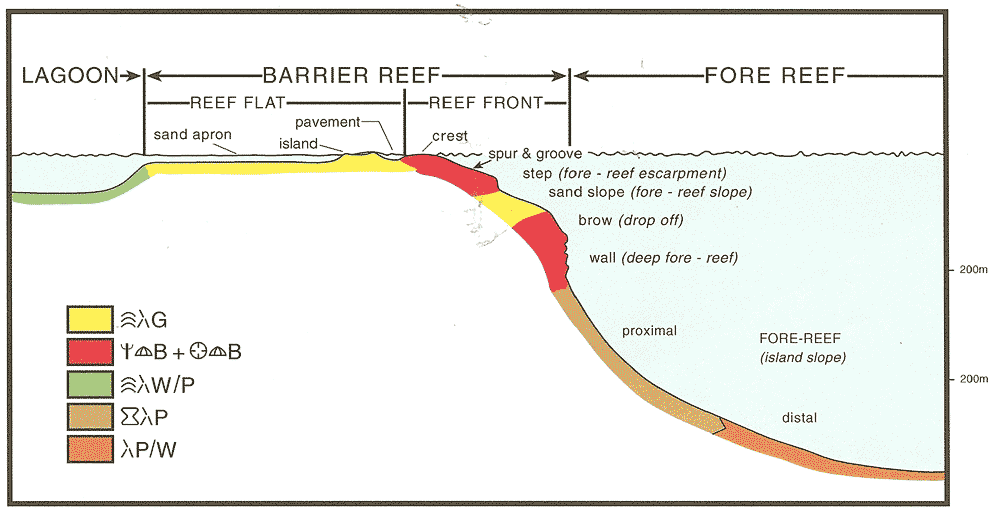
Similar to the fringing reef except that it is located several kilometers from the shore and is separated from it by a deep-water lagoon. The coral of a barrier reef is often joined to the shore, although the lagoon may be too deep for coral to grow on its bed.

iii. ATOLL
A circular coral reef usually broken in several places, surrounding a shallow lagoon. For example, Aldabra Atoll that lies between Zanzibar and Madagascar.
- It is concave shaped (atoll formed in deep sea).

Importance of Coral Reefs (Value)
- Provide habitat for fish species and protection.
- Used as raw materials in manufacturing cement in the cement industries (limestone).
- Attract tourists and lead to the earning of foreign currency.
- Used as decorations in different buildings, e.g., marble. Some well-shaped pieces of coral rock are usually stuck on the walls of buildings with cement.
- Lead to the formation of islands which can be used by humans for different purposes like settlement or recreation.
- Protect the coast against strong waves, which can cause coastal land degradation and destruction of property.
- Source of income since some people collect coral stone and sell them.
Problems posed by coral reefs in the world
- They are great barriers to navigation.
- Pieces of coral rock that break during coral quarrying, especially by using dynamite, and the solution of coral rocks due to the presence of acidic material lead to water pollution.
- Coral reefs can block the waves and lead to the failure in the formation of attractive beaches.
- Coral masses discourage the growth of plants (seaweed) that tends to pollute, discourage fishing, swimming, and navigation.
CORAL REEFS FORMATION THEORIES
The classification of coral reef theories is divided into two major groups:
- Those theories which require a change of sea level relative to reef foundation.
- Those theories that hold that coral reefs may develop without a change in sea level relative to the reef foundation.
Under the 1st group:
1. DARWIN’S THEORY
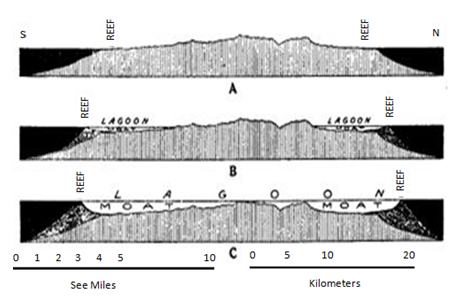
Of sinking land area and consequent rising sea level. Under those conditions, coral growth starts upward and outward, converting fringing reefs into barrier reefs and finally atolls.
These depend on the subsidence of land masses. As an island subsides, the coral reef grows upward and outward keeping pace with the subsidence.

2. DALY’S THEORY
The glacial control theory developed by Daly postulates a rising sea level due to the return of water to the sea following periods of glaciations.
This is based on the changing level of the sea after the last ice age.
Under the 2nd group:
MURRAY’S THEORY
The formation of the barrier reef doesn’t involve subsidence. He argues that coral reefs might have grown as a result of deposition of coral debris on the seaward sides of the fringing reef. The deposited materials eventually form a base for further growth of polyps.
The material deposited on the main hills or plateaus reduces the depth of the oceans, thus making them sunlit and consequently the condition becomes conducive for polyps habitation. As these polyps die, they lead to the growth of coral reefs.
GLOBAL DISTRIBUTION OF CORAL REEFS
As discussed, coral reefs are abundant on the eastern sides of major land masses in the latitudes positioned between 10° and 30° North and South where sea temperatures are reasonably high due to warm ocean currents flowing near the coasts.
Specific areas with coral reefs include:
- Along the edges of continents, e.g., along the edge of Australia where there is the greatest Barrier Reef in the world.
- Around island shores in the Pacific Ocean, e.g., New Guinea and Caledonia.
- Around the shores of volcanic peaks especially in central and western Pacific, e.g., Fiji and Samoa islands.
- In the Atlantic Ocean in the West Indian Archipelago where there is a group of islands.
- Around some islands in the Indian Ocean, e.g., Mauritius and Seychelles.
Significance of coral reefs to human beings (constructive significance)
- They are used as raw materials to manufacture cement.
- Used for building decorations.
- They provide attractive sceneries and thus form the basis for tourism.
- Provide good breeding stations for fish.
- They have resulted in the formation of beautiful islands used for recreational purposes.
- They protect the coasts against erosion by marine waves.
Destructive significance
- Coral platforms encourage the growth of weeds which have many setbacks.
- Coral reefs impose barriers to navigation.
- Contribute to coastal zone degradation because of exploitation.
- They impose difficulties in fishing activities.
1.6 WATER USES AND MANAGEMENT
1) WATER USES
Water use is understood as the utilization of water resources to meet various needs. Water is our most precious resource. Water is vital to life. Humans, plants, and animals are made up mostly of water. All living things would die in the absence of water.
There are many ways that we use our water, including:
- Water is used domestically for drinking, washing clothes, cleaning, bathing, cooking, and other domestic uses. It is estimated that 8% of worldwide water use is for household purposes.
- Power generation: Water is used to generate power which is supplied to industries, commercial areas, and residential areas. About 20% of all electricity in the world is generated by hydroelectric power (H.E.P.).
- Water is used in manufacturing industries to wash raw materials and cool industrial machines. Moreover, water is heated and steam is used to run machines. In other industries, water is used to cool metals. It is estimated that 22% of worldwide water use is for industrial purposes.
- Water of larger bodies is used to serve communication. They are important routes to transport people and goods from one area to another. Many people use boats and ferries to commute daily. People also enjoy going on cruise ships or sailing.
- Water is also used outdoors for washing cars, watering lawns, and filling swimming pools.
- Every town and city, whether small or big, uses water for firefighting, street cleaning, and watering public areas such as parks, grass, shrubs, and flowers.
- Recreation is another way that we use and enjoy water. Many people enjoy fishing, boating, sailing, canoeing, rafting, and swimming, as well as many other recreational activities that depend on water. However, recreational water use is usually a very small but growing percentage of total water use.
Generally, as already described, water is a vital resource to human life as well as the general ecological system. Thus, there is a need for water to be properly conserved and managed.
2. WATER MANAGEMENT
Population growth together with changes in lifestyle and economic development in many countries has heightened the pressure on water resources that are already limited. Moreover, environmental problems, especially climate change, add to those pressures. Furthermore, poor water management can be a source of conflict. Therefore, water being an essential resource for all life on Earth, there is a need to ensure that water resources are used equitably by making proper plans on how water can be retained and distributed to meet the numerous demands by people. This is understood as water management.
Water management is the activity of planning, developing, distributing, and managing the optimum use of water resources. In an ideal world, water management planning has regard to all the competing demands for water and seeks to allocate water on an equitable basis to satisfy all uses and demands. In water management, much effort is put on optimizing the use of water and minimizing the environmental impact of water use on the natural environment.
IMPORTANCE OF WATER MANAGEMENT
- Water management ensures the supply of water to all people demanding it, balancing the needs of industry and the environment.
- It facilitates storage and monitoring of the amount of water.
- It ensures water quality and sanitation.
- Ensures sustainable and fair access to clean water suitable for all purposes, meeting the basic needs of the most disadvantaged populations.
- Ensures fair and appropriate distribution of water between users of different kinds.
- Solves the problem of water use conflict.
- Prevents wastage and pollution of water.
- Protects wetland areas.
- Protects and conserves water resource areas.
METHODS OF WATER MANAGEMENT
There are about four methods for water resources management. They include:
- Conservation
- Allocation of water charges
- Retrofit water conservation
- Behavioral practices
1. Conservation
Water can be conserved by harvesting rainwater, groundwater recharge, and recycling wastewater.
- Rainwater harvesting involves the collection of water from surfaces which directly receive rainfall. The water harvested is stored in tanks or diverted to artificial recharge systems.
- Groundwater recharge is achieved by allowing percolation of water into the ground, which is facilitated by planting trees and constructing lakes.
- Recycling of wastewater involves treating wastewater with chemicals to make it clean and safe for reuse.
2. Allocation of water charges
This method involves two systems:
(i) Ratio utility billing system
Under this system, water costs in residential areas like apartments are distributed according to each resident based on allocation formulas such as number of occupants, square footage, number of water fixtures, number of bathrooms, size of apartment (2bhk, 3bhk), or a fixed amount per apartment. However, the system has a significant disadvantage as residents or consumers won’t understand the true cost or unit of water consumed by their family members.
(ii) Sub-metering
A typical sub-metering system consists of a meter to measure usage of a specific utility for each unit and a wireless system to transmit the data to a central computer to allow for remote reading. This system enables residents or owners to pay for the water they use rather than paying a fixed amount. For effective water management, this system is recommended as it automatically encourages people to conserve water.
3. Retrofit water conservation
Retrofitting involves the replacement of existing plumbing equipment with equipment that uses less water.
4. Behavioral practices
Behavioral practices involve modifying water use habits to achieve more efficient use of water, thus reducing overall water consumption. Changes in water use behavior can be implemented without modifying existing equipment. Behavioral practices include water conservation measures such as replacing or repairing leaky faucets and awareness activities to promote sustainable management of water resources.
Implementation approach to water management
Five activities have been identified and are required to achieve integrated management of water resources. They include:
- Awareness and participation: Users must be aware of the importance of water as a resource and their responsibilities in relation to sound management of this precious resource.
- Institution capacity building: The success of activities depends largely on the capacity, resources, and expertise of the institutions concerned. Support must be provided for the institutions responsible for water management. The main institutions for water management include urban or municipal water authorities and river basin project institutions.
- Demand-based management: It is not enough to manage only water distribution; supply must also be managed. The challenge is to reduce demand while increasing output through initiatives such as reuse of water and protecting water resources.
- Expanding the knowledge base: The necessary knowledge and information are essential for drawing up effective policies.
- Coordination among donors must be strengthened.
WATER RESOURCES AND MANAGEMENT IN TANZANIA
Tanzania has a growing demand for water sources. Access to safe water is essential for addressing poverty and health problems. The poor, most of whom live in rural areas, have limited access to clean water for domestic use and crop production and adequate sanitation. Moreover, one third of Tanzania receives less than 800 mm of rainfall and is embraced by semi-arid areas. Only one third of the rest of the country has precipitation above 1,000 mm. Also, the long dry season, normally extending from June to October, affects low river flows and drying of water reservoirs.
In response to such prevalence, there is a need for the water resources available in the country to be well managed to assure water supply to people for their varied needs.
Water resources available
Tanzania has both surface and groundwater sources. Surface water sources include lakes, rivers, ponds, wetlands, reservoirs, and others.
1. Lakes
The country has a number of freshwater lakes, including Victoria, Tanganyika, Nyasa, Rukwa, Natron, Eyasi, and Manyara.
2. Rivers
Tanzania also has a number of rivers which drain into oceans and lakes. They include Pangani, Wami, Mkondoa, Ruvu, Rufiji, Ruaha, Kilombero, Mbarangandu, Matandu, Mbwamkulu, Lukuledi, and Ruvuma, all of which drain into the Indian Ocean. Others include Malagarasi draining into Lake Tanganyika; Songwe and Ruhuhu draining into Lake Rukwa; and Meru, Maru, and Kagera draining into Lake Victoria.
3. Wetlands
Tanzania has 5,439,000 ha of lakes and swamps, representing 5.8 percent of the total land surface, but this number excludes seasonally inundated flood plains. Examples include Rufiji, Ihefu, and Jangwani in Dar es Salaam.
4. Groundwater Resources
Groundwater is a major source of water for many areas in Tanzania and is the most viable alternative supplement in the central and northern parts of the country—the drier regions of Dodoma, Singida, Shinyanga, Tabora, Mwanza, Mara, Arusha coast, and Southern Kilimanjaro.
Most of the water resources in Tanzania are managed by water projects.
RIVER BASIN DEVELOPMENT PROJECTS IN TANZANIA
River development projects are schemes developed for different purposes. They are established to meet a number of goals such as flood control, water supply for domestic consumption, industries, and irrigation schemes.
River basin projects are implemented by doing the following:
- Construction of dams for retaining water.
- Dredging of rivers, i.e., removal of silts or mud from the river.
- Clearing of vegetation where economic activities are taking place.
- Planting of trees on the sides of rivers to prevent erosion and control the speed of water flow.
- Straightening and widening of river widths so that they can hold more water.
- Establishment of canals and installation of pipes to distribute water.
1. KILOMBERO IRRIGATION SCHEME
Kilombero irrigation scheme is located along the Kilombero River in southern Tanzania, which is a tributary of the Rufiji River. The scheme has large plantations of sugarcane covering about 2,800 hectares. Under the scheme, other crops such as maize, rice, beans, and vegetables are grown.
Objectives of the scheme
- To improve crop production of sugarcane as the chief crop and other crops such as maize, rice, beans, and vegetables.
- To open up remote and potential lands for crop production.
- To control the floods of the Kilombero River.
Implementation of the scheme
- Establishment of sugarcane estates.
- Establishment of sugarcane factories at Msolwa and Ruembe.
- Small-scale farmers were allowed into the area to cultivate sugarcane and other crops.
- Establishment of roads to enhance crop production.
- Supply of electricity to the factories and to the site machines which pump water to plantations.
- Establishment of the sugarcane production company to manage overall operations.
- Construction of dams for retaining water to be used all year round.
- Training of local people on economic activities like fishing, timber production, and wildlife conservation.
Achievements of the scheme
- Increased production of sugarcane compared to previous times.
- Development of towns like Makambako, Mikumi, and Kidatu which provide services to people working in the scheme.
- To some extent, the scheme managed to control the floods of the river as much of the water is used to irrigate farms.
- Stimulated development of physical infrastructure like roads and the TAZARA railway.
- Opened up remote areas like Ifakara and Msolwa.
Challenges against the scheme
- Problems of drought in some years, creating low water supply to the scheme.
- Transportation problems since roads and bridges have not been well constructed.
- Poor labor supply due to high rates of rural to urban migration.
- Prevalence of diseases, mostly malaria, which affect farmers.
2. THE RUFIJI RIVER BASIN DEVELOPMENT (RUBADA)
Rufiji basin is one of the most potential areas in Tanzania. It has the Rufiji River which steadily flows throughout the year. It has attractive features such as waterfalls, meanders, alluvial fans, delta, and oxbow lakes. The valley of the river is very fertile for cultivation of crops. It has diverse flora and fauna. Due to its potential, efforts are taken to develop the river basin. To meet this, the River Basin Development Association of RUBADA has been established.
Activities taking place in the basin
- Generation of hydroelectricity at Kihansi.
- Fishing activities by local people.
- Cultivation of crops such as sugarcane, paddy, maize, and vegetables.
- Tourism in the Selous Game Reserve.
- Hunting of wild animals by local people.
- Lumbering by local people.
NOTE
Even though a special organization has been established to develop the basin, the Rufiji basin is not well developed due to the following problems:
- Frequent floods which affect crops and people’s properties.
- Poor market by local people. Many inhabitants are low-income earners and thus do not provide steady markets for goods produced.
- Remoteness of the river. For instance, the river is not utilized to supply water to the big city of Dar es Salaam due to its remote location.
- Poor capital outlay to be invested in the basin.
- Poor labor supply due to high rates of rural to urban migration.
- Low level of technology.
3. KAGERA RIVER BASIN PROJECT
The project was established in 1977 by three countries: Tanzania, Burundi, and Rwanda. Uganda joined later in 1981. The project was established with the fundamental objective of establishing a hydroelectric power station at Rusumo Falls.
Achievements of the project
- Production of hydroelectricity for member countries and neighboring countries.
- Provided employment to people in the four countries.
- Development of transport infrastructure in the region.
- Development of the tourist industry.
Problems incurred in the implementation of the project
- Low level of technology in the region.
- Low capital outlay to finance the project effectively.
- Land alienation to give room for the expansion of the project.
- Political conflicts in Rwanda, Burundi, and Uganda.
- Researches and preliminary plans are taking too long.
WATER POLLUTION
Water pollution is the contamination of water bodies such as lakes, rivers, oceans, and groundwater. It is an environmental pollution problem where a water body is contaminated with hazardous solid, liquid, and gaseous materials which affect its natural setting. A body of water is adversely affected due to the addition of large amounts of materials. In other words, water pollution is considered when the body of water is unfit for its intended use.
Water pollution is among the serious environmental problems and is especially serious in developing countries. It affects organisms that live in water bodies.
Water pollution occurs when pollutants are discharged directly or indirectly into water bodies without adequate treatment to remove harmful constituents.
Water pollution may occur naturally or culturally. Naturally, it occurs by materials such as dust added to water through natural processes of wind erosion and deposition. Culturally, it occurs due to households, industries, mining, and others.
The materials which make water adversely affected are known as water pollutants.
Types of water pollution
Water pollution is of two forms: surface and groundwater pollution.
Surface water pollution occurs when water contained over the earth’s surface, such as lakes and rivers, is contaminated with pollutants.
Groundwater pollution occurs when water contained in the ground is contaminated with harmful materials brought down by the process of leaching.
Sources of water pollution
Water pollution occurs culturally and naturally as harmful materials are discharged into water bodies by the following sources:
1. Agricultural activities
Agrochemicals such as fertilizers, insecticides, herbicides, and others are washed away in solution into water bodies by runoff. These agrochemicals also cause groundwater pollution through leaching.
2. Household sewage
Residential areas produce a lot of sewage that mostly causes water pollution. The sewage contains feces, urine, and laundry wastes, all of which contain organisms that live in water bodies.
3. Dumping of litter
If litter derived from various sources is dumped into seas, lakes, and rivers, it causes water pollution. The litter takes a long time to degrade, including:
- Cardboard: 2 weeks to degrade
- Newspapers: 6 weeks to degrade
- Foam: 50 years to degrade
- Aluminum: 200 years to degrade
- Plastic packaging: 400 years to degrade
- Glass: Takes a long time to degrade, exact time unknown
4. Industries
Industries are a huge source of water pollution. They produce pollutants that are extremely harmful to people and the environment and cause pollution when discharged into water bodies without adequate treatment. Common pollutants include asbestos, lead, mercury, nitrates, phosphate, sulfur, oils, petrochemicals, and others.
5. Commercial activities
Commercial activities, particularly in town centers, produce a lot of solid and liquid wastes. Most of these wastes are discharged into large water bodies and cause pollution.
6. Mining activities
Water used to wash minerals is usually discharged into water bodies. For example, the Kiwira River (Mbeya, Tanzania) is seriously polluted with liquid waste from Kiwira coal mines.
7. Oil spill
Oceans, lakes, and rivers are polluted with oil spills daily from motor vehicles, routine shipping, runoffs, dumping, underground oil storage leakages, and others. Oils cannot dissolve in water and thus form a thick layer on the water. This suffocates fish and other aquatic life.
8. Occurrence of acid rains
In the atmosphere, water droplets mix with pollutant gases such as sulfur dioxide, carbon dioxide, and nitrogen dioxide to form acid rains. When these fall on the surface of water bodies, they cause pollution.
9. Global warming
This causes an increase in water temperature, which can result in the death of many aquatic organisms.
10. Radioactive elements
These are nuclear wastes produced from industries, medical, and scientific processes that use radioactive materials. These materials have detrimental effects on marine habitats.
EFFECTS OF WATER POLLUTION
Water pollution has great impacts on people and the environment in general in a number of ways:
- Water pollution affects human health
Some health effects are recognized immediately, while others take time to be recognized, sometimes months or years. People suffer from waterborne diseases as parasites and other disease-causing organisms are transmitted via contaminated water. Common diseases include typhoid, intestinal parasites, amoebas, cholera, poor blood circulation, vomiting, diarrhea, nervous system damage, heart and kidney injury, skin irritation, and tooth decay. - Water pollution affects aquatic ecosystems
Pollution caused by acid rains, oils, and other sources greatly harms life in water bodies. It adversely affects animals and plants to the extent that some perish completely. - Water pollution affects the food chain
Toxins contained in water travel to animals, mostly fish, then to humans who eat the meat. The first international scare related to toxic chemicals in water occurred in the 1950s when a large number of people in Minamata Bay, Japan, contracted an unusual disease. Research revealed that they were suffering from mercury poisoning as a result of wastes discharged into waterways and ingested by fish that were eventually consumed by humans.
CONTROL OF WATER POLLUTION
Water pollution problems can be controlled by the following measures:
- Sewage and other wastes should be treated before being discharged into water bodies.
- People should be educated to be aware of the bad effects of water pollution and how to control it.
- Establishment of water control ordinances.

3 Comments