5.12 ENVIRONMENTAL ISSUES AND CONSERVATION
The world is rife with various environmental problems that pose significant challenges to both developed and developing countries. These problems are complex and have necessitated profound discussions to find ways to solve, reduce, or cope with them. Examples include environmental pollution, land degradation, and hazards like floods, drought, and famine. The severity of these problems has increased due to rapid technological advancements, population explosion, increased poverty leading to poor resource management, political instabilities, and more.
Environmental Pollution
Environmental pollution is the introduction or addition of any harmful or unnecessary substance or situation to the environment. Such a substance is called a pollutant. It is usually present in the wrong place, amount, or time.
Pollutants can be gaseous, liquid, or solid.
Pollution can be positive or negative. Positive pollution occurs when pollutants are introduced, causing problems for humans, animals, and plants. Negative pollution happens when something valuable is removed, creating problems; for example, removal of the upper soil layer by erosion, depletion of vegetation, or nutrient loss by leaching.
Factors Leading to Increased Environmental Pollution
- Rapid global population growth, especially in third world countries, increases waste production and complicates waste management.
- High poverty levels in developing countries lead to the use of cheap energy sources like charcoal and firewood, causing air pollution.
- Technological advances have led to industries emitting large amounts of gases and wastes.
- Development of transport networks has increased the number of cars emitting fumes and smoke.
- Political conflicts cause migration and environmental pollution, including the use of weapons like nuclear bombs.
Classification of Environmental Pollution
Environmental pollution is classified into air pollution, soil pollution, water pollution, and noise pollution.
Air Pollution
Air is essential for life, consisting mainly of nitrogen, oxygen, carbon dioxide, and other gases. Air pollution is a serious global problem because its effects spread over large areas, affecting all living organisms. It refers to the introduction of harmful substances into the atmosphere.
Urban areas experience more pollution due to industries emitting smoke and gases, high population density raising dust, and use of charcoal producing carbon monoxide. Rural areas face pollution from burning firewood, bush burning, cultivation, and mining activities that introduce dust and gases.
Causes of Air Pollution
Natural Causes:
- Volcanic eruptions emit dust, ashes, and gases like sulfur and carbon dioxide.
- Winds raise dust and pollen, some containing toxic chemicals harmful to flora and fauna.
- Temperature inversion traps air impurities near the ground, increasing pollution concentration.
Human Causes:
- Industrial activities emit fumes and gases.
- Automobiles emit fumes due to fuel combustion.
- Use of charcoal, coal, firewood, and fuel oil releases soot, fumes, and gases.
- Construction projects introduce dust into the air.
- Agricultural activities pollute air through:
- Digging soil that raises dust.
- Spraying insecticides.
- Decomposition of agricultural remains emitting methane.
- Mining introduces dust and gases.
- Lack of strict air pollution control policies contributes to the problem.
Effects of Air Pollution
- Reduction of solar energy reaching plants, affecting photosynthesis.
- Smoke and dust block stomata, disrupting plant transpiration.
- Global warming from trapped heat causes storms, droughts, sea-level rise, and plant death.
- Poisonous gases kill plants and animals.
- Ozone layer depletion allows harmful ultraviolet rays to cause skin diseases.
- Reduced air clarity due to smog and dust.
- Acid rain forms when gases mix with rainwater, leading to soil and water pollution.
- Irritating smells cause discomfort in residential areas.
- Respiratory diseases like bronchitis increase.
- Skin and eye irritation occur in humans.
- Food poisoning from contaminated crops can cause serious illnesses and death.
Measures to Reduce Air Pollution
- Plant trees to absorb carbon dioxide and reduce dust movement.
- Improve engine combustion for complete fuel burning, reducing emissions.
- Reduce small car numbers and promote mass transit systems.
- Use alternative energy sources like solar, tidal, and geothermal power.
- Enact strict resource management policies.
- Discourage aerosol use to protect the ozone layer.
- Use land-filling for waste disposal to prevent methane emissions.
Soil Pollution
Soil supports plant growth and agriculture, a major food source. Soil pollution is the introduction of harmful substances into the soil, adversely affecting plants, animals, and soil quality. Unlike air pollution, soil pollution is usually localized.
Sources of Soil Pollution
Sources include atmosphere, industries, homesteads, mining, and agriculture.
- Atmosphere: Acid rain and wind introduce pollutants that destroy soil structure and nutrients.
- Industries: Chemicals, radioactive materials, and metals contaminate soil.
- Homesteads: Dumped wastes like bottles, plastics, and cans pollute soil.
- Farms: Pesticides, crop remains, and fertilizers cause pollution.
- Irrigation leads to salinization, increasing soil alkalinity and harming plants.
- Agricultural activities cause soil erosion by depleting vegetation.
- Mining introduces rock fragments, lead, mercury, and explosives into soil.
Effects of Soil Pollution
- Kills plants and animals, disrupting decomposition processes.
- Reduces soil fertility, leading to poor crop production and famine.
- Causes waterlogging due to poor drainage.
- Increases costs for soil treatment like liming and flushing.
- Changes soil structure and color, complicating land use classification.
- Causes migration of people from affected areas.
- Pollutes water through surface runoff.
- Leads to diseases like cancer in humans.
Measures to Curb Soil Pollution
- Reduce or stop chemical use in agriculture.
- Encourage manure use instead of industrial fertilizers.
- Recycle wastes instead of dumping.
- Promote afforestation and reforestation programs.
- Control population growth to reduce waste production.
- Educate people on sustainable practices.
- Dump radioactive materials deep underground.
- Train farmers in proper farming methods like crop rotation and organic manure use.
- Promote alternative energy sources to reduce acid rain.
- Diversify economic activities to reduce dependence on agriculture.
- Enforce strict waste dumping policies with penalties.
- Designate special dumping areas away from agriculture and water bodies.
Water Pollution
Water is essential for life and used in cooking, washing, irrigation, industry, and more. Water pollution is the introduction of harmful substances into water, negatively affecting humans, animals, and plants. Polluted water is unsafe for consumption without treatment.
Ways Water Can Be Polluted
- Disposal of untreated sewage from homes and institutions into water bodies.
- Dumping industrial wastes, both liquid and solid, into water bodies.
- Farm chemicals entering water through runoff or dumping.
- Oil spills from leaking containers or pipes.
- Use of chemicals in fishing.
- Explosives used in coastal rock breaking.
- Wind carrying dust into water bodies.
- Volcanic eruptions causing thermal pollution by raising water temperature.
Effects of Water Pollution
- Death of aquatic plants and animals due to toxins or temperature changes.
- Spread of waterborne diseases like cholera and typhoid.
- Oil spills suffocate aquatic life by blocking oxygen.
- Foul smells from decomposing organic matter cause discomfort.
- Decline in tourism due to polluted water bodies.
- Water becomes unclear due to impurities.
- Eutrophication causes excessive seaweed growth, harming fisheries.
- Loss of fish reduces protein sources for humans.
Measures to Control Water Pollution
- Promote proper fishing methods avoiding chemicals.
- Maintain and inspect oil containers and pipes to prevent spills.
- Discourage clearing and settling in catchment areas.
- Control population growth to reduce waste.
- Use skimmer ships, chalk, and sawdust to absorb oil spills.
- Reduce fertilizer and chemical use in agriculture; encourage organic farming.
- Governments and NGOs should educate and support water conservation.
- Store water in clean, covered containers.
- Discourage rock breaking with explosives; use alternatives.
- Use land-filling for waste disposal to prevent runoff pollution.
- Treat and separate wastes before disposal in water bodies.
- Recycle wastes instead of dumping; for example, feed garbage to pigs for manure production.
Noise Pollution
Noise is disorganized loud sound that can harm the body, especially eardrums and the circulatory system. While complete silence can be disturbing, excessive noise is harmful and considered environmental pollution.
Sources of Noise
Factories, workshops, low-flying aircraft, homesteads (e.g., slamming doors), heavy traffic, roadwork, thunderstorms, and explosions.
Measurement of Noise
Noise levels are measured in decibels (dB) using a sound level meter.
Effects of Noise
- Exposure to noise above 80 dB can cause permanent hearing loss or speech difficulties.
- Interferes with concentration, causing errors and disrupting learning.
- Alters blood circulation and can disrupt heart function, especially in hypertensive patients.
- Explosive noises can cause fainting or death.
- Causes conflicts among neighbors due to disturbances.
- Discourages establishment of institutions near noisy areas.
- Explosive sounds can cause structural damage to buildings.
Noise Control
Noise pollution is complex, especially in busy cities, but noise should be reduced in sensitive areas like schools and hospitals by:
- Soundproofing with materials like carpets and curtains; providing ear muffs and sound-absorbing screens in factories.
- Using quieter materials in car engines and construction.
- Applying lubricants to reduce machine friction noise.
- Avoiding unnecessary shouting and loud conversations.
- Limiting use of explosives and avoiding slamming doors.
Global Climate Changes
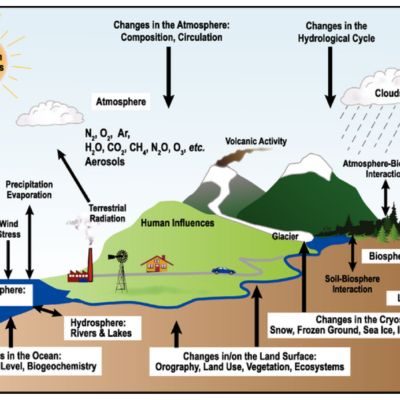
Climate change refers to significant long-term fluctuations in temperature, precipitation, wind systems, and other climate aspects. The UN defines it as changes attributed directly or indirectly to human activity altering the global atmosphere beyond natural variability. Abrupt changes are destructive due to insufficient adaptation time, while gradual changes allow adaptation.
Major climatic changes include extreme cooling (ice ages) and abnormal warming (global warming). The recent warming trend began around A.D. 1400 and has accelerated since the 1880s.
Causes of Catastrophic Climate Changes
Causes are natural and human (anthropogenic).
Natural Causes
- Chance events such as:
- Impacts of asteroids and cosmic radiation from supernovas.
- Massive volcanic eruptions emitting greenhouse gases and dust.
- Tectonic ocean spreading changing landmass locations through drifting.
- Periodic weather cycles caused by:
- Solar energy changes linked to 11-year sunspot or 22-year magnetic cycles.
- 18.6-year lunar orbital shifts affecting tides and atmospheric circulation.
- Milankovitch Cycles: periodic changes in Earth’s orbit and tilt affecting energy distribution and climate over 26,000 to 100,000-year cycles, explaining ice age glaciations.
Human (Anthropogenic) Causes
Humans exacerbate climate change through greenhouse gas emissions from fossil fuels, CFCs from air conditioners and insecticides, methane from rice cultivation and livestock, and more. The 20th century has been the warmest since A.D. 1400, with global temperatures rising about 0.5°C in the past century. Climate models predict a 1°C to 4.5°C increase by 2100 if trends continue.
Global Warming and Greenhouse Phenomena
Global warming is the unusual rise in Earth’s atmospheric temperature caused by the greenhouse effect, where gases trap heat in the lower atmosphere. Key greenhouse gases include carbon dioxide (from fossil fuel burning), methane (CH4), chlorofluorocarbons (CFCs), nitrous oxide (N2O), perfluorocarbons, and sulfur hexafluoride.
These gases trap long-wave radiation from Earth, preventing heat loss to space. The USA leads in carbon dioxide emissions. Contributions to global warming by gas type: CO2 64%, methane 19%, CFCs 11%, nitrous oxide 6%. By activity: fossil fuel burning 49%, industrial processes 24%, deforestation 14%, agriculture 13%.
Effects of Global Warming and Greenhouse Effects
- Melting of ice caps on Kilimanjaro and Antarctica.
- Sea level rise causing coastal flooding and increased wave action.
- Strong storms causing death and property damage.
- Warmer cold regions allowing tropical crops to grow.
- Disappearance of species unable to adapt to temperature rise.
- Droughts affecting food production.
- Increased precipitation in formerly dry areas.
- Mass migration of animals and humans due to floods and droughts.
- Decline in production leading to poverty and famine.
- Spread of malaria to previously malaria-free areas.
Mitigation Measures
- Discourage burning of fossil fuels and harmful materials.
- Promote environmentally friendly energy sources like geothermal, solar, and wind.
- Improve combustion efficiency to reduce emissions.
- Formulate international policies and cooperation to combat pollution.
- Control pollution to reduce fossil and biomass energy use.
- Limit large-scale rice cultivation to reduce methane emissions.
- Encourage waste recycling instead of burning or dumping.
- Promote walking and mass transit over small car use.
Desertification
Desertification is the process by which fertile land becomes desert, often due to human activities. The Sahel region south of the Sahara is a notable example. Desertification results from climatic changes and human actions like over-cultivation and over-grazing.
Desert refers to regions with low moisture and unpredictable precipitation. African countries affected include Mali, Niger, Chad, Senegal, Mauritania, and Burkina Faso. The Sahara is expanding partly due to drought cycles and human activities.
Desertification also affects eastern countries, advancing about 5 km per year in some areas.
Causes of Desertification
Poor Land Use and Mismanagement
Ignorance and low technology lead to over-cultivation and over-grazing. Deforestation for building, furniture, fuel, and other uses exposes land to erosion. For example, lumbering in Tanzania’s Miombo woodlands is severe. Wood and charcoal remain primary energy sources in many developing countries due to high costs of alternatives.
Population Pressure
Population growth causes forest clearing for cultivation, increasing erosion and land infertility. Natural drought cycles also contribute by reducing soil moisture and killing plants.
Effects of Desertification
- Decline in agriculture due to drought and poor precipitation, leading to poverty, famine, and health issues.
- Forced migration of humans and animals seeking water and food.
- Loss of tree species like Mninga, harming timber industries.
- Soil erosion destroys arable land and infrastructure.
- Water scarcity forces long-distance travel for domestic use.
- Destruction of wildlife conservation areas, reducing tourism.
- Increased storms due to atmospheric disturbances from tree loss.
- High conservation costs for planting trees, irrigation, education, and aid.
Measures to Check Desertification
- Introduce affordable alternative energy sources like solar, wind, biogas, and hydroelectric power.
- Educate locals on vegetation conservation and promote afforestation and reforestation.
- Governments should enact policies to guide forest development and control.
- Gazette conservation areas to prevent deforestation.
El Nino Phenomenon
El Nino is an abnormal ocean-atmosphere disruption in the tropical Pacific affecting global weather. It causes increased rainfall in the southern US and drought in the western Pacific. Named for its occurrence near Christmas (“little boy” or “Christ child” in Spanish), El Nino is also called ENSO (El Nino–Southern Oscillation). It has been recorded since 1597 and was first noted by Peruvian fishermen as unusually warm east Pacific waters. It is known as the “warm event.”
Characteristics of El Nino
El Nino features reversed wind systems in the west Pacific, pushing warm water eastward and weakening trade winds. It occurs every 2 to 7 years, sometimes more or less frequently. Notable events include 1972-73, 1982-83, 1997-98, and 2002-03. El Nino is often followed by La Nina, a “cold event.” The 1997-98 El Nino was particularly strong and destructive. During El Nino, water levels shift, causing significant oceanic and atmospheric changes.
Causes of El Nino / Southern Oscillation (ENSO)
The exact causes are unclear but linked to changes in atmospheric circulation called the Southern Oscillation. Several theories explain El Nino:
The first theory suggests high cirrus clouds over Indonesia absorb solar radiation, cooling the ocean surface and reversing trade winds.
The second theory involves eastward-flowing deep currents disrupting coastal upwelling off South America, eliminating temperature gradients and reversing trade winds.
The third theory links El Nino to major volcanic eruptions in the tropical Pacific, causing warming and wind reversal. Further research is ongoing.
| Eruption | Year | El Nino |
|---|---|---|
| Agung (Indonesia) Mayon (Philippines) El Chichón (Mexico) Nevado de Ruiz (Colombia) Pinatubo (Philippines) | 1963 1968 1982 1985 1991 | 1965 1968 1982-1983 1986 1992-1993 |
Note:
El Nino occurrence is not currently linked to human activities, though studies are ongoing to assess any relation to global warming.
The Occurrence of El Nino:

Effects of El Nino (ENSO)
- Heavy rains and floods in South America, such as Ecuador, causing death and property damage. East Africa, including Tanzania, experienced severe floods and famine during the 1997/98 El Nino.
- Drought in Indonesia, northeastern Brazil, and southeastern Africa, leading to agricultural decline and power shortages.
- Disruption of fishing in South America due to halted cold water upwelling, causing fish migration.
- Thunderstorms from warm Pacific waters alter jet stream patterns, causing unusual global weather, especially in winter.
- Reduced tropical storms in the Atlantic.
- Winter storms in Gulf Coast states and California causing wetter conditions.
- Disruptions in energy, recreation, manufacturing, finance, and insurance, with increased costs and claims.
La Nina
La Nina, or “the little girl,” is characterized by unusually cold ocean temperatures in the tropical Pacific, opposite to El Nino. It usually follows El Nino events. Notable years include 1987, 1988, 1995, and 2003.


Note:
During normal Pacific conditions (non-El Nino/La Nina), strong trade winds blow westward, piling warm water near Indonesia and causing cooler, nutrient-rich waters near South America, supporting fisheries. Rainfall occurs over warm waters, while the east Pacific remains relatively dry.
These abnormal conditions include global warming, drought, desertification, and excessive rain (El Nino) leading to floods.