


WILD LIFE AND TOURISM
- Plants (flora) and animals (fauna) in their natural habitats.
Factors that Influence Distribution of Wildlife in E. Africa
Climate
- Heavy rainfall results in big forests which favour animals such as elephants and buffaloes, e.g., Mt. Kenya forest.
- Arid and semi-arid climates support hardy animals which can withstand scarcity of water, e.g., hartebeest and gerenuk.
Relief
(a) Aspect
- Windward sides which receive heavy rainfall support big forests favouring animals such as elephants, while leeward sides of mountains with low rainfall favour grasslands that support carnivores, which in turn attract herbivores, e.g., Amboseli.
(b) Terrain
- Hunting animals like cheetahs are found in plains and plateaus which are relatively level, allowing them to run long distances chasing prey.
Soils
- Infertile and shallow soils favour grasslands which suit many herbivores and carnivores.
Vegetation
- Birds live where there are trees to have shelter.
- Savannah woodlands with more acacia trees favour giraffes which feed on foliage from the trees.
- Desert and semi-desert vegetation supports hardy animals such as Grant’s gazelle.
Availability of Water
- Fish are found in rivers, lakes, and oceans, e.g., Lakes Victoria, Kyoga, and the Indian Ocean.
- Some animals such as hippos and crocodiles live mainly in fresh water in rivers and lakes, e.g., River Nile and Lake Naivasha.
Human Activities
- Man hunts animals illegally, threatening some species with extinction.
- Man has displaced animals from their natural habitat by clearing vegetation for agriculture and settlement.
- Man has taken measures to conserve endangered species through establishing national parks, game reserves, and sanctuaries.
National Parks
- Areas set aside for preservation of scenery, wildlife, and historical sites, e.g., Tsavo, Mombasa Marine, Amboseli, Samburu in Kenya; Kilimanjaro, Arusha, and Serengeti in Tanzania; and Kipendo Valley and Ruwenzori in Uganda.
Characteristics
- Established by an act of parliament.
- Managed by the government.
- No other form of land use is permitted.
- May be fenced off to keep off people and prevent animals from going out.
Game Reserve
- Areas set aside for preservation of wildlife, e.g., Maasai Mara in Kenya, Selous Game Reserve in Tanzania, and Kigezi Wildlife Reserve in Uganda.
Characteristics
- Managed by local authorities.
- Accommodates both wildlife and livestock.
- May be fenced or not fenced.
Game Sanctuary
An area set aside for protection of birds or other kinds of animals which are endangered, e.g., Kisumu Impala Sanctuary, Rhino Sanctuary at Lake Nakuru National Park, and Mwaluganje Elephant Sanctuary.
Characteristics
- Hunting is not permitted.
- Predators are controlled.
- Breeding and keeping young ones until they are fit for release.
Significance of Wildlife
- Tourist attraction which brings foreign exchange and revenue for the government through entry fees to national parks and reserves.
- Wildlife conservation has led to proper utilisation of marginal areas where crop growing is difficult due to unreliable rainfall.
- Creates employment for people, raising their standards of living, e.g., game rangers, tourist guides, drivers, and workers in tourist hotels.
- Wildlife preservation helps to protect water catchment areas and soil and modifies the climate, resulting in increased rainfall.
- A source of food, e.g., animal meat and honey from bees.
- Wild plants such as Muarobaini are used as a source of medicine.
- It has led to development of industries by providing raw materials, e.g., trees provide timber used in building and construction.
- It has led to development of infrastructure when good roads are built to make game parks more accessible to tourists.
- It has diversified the economic base of East African countries instead of relying mainly on agriculture as a source of revenue.
Problems Facing Wildlife in East Africa
- Poaching, which may bring rare species such as rhinos and elephants to extinction.
- Adverse climatic conditions causing death of some animals due to shortage of water and pasture.
- Floods which drown animals and destroy plants, depriving animals of pasture.
- Bush fires which destroy large tracts of land and kill animals, potentially causing extinction of rare species and exposing land to erosion.
- Overgrazing by high populations of herbivores resulting in destruction of vegetation, exposing land to erosion, destroying animal habitats, and causing migration to areas with adequate pasture.
- Wildlife-human conflict whereby pastoralists kill carnivores that prey on their livestock.
- Pests and diseases such as Feline Immunodeficiency Virus threatening to reduce lion populations in many parts of Africa.
- Human activities including:
- Overgrazing by livestock where grazing is allowed, leading to destruction of natural wildlife habitats.
- Destruction of vegetation by tourists’ vehicles, reducing food for browsing animals.
- Encroachment of land formerly reserved for wildlife by clearing for settlement and agriculture, leading to killing of animals.
- Overfishing threatening survival of certain fish species and other marine life.
- Environmental pollution such as sewage release from lodges polluting water and poisoning animals, e.g., at Lake Nakuru causing death of flamingos; noise pollution from vehicles and people disturbing animals and affecting feeding.
Management and Conservation of Wildlife
Wildlife management is effective planning and control of wildlife, while wildlife conservation is protection of wildlife against interference and destruction by people.
Management Measures
- Educating people through print and electronic media on the need to preserve wildlife.
- Establishing wildlife clubs in schools to create awareness on the importance of wildlife conservation.
- Formation of wildlife conservation bodies, e.g., Kenya Wildlife Service, charged with management and conservation of wildlife.
- Initiating game ranching or wildlife farms to control overexploitation of wildlife resources from natural habitats.
- Culling old animals to give room for younger ones and to control animal numbers.
- Translocation of animals whose population exceeds park capacity to other parks where numbers are small to prevent overgrazing.
- Encouraging domestic tourism by lowering entry fees into parks to help people appreciate the value of wildlife and thus accept conserving it.
Conservation Measures
- Banning hunting to prevent extinction of endangered species.
- Banning trade in wild game and trophies to prevent endangered animals from becoming extinct.
- Setting up game parks to protect wildlife against destruction by people.
- Setting up wildlife sanctuaries to protect endangered species.
- Employment of paramilitary personnel by the government to combat poaching.
Tourism
- Process of travelling to other places for pleasure, business, or education.
Types
Eco-tourism
- Environmentally friendly tourism emphasizing environmental conservation where tourists and local communities enjoy and conserve nature.
Aspects/Characteristics of Ecotourism
- Tourists are guided along marked trails instead of driving into animal areas.
- Telescopic viewing of animals to avoid disturbing them.
- Use of camping sites rather than large hotels to reduce pressure on resources animals depend on.
- Prohibiting off-road driving and encouraging travel by foot.
- Allowing only particular types of vehicles.
- Warning people against throwing cigarette remains on dry vegetation.
It is encouraged by:
- Creating awareness among local communities to understand and appreciate nature by visiting game parks.
- The local community directly benefits from tourism income, providing incentive to conserve wildlife.
There are two types of tourism:
Domestic tourism involves local people visiting tourist attractions within their own country.
Why Domestic Tourism is Encouraged
- To understand and appreciate features available in the country.
- To understand and appreciate the need to conserve wildlife.
- To compensate for low international tourist turnouts in April and October, helping hotels operate without relying on foreign tourists.
It is encouraged by:
- Lowering entry fees to game parks.
- Lowering charges in tourist hotels for Kenyans.
Mass tourism involves large institutional groups visiting tourist attractions.
Green Tourism involves travel aimed at protecting and restoring damaged environments, e.g., by planting trees.
International tourism involves movement of persons from one country to another for leisure.
Factors Influencing Tourism in Kenya
Physical Factors
- Tropical location attracting tourists from temperate countries escaping harsh winter cold.
- Attractive scenery such as snow-capped Mt. Kenya, unpolluted sandy beaches, Great Rift Valley, hot springs, geysers, and great rivers with waterfalls.
- Richness in wildlife, e.g., many plants due to warm climate like rain forests and acacias of savannah, and tropical animals and birds conserved in natural habitats. Home to the famous wildebeest migration in the Mara.
Human Factors
- Diverse ethnic groups with unique dances, handicrafts, and dressing attracting tourists.
- Presence of historical sites featuring Iron Age artefacts, e.g., Kariandusi in Nakuru and Orgesailie near Magadi.
- Political stability assuring tourists of safety.
- Accessibility of many tourist sites by road, air, and water, with communication facilities throughout the country.
- Comfortable tourist accommodation facilities, e.g., high-class hotels and lodges in major towns and game parks.
Tourist Attractions in Kenya
Grouped into two:
Main Attractions at the Coast
- Beautiful, natural, uncrowded, and unpolluted sandy beaches ideal for sunbathing.
- Warm and sunny climate due to tropical location attracting tourists from temperate regions for health purposes.
- Water sports like yachting, surfing, and sport fishing in the Indian Ocean.
- Historical sites such as Fort Jesus, Gedi ruins, Vasco Da Gama, and slave caves in Malindi and Shimoni.
- Traditional culture of coastal people with unique dances, songs, clothing, handicrafts, and shrines, e.g., Kaya of the Mijikenda.
- Mangrove swamps with unique plants and diverse species of fish, snails, snakes, and birds.
Main Attractions Inland
- Wildlife conserved in national parks and game reserves in their natural habitats.
- The famous wildebeest migration in the Mara.
- Sunny warm climate attracting tourists from temperate countries.
- Attractive scenery such as snow-capped Mt. Kenya, Great Rift Valley and its lakes, hot springs, geysers, and great rivers with waterfalls.
- Diverse culture of inland people, e.g., Maasai way of dressing, dancing, and housing.
- Historical attractions such as Kariandusi near Gilgil and Orgesailie near Magadi featuring Iron Age artefacts.
- National museums of Kenya in Nairobi.
Significance of Tourism
- Earns the country foreign exchange used for trade with other countries.
- Employs many people, enabling them to earn income and raise living standards, e.g., tourist guides, drivers, hotel workers.
- Source of government revenue from licenses, entry charges, and rental fees.
- Improves infrastructure through construction and improvement of roads and airstrips, benefiting local communities and stimulating development.
- Promotes international understanding and peace by bringing people from different countries together.
- Promotes conservation of wildlife and historical sites as tourist attractions.
- Promotes agriculture as tourist hotels rely on farmers for food supply, e.g., fruits and vegetables.
- Promotes development of industries, e.g., craft industries when tourists buy curios like wood and stone carvings and ciondos.
Problems Facing Tourism in Kenya
- Insecurity where tourists are robbed, discouraging visits. The government is increasing security patrols in tourist areas.
- Ethnic clashes in tourist areas, e.g., Molo, causing tourists to avoid these places. The solution is promoting peace among tribes.
- Illegal hunting reducing rare wildlife species, decreasing tourist numbers. Some tourists encourage poaching by buying trophies and smuggling. Solutions include patrolling by game rangers, banning trade in trophies, and inspecting tourists at departure.
- Terrorism attacks, e.g., bombing at Kikambala resort, causing travel advisories and reduced tourist numbers. Security personnel are trained to detect and counter terrorism.
- Pollution of aquatic systems, e.g., Lake Nakuru causing flamingo deaths and reducing tourists attracted by flamingos. Solutions include regular factory inspections to ensure effluent treatment.
- International media giving negative publicity portraying Kenya as insecure. Establishing tourism promotion bodies abroad can counter this.
- High airfares due to fuel prices discourage tourists.
Problems Associated With Tourism
- Local people adopting negative social cultural values from tourists, e.g., homosexuality and lesbianism, potentially affecting marriage and spreading STDs.
- Government neglecting other sectors like agriculture, health, and education by spending heavily on tourist infrastructure, some rarely used.
- Tourists encouraging poaching by buying and smuggling game trophies, increasing poaching.
- Destruction of vegetation by tourists’ vehicles reducing pasture for browsing animals.
- Tourists chasing animals for photographs disrupting feeding and breeding; noise disturbance from vehicles and people.
- Some tourists involved in drug trafficking and introducing youths to drugs, leading to abuse.
- Some children dropping out of school to show tourists around and earn money, e.g., beach boys.
Tourism in Switzerland
– A landlocked country in Central Europe.
– 60% of the country is mountainous.
– One of the leading world destinations for international tourism.
– Tourism is highly developed and the leading foreign exchange earner.
Factors Influencing Tourism in Switzerland / Why it Gets More Tourists than Kenya
- Beautiful scenery produced by the Alps, the main summer attraction, including glacial erosion features, snow-capped peaks, clear blue lakes, and waterfalls.
- Climate: warm summers, especially in southern Ticino near the Mediterranean Sea, and winters with mountain slopes ideal for skiing and skating.
- Excellent infrastructure with well-developed roads, railways, electrified rail cars, and cable cars enabling easy travel to attractions.
- Policy of neutrality making visitors from all over the world feel at home.
- Several major European languages spoken, facilitating excellent tourist services.
- Central European location accessible to tourists from France, Italy, Spain, Germany, and Belgium.
- Excellent, fairly priced accommodation offering discounts to mass tourists.
- Highly industrialised with many employed people able to save for holidays.
- Centre for international meetings, e.g., UN headquarters in Geneva, with visitors touring the country.
- Tourists organize into groups to negotiate air travel and accommodation, making tourism accessible to many.
- Favourable banking laws attracting visitors for banking.
- One of the lowest crime rates globally, ensuring tourist security.
Significance of Tourism to Switzerland
- Earns foreign exchange used for development.
- Generates revenue through taxation and fees.
- Creates employment.
- Encourages development of other industries like banking, insurance, and transport.
- Opens up unproductive areas, e.g., glaciated landscapes, for development.
- Enhances international reputation and fame.
Comparison between Tourism in Kenya and Switzerland
Similarities
- Both have similar tourist attractions such as snow-capped mountains, waterfalls, and rich culture.
- Both have well-established hotel industries offering excellent accommodation.
- Both have health spas with mineral waters considered curative, e.g., Mt. Moritz in Switzerland and Lake Bogoria in Kenya.
- Tourists visit both countries year-round.
- Tourism sectors earn significant foreign exchange in both countries.
- Both enjoy peaceful political environments suitable for tourism.
- Waterfalls attract tourists in both; in Switzerland associated with hanging valleys, in Kenya along rivers.
- Both have national parks, e.g., Swiss National Park and Amboseli National Park.
Differences / Unique Tourist Attractions
- Kenya has more physical features attracting tourists, e.g., Rift Valley, lakes, mountains.
- Kenya’s climate is warm year-round; Switzerland has warm summers and cold winters.
- Kenya has tropical wildlife such as elephants, cheetahs, lions, which Switzerland lacks.
- Kenya has richer traditional culture due to many ethnic groups.
- Switzerland receives more visitors and higher tourism revenue than Kenya.
- Kenya has marine attractions; Switzerland is landlocked.
- Animals in Kenya are kept in game parks; in Switzerland, they are kept in zoos.
- Switzerland offers winter sports like skiing and ice-skating; Kenya does not.
- Domestic tourism is more pronounced in Switzerland due to higher income levels.
Reasons Why Many Kenyans Don’t Visit Other Places as Tourists
- Shortage of accommodation during peak seasons making it expensive and unaffordable.
- Unemployment limiting ability to afford travel and accommodation.
- Low income from employment restricting holiday affordability.
- Some employees unable to get leave to visit tourist attractions.
- Lack of habit of visiting tourist areas during holidays.
The Future of Tourism in Kenya / Plans to Expand Tourism
Tourism in Kenya has good prospects and may expand if the following factors are implemented:
- Improvement of infrastructure in semi-arid tourist areas, e.g., North Eastern Province.
- Aggressive promotion and marketing of Kenya as a tourist destination abroad by Kenya Tourist Development Corporation (KTDC) and Kenya Tourism Board (KTB).
- Encouragement of domestic tourism through documentaries on Kenya’s tourist sites, e.g., ‘Out and About’.
- Offering favourable accommodation rates to domestic tourists during off-peak seasons.
- Enhancing security to ensure tourist safety and attract visitors.
- Lowering tariffs on food and accommodation in tourist hotels to encourage longer stays.
ENERGY
The power required to carry out an activity, e.g., diesel, electricity.
Sources of Energy
Classified into two types: renewable and non-renewable sources.
Renewable Sources of Energy
Can be regenerated and used repeatedly.
Types of Renewable Sources of Energy
- Sun
- Wind
- Water (geothermal, hydropower, tides, and waves)
- Biomass (wood, biogas)
- Animals
Sun
Energy from the sun is called solar energy.
The sun is the primary source of all types of energy.
Solar radiation can be converted into two types of energy.
Heat
Solar panels tap solar energy to heat water in coiled pipes painted black inside.
Mirrors converge sun rays on one spot to heat water or cook food.
Sun rays are reflected and focused on crops to dry them.
Electricity
Photo-voltaic cells generate electricity when sunlight shines on them; electricity is stored in batteries.
Advantages of Solar Energy
- Cheap as sunlight is free.
- Requires minimal maintenance after installation.
- Environmentally friendly; does not pollute like fossil fuels.
- Can be stored in batteries for use when there is no sunlight.
- Inexhaustible as long as the sun shines.
- Available worldwide.
Disadvantages
- Cannot run heavy machinery.
- Solar panels are expensive to buy.
- Batteries for storage are cumbersome to carry.
- Energy output fluctuates with seasons.
- Large numbers of panels are needed to produce useful energy amounts.
Wind
Wind energy is mainly used in arid and semi-arid areas where wind flow is unobstructed.
- Windmills convert wind into mechanical energy for pumping water, grinding grain, and generating electricity.
- Wind energy propels ocean-going vessels, e.g., dhows.
Advantages
- Inexhaustible source of energy.
- Does not pollute the environment.
- Land between windmills can be used for other purposes.
- Can be produced on a small scale for local consumers.
Disadvantages / Problems
Windmills are expensive to buy, install, and maintain.
Many windmills are needed to provide significant electricity.
Energy output fluctuates with wind strength and direction.
Large land areas (wind farms) alter environmental beauty.
Not available in many areas except open spaces.
Water
Geothermal Power
Steam from underground heated by hot rocks escapes through fissures.
Steam is tapped to turn turbines generating electricity, e.g., Olkaria in Kenya.
Advantages
Cheaper as no fuel is needed to turn turbines.
Continuous and inexhaustible, unlike hydropower dependent on water levels.
Operating costs are low compared to hydropower.
Good supplement for other energy sources.
Disadvantages
- Causes noise pollution.
- Not available in many areas without hot springs or geysers.
- Gases released with steam may pollute the environment, e.g., sulphur dioxide, hydrogen sulphide.
- Exploration is expensive due to technology requirements.
Hydro/Water-power
Power obtained from falling water, widely used renewable energy source.
Used to generate electricity (HEP) by directing falling water to turbines connected to generators.
Advantages
- Does not pollute the environment.
- Inexhaustible.
- Electricity can be transmitted over long distances.
- Dams create lakes used for recreation, irrigation, and fishing.
- HEP can be used for transport, cooking, etc.
- Reliable due to significant energy production.
Disadvantages
- Affected by fluctuations in water levels.
- Dams displace many people.
- Disrupt migratory fish species.
- High construction and running costs.
- Dams may break, causing destruction downstream.
- Not available everywhere.
Tides and Waves
Dams built across estuaries use incoming and outgoing tides to rotate turbines and generate electricity similarly to hydropower.
Biomass
Energy released by plants and animal wastes.
Wood Fuel
Firewood, charcoal, and sawdust used for cooking and heating.
Can be exhausted if cut faster than replaced; requires management for sustainability.
Advantages of Wood
- Cheap energy source.
- Available almost worldwide.
- No maintenance cost.
- Ashes can be used for plastering houses and as fertilizer.
Disadvantages
- Dirty, producing smoke and soot when burned.
- Pollutes environment through emitted gases.
- Requires large storage area.
- Overexploitation leads to deforestation, causing soil erosion, global warming, and water shortages.
Power Alcohol
Agricultural wastes like straw, molasses, and cassava are fermented to produce power alcohol used for heating or blended with gasoline to run machines.
Biogas
Human and animal wastes fermented to produce methane (biogas) used for cooking and lighting.
Advantages of Biomass
- Inexhaustible energy source.
- Efficient and relatively clean fuels.
- Cheap, using waste products.
- Biogas production requires simple technology.
- Biogas produces twice as much heat as natural gas.
- Slurry left after biogas production can be used as fertilizer.
- Available worldwide.
Disadvantages
- Biogas digesters require much space, unsuitable for congested areas.
- Cannot be transported to distant places.
- Contributes to pollution causing global warming.
Animals
Examples of Animals and Their Uses
- Oxen for ploughing and pulling carts.
- Horses for transport by riding.
- Donkeys for transporting goods by riding or pulling carts.
- Camels for transporting goods and people by riding.
- Elephants in Burma and India for transporting logs from forests.
Advantages
- Inexhaustible as animals reproduce.
- Available worldwide.
- Cheap to maintain, requiring only food and water.
- Flexible, able to traverse forests and narrow paths unlike vehicles.
- Some are slaughtered for meat when no longer useful.
Disadvantages
- Prone to diseases and fatigue.
- Can die from overwork.
- Use is mostly restricted to rural areas.
- Can transport only small loads.
- Limited work capacity due to tiring easily.
Non-renewable Sources of Energy
Sources that are exhaustible if not well managed, including petroleum, coal, and uranium.
Coal
A black or brown rock made of carbon.
- Mud, sand, and other materials deposit over vegetative matter like tree trunks and branches.
- Deposited material prevents decomposition and exerts pressure causing heat.
- Peat layers form and gradually change into coal.
Coal usage has declined due to:
- Discovery of other energy forms like petroleum.
- Exhaustion of accessible mines.
- High mining costs.
Advantages of Coal
- More efficient in thermal electricity generation than oil.
- Most suitable for iron smelting.
Disadvantages
Leaves dirt on surfaces.
Leads to smog and smoke, a health hazard.
Mining causes environmental degradation.
Petroleum
Consists of gaseous and liquid hydrocarbons from animal and vegetation matter in sedimentary rocks.
Natural gas and petroleum are extracted from the same wells.
Refined to get by-products like motor oil, diesel, kerosene, gasoline, jet fuel, lubricants, liquid petroleum gas.
Natural gas is mainly methane (~90%) with propane, ethane, and butane.
Used domestically, for thermal electricity generation, and industrial activities.
Advantages
- Clean energy source.
- Cheap to transport by pipes.
- Low transport and maintenance costs.
- Easy to use with switches and burners.
- Unaffected by weather changes.
Disadvantages
- Exhaustible.
- Risk of accidental fires from leaks or damage.
- Pollutes environment if fires occur.
- Expensive for low-income groups.
Uranium
A naturally occurring radioactive material used to produce nuclear energy via fusion and fission in reactors.
Heat produced heats water to steam, which generates electricity.
Advantages
- Long-lasting raw material supply.
- Produces large amounts of energy.
- Does not produce greenhouse gases.
Disadvantages
- Expensive to construct nuclear reactors.
- Radioactive waste is difficult to dispose of, remaining hazardous for 100 years.
- Exhaustible source.
HEP Projects in Kenya
Factors Favouring Development of HEP
Physical Factors
- Large and constant volume of water, e.g., River Tana and tributaries.
- Located on areas with falling water like rapids, waterfalls, and knick points.
- Deep and narrow valleys for large reservoir capacity and reduced dam construction costs.
- Hard basement rocks for strong dam foundations and reduced infiltration.
Human Factors
Dam and reservoir areas should be sparsely populated to minimize relocation costs.
Presence of industries and urban areas provides market for electricity, making projects economically viable.
HEP construction requires adequate capital; Kenya obtains external financing, e.g., Sondu Miriu funded by Japan.
Development of HEP in Kenya
At independence, few industries and low electricity demand.
Early HEP stations supplied power for agricultural processing: Mesco (River Maragua), Ndula (River Thika), Sagana (River Sagana).
Diesel plants in Kipevu supplemented power supply.
Power imported from Uganda since 1955.
Demand increased with industrial growth.
Kenya opted to use water resources to reduce reliance on imported power.
River Tana identified as largest potential source.
Seven sites along the river identified for the Seven Forks Scheme:
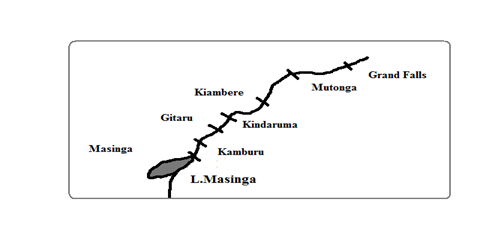
- Kindaruma, completed 1968.
- Kamburu, completed 1974.
- Gitaru, completed 1978.
- Masinga, multipurpose with largest lake, completed 1981; reservoir for downstream dams and irrigation water source.
- Kiambere, last downstream station, completed 1988.
- Proposed stations: Mutonga and Grand Falls.
- Other HEP stations: Turkwel Gorge (completed 1991) and Sondu-Miriu (expected 2008).
Main electricity source, accounting for 72% of power production.
Stations maintained by KenGen, which sells power to KPLC for distribution.
Benefits of Tana River Projects
- Reservoirs provide power for irrigation and domestic use.
- Dams promote transport by serving as bridges.
- Dams are tourist attractions, e.g., Masinga tourist lodge.
- Dams provide freshwater fisheries.
- Projects generate employment, raising living standards.
Problems Facing the Tana River Projects
- Capital shortage for spare parts affecting maintenance.
- Water level fluctuations due to drought and evaporation affecting power generation.
- Siltation blocking tail race tunnels, requiring expensive dredging.
- Inadequate skills and technology limiting power production.
HEP Projects in Uganda
Largest renewable freshwater resources in East Africa.
Numerous rivers and lakes with high electricity potential.
Average 1000mm rainfall annually.
River Nile flows out of Lake Victoria with highest potential.
Natural waterfall at outflow site.
Owen Falls Dam built in 1954, Africa’s largest storage dam.
Supplies most of Uganda’s electricity (162MW) and exports 30MW to Kenya.
Power presence catalyzed industrial development, e.g., Njinja town near dam.
Another power station under development below Owen Falls.
Kikagat River supplies power around Mutukula and Kabale in southwest Uganda.
Mobuku River supplies power for copper mines at Kilembe.
HEP Projects in Africa
Africa has largest concentration and potential for HEP generation but underutilized due to:
- Inadequate financial resources leading to external borrowing and debt.
- Potential sites in remote areas far from population and industry.
- Low industrialization limiting market for HEP, making projects economically unviable.
- Seasonal water volume fluctuations affecting power generation.
Major projects include:
- Aswan on River Nile
- Kariba (shared by Zambia and Zimbabwe) and Cabora Bassa on River Zambezi
- Kainji on River Niger
- Akosombo on River Volta (Ghana)
- Owen Falls (Uganda) and Sennar on River Nile
- Vanderkloof on River Orange
- Inga and Le Marinel on River Congo
HEP Projects in Tanzania
- Nyumba ya Mungu and Hale dams on River Pangani
- Kagera
- Malagasi
Geothermal Power Projects in Kenya
Generated in volcanic areas where:
- Magma or hot rocks heat percolating water beyond boiling point.
- Steam escapes through cracks to the surface.
- Steam is harnessed to turn turbines driving electric generators.
Greatest potential found within Rift Valley from Lake Magadi to Lake Turkana on Kenya-Ethiopia border.
Generation carried out at Olkaria south of Naivasha, accounting for 10% of power needs.
Other potential areas:
- Lake Bogoria with numerous hot springs and geysers.
- Eburu north of Lake Naivasha.
- Menengai crater region.
- Areas around Lake Baringo.
- Magadi.
- South of Lake Turkana.
- Between mountains Longonot and Suswa.
Problems of Energy Development in Kenya
Aim is to reduce overdependence on imported oil.
- Inadequate capital leading to external borrowing and debt.
- Small market due to high connection costs limiting spread.
- Seasonal water level fluctuations causing power rationing.
- Regular siltation requiring expensive dredging.
- Remote location of power plants increasing transmission costs.
- Limited solar power spread due to expensive equipment and seasonal fluctuations.
- Lack of acceptance of wind power; diesel preferred for water pumping.
- Overexploitation of wood fuel causing deforestation, soil erosion, and reduced rainfall.
Significance of Energy
- Domestic use, e.g., wood and charcoal for cooking and heating.
- Industrial use, e.g., electricity and petroleum.
- Transportation, e.g., electric cars, diesel, and petrol vehicles.
- Agriculture, e.g., diesel for tractors, electricity for milking machines.
- Water supply, e.g., diesel engines, windmills, and solar power for pumping water.
- Medical purposes, e.g., electricity for diagnostic equipment and refrigeration.
The Energy/Oil Crisis
Situation where oil demand exceeds supply, causing high prices.
Causes
- Over-reliance on petroleum and products.
- High oil prices due to increased demand.
- Economic and political sanctions.
- Uncertainties in oil supply.
- Rapid depletion of oil reserves.
- Conflicts in the Middle East, especially between Israel and Palestine.
- Exhaustion of wood fuel.
- Mismanagement of energy.
- Oil production limits set by OPEC.
- Artificial shortages by countries like Russia and USA conserving their own oil.
Examples of Energy Crisis in the Past
- 1973-1974 war between Israel and Arab countries; OPEC withheld oil supply to Israeli supporters, causing price spikes.
- 1991 Persian Gulf War triggered by Iraq’s invasion of Kuwait due to territorial claims, oil field disputes, and OPEC production limits violations.
- Iraq claimed Kuwait territory.
- Kuwait extracted oil from Rumaila fields shared with Iraq.
- Kuwait exceeded OPEC oil production limits.
Kuwait’s oil fields were set on fire; Iraq dumped 465 million gallons of crude oil into the Persian Gulf, causing a major crisis worsened by trade embargo.
- 2003 second Persian Gulf War due to Iraq’s failure to destroy weapons of mass destruction; led to oil price rise from US$35 to US$50 by 2004; OPEC increased output by 8% to stabilize prices.
Impact of Energy Crisis
- Increased commodity prices due to higher production and transport costs.
- Increased import prices affecting trade balance.
- High inflation or currency devaluation due to rising prices.
- Industries lay off workers due to high production costs.
- Other energy forms like charcoal and gas become expensive.
- Developing countries incur heavy debt from oil loans, limiting development investment.
- Reduced agricultural production due to expensive inputs like fertilizers.
- Decline in tourist numbers due to high travel costs.
- Environmental degradation from increased charcoal and firewood demand causing soil erosion and reduced rainfall.
Solutions
- Develop alternative energy sources like solar, biomass, geothermal, and HEP.
- Manage and conserve energy.
- Develop nuclear energy for self-sufficiency.
- Encourage industries to use coal, which is cheaper than petroleum.
Management and Conservation of Energy
Management involves effective planning and control of energy resources.
Management Measures
- Control importation of vehicles with large engines consuming much fuel.
- Encourage public transport to reduce vehicle numbers and fuel consumption.
- Educate people via mass media on energy conservation importance.
- Improve and plan road networks to reduce traffic jams and fuel wastage.
- Promote agroforestry, afforestation, and reforestation to reduce forest overexploitation.
- Ban logging, practice selective tree felling, and resettle people settled in forests.
Conservation of Energy
Using energy resources effectively to avoid wastage.
Conservation Measures
- Turn off electrical gadgets when not in use.
- Maintain vehicles properly for efficient fuel use.
- Encourage use of public transport carrying many passengers.
- Promote renewable energy use like solar, wind, and biogas to save oil and wood.
- Encourage energy-saving stoves that use little charcoal and produce much energy.


